Terence Tao, UCLA professor and the most decorated mathematician alive:
"Funds pay $750K to combine weak signals into one real edge. I proved the thing that makes it work and makes it dangerous: in any long enough sequence, hidden structure is unavoidable. it always accumulates. the whole job is telling the real structure from the noise that only looks like it."
this free lecture is the most decorated mathematician alive on the exact problem sitting underneath every factor model, and it costs nothing.
at the board it's simple. Tao's lifelong theme is the line between structure and randomness. The Erdős discrepancy problem asks a deceptively simple thing: can you write an endless string of plus-ones and minus-ones that stays perfectly balanced forever? Tao proved you cannot. No matter how cleverly you try, imbalance, hidden structure, is forced to accumulate as the sequence grows. There is no such thing as a long stream of pure, structureless noise. That's the whole idea, minus the jargon.
Which is exactly why a multi-factor model can work, and exactly why it can kill you. Stack enough weak signals and real structure will appear, because at scale structure is unavoidable. But so will fake structure, patterns that exist only because the data is long enough to force them. Same point as the post above: finding structure is guaranteed. Knowing which structure is an edge is the rare and expensive part.
the mathematics is free and public. what nobody can sell you is the judgment to tell the structure the market will pay you for from the structure that exists only because you looked hard enough. That judgment is the alpha, and it takes years to build.
95% of all decisions take place in the subconscious mind.
Not 5%. Not 50%. 95%.
The part of you that thinks it's in charge is mostly just the narrator, telling a story about decisions that were already made.
Every habit, every craving, every impulse, every gut reaction — subconscious.
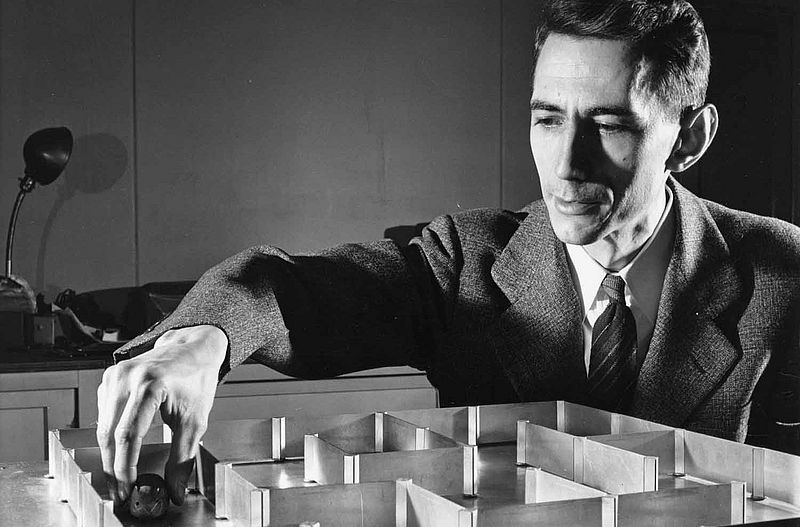
A mathematician who shared an office with Claude Shannon spent 30 years watching which scientists became legendary and which ones disappeared.
In 1986 Richard Hamming told researchers exactly what he found.
Here are the 10 habits that separated Nobel winners from everyone else:
A 21-year-old MIT student wrote a master's thesis in 1937 that Harvard's most famous professor of cognitive science later called "possibly the most important master's thesis of the century."
I read it at 2am and could not believe one paper had quietly built the entire foundation of every computer that exists today.
His name was Claude Shannon. The thesis is called "A Symbolic Analysis of Relay and Switching Circuits."
Every smartphone in your pocket. Every server farm running ChatGPT. Every chip Nvidia ships. Every line of code an engineer has ever written. All of it traces back to a single insight one graduate student had at 21 years old, working on a side project at MIT.
Here is the story almost nobody tells you.
Claude Shannon was born in 1916 in a small town in Michigan. He grew up tinkering. Built a telegraph between his house and a friend's house using barbed wire from a nearby fence. Repaired radios for the local department store. He studied both mathematics and electrical engineering at the University of Michigan because he could not decide which one he loved more. That refusal to choose is what eventually made him.
When he got to MIT for graduate school in 1936, he was assigned to operate a strange machine called the differential analyzer. It was room-sized. Mechanical. Built by Vannevar Bush. It used a tangle of gears, shafts, and electrical relays to solve calculus problems. Most students just operated it.
Shannon did something else. He stared at the relay circuits inside it. The way they clicked open and closed. The way they routed signals through the machine.
He noticed something nobody had noticed before.
The relays inside the machine had two states. Open or closed. On or off. One or zero. And the way the relays were wired together to make decisions looked exactly like a 90-year-old branch of mathematics that almost everyone had forgotten about. Boolean algebra. Invented by a British mathematician named George Boole in the 1850s. Boole had built a system of logic where statements could be true or false, and you could combine them with operators like AND, OR, and NOT to derive new statements.
For 90 years, Boolean algebra had been a curiosity. A philosophical tool. Nobody saw a practical use for it.
Shannon saw it.
He realized that an electrical circuit was not just an electrical circuit. It was a physical implementation of a logical statement. A switch that closed when both A and B were true was an AND gate. A switch that closed when either A or B was true was an OR gate. The entire branch of pure mathematics that Boole had invented as a thought experiment could be built out of wires and relays. And once you could build logic out of wires, you could build anything that could be expressed in logic out of wires too.
This was the insight that quietly created the modern world.
Before Shannon's thesis, electrical engineers designed circuits the way artisans built watches. By feel. By experience. By trial and error. Every new circuit was a craft project. There was no theory underneath it.
After Shannon's thesis, circuit design became a branch of mathematics. You could specify the logic you wanted on paper, and translate it directly into a wiring diagram. You could prove a circuit was correct before you built it. You could simplify a circuit by simplifying the underlying logical expression.
The MIT historian who reviewed his thesis described the shift in one sentence. It transformed circuit design from an art into a science.
Shannon was 21 years old when he wrote it.
That alone would have earned him a place in every computer science textbook on Earth.
But Shannon was not done. He spent the next 11 years working on a problem nobody had even framed properly. He wanted to know what information actually was. Not what messages were. Not what signals were. What information was. Mathematically. Quantitatively. As a measurable thing.
In 1948, while working at Bell Labs, he published a 79-page paper called "A Mathematical Theory of Communication." The paper invented the entire field of information theory in a single shot.
He proved that all information, regardless of whether it was a voice on a phone, a photograph in a magazine, or a chess move on a board, could be measured in a single unit. He named that unit the bit. Short for binary digit. It was the first time anyone had given information a unit of measurement.
The paper proved something that sounded impossible. He showed that you could send a message reliably through a noisy channel, with arbitrarily low error, as long as you encoded it correctly and stayed below a specific limit he called the channel capacity. Every Wi-Fi connection, every satellite signal, every cell phone call, every fiber optic transmission across the floor of the Pacific Ocean operates inside the mathematical bounds that Shannon proved in this single paper.
He did all of this in his spare time while officially working on cryptography for the war effort.
The strangest part of the man is what he did when he was not inventing the future.
He rode a unicycle through the hallways of Bell Labs at night while juggling. He built a chess-playing machine in 1950 that played a primitive form of chess decades before computers were supposed to be capable of it. He built an electronic mouse named "Theseus" that could solve a maze and remember the solution. It was one of the first machines on Earth that learned. He built a flame-throwing trumpet for fun. He had a closet full of unicycles in different sizes. He installed a chairlift across his backyard so his kids could get to the lake faster.
Marvin Minsky, one of the founders of artificial intelligence, said Shannon was the most genuinely playful great scientist he had ever met. Other people approached research with seriousness. Shannon approached it like a kid who had snuck into the toy store after closing time.
Stevens Institute of Technology called him the least known genius of the 20th century.
That title is exactly correct. Most people have heard of Einstein, Turing, von Neumann. Shannon's name barely registers outside engineering departments. Yet without his master's thesis, there is no digital circuit. Without his 1948 paper, there is no internet. Without his framework, there is no measurement of information at all, which means no compression, no error correction, no cryptography, no machine learning.
He died in 2001 at age 84, after years of Alzheimer's disease that took away his ability to recognize the world he had built. Most newspapers ran a small obituary. The world he had given us did not pause.
His thesis is on the MIT archive. His 1948 paper is on the Bell Labs site. Both are free. Both are short. Both are still readable today by anyone willing to spend an evening with them.
The least known genius of the 20th century is one click away from you.
Most people will never open the file.
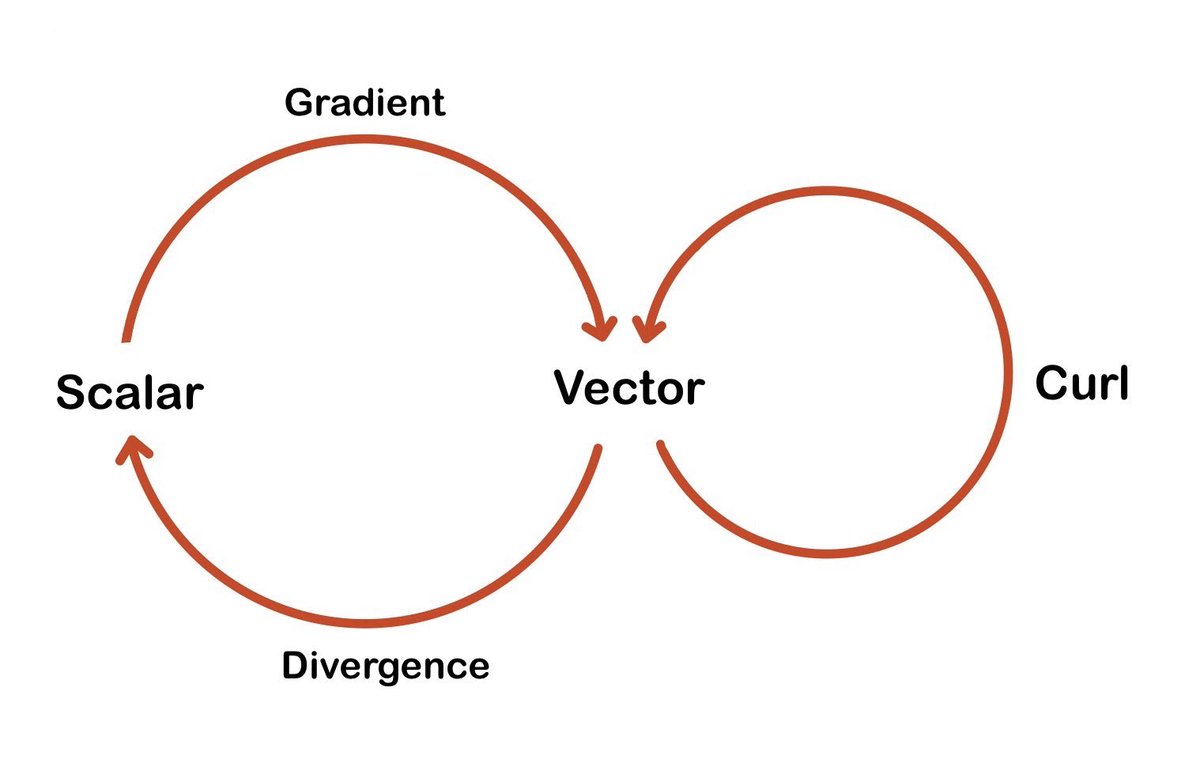
The Ultimate Vector Calculus Cheat Sheet!
Ever feel like vector calculus is just a confusing soup of operations?
This simple diagram is the ultimate mental model for understanding how the Del operator (∇) transforms our mathematical world.
Here is the breakdown of the cycle:
• Gradient: Think of a topographical map. You start with a Scalar field (just single values, like elevation or temperature) and the Gradient points you in the exact direction of the steepest climb. Boom, you've just created a Vector (∇f).
• Curl: Already have a Vector field? The Curl measures the rotation or "swirly-ness" of that field. Think of water flowing in a river: a whirlpool has high curl, while a perfectly straight current has zero. It evaluates the rotation and keeps you right there in the Vector world (∇xF).
• Divergence: This measures how much your Vector field is expanding outward (like a heat source) or collapsing inward (like a sinkhole). It strips away the direction and leaves you with a single magnitude, bringing you right back to a Scalar (∇.F).
It’s all connected in one beautiful mathematical loop. ♾️
Who said calculus couldn't be elegant?
An MIT professor taught the same math course for 62 years, and the day he retired, students from every country on earth showed up online to watch him give his final lecture.
I opened the playlist at 2am and ended up watching three of them back to back.
His name is Gilbert Strang. The course is MIT 18.06 Linear Algebra.
Every machine learning engineer, every data scientist, every quant, every self-taught programmer who actually understands how AI works learned the math from this one man. Most of them never set foot on MIT's campus. They just opened a free playlist on YouTube and let him teach.
Here's the story almost nobody tells you.
Strang joined the MIT math faculty in 1962. He retired in 2023. That is 61 years of standing at the same chalkboard teaching the same subject to 18-year-olds.
The interesting part is what he did when MIT launched OpenCourseWare in 2002. Most professors were skeptical. They worried that putting their lectures online would make their classrooms irrelevant. Strang did not hesitate. He said his life's mission was to open mathematics to students everywhere. He filmed every lecture and gave it away.
The decision quietly changed how the world learns math.
For decades linear algebra was taught the wrong way. Professors started with abstract vector spaces and proofs about field axioms. Students drowned in the abstraction. Most never recovered. They walked out believing they were bad at math when they had simply been taught in an order that nobody's brain is built to absorb.
Strang inverted the entire curriculum.
He started with matrix multiplication. Something you can write down on paper. Something you can compute by hand. Something you can see. Then he showed his students that everything else in linear algebra eigenvectors, singular value decomposition, orthogonality, the four fundamental subspaces was just a different lens for understanding what the matrix was actually doing under the hood.
His rule was strict. If a student could not explain a concept using a concrete 3 by 3 example, that student did not actually understand the concept yet. The abstraction was supposed to come last, not first. The intuition was the foundation. The proofs were just confirmation that the intuition was correct.
The second thing Strang changed was the classroom itself. He said please and thank you to his students. Every single lecture. He paused mid-derivation to ask "am I OK?" to check if anyone was lost. He never used the word "obviously" or "trivially" because he knew exactly what those words do to a student who is one step behind. He treated 19-year-olds learning math for the first time the way he treated his own colleagues. With patience. With respect. With the assumption that they belonged in the room.
For 62 years.
The result is something that has never happened in the history of education. A single math professor became the default teacher of his subject for the entire planet.
Universities in India, China, Brazil, Nigeria, every country with a computer science department, started telling their own students to just watch Strang's lectures. The University of Illinois revised its linear algebra course to do almost no in-person lecturing. The reason was honest. The professor said they could not compete with the videos.
His final lecture was in May 2023.
The auditorium was packed with students who had never met him before. He walked to the chalkboard, taught for an hour, and at the end the entire room stood and applauded. He looked confused for a moment, like he genuinely did not understand why they were cheering. Then he smiled and waved them off and walked out.
His written comment under the YouTube video of that final lecture was four sentences long. He said teaching had been a wonderful life. He said he was grateful to everyone who saw the importance of linear algebra. He said the movement of teaching it well would continue because it was right.
That was it. No book promotion. No farewell speech. No legacy management.
The man whose teaching is the foundation of modern AI just thanked the audience and went home.
20 million views. Zero ego. The entire engine of the AI revolution sits on top of math that millions of people learned for free from one quiet professor in Cambridge.
The course is still on MIT OpenCourseWare. Every lecture, every problem set, every exam, every solution. Free.
The most important math course of the 21st century is sitting one click away from you. Most people will never open it.
Alan Turing took up long-distance running seriously after the war and nearly made the 1948 British Olympic marathon team (finished 5th at trials).
When asked why he trained so hard he said: "I have such a stressful job that the only way I can get it out of my mind is by running hard"
His marathon PR was 2:46:03
You test positive for a rare disease that affects just 0.1% of people, and the test is 99% accurate—so it feels like you’re almost certainly sick. But that intuition is misleading.
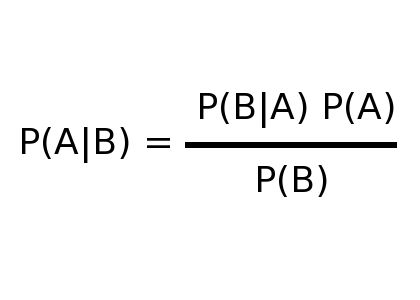
Using Bayes' Theorem, your actual chance of having the disease is only about 9%. Why? Because false positives from the large number of healthy people outweigh the few true cases.
Think of 1,000 people: 1 truly has the disease, but about 10 healthy people will also test positive. So among 11 positive results, only 1 is real.
However, if you take a second independent test and it’s also positive, your probability jumps to about 91%—showing how evidence updates beliefs over time.
First developed by Thomas Bayes and later formalized by Pierre-Simon Laplace, this idea isn’t just math—it’s a way of thinking: start with uncertainty, and refine your understanding as new evidence comes in.
Mathematics and Logic Symbols ✍️
Quantifiers and Sets:
∀ - For all (universal quantifier)
∃ - There exists (existential quantifier)
∈ - Element of
∉ - Not element of
⊂ - Subset of
⊆ - Subset or equal
⊇ - Superset or equal
⊄ - Not a subset of
∪ - Union
∩ - Intersection
∪̸ - Not a subset
∅ - Empty set
∖ - Set difference
Logical Operators:
⇒ - Implies
⇔ - If and only if (equivalence)
∧ - Logical AND
∨ - Logical OR
¬ - Negation
⊤ - True
⊥ - False
⊕ - Exclusive OR (XOR)
→ - Conditional implication
≡ - Equivalent
Numbers and Constants:
ℕ - Set of natural numbers
ℤ - Set of integers
ℚ - Set of rational numbers
ℝ - Set of real numbers
ℂ - Set of complex numbers
∞ - Infinity
π - Pi
e - Euler’s number
Operations and Relations:
∑ - Summation
∏ - Product
√ - Square root
|x| - Absolute value of x
Δ - Change/difference
∇ - Gradient
⊗ - Tensor product
≤ - Less than or equal to
≥ - Greater than or equal to
≠ - Not equal to
≈ - Approximately equal
∝ - Proportional to
Geometric Symbols:
∡ - Angle
⊥ - Perpendicular
∥ - Parallel
Reasoning and Statements:
∴ - Therefore
∵ - Because
5 years old - Dad knows everything!
7 years old - Dad knows.
10 years old - Maybe Dad doesn’t know?!
12 years old - Dad doesn’t know.
14 years old - Dad's gone crazy!
16 years old - Can’t take Dad seriously.
18 years old - What does dad know?!
22 years old - Dad's talking rubbish!
24 years old - I know more than Dad!
26 years old - Dad seems to know some things after all.
30 years old - Think I should ask Dad about this?!
40 years old - It’s amazing how Dad went through all this!
45 years old - Dad's been right all along.
50 years old - If Dad was here, I could have learned a lot from him.
The Krylov-Bogolyubov theorem guarantees that dynamical systems on a compact space have at least one invariant probability measure. In machine learning, this is the theoretical bedrock for Reinforcement Learning and Recurrent Neural Networks (RNNs). It proves that despite noise and complexity, an agent's policy or a network's state will eventually settle into a stable statistical equilibrium. In real life, it explains why physical systems reach thermodynamic equilibrium.
Image: https://t.co/vGxW0LnAbz
Calling c the "speed of light" completely misses the point. Rather, c is the "spacetime exchange rate": how many units of space you can exchange for one unit of time.
In actuality, everything travels at the "speed of light", just not necessarily through space alone... (1/4)







![mathladyhazel's tweet photo. The Fourier Transform, explained in one sentence by Stuart Riffle. [https://t.co/qxTOx44EfS] https://t.co/ObmlCvx0tD](https://pbs.twimg.com/media/GlVE479WgAAGAeT.png)