Er zijn enorme verschillen tussen kinderen met autisme. Kinderpsychiater Bruining: ‘Het label autismespectrumstoornis is te breed. Op termijn moeten niet meer de labels domineren, maar de persoonlijke problemen van het kind.’
https://t.co/snLm2pxvHA
Belangrijk wake up call van @lindajilderda voor psychiaters, we weten zo goed hoe belangrijk preventie van pychische problemen is voor de kinderen van ouders met psychische problemen, maar wat wordt er weinig verwezen naar de KOPP groepen! #eVJC2020 @debascule @spiritjeugdhulp
Vanuit eigen kantoor 2 dagen #eVJC2020 gevolgd. Echt van genoten. Hopelijk blijft online optie bestaan al miste ik collega’s in #Maastricht in life kunnen spreken. Dank @psychiaters en tot volgend jaar!
This suggests that both increased and decreased excitation/inhibition ratio could be associated with autism spectrum disorder. Therefore, the fE/I algorithm shows promise as a method to stratify patients, which could guide personalized treatment options. (8/9)
To test clinical applicability , we recorded EEG in unmedicated children with autism spectrum disorder (ASD). Compared to controls, we found no difference in the mean fE/I, but a higher variance in ASD, suggesting that autism is characterized by physiological heterogeneity. (6/9)
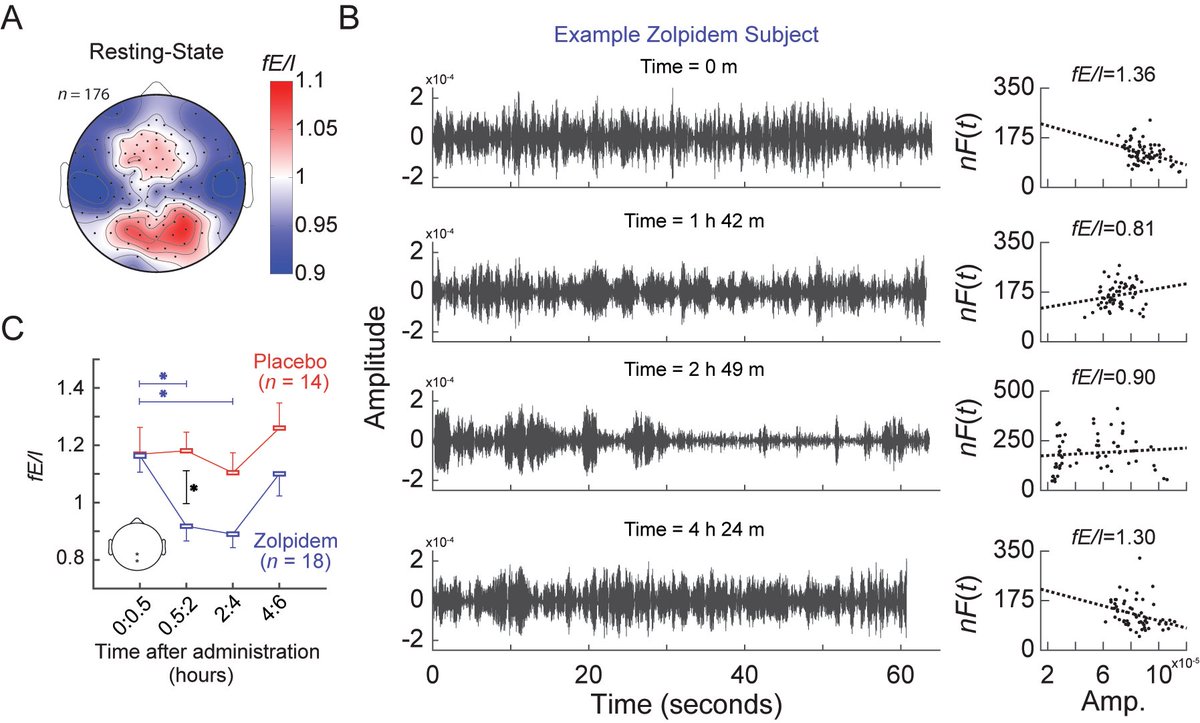
Applying the algorithm to a large human EEG dataset, we see that on average fE/I is close to 1 (A). To validate the algorithm, we applied it to data recorded from subjects who received a drug that enforces inhibition (B), and found the expected decrease in fE/I (C). (5/9)
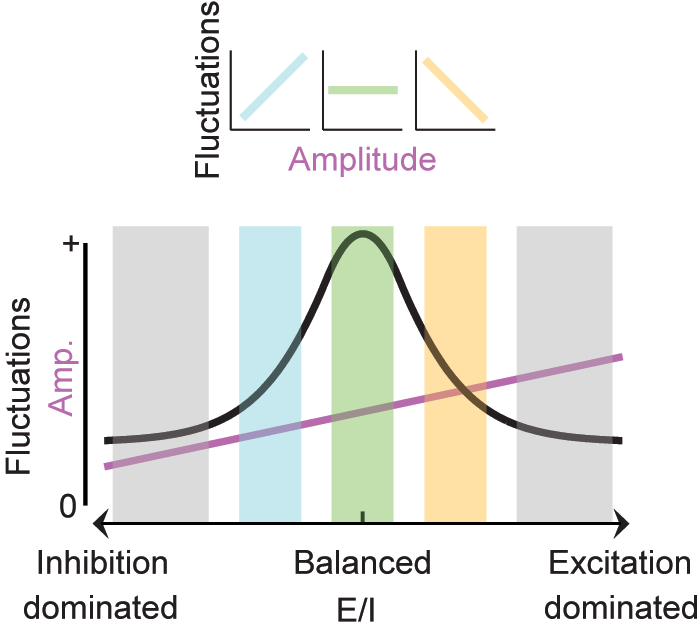
Looking at network activity produced over time in the model, we observe these predicted relationships. Therefore, we can estimate the functional excitation/inhibition ratio (fE/I) from ongoing oscillations, with fE/I = 1 when excitation and inhibition balance (4/9)
This suggests that the relationship between the amplitude of oscillations and the fluctuations in amplitude relate to the E/I balance, where amplitude and fluctuations correlate positively for inhibition-dominated networks, and negatively for excitation-dominated networks (3/9)