BREAKING: “Prayer Permit” case going to the Supreme Court!
SCOTUS has just agreed to hear the case of Daniel Grand, an Orthodox Jew forbidden from holding a Sabbath prayer meeting in his Ohio home without a “special use permit.” City officials later harassed him and encouraged neighbors to watch his home for signs of religious activity.
Governments can’t use zoning laws as an excuse to chill religious freedom. With our co-counsel @Orrick, @ADFLegal looks forward to representing Daniel at the high court next term.
🇺🇸🇮🇱🇱🇧Behind the scenes: How shared fear of Iran led to the historic Israel-Lebanon deal brokered by the Trump administration. My story on @axios
https://t.co/fpvgnnVZQV
Forty-four years ago, as Israeli forces drove deep into Lebanon, U.S. special envoy Philip Habib arrived determined to take Defense Minister Ariel Sharon to task. Habib—who made little secret of his contempt for Sharon—believed he held the upper hand and pressed the case that Israel pull back and stop bending Lebanon’s fragile government toward Israel’s terms. Sharon sat back and let the American diplomat run through his lecture. When Habib finished, Sharon reportedly produced a card of his own: a secret document, quietly drawn up with a confidant of the Lebanese leadership, already sketching the outline of an accord—normalization, security arrangements and a phased Israeli withdrawal that would leave Israel holding outposts on Lebanese soil.
Sharon had bypassed the U.S. mediators entirely, having quietly negotiated his own full-blown peace agreement directly with Lebanese President Amin Gemayel through a private emissary. Habib’s trip was pointless.
This time, the agreement went through Washington.
On Friday, Israel announced a framework agreement with Lebanon, its first accord with the country since the short-lived 1983 treaty. The two sides commit to formally end their state of war and pursue normal relations through later negotiations. The engine is a reciprocal, sequenced process: Lebanon pledges the complete, verified disarmament of all non-state armed groups—Hezbollah is named—and the restoration of Lebanese Armed Forces control over all its territory, while, in exchange, the IDF redeploys zone by zone as disarmament is verified. Two initial “pilot zones” are agreed, with the rest left to a forthcoming Security Annex. Lebanon affirms Israel’s right to exist and that only the Lebanese state may authorize force on its soil; Israel disclaims any territorial ambitions.
In short: Lebanon sublets its own territory to Israel so Israel can evict the problematic tenant, Hezbollah, and hands the keys back once the premises are cleared—with normalization as the reward at the end of the eviction. On paper, it’s a phased withdrawal. In practice, it’s an admission that Israel stays in southern Lebanon until Hezbollah is gone. The price of that presence was paid again early this morning, when Captain David Hazut, 21, fell in a firefight with a Hezbollah operative in southern Lebanon. For the past four months, Iran has been demanding Israel withdraw from sovereign Lebanese soil; Lebanon’s own government has effectively answered, “You first.”
Even if the ultimate goal of normalization goes unmet, this is a genuine achievement for Israel because it upends the entire conception that has governed Lebanon until now. The old arrangement was simple: If Israel wanted to stay, the authority it had to consult was Washington, while Hezbollah took its marching orders from Tehran. The Lebanese government, meanwhile, oscillated between the roles of Hezbollah cutout and impotent failed state.
Now the United States has pulled the Lebanese government itself into the anti-Iran camp. And unlike Israel’s first treaty with Lebanon, this one is built to require America as a partner. Lebanon isn’t merely choosing a future without Hezbollah; it’s choosing a new Lebanon—rebuilt and bankrolled by the United States. Put plainly: It needs Trump to hold its spine straight for the confrontation with Hezbollah, and it needs Israel to do the dirty work to win that confrontation.
The agreement is a godsend for Netanyahu. Hezbollah won’t be eliminated by Election Day even if it’s pushed to the last possible day, but if the Israeli public reads southern Lebanon as a story of progress rather than an attritional swamp, he has a chance. Internationally, the framework isn’t about to get his face taken off the dartboard—but it has validated a strategy that drew enormous criticism. It turns out you don’t always need to know the “day after” before you launch an operation. As in Gaza, if you focus on degrading capabilities and keep your options open, opportunities may materialize on their own.
But let’s turn to the negatives.
The biggest risk is a simple reality: What Lebanon giveth, Lebanon can taketh away. The very existence of this second agreement is proof that the first, in 1983, didn’t hold. Back then, hopes of a full peace were dashed by the assassination of Israel’s intended intermediary, President-elect Bashir Gemayel; the agreement that did get signed was stripped back, then collapsed under a combination of internal Lebanese opposition and overwhelming regional pressure, above all from Syria. Within a year, Lebanon abandoned it, and it never took effect.
Hezbollah will do everything in its power to ensure that outcome, and it has several tools at hand. The first, and its favorite, is intimidation: President Joseph Aoun and other prominent figures backing the deal likely have targets on their backs. Hezbollah members of Lebanon’s Parliament have already declared that they will resist any effort at disarmament and labeled the LAF as incapable of forcing them to do so.
The second is mobilizing the street. Hezbollah’s supporters have already poured into Beirut to protest the framework, making good on the group’s threat to set the Lebanese “street” against any move toward implementation.
The third is delegitimization. Other Hezbollah figures have moved to brand the agreement unlawful and muddy its terms—parliamentary bloc leader Mohammad Raad calling it a “cover-up” for a permanent Israeli military presence, even though the text explicitly disclaims any Israeli territorial ambitions in Lebanon. The implicit, and sometimes explicit, threat behind all of Hezbollah’s actions is unmistakable: Cross us, and Lebanon returns to civil war.
Behind the group stands Iran, which has never respected Lebanon’s sovereign decisions and won’t start now. Tehran is already treating the framework as a pretext to stall nuclear negotiations, claiming it violates the Lebanon clause of the MoU. Which means it comes down, once again, to Trump—to whether he holds the line on his diplomatic revolution in Lebanon.
As we have experienced recently, history in this region is written and rewritten by the week, and there is every chance this agreement ends up where so many others have: abandoned, unenforced and simply a footnote to the next war. But should it hold, June 26 may be remembered as the date a broken country began the long climb back to being the Paris of the Middle East. For now, that possibility alone is more than Lebanon has had in decades.
The importance of the U.S., Israel, Lebenon Trilateral Framework are many. But one of the key achievement is that *Lebanon recognizes the sovereignty of Israel* for the first time since the short lived recognition in the early 198Os, Abraham Accords level.
https://t.co/rK3fwRd7gG
Even in the ‘Maritime Agreement' signed by the previous government, the Lebanese government *did not* recognize Israel's sovereignty.
Honored to host a true friend of Israel, South Sudan’s FM James Pitia Morgan in Jerusalem today.
Israel supported the establishment and independance of South Sudan, and continue to stand with its people in many ways, working together to grow our bilateral relations and cooperation.
Speaking about regional developments, I reiterated Israel’s desire for peace with Lebanon as reflected in the framework agreement signed this weekend.
I stressed that peace and security can only be achieved by the disarmament of Hezbollah.
This is a breakthrough agreement both in terms of security and sovereignty on both sides. 🇱🇧🇮🇱🇺🇸
It explicitly drives Iran out of any role in Lebanon.
Like the 20 point plan in Gaza, it demands that the terrorists disarm and the area is demilitarized.
I am hopeful that one day I will have morning coffee in Beirut and wine in the Evening in Tel Aviv with my Lebanese friends.
Kudos to @SecRubio, @netanyahu, @yechielleiter@PresidentAoun
Today, the United States, Israel, and the UAE held a first trilateral economic dialogue on the margins of the 2nd Pax Silica Summit. In President Trump’s first term, the Abraham Accords showed peace builds prosperity. In his second term, under Secretary Rubio leadership, Pax Silica is showing shared supply chains builds shared economic security. 🇺🇸 🇦🇪 🇮🇱
Today, the U.S. and GCC reaffirmed their strong support for the Board of Peace's efforts to advance stabilization, recovery, and reconstruction in Gaza in line with U.N. Security Council Resolution 2803. They stressed the importance of demilitarization in Gaza to enable reconstruction and the transfer of responsibility to an independent, technocratic civil Palestinian committee, while commending President Trump's vision to create a new Gaza of peace and prosperity.
https://t.co/7ZAjPuyYem
Sarah Hurwitz, former Chief Speechwriter for First Lady Michelle Obama, speaks about the most misunderstood thing about Jewish identity and why getting it right matters more than ever.
"Jews are not just a religion, nor are Jews a race or an ethnicity. We are incredibly diverse. We're something that predates the categories of the modern world, predates race, ethnicity, religion. We're a people, we're a tribe, we're a nation, we're a civilization, and most of all, we're a family."
Understanding who the Jewish people are helps negate misinformation and disinformation that feeds the hate directed at Jews around the world.
The @CivilRights is aware of the denial of service taunts to @danielsgoldman by Poetica Coffee in Brooklyn.
Federal law prohibits public accommodations such as coffee shops from discriminating against patrons based on their race, religion, or national origin. These actions are not only reprehensible, they’re potentially illegal. The Civil Rights Division has opened an investigation, and will bring an enforcement action if warranted.
If you have been denied service at a public accommodation on the basis of a protected characteristic, we at @TheJusticeDept want to know!
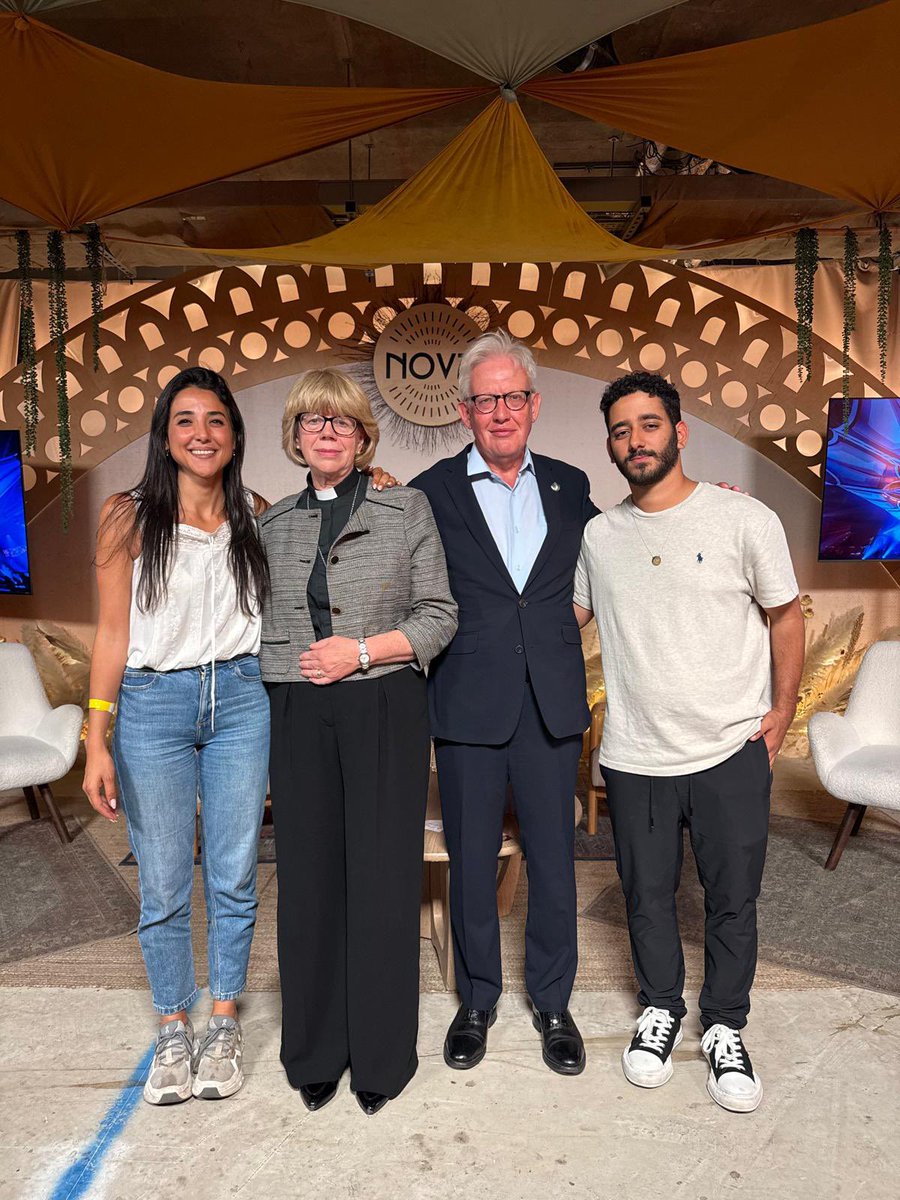
It was deeply shocking and moving to visit the @novaexhibition in London this week, and a privilege to meet with relatives of those who were murdered in the 7 October attacks.
Excellent from @LordIanAustin on yet ANOTHER debate on the evils of Israel:
As he says: ‘Over the last few years, Parliament has discussed Israel more than any other issue, not just any international issue, more than any domestic issue: more than the economy, unemployment, crime, the NHS.
‘The public out there look at Parliament and think this is utterly mad, utterly, utterly mad.’
Lord Ian blames Parliament for helping fuel antisemitism adding:
‘Does Parliament not understand that singling out the world's only Jewish state, holding its standards not applied to anywhere else, falsely accusing Israel of committing these terrible crimes? ‘This is bound to drive hostility towards people who are identified with Israel, which is the vast majority of the Jewish community, and I have to say this is why I believe Parliament is playing a large role in driving the explosion of anti-Semitism that we've seen on the streets of Britain.’
Secret’s out as @nytimes profiles #CBUS region as a new high tech, advanced manufacturing center. Of course, there is @anduriltech & @intel but there’s now so much more. https://t.co/AbSEABgS91 1/
Our community is in pain tonight as a result of senseless gun violence in Toledo's storied Old West End community. Let me express our gratitude to the Toledo Police and Fire Departments and all first responders for once again proving their courage and utter devotion to duty.
Editor's Notes: Only vocal moderate majority can carry Israel, Jews, Middle East forward - comment
From the Gulf to Capitol Hill to my own readers back home, I kept meeting the same person.
https://t.co/EN9JE3FLyw
I met Ben once. We were seated at the same dinner table.
At first, we did not recognise each other. Neither of us had any idea we would end up at the same table.
I asked him where I knew him from. He replied, “Ben, from Ben & Jerry’s.”
I smiled and said, “Nice to meet you. I’m Alex, Deputy Consul General of Israel to the Southeastern United States.”
This was at the height of the Ben & Jerry’s Israel controversy. I decided not to raise politics, out of respect for our gracious host. But I was also biding my time, because I suspected he would not be able to resist bringing it up.
About an hour into dinner, he came over to talk.
I saw it as an opportunity to understand where he was coming from, to explain a few things, and to keep the conversation as civil as possible. And to be fair, it was civil. He was pleasant, curious, and polite.
But quite quickly, I also realised he was completely ignorant about Israel.
He had never visited the country or the region. He had basic facts wrong, not only about the narrative, but about the foundations of the conflict itself: the makeup of the countries involved, the history, and the deeply rooted reasons each side sees the conflict the way it does.
For him, it was simple: there are people who appear oppressed, so someone must be the oppressor.
I do not blame Ben personally. He is a businessman who sells ice cream. Why should he be expected to understand Israel, the Middle East, or geopolitics?
The real problem is with those who treat him as an authority.
The media gives him a pedestal to speak about issues he clearly does not understand. And that is the absurdity of it all: taking an ice cream salesman and presenting him as a voice of moral clarity on one of the most complex conflicts in the world.