Buffett's most important warning during the 2008 crisis was not about stock prices. It was about trust.
He told Charlie Rose that the economy depends on credit and confidence. When those disappear, businesses and households begin protecting themselves at the same time.
Banks want to reduce risk. Companies want to cut debt. Investors rush toward safety. Individually, those decisions may look sensible. Collectively, they can bring economic activity to a halt.
Buffett described this process as deleveraging, and he saw it as the force driving the credit crisis.
That is why he supported emergency action to restore the flow of credit, even while acknowledging that the rescue plan was imperfect.
He made another point that is easy to forget: fixing the immediate problem would not produce an instant recovery. The economy could keep getting worse for months before the benefits became visible.
This is how financial crises test investors. The headlines focus on losses, but the deeper issue is whether the system can keep functioning.
Confidence is not a soft concept. It is part of the infrastructure that allows an economy to operate.
Buffett explained this to Charlie Rose in 2008. The full interview is free, but surprisingly few people go back to watch it.
Tencent 700: very limp results as expected. Turning into Baidu (i.e., core biz in decline, growth businesses too small to matter). Big problem for Chinese CSPs is that China completely lacks a culture of paying for software or services, either consumer or enterprise level.
$NVDA: NVIDIA with ~$550B in future commitments:
— $390B in supply and capacity commitments, up from $279B last quarter.
— $102B in cloud service and data center lease commitments, up from $74B.
— $20B in equity investments.
— $6B in capex
— $32B in additional conditional neocloud agreements.
One reason people love Jensen is that he made the public rich. $NVDA went public at $600m & went to $6 trillion. A gain which literally anyone could participate in.
Meanwhile, Dario at $ANT only made the Epstein-oligarchy rich. Now he’s flipping you their shares at $2 trillion.
🚨 NOW: President Trump SPEAKS OUT on the public disagreement between Secretaries Scott Bessent and Howard Lutnick
"One wants to be friendly with China, and one wants to have a blow-up with China."
"I understand very well both sides."
Bessent says Commerce SLOW-WALKED putting MEGASPEED on the entity list
Bessent says Treasury, State, War, and USTR all wanted it on the ENTITY LIST for months, but Commerce held it up
🇺🇸 Open Source es la verdadera razón por la que “sacaron” a Jensen 👇
Hay muchos indicios de que el post de julio de 2026 en el que Jensen Huang defendía los modelos abiertos de IA, lo metió en graves problemas.
En él, Huang argumentaba que la IA transformará industrias y países, que los modelos abiertos fortalecen la seguridad, aceleran la innovación y, sobre todo, permiten la soberanía, y que el mundo necesita tanto modelos cerrados como abiertos de frontera.
Quizás fue esa defensa de la apertura y la soberanía tecnológica y no los escándalos personales, la verdadera causa de su salida.
Por su puesto, esto implicaría que quienes controlan el poder prefieren mantener la IA concentrada y bajo llave, y que el impulso de Nvidia a los modelos abiertos chocaba con esos intereses.
Berkshire Hathaway 3Q'26 $BRK.B $BRK.A
What you need to know (and more in the link):
Most importantly:
Book value +7.6% ytd and on track to continue its >10% rate of growth ($357 per share of book value).
Current share price of $571 is ~1.60x Price / Book ratio
-Modestly above recent trading valuations and stock buyback prices, but not overvalued.
Earnings:
3Q Operating Earnings reported at down -5.8%.
Operarting Earnings ytd (year-to-date) +8% reported
"Core" operating earnings up +3.5% ytd after removing FX movements
Capital allocation:
$352 billion of cash, -5% ytd due to earnings, acquisitions and stock repurchases.
Share repurchases of ~$13.8 billion ytd, retiring ~1.3% of its share outstanding.
$335 billion of stock holdings, +13% ytd primarily driven by purchases of $GOOG (net purchases ytd of $11 billion)
$6.8 billion acquisition of home builder Taylor Morrison completed (~$9 billion OxyChem acquisition completed in January).
Operations:
Strength at BNSF railroad, Precision Castparts (PCC) and recovery from wildfire costs at BH Energy (utility) offset by weakening underwriting profits at GEICO (car insurance).
Far more details here (and an upcoming webcast on Friday):
https://t.co/4Hjx7n9OYM
According to Korean media, Samsung and SK Hynix just traded near BOOK VALUE while printing record profits.
Meritz Securities says Samsung's 2027 forward PBR briefly hit 1.13 times and SK Hynix hit 1.00 times during Friday's session.
Foreigners have sold 7.77 TRILLION won of Korean stocks in the first four trading days of November, on top of 18.7 trillion won in October.
SK Hynix just reported about 83 trillion won of operating profit last quarter at an 80% margin while Samsung printed about 107 trillion won of operating profit, a quarterly record.
iM Securities says this selloff looks nothing like COVID, rates, oil, and the broad macro tape are not breaking and this is a sector deleveraging event, not a system crisis.
Hanwha Investment recommends staggered buys in Samsung around 170,000 to 180,000 won while Meritz calls the risk reward overwhelmingly favorable.
Mirae Asset says keep cash because volatility can run into year end.
I spent some time going through Berkshire’s Q3 report, and my takeaway on $BRK.B is more nuanced than when I started.
I still think Berkshire is one of the highest-quality businesses in the market.
But I’m finding it harder to make the investment case at today’s price than I could a year ago.
The good first.
BNSF had a very strong quarter.
Revenue was up ~15%, pretax earnings up ~19%, volumes up ~4%, and revenue per unit increased ~11%.
That is the kind of operating leverage I want to see from a railroad: more volume, pricing power and higher earnings.
BHE was also solid, with pretax earnings up ~8%.
Manufacturing was reasonably healthy as well.
And then there’s the balance sheet.
Berkshire still has more than $350B in cash and Treasury bills.
That gives Abel something almost no other company has: the ability to sit patiently while everyone else is forced to act.
I also like that he’s actually starting to deploy it.
OxyChem.
Taylor Morrison.
Alphabet.
And nearly $9.7B of Berkshire buybacks in Q3.
That tells me Berkshire isn’t simply sitting on Buffett’s cash pile forever.
But there are things I don’t like.
GEICO is the biggest one.
Q3 underwriting earnings fell roughly 45% YoY.
That deserves attention because insurance is one of Berkshire’s crown jewels. A weak quarter isn’t necessarily a thesis-breaker, but I want to see whether this is cyclical or something more structural.
The consumer businesses also caught my attention.
McLane revenue fell ~7% in Q3 and pretax earnings fell ~22%.
Several other retail businesses are seeing weaker demand.
I wouldn’t be surprised if Berkshire sees more pressure here if the consumer continues to weaken.
This is one thing I think investors sometimes forget about Berkshire:
It may have a fortress balance sheet, but the underlying businesses are still exposed to the economy.
The other thing I’m wrestling with is capital allocation.
I like the Taylor Morrison and OxyChem deals.
But Berkshire is now so large that the hurdle rate has to be extremely high.
Putting $10B into a mediocre business doesn’t move the needle much anymore.
Abel needs to find very large opportunities that can generate attractive returns without taking Berkshire outside its circle of competence.
Alphabet is another one I’m watching.
I understand the thesis.
It’s an exceptional business with enormous cash generation and multiple long-term growth drivers.
But I keep coming back to the same question:
What return is Berkshire actually underwriting at the price it paid?
Great business ≠ great investment at any price.
And this is where my view of $BRK.B has changed.
When Berkshire was around $400, I found the setup much more compelling.
Today, I think the quality is still obvious.
The valuation is what makes me hesitate.
I’m not looking at Berkshire thinking “sell.”
I’m looking at it thinking:
I want a better price.
The irony is that Berkshire is probably one of the stocks I’d most want to own during a market panic because that’s when its balance sheet, liquidity and capital allocation flexibility become incredibly valuable.
But that’s also why I’m reluctant to overpay for that optionality today.
My biggest things to watch from here:
• GEICO underwriting
• Consumer/retail demand
• BNSF margins and volumes
• BHE’s returns on incremental capital
• Abel’s acquisition discipline
• Berkshire’s buyback activity
• Where that $350B+ cash pile ultimately goes
• Whether Alphabet becomes an exceptional investment or simply an exceptional business bought at a less exceptional price
My personal conclusion after Q3:
Berkshire’s business quality hasn’t changed much. The price has.
I still want to own Berkshire.
I just don’t feel the same urgency to buy it that I did a year ago.
If the market eventually panics, I don’t have to wonder whether the company will have the financial strength to take advantage of it. I just need to make sure I’m paying a price that leaves enough upside for me.
“John D. Rockefeller in his day was smart enough to see oil as what the U.S. was going to run on for a long time into the future, and you could say the same today about semiconductors…
Holding a dominant position at the key bottleneck in the chip-manufacturing process should greatly benefit ASML over time.”
🗣️ Dev Kantesaria, ValueInvestor Insight, October 31, 2026 ($ASML)
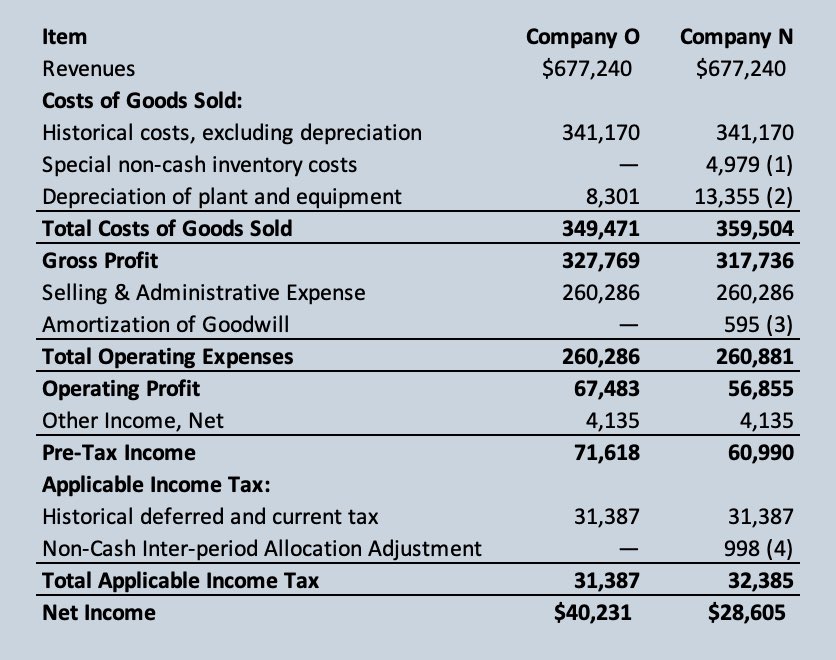
In his 1986 shareholder letter, Buffett discussed the concept of “owner earnings” in detail, using the example of two companies, labeled “O” and “N”.
In fact, both companies were Scott Fetzer, and Buffett used the example to illustrate how a good investor must create their own estimates of a company’s earnings power.
See the latest Owner’s Memo for more.
https://t.co/7lQtn0oPN3
on EPS vs FCF, why FCF matters, how they differ...gets mixed up daily, but is "LAW" and not opinion.
Bezos: "Though it’s more subtle and complex in the real world, this issue—the duality between earnings and cash flows—comes up all the time."
for him to say that, tells u how common it is.
1. bezos' amazon 2004 shareholder letter:
very first sentence cuts right to the heart of the matter
Bezos: "Our ultimate financial measure, and the one we most want to drive over the long-term, is free cash flow per share. Why not focus first and foremost, as many do, on earnings, earnings per share or earnings growth?"
i'll walk thru his example, but the shortest/simplest answer = capex
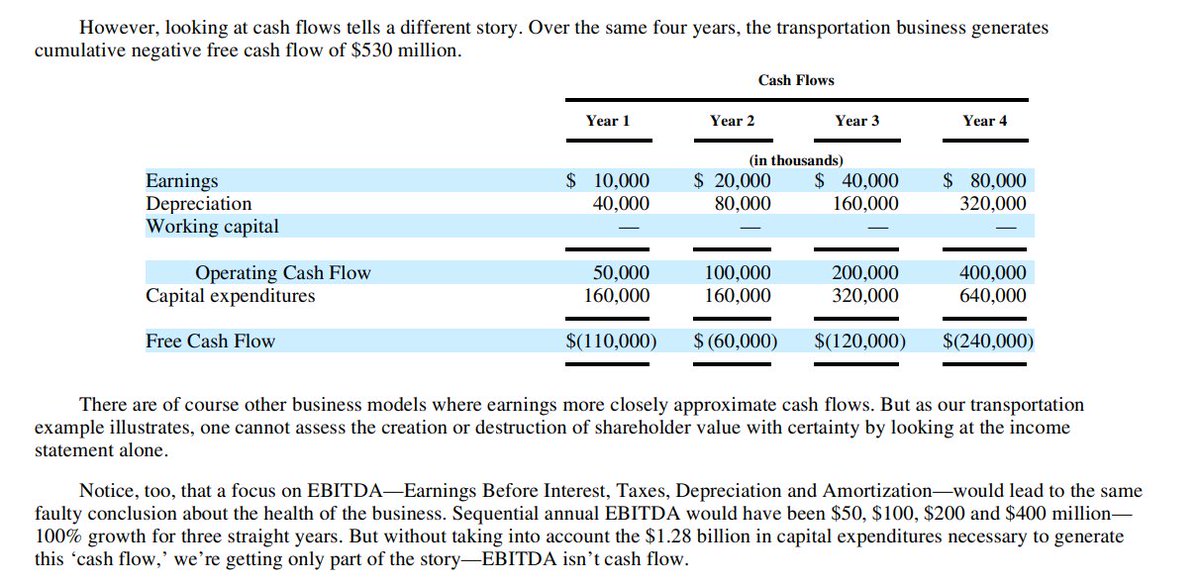
EBITDA and EPS= income statement
capex and FCF = CF statement
in theory, a company could spend $100B on capex today, which would "create" positive EBITDA and EPS, but negative FCF.
this is why Buffett calls EBITDA "bullshit earnings" -- have to use (EBITDA - capex) as a proxy for FCF....bezos says the same thing here:
Bezos: But without taking into account the $1.28 billion in capital expenditures necessary to generate this ‘cash flow,’ we’re getting only part of the story—EBITDA isn’t cash flow.
check out the first screenshot for a visual on how earnings and fcf diverge
2. next, the other key concept to understand is return on capex:
Bezos: "Though some may find it counterintuitive, a company can actually impair shareholder value in certain circumstances by growing earnings."
this is also not very well understood
if company returns below their cost of capital (ROIC < WACC), faster growth DESTROYS value.
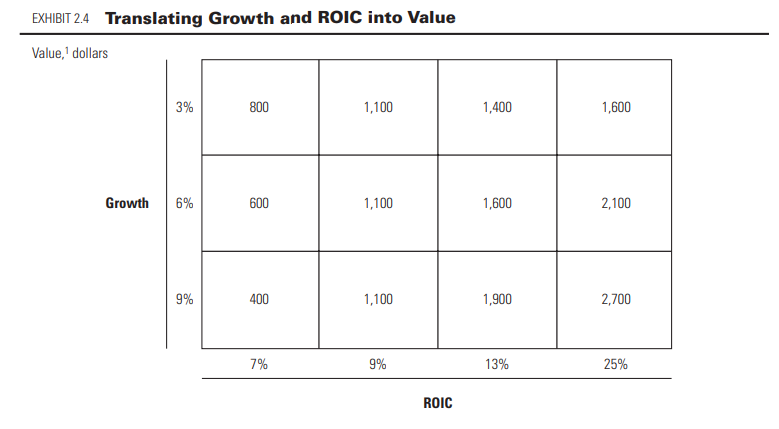
I'll pull an external photo -- 2nd screenshot is a company where 9% is their cost of capital
if ROIC is below their cost of capital (9%), the faster growth is, the more value gets destroyed.
the left column is the one to look at (ROIC of 7% vs cost of capital 9%)...shows how faster growth leads to lower value.
growth of 9% destroys far more value than growth of 3%.
this is not intuitive, but its very real
stock prices are incredibly attuned to this dynamic. you will see a company announce an M&A deal, which is accretive to earnings by 50%
and then their stock collapses 20%
the market doesn't price off EPS...it's going right to ROIC vs WACC, and what FCF looks like.
I have always been in awe at how quickly the market prices a complex deal -- which hits IS, BS, and CF -- and runs the implicit ROIC vs WACC math
within 3-5 seconds the stock is down 16.5% and it sits there all day. and that number ends up being correct.
this is why ROIC and WACC, while a pain in the ass to understand and calculate, have to be understood conceptually
these are what drive stock prices....focusing on anything else would be a gigantic waste of time lol
I think I just sliced through 99% of this quandary but the Bezos 2004 letter link is below
remember, this is law, this is not opinion.
many things in markets are up for debate...but "FCF over EPS" is not one of them.
https://t.co/IaAtp6sS0q
Barclays estimates a free consumer agent costs 10x the free ChatGPT tier to run.
Winning means being willing to burn something like $40B a year in extra compute to give the product away.
That's why Meta is the favorite, and it's not about whose agent is smarter. Meta and Google are the only two with ad businesses printing enough cash to subsidize a free tier indefinitely. Apple could afford it but won't spend it. OpenAI basically has to charge.
The winners will be whoever can afford to lose the most money the longest.
$META $GOOG