Excited to share a new result on random quantum circuits: every strong ε-approximate unitary k-design reproduces the full distribution of each Haar output probability at rate Θ(1/√k+ε). With local random gates, the error decays exponentially in k. https://t.co/lzKI1QHOoD
I have a song for our new quantum obfuscation paper<3
(Hoping FOCS 2025 gives us a rump session lol)
In this paper, we show how to obfuscate a quantum program implementing a unitary transformation.
The work is done by me and Er-Cheng.
https://t.co/kvbhP9DwA7
🚀 Really exciting new approach to making Random Circuit Sampling useful on quantum computers — for Certifiable Randomness — from researchers at @jpmorgan , @QuantinuumQC , and @argonne National Lab 🔬⚛️
💡 “This work marks a major milestone in quantum computing, demonstrating a solution to a real-world challenge using a quantum computer beyond the capabilities of classical supercomputers today.”
🔐 “This development of Certified Randomness not only shows advancements in quantum hardware, but will be vital to further research, statistical sampling, numerical simulations, and cryptography…”
👏 Huge step forward for practical quantum applications and a great example of industry-lab collaboration pushing boundaries.
#QuantumComputing #CertifiedRandomness #QuantumAdvantage #RandomCircuitSampling #JPMorgan #Quantinuum #Argonne #QuantumResearch #QuantumHardware #BlueQubitCommunity
https://t.co/MY6OLpXuqQ
If you ever wished that quantum supremacy experiments such as random circuit sampling can actually be useful, then you should be happy to see our results published on #Nature today! https://t.co/RBvZqiBMrI. This is a step towards commercial usefulness of quantum computing.
@HayataYamasaki, @quantum_minhsiu and I are excited to be sharing our work ‘Constant-Overhead Magic State Distillation’ https://t.co/SjTmEBR0Au. This work resolves a long-standing open problem on how efficiently magic state distillation can be done…
Did you see @GoogleQuantumAI’s exciting new paper on Shadow Hamiltonian Simulation?
Korbinian Kottmann shines a💡on Shadow Hamiltonian Simulation (which is unrelated to classical shadows!) and shows how this boils down to g-sim on a quantum computer 👇
https://t.co/JivUUe2c9e
STOC 2024 talk videos are now online:
https://t.co/aZtrjSVf8h
If you'd like to dip in, a nice one to start with is
"Tree Evaluation is in Space O(log n log log n)"
by James Cook & Ian Mertz (presented by Ian):
https://t.co/hrf2XDjqNz
Fresh on the arXiv: Alexander Schmidhuber, Ryan O'Donnell (@BooleanAnalysis), Ryan Babbush, and I show a quartic quantum speedup for the Planted Noisy kXOR problem / Sparse Learning Parity with Noise.
https://t.co/SSvkMMab33
https://t.co/owBI4GFSG7
Given a random circuit (where each gate is chosen randomly and independently), is there a smaller circuit that implements the same operation? That is, are random circuits compressible? We show that the answer is no, for both random reversible and quantum circuits.
Shannon’s 1949 counting argument shows that a random Boolean function has exponential circuit complexity. The above question is more general: a random circuit is parameterized by L, the number of random gates; so how does circuit complexity depend on L?
Intuitively, one might expect the “linear growth of circuit complexity”, where the circuit complexity grows linearly with L until it reaches exponential. This has been a well-known conjecture due to connections with black holes and the AdS/CFT correspondence.
In this paper we prove this conjecture: we show that a random quantum (or reversible) circuit on n qubits (or bits) with L ≤ 2^Θ(n) gates cannot be implemented by any quantum (or reversible) circuit with L/poly(n) gates. This is joint work with Anthony, Jeongwan, Jonas @haferjonas, Tony, and Norah @NorahTan1.
The key is to show that random quantum circuits quickly converge to Haar random – more precisely, it forms a multiplicative unitary t-design with O(t·poly(n)) gates. Linear growth of circuit complexity follows from the linear dependence in t via a generalization of Shannon’s argument.
This quick convergence is proven by first constructing a structured random walk on the unitary group with a large spectral gap, and then approximating the structured walk with local random circuits without losing the gap. This argument crucially uses a modification of the “PFC ensemble” of Metger, Poremba, Sinha, and Yuen, as well as Kassabov’s expander on the alternating group.
Also see the amazing work of Gretta, He, and Pelecanos for related results on random reversible circuits: https://t.co/E5Z6ahnmi0
Paper link: https://t.co/RRZ7rorU2f
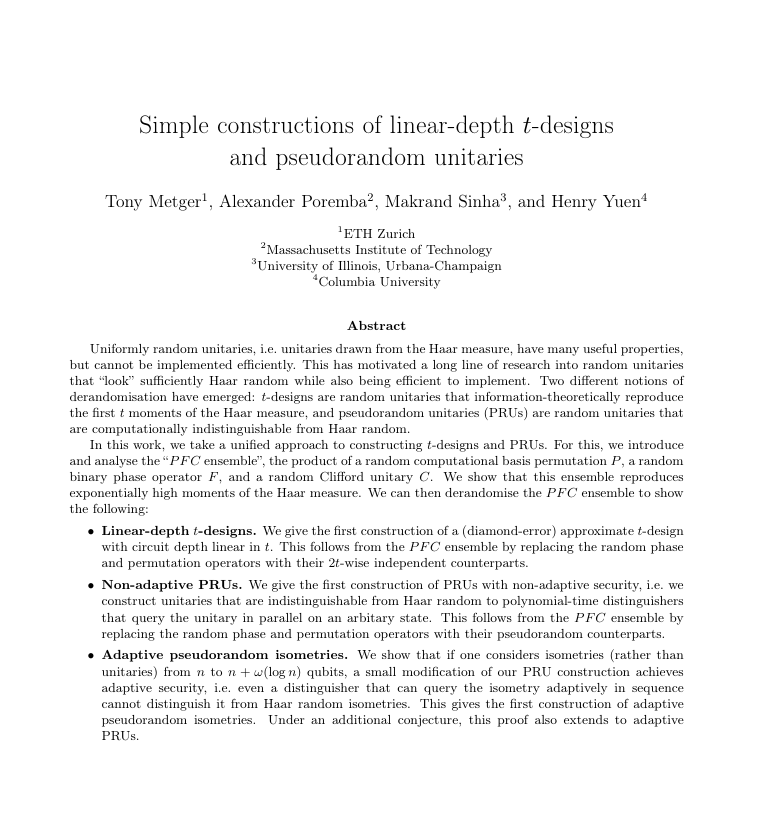
A new unitary t-design construction---it’s so simple, you could teach it in an intro to quantum computing class! Follow-up paper on how to derandomize the Haar measure with Tony Metger, Makrand Sinha and Henry Yuen @henryquantum 🧵
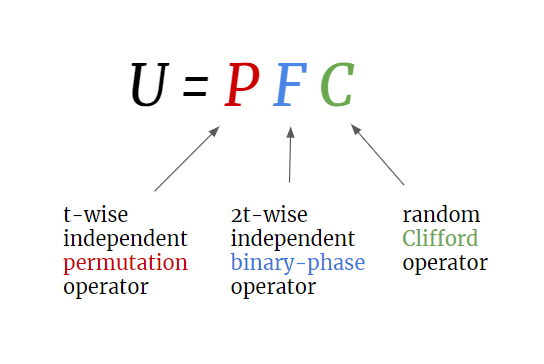
We present a simple unified approach for Haar (pseudo)randomness: the “PFC ensemble”---it consists of a random computational basis permutation P, a random binary phase operator F, and a random Clifford unitary C.
Thanks to everyone who submitted to STOC '24, and to the fantastic PC for their hard work. The list of accepted papers is now out: https://t.co/sy3qrwX4d6