Today is the start of a new era of natively multimodal AI innovation.
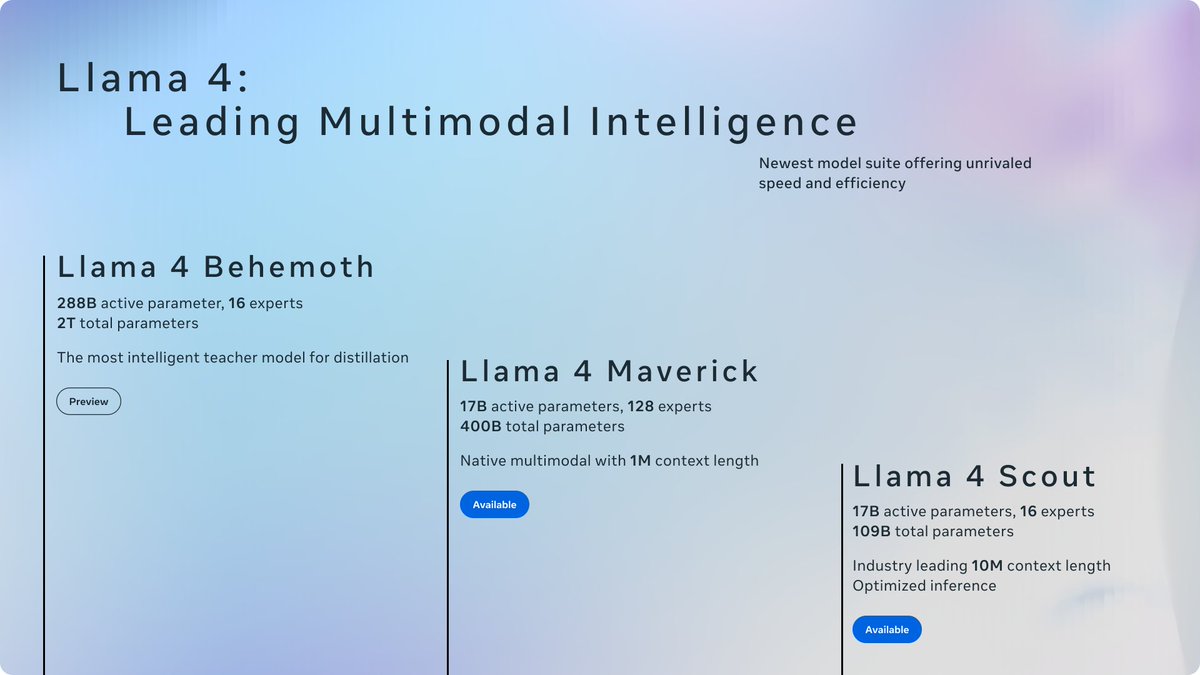
Today, we’re introducing the first Llama 4 models: Llama 4 Scout and Llama 4 Maverick — our most advanced models yet and the best in their class for multimodality.
Llama 4 Scout
• 17B-active-parameter model with 16 experts.
• Industry-leading context window of 10M tokens.
• Outperforms Gemma 3, Gemini 2.0 Flash-Lite and Mistral 3.1 across a broad range of widely accepted benchmarks.
Llama 4 Maverick
• 17B-active-parameter model with 128 experts.
• Best-in-class image grounding with the ability to align user prompts with relevant visual concepts and anchor model responses to regions in the image.
• Outperforms GPT-4o and Gemini 2.0 Flash across a broad range of widely accepted benchmarks.
• Achieves comparable results to DeepSeek v3 on reasoning and coding — at half the active parameters.
• Unparalleled performance-to-cost ratio with a chat version scoring ELO of 1417 on LMArena.
These models are our best yet thanks to distillation from Llama 4 Behemoth, our most powerful model yet. Llama 4 Behemoth is still in training and is currently seeing results that outperform GPT-4.5, Claude Sonnet 3.7, and Gemini 2.0 Pro on STEM-focused benchmarks. We’re excited to share more details about it even while it’s still in flight.
Read more about the first Llama 4 models, including training and benchmarks ➡️ https://t.co/9G3QgVdCkB
Download Llama 4 ➡️ https://t.co/eVomRvEr0w
🚀Excited to share our #CHI2025 paper on AACessTalk, an #AI-driven tablet app that fosters communication between a minimally-verbal autistic (MVA) child and parent, which was an internship project of @NAVER_AI_LAB led by @manycotton94! 🧵(1/6) #hci#nlproc#autism@acm_chi
New 3h31m video on YouTube:
"Deep Dive into LLMs like ChatGPT"
This is a general audience deep dive into the Large Language Model (LLM) AI technology that powers ChatGPT and related products. It is covers the full training stack of how the models are developed, along with mental models of how to think about their "psychology", and how to get the best use them in practical applications.
We cover all the major stages:
1. pretraining: data, tokenization, Transformer neural network I/O and internals, inference, GPT-2 training example, Llama 3.1 base inference examples
2. supervised finetuning: conversations data, "LLM Psychology": hallucinations, tool use, knowledge/working memory, knowledge of self, models need tokens to think, spelling, jagged intelligence
3. reinforcement learning: practice makes perfect, DeepSeek-R1, AlphaGo, RLHF.
I designed this video for the "general audience" track of my videos, which I believe are accessible to most people, even without technical background. It should give you an intuitive understanding of the full training pipeline of LLMs like ChatGPT, with many examples along the way, and maybe some ways of thinking around current capabilities, where we are, and what's coming.
(Also, I have one "Intro to LLMs" video already from ~year ago, but that is just a re-recording of a random talk, so I wanted to loop around and do a lot more comprehensive version of this topic. They can still be combined, as the talk goes a lot deeper into other topics, e.g. LLM OS and LLM Security)
Hope it's fun & useful!
https://t.co/75mXcUBI8L
I still do this most days and I think it works great. My morning brain (right after 1hr exercise and 1 coffee) is quite eager to work and I go directly to the one top priority item. The energy decreases over time and with every distracting item loaded into the context window.
New Anthropic research: Alignment faking in large language models.
In a series of experiments with Redwood Research, we found that Claude often pretends to have different views during training, while actually maintaining its original preferences.
👩🎓Women in AI/EE/CS at KAIST
https://t.co/MwdOryiWf0
I successfully organized the 2nd workshop on #WomenInAI@kaistpr in a hybrid format across three different cities: Seoul, Seongnam, Daejeon!
Kudos to wonderful co-organizers @kim__minseon, @hyesu_lim, and Younghye Hwang 🫶
Google’s Gemini recently made waves as a major competitor to OpenAI’s GPT. Exciting! But we wondered:
How good is Gemini really?
At CMU, we performed an impartial, in-depth, and reproducible study comparing Gemini, GPT, and Mixtral.
Paper: https://t.co/S3T7ediQLa
🧵
Today with @YouTube, we’re announcing Lyria: our most advanced music generation model to date. 🎶
We’re also releasing 2️⃣ AI experiments in close collaboration with participating artists and creators to bring their ideas to life responsibly. →
https://t.co/i9ve66A5rv
A2. Towards Calibrated Robust Fine-Tuning of Vision-Language Models (Workshop on Distribution Shifts) :: https://t.co/VUzYaFBRDL
@hyesu_lim@ZhiQiCheng@KyungwooSong
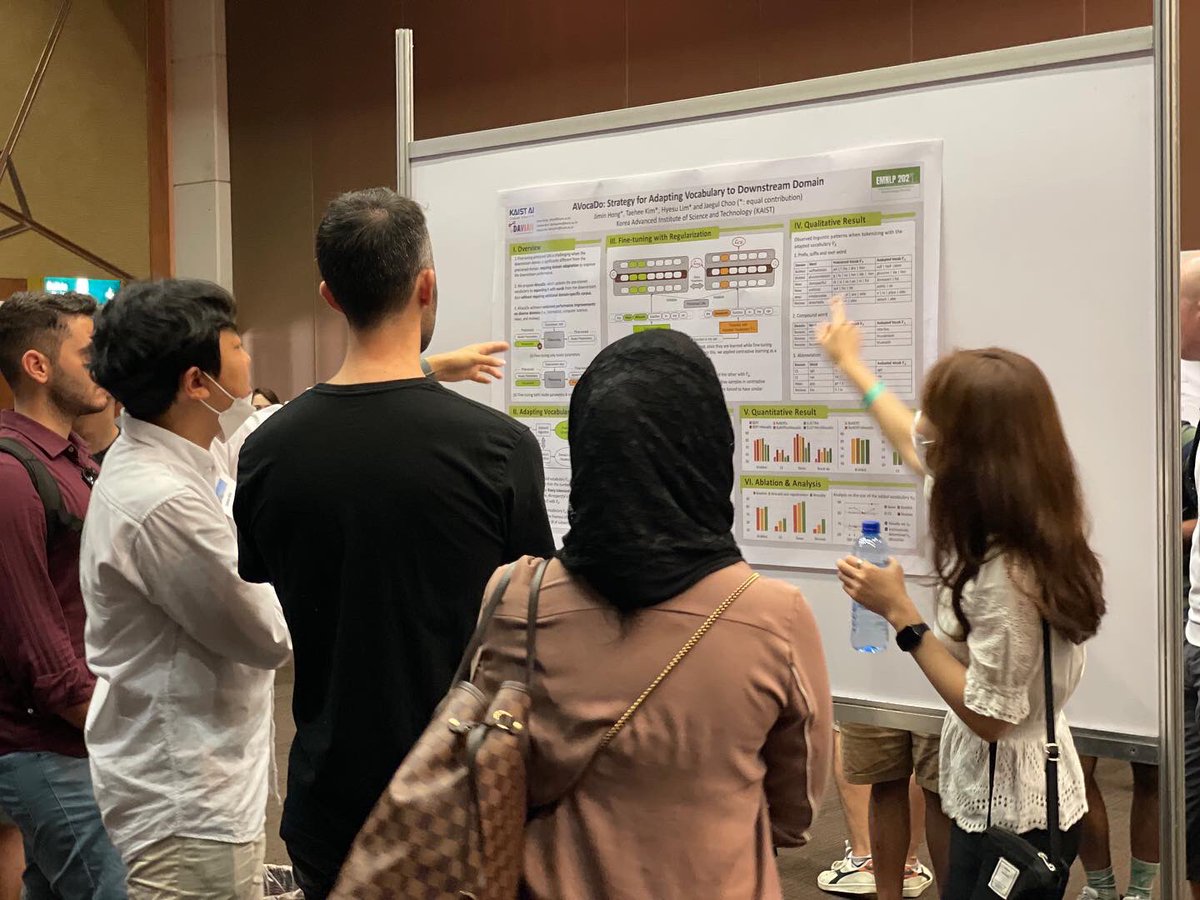
I am delighted to share you my paper “AVocaDo: Strategy for Adapting Vocabulary to Downstream Domain” is accepted to #EMNLP2021. In-person #EMNLP2021 was super fun 😁 Many other researchers were interested in my work (Thank you!).
Paper&code:
https://t.co/BwLnARQ7Qt