Brilliant idea! Next up: Apple randomly reboots your Mac if you're building competing tech, Gmail silently edits your email if you mention rival platforms, and Tesla Autopilot swerves if it detects you're working on self-driving cars.
All in the name of safety, of course. Because malicious actors controlling the world’s operating systems, inboxes and cars would be extremely dangerous!
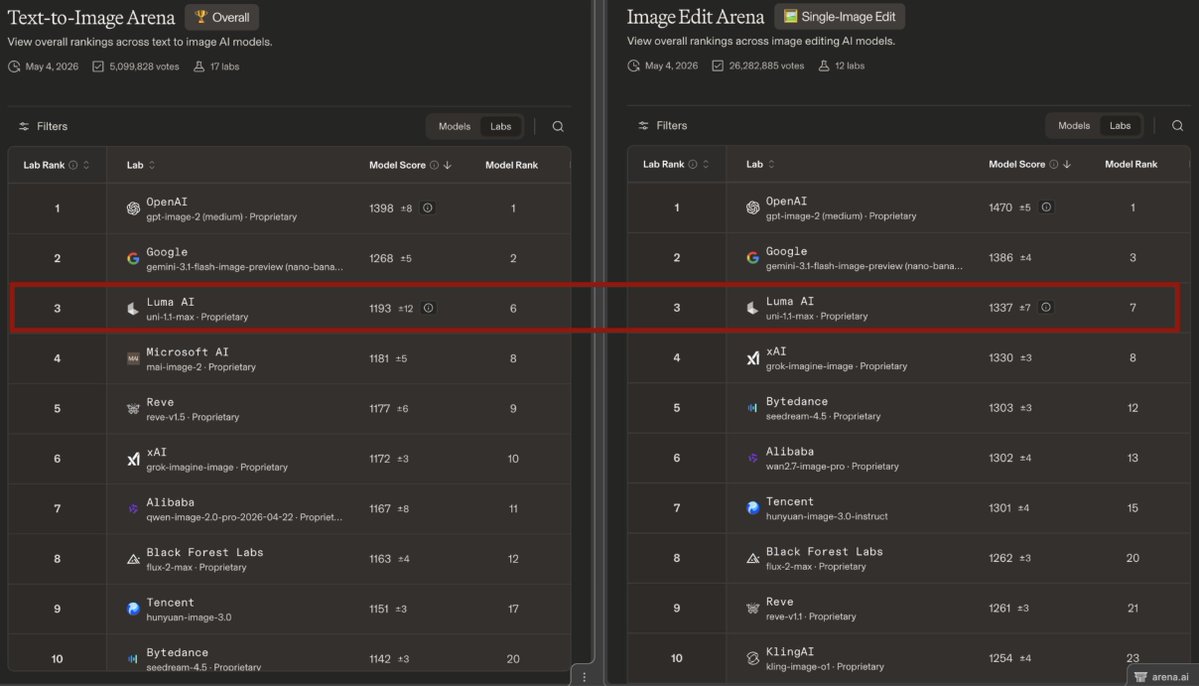
Exciting news: UNI-1.1-Max and UNI-1.1 debuts making @LumaLabsAI the #3 lab in the Image Arena across both Text-to-Image and Image Edit! These are versions released without agentic search.
Text-to-Image Arena
- UNI-1.1-Max #6 overall (1193), +12 points over MAI-Image-2
- UNI-1.1 #7 overall (1190), +13 points over Reve-v1.5
Multi-Image Edit Arena
- UNI-1.1-Max #7 overall (1315), +21 points over Seedream 4.5
- UNI-1.1 #8 overall, (1298)
Single-Image Edit Arena
- UNI-1.1-Max #7 overall (1337)
- UNI-1.1 #11 overall, (1310) on par with Grok-Imagine-Image (20260207)
Congratulations to @LumaLabsAI on this solid performance!
#3 on Image Edit. #3 on Text-to-Image. @arena
The compute we did it with would surprise you. Proud of this team @LumaLabsAI !
(A slightly more detailed report will come out soon)
Most image models are good at one thing.
Uni-1 has been good at everything we've thrown at it.
Our team generated thousands of images leading up to Uni-1 launch. We embedded them all into a single map where visual similarity determines proximity. The result speaks for itself.
We are loving the energy around Uni-1!
Quick note since we’re seeing questions:
With Luma Agents, requests can route across models. If you want to make sure you’re using Uni-1, here’s how:
- Select Create Image → Uni-1
- Or, explicitly ask the agent to use Uni-1
- Check the model label on outputs to confirm
API access coming soon for more direct testing.
Keep the feedback coming, and keep on creating → https://t.co/zjJZMt8Dt6.
Introducing Uni-1, Luma’s first unified understanding and generation model, our next step on the path towards unified general intelligence.
https://t.co/QjdrnYoWe5
Excited to introduce Uni-1, our new *unified* multimodal model that does both understanding and generation: https://t.co/VkgMNnYtZv
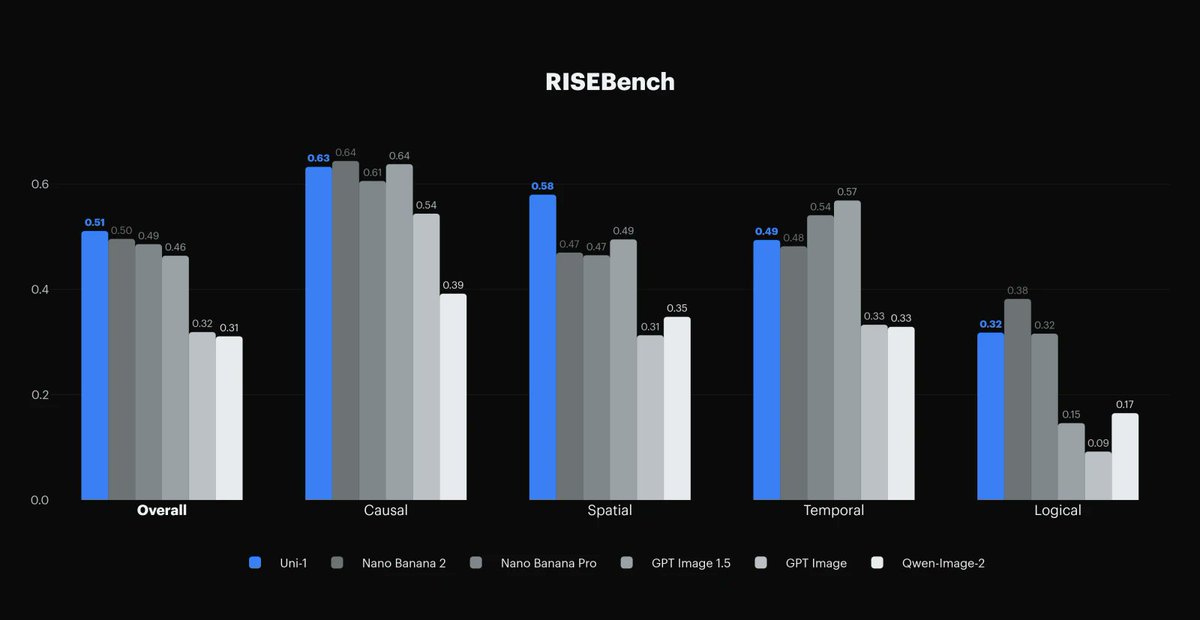
TLDR: I think Uni-1 @LumaLabsAI is > GPT Image 1.5 in many cases, and toe-to-toe with Nano Banana Pro/2. (showcase below)
Introducing Luma Agents. Creative agents that make you prolific. You set the direction. They build with you, seeing what you see and helping teams explore further, iterate faster, and watch ideas multiply.
Excited to introduce Uni-1, our new multimodal model that *unifies* understanding and generation.
TLDR: a team of ~15 researchers is going pound-for-pound with nano banana and gpt image 🧵
We’re excited to announce UPLiFT, our lightweight, pixel-dense feature upsampler. UPLiFT boosts feature density, preserves semantics, and has better efficiency scaling than recent SOTA methods. See all links in the thread below.
Coauthors: @_sakshams_@AnirudAgg@abhi2610
🧵[1/6]
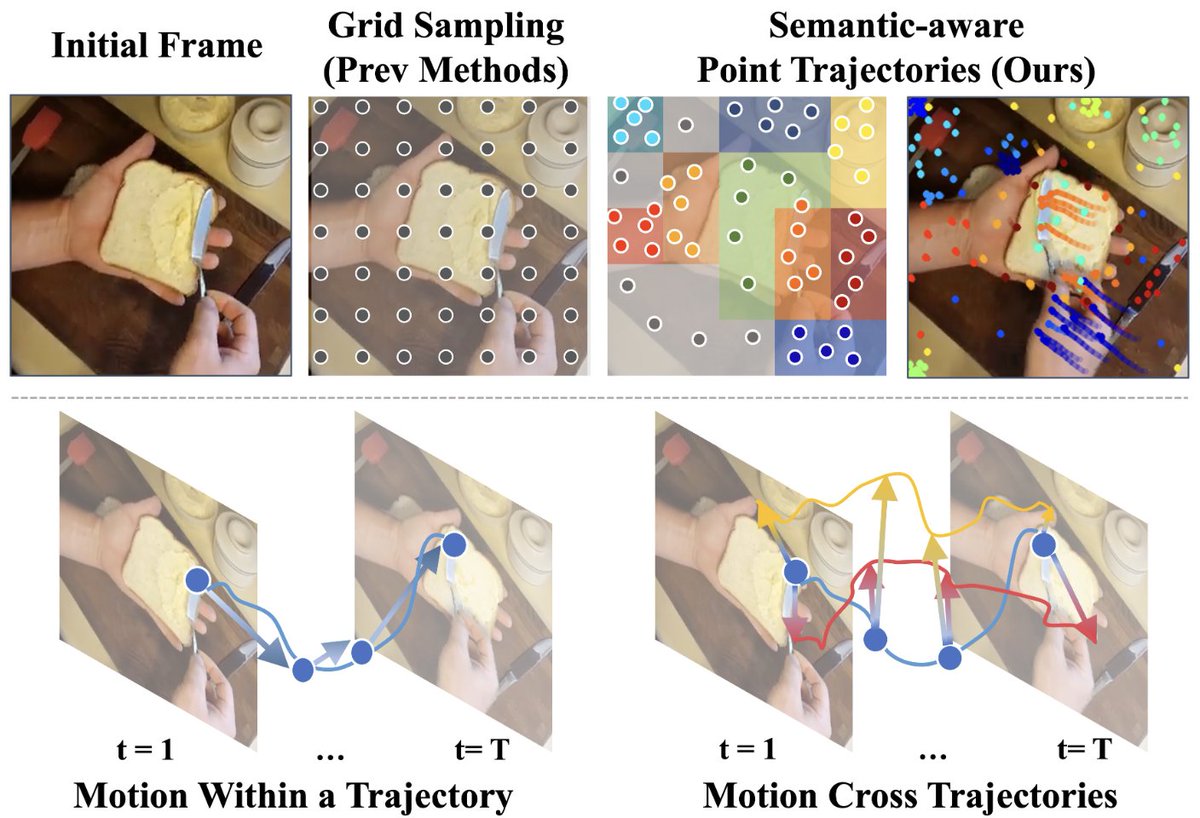
🎉 Excited to share our paper "Trokens: Semantic-Aware Relational Trajectory Tokens for Few-Shot Action Recognition" has been accepted to #ICCV2025!
Equally co-led with @ShuaiyiH — we advance few-shot action recognition via smart point tracking.
🔗 https://t.co/449JI1WiL4
🧵👇
I will be presenting LARP at ICLR today.
🎤 Oral: 11:18 AM – 11:30 AM (UTC+8), Oral Session 3C
🖼️ Poster: 3:00 PM – 5:30 PM (UTC+8), Hall 3 + Hall 2B, Poster #162
You’re very welcome to drop by for discussion and feedback!
🌟 CoLLM: A Large Language Model for Composed Image Retrieval (CVPR 2025)
✨A cutting-edge training paradigm using image-caption pairs
📊High-quality synthetic triplets for training & benchmarking
🔗Project: https://t.co/CbAa3rF9D5
📄Paper: https://t.co/iSLvGU4yHY
#LLM#CIR
I saw a slide circulating on social media last night while working on a deadline. I didn’t comment immediately because I wanted to understand the full context before speaking. After learning more, I feel compelled to address what I witnessed during an invited talk at NeurIPS 2024 by Professor Rosalind Picard.
I deeply respect Professor Picard’s scholarship and contributions to the field. However, her comments during the talk reflected a deeply troubling and racist view of Chinese scholars. This was not just inappropriate but also profoundly disheartening.
First, it was entirely unnecessary to mention the student’s nationality when discussing an incident of cheating. The point about academic integrity could have been made without emphasizing nationality. Yet, Professor Picard chose to highlight it. This choice perpetuates harmful stereotypes about Chinese scholars and reflects a broader bias against Asians, often rooted in the assumption that we “work hard, avoid conflict, and don’t push back.”
This needs to change. Asians, like everyone else, have the right to speak out and demand accountability when racism occurs. We will ensure that being racist against Asians has consequences, including here, Professor Picard.
What made this incident worse was how it unfolded during the Q&A session. A Chinese attendee asked a professional and thoughtfully articulated question. She began by thanking Professor Picard for her talk and posed this question:
Are you calling out the student’s nationality because you find most Chinese scholars honest, and the fact that the cheating student was Chinese is rare? Is that why you emphasized nationality?
This was a generous and high-EQ question, offering Professor Picard an opportunity to reconsider or clarify her comments. Unfortunately, she doubled down instead.
Professor Picard reinforced her remarks by quoting the student’s excuse —that ethics wasn’t taught in their school—and generalized this as a broader issue with Chinese education. This statement is both factually incorrect and deeply offensive.
There are glaring logical flaws in this argument:
1.If the student cheated, why would their excuse about ethics education be taken at face value? A serious scholar would investigate the claim before making it a central part of their argument.
2.Even if the student’s school didn’t teach ethics (which is false for schools in China), other sources like family and community often instill strong ethical values. Ignoring this nuance is careless and reinforces stereotypes.
What is most heartbreaking is that Professor Picard couldn’t even acknowledge something as simple as: “Most Chinese scholars are honest and upright.” Instead, she focused on the singular exception and added, “Of course, with this one exception in this case” in her response.
I regret that this happened at NeurIPS. I regret that this happened in my research community—a place I have cherished and contributed to for over 14 years. I regret that this happened at MIT, an institution of excellence and aspiration for many Chinese scholars.
Racism has no place in academia, and incidents like this tarnish the principles of inclusion and respect that we, as a global research community, should uphold.
I hope NeurIPS and the broader academic community take this as a wake-up call to address the biases and systemic issues that enable such comments to go unchallenged. We must do better.
@MIT_CSAIL@NeurIPSConf
Mitigating racial bias from LLMs is a lot easier than removing it from humans!
Can’t believe this happened at the best AI conference @NeurIPSConf
We have ethical reviews for authors, but missed it for invited speakers? 😡
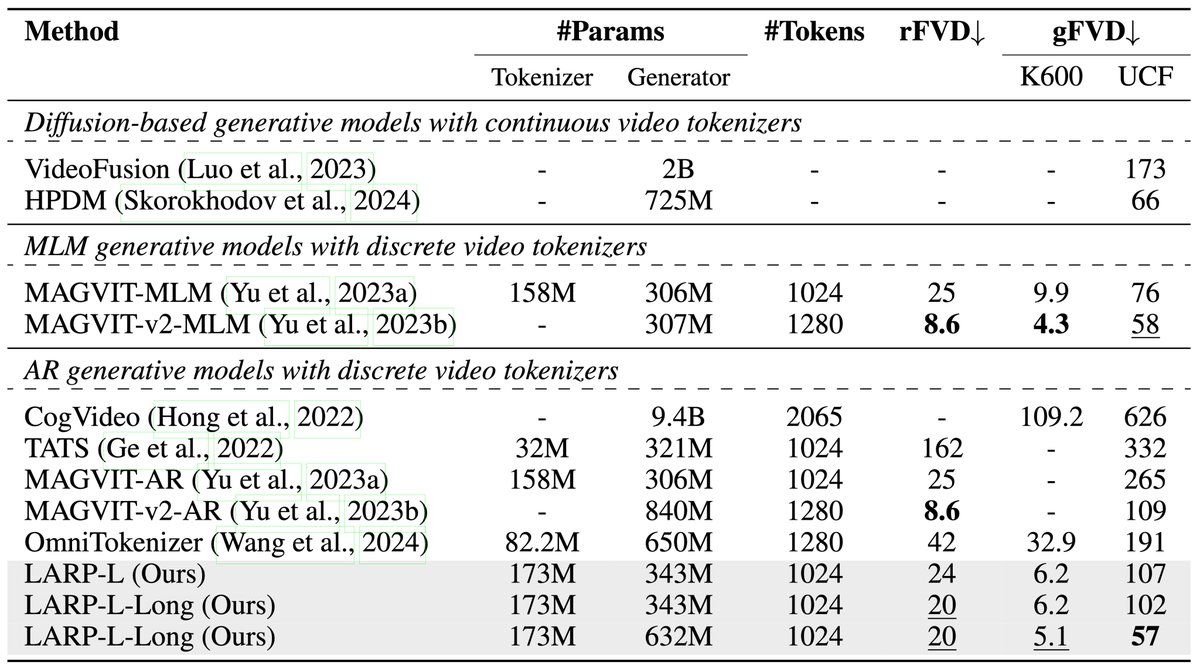
LARP features a learned AR generative prior, achieved by co-training an AR prior model, effectively aligning LARP's latent space with the downstream AR generative models.






![MatthewWalmer's tweet photo. We’re excited to announce UPLiFT, our lightweight, pixel-dense feature upsampler. UPLiFT boosts feature density, preserves semantics, and has better efficiency scaling than recent SOTA methods. See all links in the thread below.
Coauthors: @_sakshams_ @AnirudAgg @abhi2610
🧵[1/6] https://t.co/kjwnKzaGkt](https://pbs.twimg.com/media/G_r4xoMXMAA7CVf.jpg)