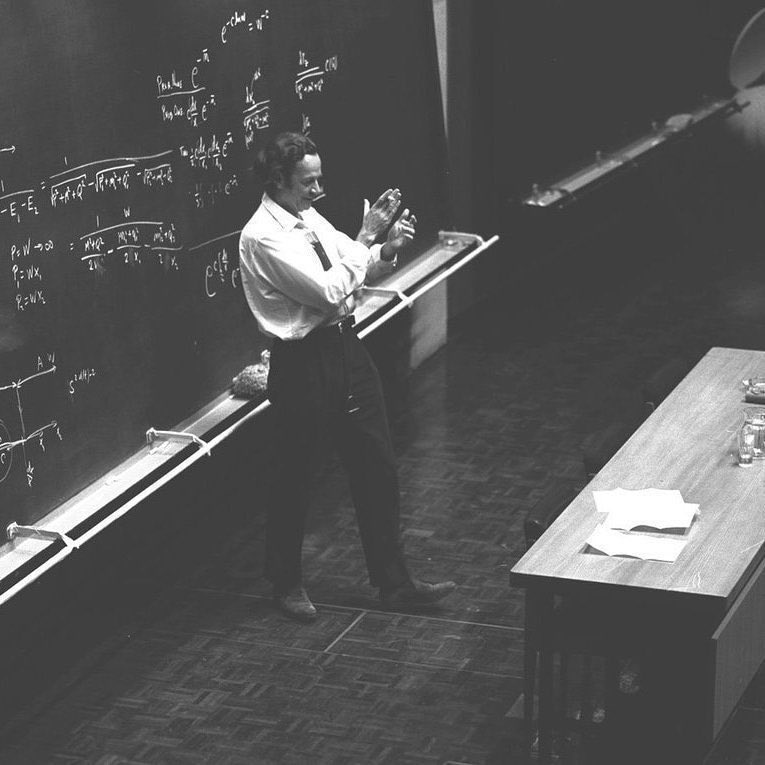
@PhysInHistory Richard Feynman the "Great Explainer" - for his unique teaching style that made complex scientific concepts accessible to everyone.
He would be the only one from whom I would grasp the complexity of quantum mechanics.
📸: Caltech Archives
All the Nobel Laureates in Physics from 1901-2022 🏅📑
1901: Wilhelm Conrad Röntgen
1902: Hendrik Lorentz and Pieter Zeeman
1903: Henri Becquerel, Pierre Curie and Marie Curie
1904: Lord Rayleigh
1905: Philipp Lenard
1906: J. J. Thomson
1907: Albert A. Michelson
1908: Gabriel Lippmann
1909: Guglielmo Marconi and Ferdinand Braun
1910: Johannes Diderik van der Waals
1911: Wilhelm Wien
1912: Gustaf Dalén
1913: Heike Kamerlingh Onnes
1914: Max von Laue
1915: William Henry Bragg and William Lawrence Bragg
1917: Charles Glover Barkla
1918: Max Planck
1919: Johannes Stark
1920: Charles Edouard Guillaume
1921: Albert Einstein
1922: Niels Bohr
1923: Robert A. Millikan
1924: Manne Siegbahn
1925: James Franck and Gustav Hertz
1926: Jean Baptiste Perrin
1927: Arthur H. Compton and Charles T. R. Wilson
1928: Owen Willans Richardson
1929: Louis de Broglie
1930: C. V. Raman
1932: Werner Heisenberg
1933: Erwin Schrödinger and Paul A. M. Dirac
1935: James Chadwick
1936: Victor F. Hess and Carl D. Anderson
1937: Clinton Davisson and George Paget Thomson
1938: Enrico Fermi
1939: Ernest Lawrence
1943: Otto Stern
1944: Isidor Isaac Rabi
1945: Wolfgang Pauli
1946: Percy W. Bridgman
1947: Edward V. Appleton
1948: Patrick M. S. Blackett
1949: Hideki Yukawa
1950: Cecil F. Powell
1951: John Cockcroft and Ernest T. S. Walton
1952: Felix Bloch and Edward M. Purcell
1953: Frits Zernike
1954: Max Born and Walther Bothe
1955: Willis E. Lamb and Polykarp Kusch
1956: William B. Shockley, John Bardeen and Walter H. Brattain
1957: Chen-Ning Yang and Tsung-Dao Lee
1958: Pavel A. Cherenkov, Ilya M. Frank and Igor Y. Tamm
1959: Emilio G. Segrè and Owen Chamberlain
1960: Donald A. Glaser
1961: Robert Hofstadter and Rudolf L. Mössbauer
1962: Lev D. Landau
1963: Eugene P. Wigner, Maria Goeppert-Mayer and J. Hans D. Jensen
1964: Charles H. Townes, Nicolay G. Basov and Aleksandr M. Prokhorov
1965: Sin-Itiro Tomonaga, Julian Schwinger and Richard P. Feynman
1966: Alfred Kastler
1967: Hans A. Bethe
1968: Luis W. Alvarez
1969: Murray Gell-Mann
1970: Hannes Alfvén and Louis E. Néel
1971: Dennis Gabor
1972: John Bardeen, Leon N. Cooper and John R. Schrieffer
1973: Leo Esaki, Ivar Giaever and Brian D. Josephson
1974: Martin Ryle and Antony Hewish
1975: Aage N. Bohr, Ben R. Mottelson and Leo James Rainwater
1976: Burton Richter and Samuel C.C. Ting
1977: Philip W. Anderson, Nevill F. Mott and John H. van Vleck
1978: Pyotr L. Kapitsa, Arno A. Penzias and Robert W. Wilson
1979: Sheldon L. Glashow, Abdus Salam and Steven Weinberg
1980: James W. Cronin and Val L. Fitch
1981: Nicolaas Bloembergen, Arthur L. Schawlow and Kai M. Siegbahn
1982: Kenneth G. Wilson
1983: Subramanyan Chandrasekhar and William A. Fowler
1984: Carlo Rubbia and Simon van der Meer
1985: Klaus von Klitzing
1986: Ernst Ruska, Gerd Binnig and Heinrich Rohrer
1987: J. Georg Bednorz and K. Alex Müller
1988: Leon M. Lederman, Melvin Schwartz and Jack Steinberger
1989: Norman F. Ramsey, Hans G. Dehmelt and Wolfgang Paul
1990: Jerome I. Friedman, Henry W. Kendall and Richard E. Taylor
1991: Pierre-Gilles de Gennes
1992: Georges Charpak
1993: Russell A. Hulse and Joseph H. Taylor Jr.
1994: Bertram N. Brockhouse and Clifford G. Shull
1995: Martin L. Perl and Frederick Reines
1996: David M. Lee, Douglas D. Osheroff and Robert C. Richardson
1997: Steven Chu, Claude Cohen-Tannoudji and William D. Phillips
1998: Robert B. Laughlin, Horst L. Störmer and Daniel C. Tsui
1999: Gerardus 't Hooft and Martinus J.G. Veltman
2000: Zhores I. Alferov, Herbert Kroemer and Jack S. Kilby
2001: Eric A. Cornell, Wolfgang Ketterle and Carl E. Wieman
2002: Raymond Davis Jr., Masatoshi Koshiba and Riccardo Giacconi
2003: Alexei A. Abrikosov, Vitaly L. Ginzburg and Anthony J. Leggett
2004: David J. Gross, H. David Politzer and Frank Wilczek
2005: Roy J. Glauber, John L. Hall and Theodor W. Hänsch
2006: John C. Mather and George F. Smoot
2007: Albert Fert and Peter Grünberg
2008: Yoichiro Nambu, Makoto Kobayashi and Toshihide Maskawa
2009: Charles K. Kao, Willard S. Boyle and George E. Smith
2010: Andre Geim and Konstantin Novoselov
2011: Saul Perlmutter, Brian P. Schmidt and Adam G. Riess
2012: Serge Haroche and David J. Wineland
2013: François Englert and Peter W. Higgs
2014: Isamu Akasaki, Hiroshi Amano and Shuji Nakamura
2015: Takaaki Kajita and Arthur B. McDonald
2016: David J. Thouless, F. Duncan M. Haldane and J. Michael Kosterlitz
2017: Rainer Weiss, Barry C. Barish and Kip S. Thorne
2018: Arthur Ashkin, Gérard Mourou and Donna Strickland
2019: James Peebles, Michel Mayor and Didier Queloz
2020: Roger Penrose, Reinhard Genzel and Andrea Ghez
2021: Syukuro Manabe, Klaus Hasselmann and Giorgio Parisi
2022: Alain Aspect, John F. Clauser and Anton Zeilinger
[Source: https://t.co/shIiFe6bod]
[Alfred Nobel's portrait courtesy: Bettmann Archive/Getty Images]
All the Nobel Laureates in Physics from 1901-2022 🏅📑
1901: Wilhelm Conrad Röntgen
1902: Hendrik Lorentz and Pieter Zeeman
1903: Henri Becquerel, Pierre Curie and Marie Curie
1904: Lord Rayleigh
1905: Philipp Lenard
1906: J. J. Thomson
1907: Albert A. Michelson
1908: Gabriel Lippmann
1909: Guglielmo Marconi and Ferdinand Braun
1910: Johannes Diderik van der Waals
1911: Wilhelm Wien
1912: Gustaf Dalén
1913: Heike Kamerlingh Onnes
1914: Max von Laue
1915: William Henry Bragg and William Lawrence Bragg
1917: Charles Glover Barkla
1918: Max Planck
1919: Johannes Stark
1920: Charles Edouard Guillaume
1921: Albert Einstein
1922: Niels Bohr
1923: Robert A. Millikan
1924: Manne Siegbahn
1925: James Franck and Gustav Hertz
1926: Jean Baptiste Perrin
1927: Arthur H. Compton and Charles T. R. Wilson
1928: Owen Willans Richardson
1929: Louis de Broglie
1930: C. V. Raman
1932: Werner Heisenberg
1933: Erwin Schrödinger and Paul A. M. Dirac
1935: James Chadwick
1936: Victor F. Hess and Carl D. Anderson
1937: Clinton Davisson and George Paget Thomson
1938: Enrico Fermi
1939: Ernest Lawrence
1943: Otto Stern
1944: Isidor Isaac Rabi
1945: Wolfgang Pauli
1946: Percy W. Bridgman
1947: Edward V. Appleton
1948: Patrick M. S. Blackett
1949: Hideki Yukawa
1950: Cecil F. Powell
1951: John Cockcroft and Ernest T. S. Walton
1952: Felix Bloch and Edward M. Purcell
1953: Frits Zernike
1954: Max Born and Walther Bothe
1955: Willis E. Lamb and Polykarp Kusch
1956: William B. Shockley, John Bardeen and Walter H. Brattain
1957: Chen-Ning Yang and Tsung-Dao Lee
1958: Pavel A. Cherenkov, Ilya M. Frank and Igor Y. Tamm
1959: Emilio G. Segrè and Owen Chamberlain
1960: Donald A. Glaser
1961: Robert Hofstadter and Rudolf L. Mössbauer
1962: Lev D. Landau
1963: Eugene P. Wigner, Maria Goeppert-Mayer and J. Hans D. Jensen
1964: Charles H. Townes, Nicolay G. Basov and Aleksandr M. Prokhorov
1965: Sin-Itiro Tomonaga, Julian Schwinger and Richard P. Feynman
1966: Alfred Kastler
1967: Hans A. Bethe
1968: Luis W. Alvarez
1969: Murray Gell-Mann
1970: Hannes Alfvén and Louis E. Néel
1971: Dennis Gabor
1972: John Bardeen, Leon N. Cooper and John R. Schrieffer
1973: Leo Esaki, Ivar Giaever and Brian D. Josephson
1974: Martin Ryle and Antony Hewish
1975: Aage N. Bohr, Ben R. Mottelson and Leo James Rainwater
1976: Burton Richter and Samuel C.C. Ting
1977: Philip W. Anderson, Nevill F. Mott and John H. van Vleck
1978: Pyotr L. Kapitsa, Arno A. Penzias and Robert W. Wilson
1979: Sheldon L. Glashow, Abdus Salam and Steven Weinberg
1980: James W. Cronin and Val L. Fitch
1981: Nicolaas Bloembergen, Arthur L. Schawlow and Kai M. Siegbahn
1982: Kenneth G. Wilson
1983: Subramanyan Chandrasekhar and William A. Fowler
1984: Carlo Rubbia and Simon van der Meer
1985: Klaus von Klitzing
1986: Ernst Ruska, Gerd Binnig and Heinrich Rohrer
1987: J. Georg Bednorz and K. Alex Müller
1988: Leon M. Lederman, Melvin Schwartz and Jack Steinberger
1989: Norman F. Ramsey, Hans G. Dehmelt and Wolfgang Paul
1990: Jerome I. Friedman, Henry W. Kendall and Richard E. Taylor
1991: Pierre-Gilles de Gennes
1992: Georges Charpak
1993: Russell A. Hulse and Joseph H. Taylor Jr.
1994: Bertram N. Brockhouse and Clifford G. Shull
1995: Martin L. Perl and Frederick Reines
1996: David M. Lee, Douglas D. Osheroff and Robert C. Richardson
1997: Steven Chu, Claude Cohen-Tannoudji and William D. Phillips
1998: Robert B. Laughlin, Horst L. Störmer and Daniel C. Tsui
1999: Gerardus 't Hooft and Martinus J.G. Veltman
2000: Zhores I. Alferov, Herbert Kroemer and Jack S. Kilby
2001: Eric A. Cornell, Wolfgang Ketterle and Carl E. Wieman
2002: Raymond Davis Jr., Masatoshi Koshiba and Riccardo Giacconi
2003: Alexei A. Abrikosov, Vitaly L. Ginzburg and Anthony J. Leggett
2004: David J. Gross, H. David Politzer and Frank Wilczek
2005: Roy J. Glauber, John L. Hall and Theodor W. Hänsch
2006: John C. Mather and George F. Smoot
2007: Albert Fert and Peter Grünberg
2008: Yoichiro Nambu, Makoto Kobayashi and Toshihide Maskawa
2009: Charles K. Kao, Willard S. Boyle and George E. Smith
2010: Andre Geim and Konstantin Novoselov
2011: Saul Perlmutter, Brian P. Schmidt and Adam G. Riess
2012: Serge Haroche and David J. Wineland
2013: François Englert and Peter W. Higgs
2014: Isamu Akasaki, Hiroshi Amano and Shuji Nakamura
2015: Takaaki Kajita and Arthur B. McDonald
2016: David J. Thouless, F. Duncan M. Haldane and J. Michael Kosterlitz
2017: Rainer Weiss, Barry C. Barish and Kip S. Thorne
2018: Arthur Ashkin, Gérard Mourou and Donna Strickland
2019: James Peebles, Michel Mayor and Didier Queloz
2020: Roger Penrose, Reinhard Genzel and Andrea Ghez
2021: Syukuro Manabe, Klaus Hasselmann and Giorgio Parisi
2022: Alain Aspect, John F. Clauser and Anton Zeilinger
[Source: https://t.co/shIiFe6bod]
[Alfred Nobel's portrait courtesy: Bettmann Archive/Getty Images]
@PhysInHistory Tesla would have gotten it, they had to share it with Edison for electricity. When they approached Edison with the news, he said he'd rather not get the Prize if it meant sharing it with Tesla. That's how they both missed out.
Henry Moseley, the inventor of the modern periodic table, was killed at the age of 27 by a sniper in the Gallipoli battle in 1915.
Moseley was a brilliant physicist who worked at the University of Manchester under Ernest Rutherford, the father of nuclear physics. He was interested in the properties of X-rays and how they could be used to study the structure of atoms. He used a device called a spectrometer to measure the wavelengths of X-rays emitted by different elements when they were bombarded by electrons. He found that there was a regular pattern in the X-ray spectra, and that each element had a characteristic set of lines that could be used to identify it. He also found that the frequency of the most intense line in each spectrum was proportional to the square of a number that he assigned to each element. This number, which he called the atomic number, was later found to be equal to the number of protons in the nucleus of an atom.
Moseley’s discovery was very important for chemistry and physics, as it provided a clear and logical way to organize the elements in the periodic table. It also explained why some elements had similar chemical properties, as they had the same number of electrons in their outer shells. Moseley’s work also supported Niels Bohr’s theory of the atom, which proposed that electrons orbit around the nucleus in discrete energy levels. Moseley’s law also predicted the existence of some missing elements that had not been discovered yet, such as technetium, promethium, and rhenium.
Unfortunately, Moseley’s life and career were cut short by World War I. He volunteered for the British Army as a telecommunications officer, and was sent to Gallipoli, Turkey, where he participated in a campaign against the Ottoman Empire. He was killed by a sniper on August 10, 1915, at the age of 27. His death was mourned by many scientists and scholars, who regarded him as one of the most promising physicists of his generation. Some even speculated that he would have won the Nobel Prize in Physics if he had survived.
Niels Bohr once said that,
Rutherford's work "was not taken seriously at all" and that the "great change came from Moseley."
His death also prompted the British government to ban other prominent scientists from serving in front-line roles, as they realized the value and importance of scientific research for society
[Photograph: Balliol-Trinity College Laboratory, 1910]
• Study hard.
• What others think of you is none of your business.
• It's OK not to have all the answers.
• Experiment, Fail, Learn and Repeat.
• Knowledge comes from experience.
• Imagination is important.
• Do what interests you the most.
• Stay curious
@kanyewest From Babylon to Timbuktu is a good book.. also “Africa being an accurate description “ by John Ogilby written around the 1600 speaks of how the Jews in Portugal were black and deported to São Tomé and the Guinea by King John ii when they refused to convert to Christianity
@Jose___Rego Damn dawg 😢this right here is the exact dose of energy I needed. A healthy reminder of the fact that no matter what is happening around me I just gots ta focus on and guard the energy I put out. There's too many changes happening these days, its easy to get lost 🥵
Protecting our rivers, beaches, and oceans isn’t rocket science. Right, @sciencebob?
Hear why it’s so important to clean up trash with a fun fact about oceans you probably didn’t know.







![PhysInHistory's tweet photo. All the Nobel Laureates in Physics from 1901-2022 🏅📑
1901: Wilhelm Conrad Röntgen
1902: Hendrik Lorentz and Pieter Zeeman
1903: Henri Becquerel, Pierre Curie and Marie Curie
1904: Lord Rayleigh
1905: Philipp Lenard
1906: J. J. Thomson
1907: Albert A. Michelson
1908: Gabriel Lippmann
1909: Guglielmo Marconi and Ferdinand Braun
1910: Johannes Diderik van der Waals
1911: Wilhelm Wien
1912: Gustaf Dalén
1913: Heike Kamerlingh Onnes
1914: Max von Laue
1915: William Henry Bragg and William Lawrence Bragg
1917: Charles Glover Barkla
1918: Max Planck
1919: Johannes Stark
1920: Charles Edouard Guillaume
1921: Albert Einstein
1922: Niels Bohr
1923: Robert A. Millikan
1924: Manne Siegbahn
1925: James Franck and Gustav Hertz
1926: Jean Baptiste Perrin
1927: Arthur H. Compton and Charles T. R. Wilson
1928: Owen Willans Richardson
1929: Louis de Broglie
1930: C. V. Raman
1932: Werner Heisenberg
1933: Erwin Schrödinger and Paul A. M. Dirac
1935: James Chadwick
1936: Victor F. Hess and Carl D. Anderson
1937: Clinton Davisson and George Paget Thomson
1938: Enrico Fermi
1939: Ernest Lawrence
1943: Otto Stern
1944: Isidor Isaac Rabi
1945: Wolfgang Pauli
1946: Percy W. Bridgman
1947: Edward V. Appleton
1948: Patrick M. S. Blackett
1949: Hideki Yukawa
1950: Cecil F. Powell
1951: John Cockcroft and Ernest T. S. Walton
1952: Felix Bloch and Edward M. Purcell
1953: Frits Zernike
1954: Max Born and Walther Bothe
1955: Willis E. Lamb and Polykarp Kusch
1956: William B. Shockley, John Bardeen and Walter H. Brattain
1957: Chen-Ning Yang and Tsung-Dao Lee
1958: Pavel A. Cherenkov, Ilya M. Frank and Igor Y. Tamm
1959: Emilio G. Segrè and Owen Chamberlain
1960: Donald A. Glaser
1961: Robert Hofstadter and Rudolf L. Mössbauer
1962: Lev D. Landau
1963: Eugene P. Wigner, Maria Goeppert-Mayer and J. Hans D. Jensen
1964: Charles H. Townes, Nicolay G. Basov and Aleksandr M. Prokhorov
1965: Sin-Itiro Tomonaga, Julian Schwinger and Richard P. Feynman
1966: Alfred Kastler
1967: Hans A. Bethe
1968: Luis W. Alvarez
1969: Murray Gell-Mann
1970: Hannes Alfvén and Louis E. Néel
1971: Dennis Gabor
1972: John Bardeen, Leon N. Cooper and John R. Schrieffer
1973: Leo Esaki, Ivar Giaever and Brian D. Josephson
1974: Martin Ryle and Antony Hewish
1975: Aage N. Bohr, Ben R. Mottelson and Leo James Rainwater
1976: Burton Richter and Samuel C.C. Ting
1977: Philip W. Anderson, Nevill F. Mott and John H. van Vleck
1978: Pyotr L. Kapitsa, Arno A. Penzias and Robert W. Wilson
1979: Sheldon L. Glashow, Abdus Salam and Steven Weinberg
1980: James W. Cronin and Val L. Fitch
1981: Nicolaas Bloembergen, Arthur L. Schawlow and Kai M. Siegbahn
1982: Kenneth G. Wilson
1983: Subramanyan Chandrasekhar and William A. Fowler
1984: Carlo Rubbia and Simon van der Meer
1985: Klaus von Klitzing
1986: Ernst Ruska, Gerd Binnig and Heinrich Rohrer
1987: J. Georg Bednorz and K. Alex Müller
1988: Leon M. Lederman, Melvin Schwartz and Jack Steinberger
1989: Norman F. Ramsey, Hans G. Dehmelt and Wolfgang Paul
1990: Jerome I. Friedman, Henry W. Kendall and Richard E. Taylor
1991: Pierre-Gilles de Gennes
1992: Georges Charpak
1993: Russell A. Hulse and Joseph H. Taylor Jr.
1994: Bertram N. Brockhouse and Clifford G. Shull
1995: Martin L. Perl and Frederick Reines
1996: David M. Lee, Douglas D. Osheroff and Robert C. Richardson
1997: Steven Chu, Claude Cohen-Tannoudji and William D. Phillips
1998: Robert B. Laughlin, Horst L. Störmer and Daniel C. Tsui
1999: Gerardus 't Hooft and Martinus J.G. Veltman
2000: Zhores I. Alferov, Herbert Kroemer and Jack S. Kilby
2001: Eric A. Cornell, Wolfgang Ketterle and Carl E. Wieman
2002: Raymond Davis Jr., Masatoshi Koshiba and Riccardo Giacconi
2003: Alexei A. Abrikosov, Vitaly L. Ginzburg and Anthony J. Leggett
2004: David J. Gross, H. David Politzer and Frank Wilczek
2005: Roy J. Glauber, John L. Hall and Theodor W. Hänsch
2006: John C. Mather and George F. Smoot
2007: Albert Fert and Peter Grünberg
2008: Yoichiro Nambu, Makoto Kobayashi and Toshihide Maskawa
2009: Charles K. Kao, Willard S. Boyle and George E. Smith
2010: Andre Geim and Konstantin Novoselov
2011: Saul Perlmutter, Brian P. Schmidt and Adam G. Riess
2012: Serge Haroche and David J. Wineland
2013: François Englert and Peter W. Higgs
2014: Isamu Akasaki, Hiroshi Amano and Shuji Nakamura
2015: Takaaki Kajita and Arthur B. McDonald
2016: David J. Thouless, F. Duncan M. Haldane and J. Michael Kosterlitz
2017: Rainer Weiss, Barry C. Barish and Kip S. Thorne
2018: Arthur Ashkin, Gérard Mourou and Donna Strickland
2019: James Peebles, Michel Mayor and Didier Queloz
2020: Roger Penrose, Reinhard Genzel and Andrea Ghez
2021: Syukuro Manabe, Klaus Hasselmann and Giorgio Parisi
2022: Alain Aspect, John F. Clauser and Anton Zeilinger
[Source: https://t.co/shIiFe6bod]
[Alfred Nobel's portrait courtesy: Bettmann Archive/Getty Images]](https://pbs.twimg.com/media/F2iHlC6WUAIeWNs.jpg)
![PhysInHistory's tweet photo. Henry Moseley, the inventor of the modern periodic table, was killed at the age of 27 by a sniper in the Gallipoli battle in 1915.
Moseley was a brilliant physicist who worked at the University of Manchester under Ernest Rutherford, the father of nuclear physics. He was interested in the properties of X-rays and how they could be used to study the structure of atoms. He used a device called a spectrometer to measure the wavelengths of X-rays emitted by different elements when they were bombarded by electrons. He found that there was a regular pattern in the X-ray spectra, and that each element had a characteristic set of lines that could be used to identify it. He also found that the frequency of the most intense line in each spectrum was proportional to the square of a number that he assigned to each element. This number, which he called the atomic number, was later found to be equal to the number of protons in the nucleus of an atom.
Moseley’s discovery was very important for chemistry and physics, as it provided a clear and logical way to organize the elements in the periodic table. It also explained why some elements had similar chemical properties, as they had the same number of electrons in their outer shells. Moseley’s work also supported Niels Bohr’s theory of the atom, which proposed that electrons orbit around the nucleus in discrete energy levels. Moseley’s law also predicted the existence of some missing elements that had not been discovered yet, such as technetium, promethium, and rhenium.
Unfortunately, Moseley’s life and career were cut short by World War I. He volunteered for the British Army as a telecommunications officer, and was sent to Gallipoli, Turkey, where he participated in a campaign against the Ottoman Empire. He was killed by a sniper on August 10, 1915, at the age of 27. His death was mourned by many scientists and scholars, who regarded him as one of the most promising physicists of his generation. Some even speculated that he would have won the Nobel Prize in Physics if he had survived.
Niels Bohr once said that,
Rutherford's work "was not taken seriously at all" and that the "great change came from Moseley."
His death also prompted the British government to ban other prominent scientists from serving in front-line roles, as they realized the value and importance of scientific research for society
[Photograph: Balliol-Trinity College Laboratory, 1910]](https://pbs.twimg.com/media/F2dQ5DVagAAo_io.jpg)