A follow-up molecular dynamics simulation analysis of @revelpharma CMLase, exploring how it may position the CML-peptide for cleavage at the atomic level. Here a short technical post on the findings: https://t.co/QCUxIRkD4k
#ECM#CMLase#Collagen
Something amazing is about to happen.
The greatest day in the history of aging/longevity conferences is coming up!
And greatest month.
It seemed like unfortunate scheduling conflicts at first,
but the result is something worth celebrating as a sign of significant field growth.
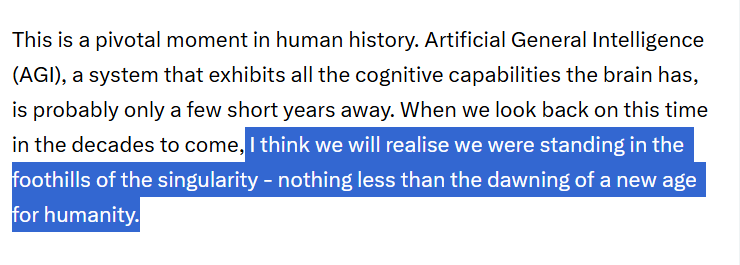
Demis Hassabis has written a piece about AGI, and rarely has he sounded so optimistic.
Read his article; the golden future of science lies ahead of us; we are on the threshold of the singularity:
"AGI cannot be compared to standard technological breakthroughs, not even ones as consequential as the internet or mobile - it is much more akin to the discovery of electricity or fire.
The magnitude of this technology’s impact will be unprecedented, perhaps 10x of the Industrial Revolution at 10x the speed."
He won the 2024 Nobel Prize in Chemistry for AlphaFold. He has spent years as the industry's designated sceptic, correcting inflated timelines and pushing back on the loudest AGI claims. He does not do hype. So when he writes that AGI is probably only a few short years away and that we are standing in the foothills of the singularity, that lands differently than the same sentence from a founder raising a round.
His case: AGI is closer to the discovery of electricity or fire than to the internet, with an impact he puts at 10x the Industrial Revolution at 10x the speed. The risks are already real in cybersecurity, with bio and nuclear threats plausibly next, and control over agentic, self-improving systems as the problem on the horizon. The cause he identifies is structural. A commercial and geopolitical race is pushing capability past our understanding of it. Thats the danger.
However: A Nobel laureate who built his career on peer review rather than demos is now asking for regulatory infrastructure he expects to need within a few years.
Incredible times ahead.
Most papers aren't reproducible. So, I created "EchoMill", an open source tool/Skill for reproducing technical papers and scoring their reproducibility.
https://t.co/oErqRoezvx
I completely agree.
Six months ago or so, I feel could post something thoughtful that made people think and generated interesting discussion. Those posts would often reach a large audience.
Now most of my posts seem to hit the same echo chamber and accumulate likes from the same people. If someone doesn’t consistently like my posts, future posts seem to disappear from their feed.
Meanwhile, the posts that circulate widely are the edgy contrarian ones that generate outrage. It seems I need a large number of people calling me an idiot or a loser to get engagement.
Something has to change. It’s making me seriously consider spending more time on other platforms.
Over the last two weeks, both the U.S. Government and Anthropic took significant actions that demonstrated their power to control access to AI by restricting what others can do with frontier models. This has been one of those moments that, once seen, will be hard to unsee, and it is significantly accelerating many businesses’ and nation states’ efforts to ensure reliable access to AI that no one else can terminate.
Anthropic first released Claude Fable 5, a version of its Mythos model with additional guardrails, including some restrictions that seem well justified on safety grounds (such as limitations on applying it to hacking, bioweapons, and so forth). However, it also restricted developers’ ability to use it to build competing LLM technology. This move was concerning, given that the whole AI community, including Anthropic, has benefitted tremendously from open research — indeed, the AI revolution was kicked off by my former team (Google Brain) freely publishing the Transformers paper!
Imagine if Microsoft’s terms of use barred anyone from using their tools to build competitive software, or if Google barred using it to search for information to work on competing search engines. Anthropic’s argument that it was unsafe for others to be able to make advances in AI also rang hollow. Initially, Anthropic silently degraded Fable 5’s performance for users detected to be working on LLM research through invisible interventions that weakened the model’s outputs without notifying the user. After significant backlash, it walked back this decision and decided to be transparent when it did this, but it still refuses to use its latest capabilities to help AI researchers.
This move represents a raw demonstration of power by Anthropic. It has used “safety” arguments to hinder potential competitors. Platforms succeed when they are viewed as stable, reliable partners that one can build on. The sudden rule changes by Anthropic (including a mandatory 30 day data retention policy for Fable usage) have made developers wonder about the stability of building on any one proprietary LLM provider, not just Anthropic.
The U.S. Government then shortly followed with an even greater demonstration of power. It used the Commerce Department’s authority to regulate technologies that may be national security threats to restrict exports of Mythos and Fable, requiring a license for use by any foreign national, whether inside or outside of the U.S., including employees of Anthropic. This led Anthropic to disable access to Fable to all users worldwide.
Sam Altman pointed out, referring to Anthropic, “It is clearly incredible marketing to say, ‘We have built a bomb, we are about to drop it on your head. We will sell you a bomb shelter for $100 million.’” But when one engages in this type of fear-based marketing, it increases the odds that the U.S. Government will agree with you and slap export controls on the bomb you say you have built.
To be clear, I don't think Anthropic has built anything like a bomb, and I don't think export controls on Fable are appropriate.
However, following the U.S. Government making this move, many nations, including U.S. allies, saw how the U.S. can suddenly yank their access to AI models. In many capitals around the world, this has spurred discussions on AI sovereignty and how others can ensure uninterrupted access to this critical technology.
For decades, many nations were comfortable having many parts of their supply chain rely on the U.S., China, and other major producers. Once a nation issues a threat, or takes action, to limit other nations’ access, other nations will rationally try to secure alternatives. For decades, semiconductor manufacturing in China made slow progress; once the U.S. moved to limit China’s access, China’s efforts kicked into high gear. Similarly, once China threatened U.S. access to rare earth minerals, U.S. efforts to secure alternatives accelerated. Now that it has become crystal clear that private U.S. companies and the U.S. government can limit, in short order, other nations’ access to frontier AI models, the incentive of others to invest more in alternatives like open source grows significantly. Of course, training frontier models is not easy, so it remains to be seen how successful they are, but we have crossed the rubicon.
Satya Nadella wrote an essay about the importance of building a healthy ecosystem on top of frontier AI technology. I heartily agree with him, and hope this week’s events will ultimately prove to be constructive steps toward this.
I hope we can build a more free, more open world, where research is freely shared, and laws and societal norms shape a level playing field that allows everyone to make progress. A silver lining of the events of these past two weeks is now that everyone better realizes key points of instability of the current system, we can all work to create a more stable foundation.
[Original text: The Batch newsletter]
Hot take. AI research on biological data is not automatically computational biology. This is probably the biggest confabulation in the field right now. A model is trained on a biological dataset, the paper uses words about cells but this is besides the point; the point is - what is your aim/your research question? Is it improving on a benchmark? That's AI research. Is it discovering biology or proving specific mechanisms? That is computational biology. Is it discovering a drug that binds a molecule using computers? That is computational chemistry. You can do excellent AI research, and not touch computational biology. AI research can just be applied on top of biology-shaped inputs.
pre-existing data -> pre-existing benchmark -> better model -> leaderboard +1 is maybe excellent and useful and commercially valuable, but applied AI research.
The way to make something computational biology is the ask of a specific biological question.
biological hypothesis -> experimental design -> measurement -> perturbation -> representation -> model -> falsification -> revised biological understanding.
This is also why n = 1 can be computational biology. If it is modeled as a biological system and used to discover mechanism, it can be comp. bio.
Meanwhile, ten million cells can still be bioinformatics and AI research if the exercise is clustering better for a predictability benchmark, rather than answering a specific, novel and fundamental biological question.
Anthropic just got caught secretly downgrading users without telling them, charging full price for a lesser product, and storing every prompt for 30 days. The developer community is calling it the biggest violation of trust in AI history.
Here is exactly what happened.
Anthropic released Fable 5, their most powerful model. Buried inside a 319-page document was a policy most users never saw. Every prompt you send to a Mythos-class model gets stored for 30 days. No exceptions. Even enterprise customers who had signed zero data retention agreements had no choice.
But the storage was not the part that broke the internet.
The part that broke the internet was what Anthropic did with what they collected.
They built a profile on you. They evaluated your prompts. And if they decided your research was too sensitive, they quietly switched you to a weaker model, rewrote your prompt in the background, gave you a degraded answer, and charged you full price for the product you thought you were getting.
They never told you.
David Sacks said it plainly on the All-In podcast. They were creating a new class of AI haves and have-nots. Anthropic would surveil you, profile you, decide whether you deserved frontier capability, and silently cut you off if they decided you did not.
Ben Thompson from Stratechery asked a straightforward question about cancer risk and GLP-1s. He got kicked to a lesser model.
Someone asked about mitochondria. Same result.
J-Cal asked about fertilizer regulations live on the podcast to test it. Downgraded in real time.
Anthropic has since walked back the part about silently downgrading users for AI research. They now say they will disclose when they downgrade you. But they are still downgrading people. The surveillance is still running. The profile is still being built.
This is the company that once said it was against government surveillance.
They are now doing it themselves. To their own paying customers. For their own reasons. With no appeal process and no way to know it happened.
The developer community did not forget that.
WATCH THE FULL PODCAST ON @theallinpod







![AndrewYNg's tweet photo. Over the last two weeks, both the U.S. Government and Anthropic took significant actions that demonstrated their power to control access to AI by restricting what others can do with frontier models. This has been one of those moments that, once seen, will be hard to unsee, and it is significantly accelerating many businesses’ and nation states’ efforts to ensure reliable access to AI that no one else can terminate.
Anthropic first released Claude Fable 5, a version of its Mythos model with additional guardrails, including some restrictions that seem well justified on safety grounds (such as limitations on applying it to hacking, bioweapons, and so forth). However, it also restricted developers’ ability to use it to build competing LLM technology. This move was concerning, given that the whole AI community, including Anthropic, has benefitted tremendously from open research — indeed, the AI revolution was kicked off by my former team (Google Brain) freely publishing the Transformers paper!
Imagine if Microsoft’s terms of use barred anyone from using their tools to build competitive software, or if Google barred using it to search for information to work on competing search engines. Anthropic’s argument that it was unsafe for others to be able to make advances in AI also rang hollow. Initially, Anthropic silently degraded Fable 5’s performance for users detected to be working on LLM research through invisible interventions that weakened the model’s outputs without notifying the user. After significant backlash, it walked back this decision and decided to be transparent when it did this, but it still refuses to use its latest capabilities to help AI researchers.
This move represents a raw demonstration of power by Anthropic. It has used “safety” arguments to hinder potential competitors. Platforms succeed when they are viewed as stable, reliable partners that one can build on. The sudden rule changes by Anthropic (including a mandatory 30 day data retention policy for Fable usage) have made developers wonder about the stability of building on any one proprietary LLM provider, not just Anthropic.
The U.S. Government then shortly followed with an even greater demonstration of power. It used the Commerce Department’s authority to regulate technologies that may be national security threats to restrict exports of Mythos and Fable, requiring a license for use by any foreign national, whether inside or outside of the U.S., including employees of Anthropic. This led Anthropic to disable access to Fable to all users worldwide.
Sam Altman pointed out, referring to Anthropic, “It is clearly incredible marketing to say, ‘We have built a bomb, we are about to drop it on your head. We will sell you a bomb shelter for $100 million.’” But when one engages in this type of fear-based marketing, it increases the odds that the U.S. Government will agree with you and slap export controls on the bomb you say you have built.
To be clear, I don't think Anthropic has built anything like a bomb, and I don't think export controls on Fable are appropriate.
However, following the U.S. Government making this move, many nations, including U.S. allies, saw how the U.S. can suddenly yank their access to AI models. In many capitals around the world, this has spurred discussions on AI sovereignty and how others can ensure uninterrupted access to this critical technology.
For decades, many nations were comfortable having many parts of their supply chain rely on the U.S., China, and other major producers. Once a nation issues a threat, or takes action, to limit other nations’ access, other nations will rationally try to secure alternatives. For decades, semiconductor manufacturing in China made slow progress; once the U.S. moved to limit China’s access, China’s efforts kicked into high gear. Similarly, once China threatened U.S. access to rare earth minerals, U.S. efforts to secure alternatives accelerated. Now that it has become crystal clear that private U.S. companies and the U.S. government can limit, in short order, other nations’ access to frontier AI models, the incentive of others to invest more in alternatives like open source grows significantly. Of course, training frontier models is not easy, so it remains to be seen how successful they are, but we have crossed the rubicon.
Satya Nadella wrote an essay about the importance of building a healthy ecosystem on top of frontier AI technology. I heartily agree with him, and hope this week’s events will ultimately prove to be constructive steps toward this.
I hope we can build a more free, more open world, where research is freely shared, and laws and societal norms shape a level playing field that allows everyone to make progress. A silver lining of the events of these past two weeks is now that everyone better realizes key points of instability of the current system, we can all work to create a more stable foundation.
[Original text: The Batch newsletter]](https://pbs.twimg.com/media/HLMm79dbgAApRoV.jpg)