Hello world 👋 We're building the first medicines to repair the aging extracellular matrix, the scaffold that holds your body together.
Our new results in Nature Communications got picked up by @theallinpod, @bryan_johnson, @davidasinclair, @afshineemrani, and many others.
What did we find? Let's dig in 🧵
Cells get almost all the attention in biology. But cells don't live in a vacuum; they're held up by structural tissue, the extracellular matrix. Collagen, elastin, and the scaffolding that gives your body its shape.
As the matrix accumulates chemical damage over time, its properties change. Skin sags, arteries stiffen, and the damaged matrix draws in immune responses and drives oxidative stress.
It's one of the root causes of aging, and it's been largely neglected.
Natively, our bodies can't repair this damage. But some bacteria have enzymes that can break these chemical bonds. So we asked: can we engineer highly efficient, therapeutic versions of these enzymes? Many said it couldn't be done. We built a platform to do exactly that.
CML forms via the same Maillard reaction that browns bread: slowly, over a lifetime, at body temperature. Protein-bound CML has been considered irreversible for 40 years. You can't untoast bread. 🍞
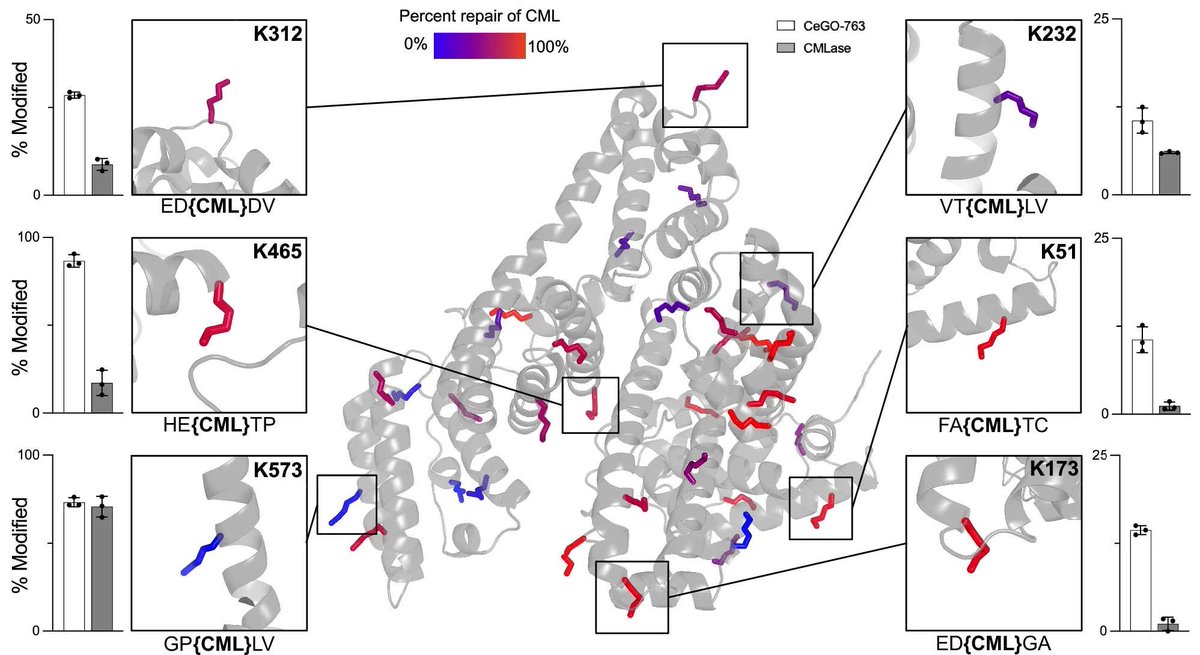
So we built CMLase, an enzyme that clips CML off proteins and restores the original. We screened tens of thousands of natural enzymes, then ran directed evolution across 500 million variants of the best ones. In vitro, it works.
More importantly: CMLase reverses CML in real ex-vivo human tissue from elderly donors. This is the test that matters. So many aging interventions look great in mice and fail in humans.
After applying CMLase overnight to tissue from elderly donors, residual CML dropped to levels seen in far younger tissue. In elderly skin: a 55%+ reduction, down to below the level of 31-year-old skin.
This is just the start. We've shown proof-of-concept that engineering enzymes to rejuvenate the extracellular matrix is possible: untoasting the proverbial bread. We're raising our Series A soon. If you believe, like @chamath at the @theallinpod, that this is a trillion-dollar market, get in touch.
BIG ANTI-AGING PROGRESS:
Scientists just reversed a form of molecular aging once thought permanent. 🤯!
"For decades, scientists believed Nε-carboxymethyllysine (CML), one of the most common Advanced Glycation End Products (AGEs) that accumulates on our proteins with age, was essentially irreversible."
But not anymore!
"Researchers just engineered CMLase, the first enzyme designed to repair this age-related damage by removing CML and restoring the protein's original lysine residue."
The results were remarkable:
> 55% reduction of CML in aged human skin
> 70% reduction in elderly human arteries
> 45% reduction in a 64-year-old human lens
Even more striking, CML levels in treated aged skin fell below those measured in skin from a 31-year-old donor.
"Instead of replacing cells or slowing future damage, CMLase directly repairs proteins that have accumulated decades of chemical aging. It's the first demonstration that this type of molecular damage can be enzymatically reversed in naturally aged human tissues."
This breakthrough could open an entirely new frontier in rejuvenation biotechnology.
Researchers have engineered CMLase, the first enzyme shown to reverse the advanced glycation end product (AGE) Nε-carboxymethyl-lysine (CML), a form of protein damage long believed to be irreversible and strongly associated with aging and chronic disease. In laboratory studies, CMLase repaired CML damage in aged human tissues, providing proof-of-concept that age-related molecular damage may one day be repaired rather than merely slowed.
https://t.co/cBHwR4MDV1
Starbloom is very proud to be a supporter of Aaron and the team at Revel. Truly making breakthroughs in aging biology that many thought impossible. 🚀
This is just the one program. wait till you see what else they are cooking in this domain.
HUGE breakthrough out today, in arguably the single most neglected aspect of aging, extracellular matrix damage. Top researchers have tried & failed for decades to do this. Massive kudos to Aaron and his team! (Proud to note that Revel is a SENS spinout.) https://t.co/zaVfnoiwVT
Can We Finally Reverse Aging? Dr. Aubrey de Grey explains a new breakthrough in longevity research using an engineered enzyme that repairs molecular damage once thought permanent. FULL STORY: https://t.co/no8bUdA4bb
@aubreydegrey@LEVfoundation@revelpharma@TheScientistLLC #longevity #life #tech #research #aging
This is great news.
As you age, sugar binding to your proteins creates stiff, sticky chemical scars that affect skin, arteries, eyes and more. It was considered irreversible and now may be reversible, restoring to a healthy state.
Researches did this by using AlphaFold to search 45,000 oxidases, then screened more than 500 million engineered variants through directed evolution.
The work is still ex vivo in a lab setting. Delivering a large bacterial enzyme safely into living tissues, with sufficient penetration and bioavailability, remains a major challenge.
I'm a cardiologist. Everyone is sharing this study as a skin story. They're burying the part that matters.
Scientists took the aorta of a 75-year-old donor, applied a single engineered enzyme, and stripped away more than 70% of the molecular damage — bringing it down to the levels you'd see in a 30-year-old artery.
Published five days ago in Nature Communications. Revel Pharmaceuticals, with Calico and the University of Colorado.
Here's what they erased.
Sugar reacts with proteins in your body the same way heat browns bread — slowly, over a lifetime. It leaves behind a residue called CML, the most abundant advanced glycation end product in aging tissue. It welds itself onto collagen and elastin in your skin, your eye lens, and your arterial walls.
Two things follow. Your arteries stiffen. And CML latches onto a receptor called RAGE, which drives chronic inflammation — the exact fire I've been writing about for months as the engine of heart disease.
Since the 1980s this damage was considered permanent. Your body has no enzyme to remove it. Every existing approach only slows new damage from forming. Nothing touched what was already there.
So they built an enzyme that doesn't exist in nature. They screened 45,000 protein structures, then ran five rounds of directed evolution across more than 500 million variants until they had CMLase — a molecular lawnmower that oxidizes the CML off the protein and restores the original, healthy lysine underneath.
Not patched. Reversed.
Over 70% cleared from elderly arterial tissue. Over 55% from elderly skin — below the levels found in 31-year-old skin. 45-78% in lens proteins. The CEO said they expected 20% and were floored.
Arterial stiffness drives systolic hypertension, heart failure, and stroke, and I have no drug that reverses it. I can slow the process. I cannot undo it. This paper says undoing it may be possible.
The caveats are real and I won't skip them. This was done on donated tissue in a dish, not in a living person. No functional data yet — we don't know if that artery got measurably more elastic. Delivering a large enzyme deep into human tissue is a hard, unsolved problem. Clinical trials are years away.
But something considered permanent for forty years just came off human tissue.
We spent a century learning to slow aging. Someone finally figured out how to erase it.
Thank you @theallinpod@friedberg@chamath@pesottas
Friedberg: New study shows enzyme reverses skin age from 70+ years to 31
Chamath: That’s a $2T market.
Did Scientists Just Discover How to Reverse Skin Aging!?
“CML is kind of the predominant molecule that gets formed in this extracellular matrix that's driving aging, and nothing breaks it down.
So these scientists set out to try and create an enzyme, an enzyme is a protein that breaks something down, that can break down CML.
And so these guys kind of went out and they took the target, which is CML, and tried to figure out, ‘Okay, how do we actually degrade CML, clear that extracellular matrix, and reverse aging?’
They started to test it on the proteins that we would find in our body, casein, collagen, retinal proteins, which are in your eye, hemoglobin, and they were able to get rid of 52 to 97% of the CML, just degrade it away.
And then they found several sites where they were able to degrade over 90%.
And then they took actual human skin from elderly patients that had donated their skin, and they put this enzyme onto that skin, and they were able to eliminate 55% of the CML on the skin, basically reverse the skin's age down to the age of a 31-year-old, this is from greater than 70-year-old patients, just by putting this enzyme on the skin.
And so it's kind of a groundbreaking demonstration of combination of AlphaFold, what's called directed evolution, where you change the order of the DNA that changes the structure of the protein to test different proteins, do high throughput screening, and ultimately make a novel protein that doesn't exist in nature today that can do something pretty profound for human health.”
Chamath:
“It will be a trillion-dollar market. If you can create a cream…”
Friedberg:
“I mean, dude, if you could put this enzyme literally on your skin and have it absorb in…”
Chamath:
“Game over. That alone is $2 trillion.”
Hello world 👋 We're building the first medicines to repair the aging extracellular matrix, the scaffold that holds your body together.
Our new results in Nature Communications got picked up by @theallinpod, @bryan_johnson, @davidasinclair, @afshineemrani, and many others.
What did we find? Let's dig in 🧵
Cells get almost all the attention in biology. But cells don't live in a vacuum; they're held up by structural tissue, the extracellular matrix. Collagen, elastin, and the scaffolding that gives your body its shape.
As the matrix accumulates chemical damage over time, its properties change. Skin sags, arteries stiffen, and the damaged matrix draws in immune responses and drives oxidative stress.
It's one of the root causes of aging, and it's been largely neglected.
Natively, our bodies can't repair this damage. But some bacteria have enzymes that can break these chemical bonds. So we asked: can we engineer highly efficient, therapeutic versions of these enzymes? Many said it couldn't be done. We built a platform to do exactly that.
CML forms via the same Maillard reaction that browns bread: slowly, over a lifetime, at body temperature. Protein-bound CML has been considered irreversible for 40 years. You can't untoast bread. 🍞
So we built CMLase, an enzyme that clips CML off proteins and restores the original. We screened tens of thousands of natural enzymes, then ran directed evolution across 500 million variants of the best ones. In vitro, it works.
More importantly: CMLase reverses CML in real ex-vivo human tissue from elderly donors. This is the test that matters. So many aging interventions look great in mice and fail in humans.
After applying CMLase overnight to tissue from elderly donors, residual CML dropped to levels seen in far younger tissue. In elderly skin: a 55%+ reduction, down to below the level of 31-year-old skin.
This is just the start. We've shown proof-of-concept that engineering enzymes to rejuvenate the extracellular matrix is possible: untoasting the proverbial bread. We're raising our Series A soon. If you believe, like @chamath at the @theallinpod, that this is a trillion-dollar market, get in touch.