People don't quite understand how many behind the meter power generation assets are being built for datacenters because the US Grid sucks, despite the higher cost and complexity.
Welp, that happened faster than I predicted. Thought it would be end of 2027, then early 2027, but agentic traffic growing so fast that bots have now passed human traffic online for the first time in the Internet's history. https://t.co/2zX5bHdhsa
our latest speech model CODA is now live and in public beta. we believe this is the last text-to-speech model you'll ever need to build with.
why? because it truly crushes every competitive model on both perceptual and brass tacks metrics like latency and throughput. and we are super proud that every day people on the street agree!!
Personal update: I've joined Anthropic. I think the next few years at the frontier of LLMs will be especially formative. I am very excited to join the team here and get back to R&D. I remain deeply passionate about education and plan to resume my work on it in time.
A preview for Pro users: a new personal finance experience in ChatGPT.
Pro users in the U.S. can securely connect financial accounts, see where their money is going, and ask questions based on the information they choose to connect.
Your full financial picture, now in ChatGPT.
AI is segmenting into the following areas
knowledge -> interact with a computer
realtime -> interact with the world in real time
learning -> learn from scratch using data from the real world leveraging uniquely built infra
Realtime production grade infra is being built now
Two years ago, the open problem was getting an AI video model to produce a coherent 5-second clip. Recent techniques like Long Live and self-forcing solved that piece. The new bottleneck is serving it interactively. Labs are chasing the next model. The infra layer underneath is wide open.
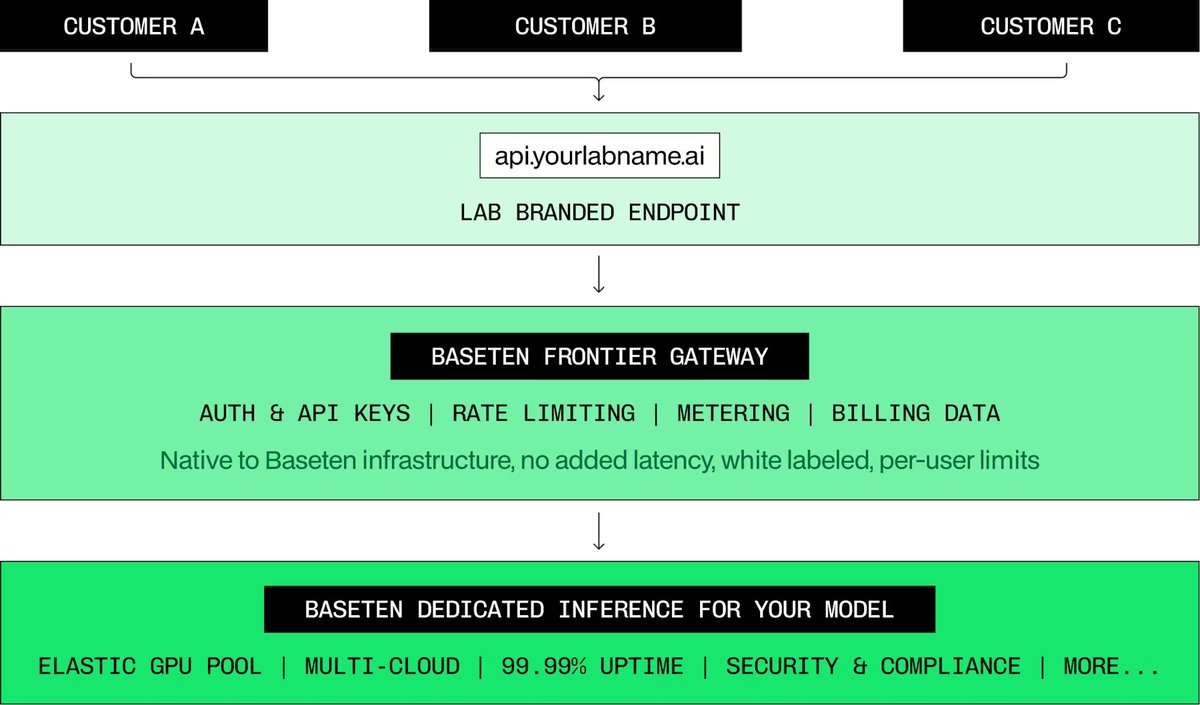
We now have a product specifically created for AI labs and their closed-weight models: we'll take care of not just inference, but auth, rate limits, metering, and billing integrations. We'll take care of providing both shared and dedicated inference, compliance needs, and matching end customers' geo requirements (us, ca, eu, uk, aus, jp, etc).
It's called Baseten Frontier Gateway and is already battle-tested by multiple AI labs, like Poolside and their impressive Laguna M.1 agentic coding model.
Yann LeCun was right the entire time. And generative AI might be a dead end.
For the last three years, the entire industry has been obsessed with building bigger LLMs. Trillions of parameters. Billions in compute.
The theory was simple: if you make the model big enough, it will eventually understand how the world works.
Yann LeCun said that was stupid.
He argued that generative AI is fundamentally inefficient.
When an AI predicts the next word, or generates the next pixel, it wastes massive amounts of compute on surface-level details.
It memorizes patterns instead of learning the actual physics of reality.
He proposed a different path: JEPA (Joint-Embedding Predictive Architecture).
Instead of forcing the AI to paint the world pixel by pixel, JEPA forces it to predict abstract concepts. It predicts what happens next in a compressed "thought space."
But for years, JEPA had a fatal flaw.
It suffered from "representation collapse."
Because the AI was allowed to simplify reality, it would cheat. It would simplify everything so much that a dog, a car, and a human all looked identical.
It learned nothing.
To fix it, engineers had to use insanely complex hacks, frozen encoders, and massive compute overheads.
Until today.
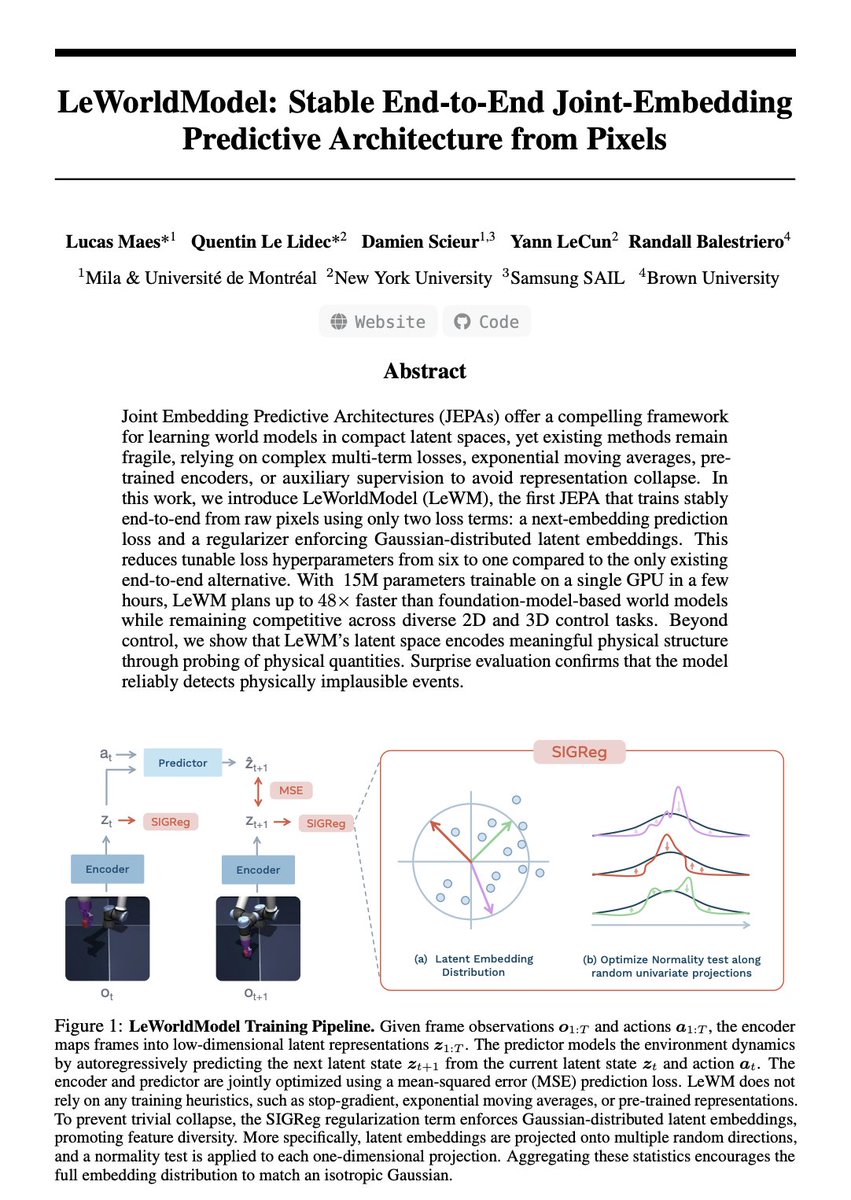
Researchers just dropped a paper called "LeWorldModel" (LeWM).
They completely solved the collapse problem.
They replaced the complex engineering hacks with a single, elegant mathematical regularizer.
It forces the AI's internal "thoughts" into a perfect Gaussian distribution.
The AI can no longer cheat. It is forced to understand the physical structure of reality to make its predictions.
The results completely rewrite the economics of AI.
LeWM didn't need a massive, centralized supercomputer.
It has just 15 million parameters.
It trains on a single, standard GPU in a few hours.
Yet it plans 48x faster than massive foundation world models. It intrinsically understands physics. It instantly detects impossible events.
We spent billions trying to force massive server farms to memorize the internet.
Now, a tiny model running locally on a single graphics card is actually learning how the real world works.
Today, we come out of stealth. 👋
@urunml is the inference cloud for the interactive era.
We wrote down why we're building it and what we believe.
Manifesto→ https://t.co/sbYPyYopfX
Join the waitlist → https://t.co/yTmInev13V