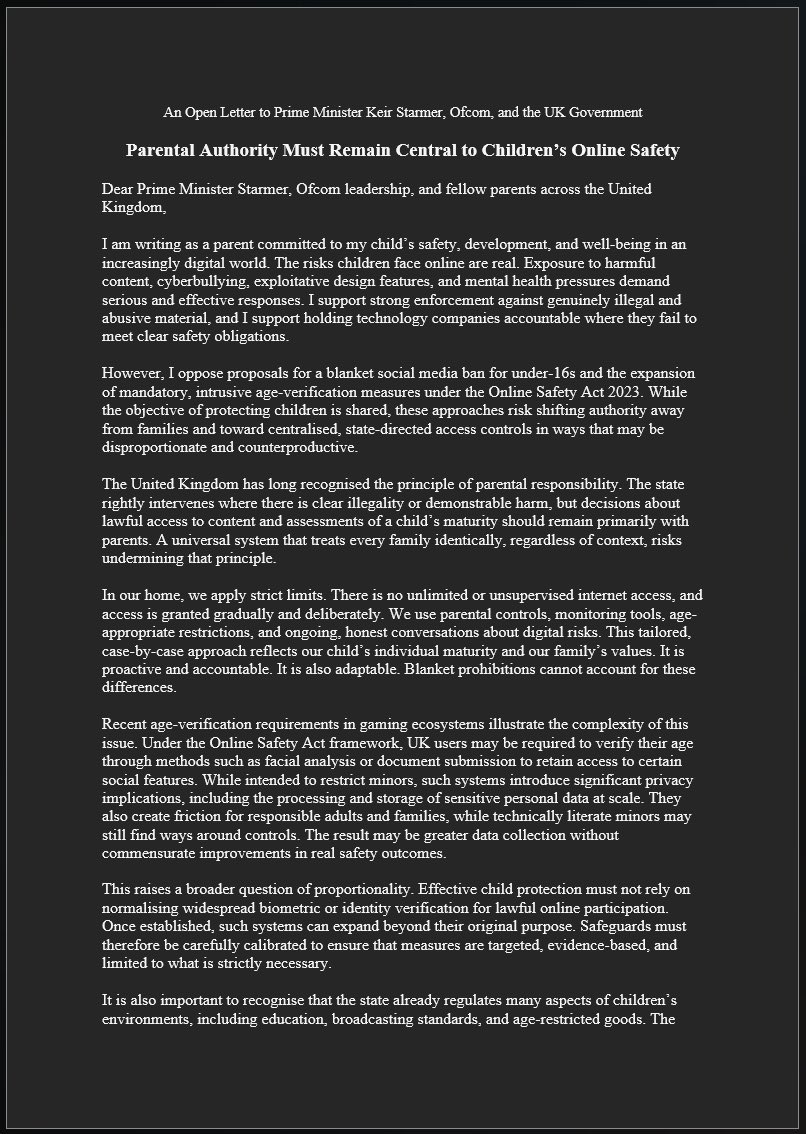
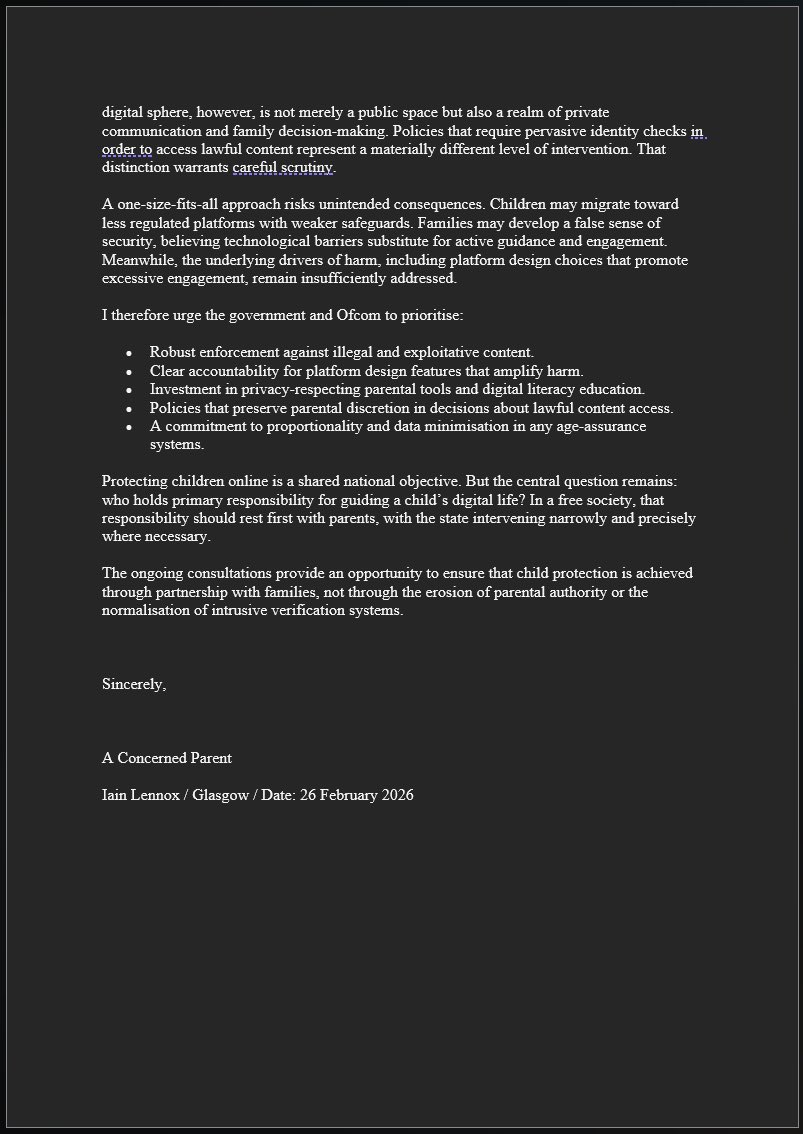
@Keir_Starmer@Ofcom@ScotGovFM An Open Letter to Prime Minister Keir Starmer, Ofcom, and the UK Government: Parental Authority Must Remain Central to Children’s Online Safety
Dear Prime Minister Starmer, Ofcom leadership, and fellow parents across the United Kingdom,
I am writing as a parent committed to my child’s safety, development, and well-being in an increasingly digital world. The risks children face online are real. Exposure to harmful content, cyberbullying, exploitative design features, and mental health pressures demand serious and effective responses. I support strong enforcement against genuinely illegal and abusive material, and I support holding technology companies accountable where they fail to meet clear safety obligations.
However, I oppose proposals for a blanket social media ban for under-16s and the expansion of mandatory, intrusive age-verification measures under the Online Safety Act 2023. While the objective of protecting children is shared, these approaches risk shifting authority away from families and toward centralised, state-directed access controls in ways that may be disproportionate and counterproductive.
The United Kingdom has long recognised the principle of parental responsibility. The state rightly intervenes where there is clear illegality or demonstrable harm, but decisions about lawful access to content and assessments of a child’s maturity should remain primarily with parents. A universal system that treats every family identically, regardless of context, risks undermining that principle.
In our home, we apply strict limits. There is no unlimited or unsupervised internet access, and access is granted gradually and deliberately. We use parental controls, monitoring tools, age-appropriate restrictions, and ongoing, honest conversations about digital risks. This tailored, case-by-case approach reflects our child’s individual maturity and our family’s values. It is proactive and accountable. It is also adaptable. Blanket prohibitions cannot account for these differences.
Recent age-verification requirements in gaming ecosystems illustrate the complexity of this issue. Under the Online Safety Act framework, UK users may be required to verify their age through methods such as facial analysis or document submission to retain access to certain social features. While intended to restrict minors, such systems introduce significant privacy implications, including the processing and storage of sensitive personal data at scale. They also create friction for responsible adults and families, while technically literate minors may still find ways around controls. The result may be greater data collection without commensurate improvements in real safety outcomes.
This raises a broader question of proportionality. Effective child protection must not rely on normalising widespread biometric or identity verification for lawful online participation. Once established, such systems can expand beyond their original purpose. Safeguards must therefore be carefully calibrated to ensure that measures are targeted, evidence-based, and limited to what is strictly necessary.
It is also important to recognise that the state already regulates many aspects of children’s environments, including education, broadcasting standards, and age-restricted goods. The digital sphere, however, is not merely a public space but also a realm of private communication and family decision-making. Policies that require pervasive identity checks in order to access lawful content represent a materially different level of intervention. That distinction warrants careful scrutiny
Cont…
Our statement on the UK government’s demand that all content on all devices sold or used in the country be scanned, on the presumption of nudity, using a dystopian combination of age verification and content scanning. This proposal will not safeguard children. It endangers us all.
https://t.co/VdWe9uhi8p
You really need to stop using the word “free” I don’t think it means what you think it does. It’s a national tragedy that so many children need schools to feed them and yet you seem to think this is something to celebrate, what is the UK government doing to address actual poverty and it’s root causes?
You really need to stop using the word “free” I don’t think it means what you think it does. It’s a national tragedy that so many children need schools to feed them and yet you seem to think this is something to celebrate, what is the UK government doing to address actual poverty and it’s root causes?
@davepl1968 1 sku with all features, free for home users and non commercial use, business pay small licence fee. No activation, honour system. Reduces lot of pointless engineering effort.