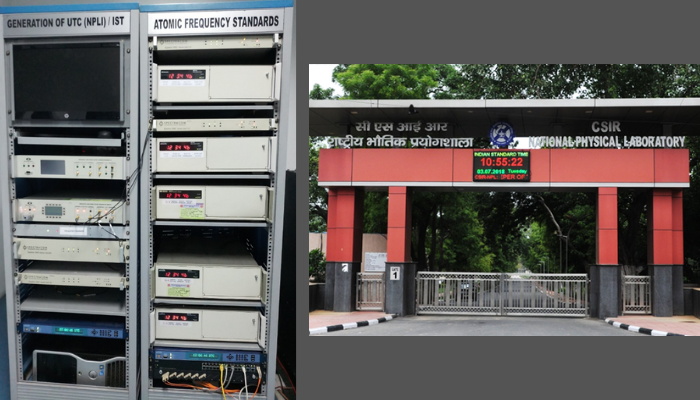
A few days back, I was reading about how Indian Standard Time (IST) is actually generated. IST is not generated by a single clock, it is a synthetic time.
The National Physical Laboratory (NPL) in New Delhi is the guardian of Indian Standard Time. NPL maintains an ensemble of 5 Cesium atomic clocks & 2 Hydrogen Masers.
These clocks are kept in a specialized, environmentally controlled vault in New Delhi. The true IST is a weighted average of all 7. If one clock drifts by even a nanosecond, the others vote it out of the calculation.
The Hydrogen Masers are the stable anchors, while the Cesium clocks provide the accuracy. This allows India to maintain a time signal that is accurate to within 20 nanoseconds of the Bureau International des Poids et Mesures (BIPM) in France.
It's a weird time. I am filled with wonder and also a profound sadness.
I spent a lot of time over the weekend writing code with Claude. And it was very clear that we will never ever write code by hand again. It doesn't make any sense to do so.
Something I was very good at is now free and abundant. I am happy...but disoriented.
At the same time, something I spent my early career building (social networks) was being created by lobster-agents. It's all a bit silly...but if you zoom out, it's kind of indistinguishable from humans on the larger internet.
So both the form and function of my early career are now produced by AI.
I am happy but also sad and confused.
If anything, this whole period is showing me what it is like to be human again.
Banks aren't really counting on deposits for their growth - they effectively create money so the amount in gross deposits is almost solely their creation. Sure, CASA will go down, but that's the nature of the business.
Banks will access money from money markets, and customers wil put short term money in money markets. (CP/CD and the like) Banks should embrace this quickly.
So the call for saying accrual income in mutual funds or insurance companies or EPF is not taxed while deposit interest is taxed - that is not really relevant. One way to sort this would be to create a proper retirement account concept - where even an FD interest would not attract tax until it's actually withdrawn from the retirement account. I've elaborated on it in a "MERA" account (a retirement account for india)
This is a combination of a bank+demat account. Any money into the bank account is untaxed (upto say 10L per year). Withdrawals are taxed as income. Money invested into fixed deposits, or bonds or stocks that sit in the demat, will pay no tax on dividends or interest (no tax on accrual).
Since the withdrawals are taxed as income (not capital gains) and there is TDS, it's only to defer taxation till you retire or withdraw and you pay tax as full income (marginal tax rates). So this will in fact raise more tax tomorrow for a smaller payout today. (On death, the money is taxed fully with TDS before it's paid to heirs)
Such an account is common in the US (401K etc), Aus, UK etc but the demat+bank combination For MERA is a super thing for India since the infrastructure is strong and has been built already.
I have spoken about it (links later). This will be a radical way to ensure that long term bank deposits get the same tax treatment as mutual funds, insurance and pension funds.
Lots of outrage about loan write-offs at banks. But this is a) part of the game because in every risk taking enterprise there will be some risk and b) loan recovery is a complex business.
When you lend to someone against, say, a car. If they default, you can repossess the car, and then sell it. You get only about 50% of the price - and the person has no other assets (say a taxi driver). What can you do?
For a 20 lakh car and a 15 lakh loan, you have probably lost Rs. 5 lakh. Now you can say that I'll recover from the taxi driver eventually - hounding the guy for every rupee he earns from any job. This will discourage him from ever working in the formal system - and even the costs for the bank, for recovery over a long period, is probably higher than the balance. So they'll try for like two years, then write-off the loan in the book, try some more say for a year, and then say it's completely gone.
The write-off is just saying that this loan is no longer an NPA. After two years, you anyhow have to provision 100% of the loan balance, so you have
NPA= 5 lakh
Provisions = 5 lakh
You write it off and you get
NPA = 0
Provisions = 0
But you can still go after the taxi driver, in theory, to recover. Any recovery is a "profit" because you had taken the losses earlier.
Now writing off and forgetting a taxi driver loan is one thing. There is no personal bankruptcy in India so if the Taxi Driver wins a lottery say 20 years later, the bank can still come and say gimme my money back. There is permanent recourse.
Companies though, get bankruptcy protection. Means: If a company bought the car and defaulted, the bank can take it to bankruptcy court. Let's say the company had only Rs. 1 lakh of assets (tables/chairs) and the car sells for 10 lakh, but the loan is 20 lakh. The bank can recover the 11 lakh but the bankruptcy court will write off the entire remaining 9 lakh. There is no further recourse. If the promoter, or the company, goes on to make lots of money, the bank cannot recover any further money.
In such a case, the bank has to write off and forget, forever. A "permanent" write-off, so to speak.
It's not useful to outrage only at write-offs, you have to understand the nature of what's written off - banks must be forced to reveal how much of the assets are permanently written off, the split of written-off loans (retail vs. corporate vs. SME etc) and the cost of recovery of any write-off separately. Eventually it might be that loan recovery is more costly in many cases than the loan itself and banks must permanently write off such loans.
I hope this helps the outrage. Oh, and farmer loan forgiveness is not a write-off for banks - it's a full recovery since the government pays. There are other nuances. But that will be for another day.
1/
Get a cup of coffee.
In this thread, I'll walk you through "Gambler's Ruin".
This is a classic exercise in probability theory.
But going beyond the math, this exercise can teach us a lot about life, business, and investing.
When Anchor said "Mughals destroyed Hindu temples"
Rajdeep Sardesai retorted "What about Buddhist temples destroyed by Hindu kings?" (at 2.05)
Dear @sardesairajdeep, I CHALLENGE you to name three Hindu kings who destroyed Buddhist temples.
Just three.
Au contraire, I can give you the names of hundreds of Hindu kings who built Buddhist establishments. From their own authentic inscriptions and records.
The film #RRR earned an Oscar.
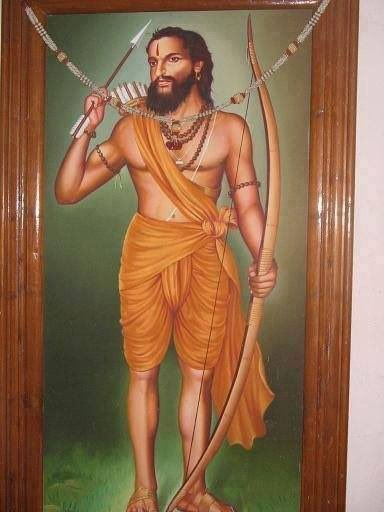
This film was inspired by a Hindu Sanyasi named Alluri Sitarama Raju.
Alluri Sitarama Raju used to travel from village to village & preach Bhagavad Gita among tribals. He urged Hindus to revolt against foreign rule.
A thread about his life🧵
I have spent the last couple of years thinking quite a bit about health. Experimenting with myself and our team, and supporting startups that are trying to help Indians make healthier choices.
A few thoughts on how and why you should focus on your health. 1/9