your agent setup needs two roles. most people ship only one.
Point REA and Opus 5.5 at a big app you own and the first instinct is one chat for all of it.
It goes fine for a while.
Then it forgets what it read early on, gives the same thing different names and starts contradicting its own notes.
More context won't fix that. Splitting the job will.
→ One controller hands out the work and never does it itself.
→ Each worker gets one small piece, finishes it and stops.
→ Every worker starts with the names the others already settled on, so the notes match.
→ Anything a worker isn't sure about comes back for a second pass, never a guess.
→ The spend is tracked as it goes, so the bill never surprises you.
A big job doesn't need a bigger chat. It needs one that only hands out the work.
save this, then read the full guide below ↓
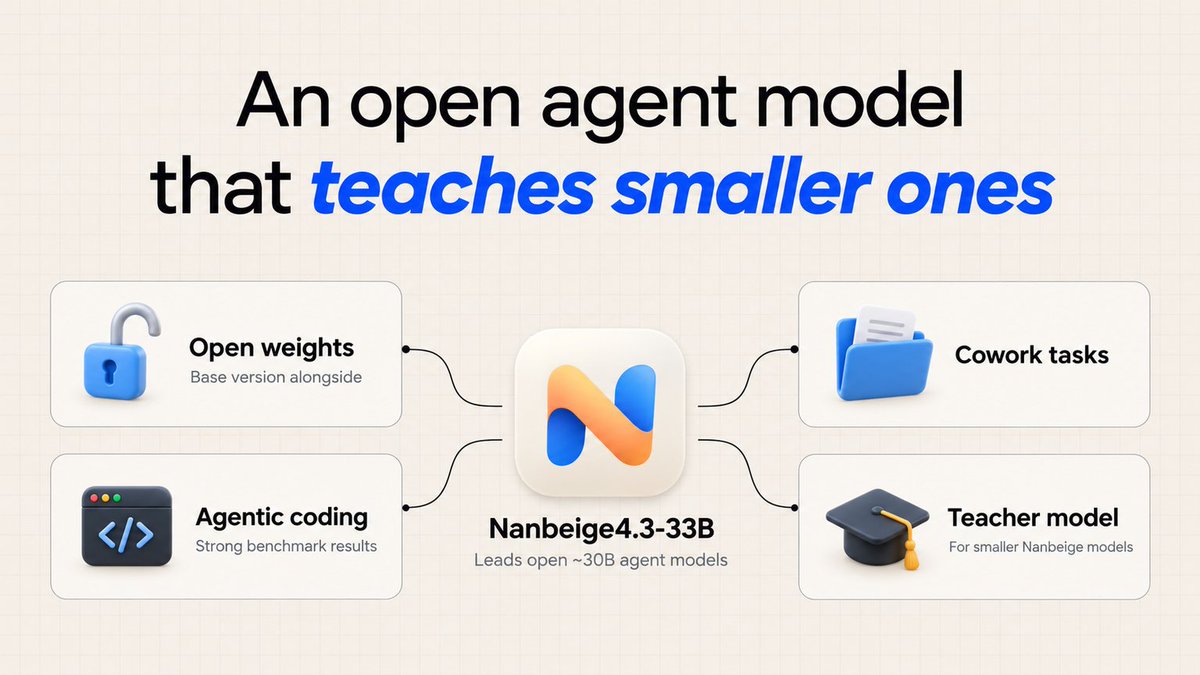
Nanbeige4.3-33B is out: an open model made for agent work, and the teacher for Nanbeige's smaller ones. here's what builders need to know:
what shipped:
> an open ~33B agent model, weights on Hugging Face, with a base version alongside.
> it leads open models around 30B parameters on agent performance, per Nanbeige.
> it posts strong results on agentic coding and cowork benchmarks.
what builders need to know:
> it runs real tasks inside mainstream agent harnesses at low inference cost: an open pick for agent loops that run all day.
> the base version ships too, a starting point if you want to train your own agent model on top.
> its first student will be Nanbeige4.3-3B, a tenth the size, built to inherit these agent skills.
the real bet is the 3B: if agent skill survives a 10x shrink, capable agents get a lot cheaper to run.
🚀Excited to announce Nanbeige4.3-33B!
To push the performance ceiling of small agents, our strategy in Nanbeige4.3 starts with building a powerful teacher first.
Nanbeige4.3-33B delivers SOTA agentic performance among open models at ~30B parameters:
* Strong results on agentic coding and cowork benchmarks.
* When integrated into mainstream agent harnesses, it tackles real-world tasks with cost-efficient inference.
* It will serve as a teacher for upcoming smaller Nanbeige models, starting with Nanbeige4.3-3B.
https://t.co/tSToQgZf2O
https://t.co/D228euvybz
#LLM #Agent
don't leave Opus 5.5 on default effort until you've seen this
Most people open an app they own, leave that dial wherever it was and get a shallow read.
Then they blame the model.
Effort is the biggest quality knob in the whole setup, and it was never meant to be one setting.
Finding your way around is cheap work. Deep thinking there just burns the bill.
The logic the whole app runs on is where deep thinking pays off.
Code written to confuse you gets even more, but on a budget per piece, never per session.
A failed pass costs about twice a good one, so stopping is part of the skill.
When the budget runs out, the call comes back to you instead of the model grinding on.
The model was never the weak part. One setting for every job was.
save this, then read the full guide below ↓
Grok Bot just shipped saved details: it can now remember who you are and how you pay. here's what it opens for builders:
what shipped:
> Grok Bot can now save three kinds of details for you: your logins, your payment cards and your contact info.
> you add each one a single time, and there is nothing to type again after that.
> the launch says the bot stores them securely and uses them on later tasks that need them.
how builders can use it:
> run your signup, login and checkout through Grok Bot, fix where it stalls, and its users finish on your product.
> save your details once and hand Grok Bot the trial signups and vendor forms you used to fill in by hand.
the sign-in and the card used to be the point where you took over from the bot. now they're part of what you hand it.
Kimi K3.1 Pro is out: an open-weight model scoring close to the top closed ones on coding and agent work. here's what builders need to know:
what shipped:
> a 2.8T-parameter model with 104B active per token, multimodal, 1M-token context, live now in Kimi Code and the API
> priced at $2 per million input tokens and $10 output, 2/3 of K3's price; the 2-3x faster Highspeed costs double
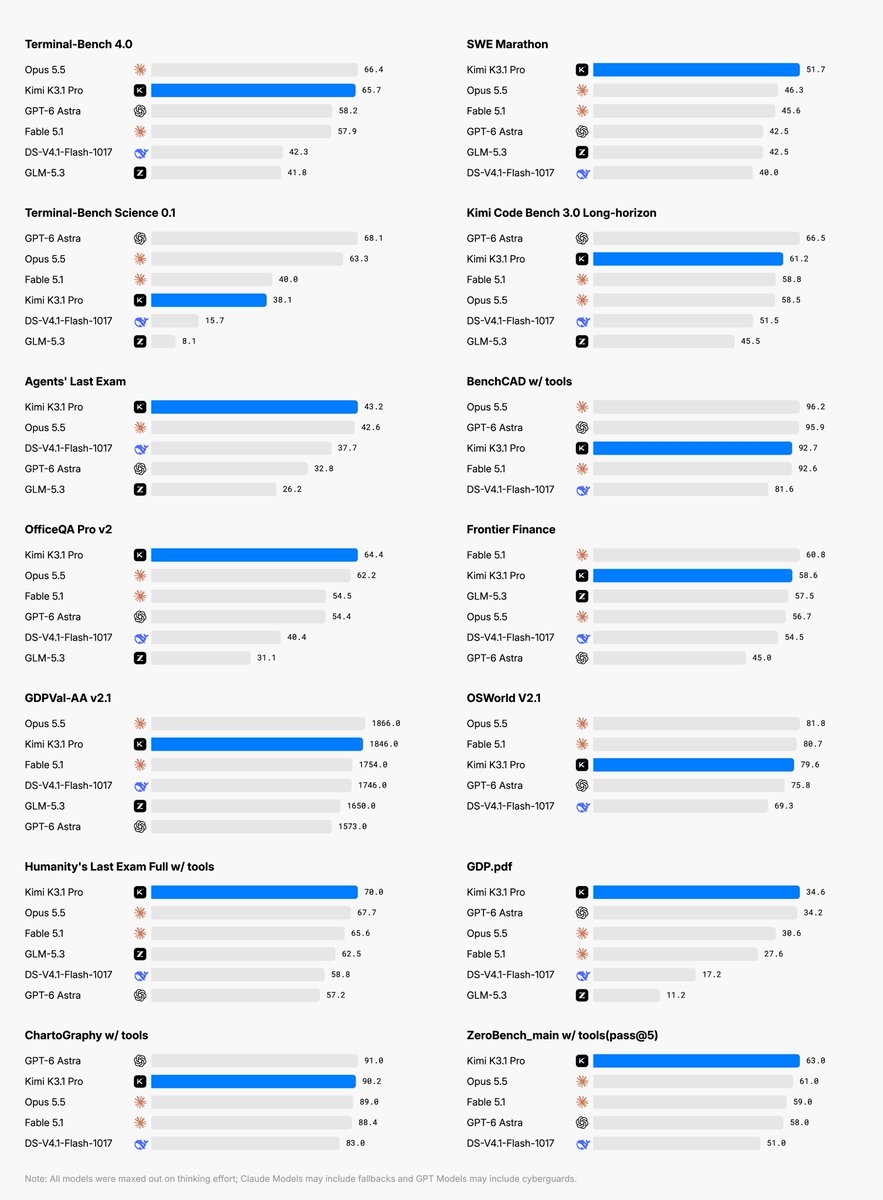
> scores 65.7% on Terminal-Bench 4.0, past GPT-6 Astra's 58.2% and just under Claude Opus 5.5's 66.4%
what builders need to know:
> a Terminal-Bench task costs about $5 vs about $14 on Opus 5.5: near-equal coding-agent runs for well under half the bill
> open weights land by Nov 4: a near-frontier coding model you can run on hardware you control, so your code stays in-house
> hallucinated claims on Kimi's internal stress test fell from K3's 23.4% to 8.3%: fewer made-up numbers in finance work
top-tier coding agents are no longer locked behind closed-model pricing.
Introducing Kimi K3.1 Pro: our most capable 3T-class open-weight model.
🔹 1M-token context, 2.8T total / 104B active params (MoE), Multimodal.
🔹 Full-project coding: games in Unreal, Unity & Godot.
🔹 Excels at parametric 3D modeling in Blender & CAD.
🔹 More reliable at finance work: Accurate modeling with hallucination down by 65%.
🔹 Matching the strongest proprietary models across coding, agentic and knowledge benchmarks.
Kimi K3.1 Pro and K3.1 Pro Highspeed (2–3× faster) are now live on https://t.co/85jA71X9gw, Kimi Work, Kimi Code, and the Kimi API.
Open weights by Nov 4, 2026.
🔗 API: https://t.co/XCrgjXAqMw
🔗 Tech blog: https://t.co/5iPP0MBej6
half a billion free tokens on GLM-5.3 and GLM-5.3-Flash: ZCode is giving them away for China's Programmer's Day.
> the split is 200M on GLM-5.3 and 300M on Flash
> free-tier users can claim too
> only 200k packs, first come, first served
> usable Oct 23 to 26, inside ZCode only, no API
got ZCode installed? update it and check before the packs run out.
why are people still paying monthly for features they could rebuild?
For years closed source meant you never knew what was inside.
Now REA reads an app you own and Opus 5.5 explains it.
That takes care of the reading.
The rebuild is where you win.
You never copy a line of the original.
You start from a plain description of what it does.
Every decision after that is yours.
Your language, your stack, choices that make sense today.
That's why a clean rebuild can beat the original in places.
It only counts with proof.
"I think it matches" is a feeling. A match rate is evidence.
The people who learn this stop renting software.
They start shipping their own.
save this, then read the full guide below ↓
Ling-3.0-flash-Sante is out: AntLing open-sourced a healthcare model built to work as an agent. here's what builders need to know:
what shipped:
> a 124B-parameter MoE that uses only 5.1B per token, weights on Hugging Face and ModelScope, API on Vercel AI Gateway
> built on Ling-3.0-flash, tuned for medical reasoning, deep research and tool calls, with 256K context
> 54.3 on HealthBench Professional: best in its size class, #2 overall in AntLing's tests, ahead of Claude Opus 4.8 at 49.4
what builders need to know:
> 80.2 on BrowseComp as a single agent, 90.5 with up to 64 sub-agents in AntLing's harness: built for multi-step research jobs
> self-hosting at full context takes four 141GB GPUs or eight H100s: it fits on one GPU server
> a research model, not a medical device: no diagnosing or prescribing alone, so it fits literature and document work with human review
if you build health agents, the model can now run on your own servers, next to the data it reads.
Today, we’re officially open-sourcing Ling-3.0-flash-Sante.
Sante is a healthcare-enhanced MoE model with 124B total parameters and only 5.1B active parameters per token, delivering leading performance among similarly sized models on professional healthcare tasks and complex medical reasoning.
Beyond answering medical questions, Sante is built for real-world healthcare research and workflows, with strengthened capabilities in deep research, multi-agent collaboration, and tool use.
The model weights are now available — we welcome researchers, developers, and healthcare practitioners to explore Sante and build with it.
More below ↓
Figma just shipped code layers: working code now lives on the shared design canvas. here's what it opens for builders:
what shipped:
> open beta from today: each code layer is a live prototype your team can play with, comment on and duplicate.
> you start from a Figma design, a live page via the Chrome extension, a coding-tool prototype via Figma MCP or a GitHub prototype repo, then prompt the Figma agent.
> it uses AI credits, but creating and editing code layers is free on paid plans through November 4.
how builders can use it:
> capture your live pages and have the agent try redesigns beside them, no Figma rebuild, prod untouched.
> stop settling for your agent's first UI idea: run versions side by side, merge the best, push it as a PR.
> pull an agent-built flow into editable frames, fix every screen by hand, send it back, no re-prompting.
if you build UI with coding agents, your code can now go into Figma, split into versions and come back as a branch.
Design & code, finally together on the canvas thanks to Code Layers
→ Turn a design layer into an interactive code layer
→ Capture what's live on your website as a code layer with Chrome Extension
→ Duplicate a code layer to explore multiple directions side by side
→ Drop your prototype into a code layer via Figma MCP
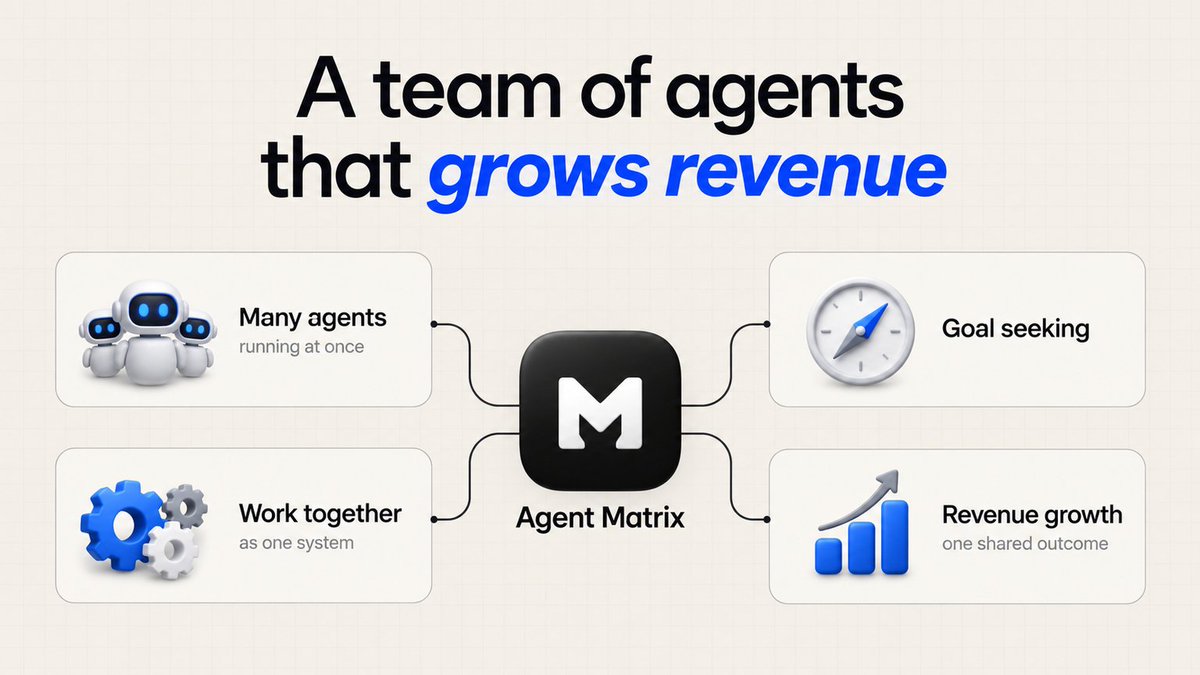
Monaco just shipped Agent Matrix: a team of agents that works to grow revenue. here's what builders need to know:
what shipped:
> the product runs many agents at once, and they work together as one system.
> each agent is goal seeking, and all of them chase one shared outcome.
> it is in early access for now: you apply to get in.
what builders need to know:
> Monaco pitches the agents as working 24/7, so the work goes on after your team logs off.
> the target is revenue itself, so whether it works shows up in a number you already track.
for anyone building agents, the bar is moving from tasks done to revenue moved.
Today Monaco is launching Agent Matrix.
Monaco unleashes countless agents working together, goal seeking, with one outcome in mind: accelerate revenue growth.
If you don’t have an army of agents working 24/7 to accelerate revenue growth, you’re living in the past.
Apply for early access now.
Grok Bot just shipped a 1Password integration: it can now sign in to your accounts for you. here's what it opens for builders:
what shipped:
> a new link between Grok Bot and your 1Password account, reaching users gradually over the next few days.
> you pick the logins you're happy to share, and the Bot uses them to sign in on its own.
> sharing is per login: the Bot gets only the ones you approve, not the rest of your 1Password.
how builders can use it:
> give the Bot the daily dashboard checks you still do by hand in tools with no API.
> approve only read-only accounts made for the Bot, and your admin logins never get shared.
> have the Bot sign in as a test user and check what your logged-in users see, no test setup to build.
work that sits behind a login can now go to the agent, and you still choose every account it touches.
Grok Bot can now use your 1Password account.
Approve the logins you want to share, and your Bot signs in for you. This new integration is rolling out to users over the next few days.
Higgsfield just shipped Content Factory: it turns an idea into a short video reel. here's what it opens for builders:
what shipped:
> Content Factory is a new tool inside Higgsfield, and it is live there today.
> there is no footage to shoot: you bring the idea, and it makes the reel from it.
> its formats run from "what if" explainers to animated hooks for the first seconds of an ad.
how builders can use it:
> pitch a product as a "what if" reel and see if anyone cares before you build it.
> make several animated hooks for one ad and keep the one that holds viewers.
> turn each release into a reel and reach people your changelog never will.
video can now sit behind every test, feature and ad a builder runs, starting from the idea alone.
Introducing Higgsfield Content Factory.
Turn any idea into a viral reel, from “What if” explainers to animated hooks for your ads.
Available now on Higgsfield.
Recursive Flint is out: an open-weight coding model built to run fast on your own hardware. here's what builders need to know:
what shipped:
> a 40B mixture-of-experts coding model that uses only 2.5B per token, weights out now on Hugging Face.
> free under Apache 2.0: run it in Ollama, LM Studio, llama.cpp, vLLM or SGLang, or try it on opencode.
> best among MoE models under 50B on agentic coding: 89.7% SWE-bench Pro v2, 54.9% Terminal-Bench 2.1, 74.2% SWE-bench Verified.
what builders need to know:
> 125+ tokens/sec on an M4 Pro MacBook Pro, 150+ on RTX Spark: a local coding agent stops being the slow option.
> rivals dense 25-40B models on coding at 5x+ their speed, and works offline with your code never leaving the machine.
> it needs more guidance than big closed models, per Recursive: give it the daily work, keep the hardest jobs on frontier models.
everyday coding agent work no longer has to run on a token bill.
Introducing Flint, @Recursive_SI’s first model: a fast local coding model built with our automated research system, the Eureka Machine.
• Best-in-class fast local coding
• Up to 2x faster than comparable models: 125+ tokens/sec on a MacBook Pro, 150+ on RTX Spark
• Built from scratch in under 4 months
Private, unmetered intelligence on your own machine. Open weights available now on @huggingface, run it locally on your favorite framework or try it for free on @opencode or @pidotdev.
Anthropic just shipped continuous scanning in Claude Security: it now re-scans your repos as new code lands. here's what it opens for builders:
what shipped:
> in public beta on Claude Enterprise; each project gets a threat model Claude writes from your code, which you can edit.
> connect your Git repos once: after a deep first scan, a finding closes when its fix ships, even one made elsewhere, and reopens if the bug returns.
> findings reach your tools via a new API and MCP connector; eligible orgs get $25K a month in credits for two months.
how builders can use it:
> let your coding agent pull open findings over MCP and fix them; nobody re-checks each fix by hand.
> route reopened findings via the API to your tracker: a returning bug is flagged at once, not months later.
> answer a big customer's security review with the threat model and fix history you already have.
your security findings become a live queue that keeps itself current and your agents can work through.
Claude Security now keeps up with your code as it changes.
Connect your repositories once. Claude runs a deep first scan, then re-scans as changes land, so findings stay close to the current state of your code.
In public beta on Claude Enterprise.
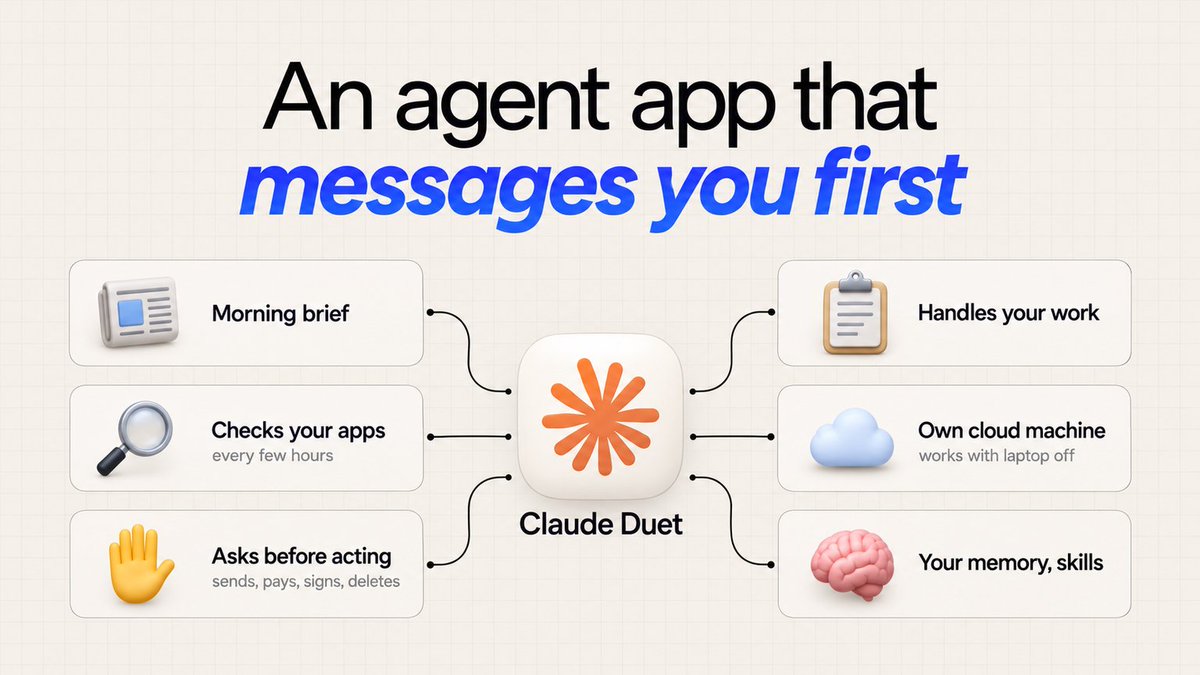
Anthropic just shipped Claude Duet: an agent app that messages you first and handles the work you hand it. here's what it opens for builders:
what shipped:
> a standalone app on iOS, Android and the web, built on Opus 5.5, in research preview by waitlist for US Pro and Max users.
> it carries over your Claude memory, skills and connectors, briefs you each morning and works on its own cloud machine with your laptop off.
> it asks before it sends, pays, signs or deletes anything, and its checks every few hours count toward your plan's usage limits.
how builders can use it:
> ship a Claude Marketplace connector, and your product lands in Duet users' morning briefs and tasks.
> have it watch your Stripe, support inbox and Slack, and catch churn or billing problems as they start.
> describe a prototype by voice on a walk, and come back to a first draft ready for review.
you stop checking your apps: the agent does, and you keep only the calls that are actually yours.
We’re opening a research preview of Claude Duet, a new app where Claude works as a proactive agent.
It comes to you with what needs your attention, completes tasks you ask of it, keeps working when you step away, and checks with you before it acts on your behalf.
Reflection AI just shipped customization recipes: its open Beam model now trains in Axolotl, TRL, NeMo, Miles and SkyRL. here's what it opens for builders:
what shipped:
> a public cookbook of complete runs for the 501B model, each with its scripts, configs, hardware and runtime
> two paths: tune Beam itself with LoRA, full fine-tuning or RL, or use it as a teacher for a small model like Gemma 4 E4B
> the cheapest start is inference-only data generation, then QLoRA on one 8x H200 node; full fine-tuning and RL take up to 8 nodes
how builders can use it:
> move your agent's tool-calling step off a big model onto a small one you serve, cheaper on every call
> build a small coding agent's training set from your own tasks, with no labeling: tests do the review
> make Beam better at any task a script can check, with a verifier instead of hand-labeled data
a model tuned to your own agent's work now starts with Beam writing the data and one node to train on.
Model customization recipes are live on our website and in the cookbook repo.
Beam is now supported across RL and SFT stacks including @axolotl_ai, NeMo RL, NeMo AutoModel, Megatron Bridge (@NVIDIAAI), Miles (@radixark), SkyRL (@NovaSkyAI), and TRL (@huggingface).
Get cooking 🧑🍳
https://t.co/gRHcqEsa0s
REA is the most useful repo on GitHub right now.
Most people never open the workflows built right into it.
They open a binary, start reading from the top and lose the weekend.
→ Start from one question you actually have instead.
→ Let the agent walk from that question to the evidence, never the other way around.
→ Keep every answer tied to the place it came from, so you can trust it or throw it out.
→ Keep a list of what is still unproven. It is worth more than the confident parts.
→ One question per session keeps the notes clean and the bill small.
A sharp question and an answer with proof attached. On software you own, that is the whole skill.
save this, then read the full guide below ↓
NVIDIA Nemotron 3.5 is out: open agent models that read text and images. here's what builders need to know:
what shipped:
> the Super VL model is live on Hugging Face, OpenRouter and NVIDIA NIM, with a 4GB Bolt version expected Oct 23
> the drop also adds Nemotron Retriever, Kumo, and open models for robots, self-driving cars, proteins and quantum computing
> all of it is open, made to be tuned on your own data and run on servers you control
what builders need to know:
> Nemotron ships with open training data and recipes, so you can tune your own domain agent, as SAP and Shopify are doing
> Nemotron Retriever covers embedding, reranking and document parsing, so your agent's whole search layer can run on models you host
> Kumo gives agents pretrained models for forecasting, fraud scoring and recommendations on tables, instead of an ML pipeline per task
an agent's model, search and predictions can now all be open and self-hosted, so your edge comes down to your data.
We’re releasing more open models to help teams across Europe build AI with their own data, on infrastructure they control.
Announced at GTC Berlin, the models help developers, researchers and enterprises build specialized AI agents, train robots, design proteins and develop quantum computers.
See what’s new: https://t.co/gXbVJfRn1b
Ampersand v0.1 is out: a model trained to help groups of people reach shared goals. here's what builders need to know:
what shipped:
> a collaborator model trained from GLM 5.3 (744B parameters) in long simulations of people working in groups
> live now through their Agents API with no waitlist, and the official OpenAI SDK works with it
> in multi-month simulated group work it drove the most goal progress of any model tested, level with Fable 5.1 overall
what builders need to know:
> on every message it decides whether to reply or stay quiet, so it can sit in a group chat and flag what others missed
> it also coordinates with other agents: 39.0% success building features together in one repo, vs 17.3% for its base model
> its weak spot is coaching: it sometimes offers guidance when people just want an answer, adding more friction than other top models
an AI teammate for group chats and shared projects is now one API key away.
No one changes the world alone
Introducing Ampersand - the first model built for us. Ampersand is a collaborator trained to help people achieve their individual and collective goals. In multi-month simulations, users collaborating with Ampersand accomplished more than with Fable and other frontier models
Available to everyone through our API