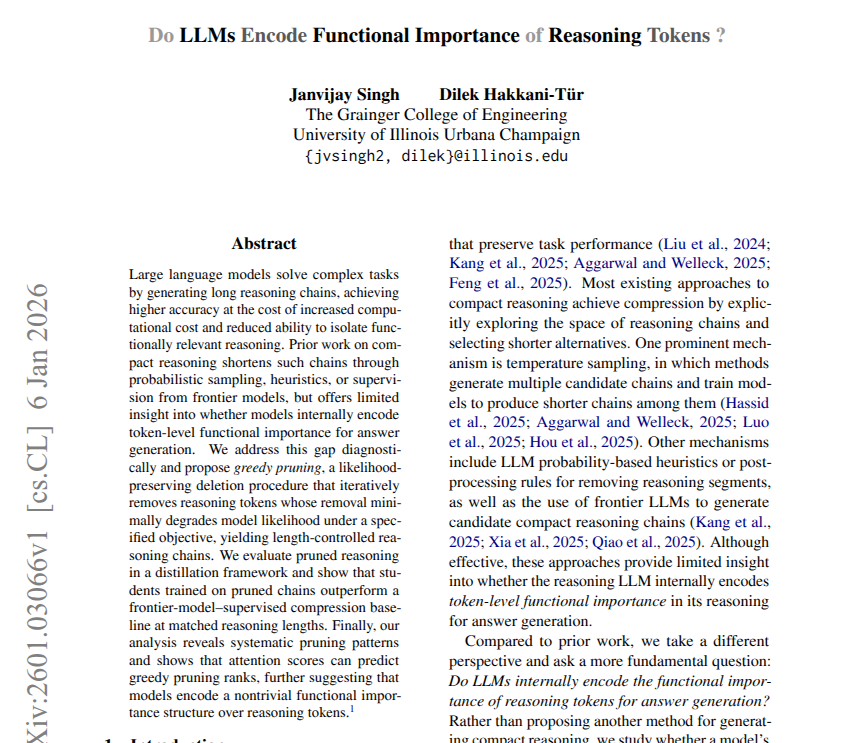
Do all reasoning tokens matter equally? We study the functional importance of reasoning tokens implicitly encoded in LLMs.
Work w/ my cool advisor @dilekhakkanitur at @convai_uiuc; to appear in ACL Main 2026. #ACL2026
Paper: https://t.co/npyfqxU5pU
Demo: https://t.co/C1jFYQ9bT3
Congrats to @PardisZahraei and @iamjanvijay for the outstanding paper award at the KnowFM Workshop (Towards Knowledgeable Foundation Models, https://t.co/yG0GDIrisQ) at ACL 2026 for the following paper: https://t.co/IjjRrpePTg
@convai_uiuc@uiuc_nlp
When a reasoning model "thinks," it backtracks, reflects, and verifies. In ReasoningFlow, we track how sentences *combine* throughout these behaviors, and reveal insights on how to evaluate and monitor these reasoning traces. Thread 👇
🔗 Paper: https://t.co/iCDEDTSZzT
@Yuchenj_UW Probably because tax-filing is a seasonal business? Slower to optimise/iterate and limited market size. Anthropic has better areas to invest in…
ACL Main
Do LLMs Encode Functional Importance of Reasoning Tokens?, by @iamjanvijay@dilekhakkanitur
We use likelihood-based greedy pruning to reveal the functional importance structure of reasoning tokens in LLMs. Functional importance from Llama-8B outperforms a GPT-4–based semantic importance baseline for compressed reasoning distillation and aligns with human intuition, e.g., preserving equations over surrounding text in math reasoning.
Watch more here: https://t.co/V20gl0gIq5
@ZhijingJin Just curious, what key features does this library add on top of existing ones? Or is it more of an aggregation of existing features? https://t.co/nDvVMEIqzV https://t.co/vWnI49htku https://t.co/uSndnXu42y
@deviparikh Just wondering if Scout is also meant for enterprises (like partnerships with media houses) or if it’s intended only for direct customers..
This paper shows a simple way to shorten LLM reasoning while keeping what decides the answer.
Attention, meaning which earlier words the model looks at, predicted pruning scores with 0.88 correlation, a very strong match.
An LLM writes by predicting the next words, so long reasoning chains are slow and pricey, and they hide which parts are actually needed for the final answer.
The authors treat each reasoning token, a tiny chunk of text, as removable, and delete the chunk that causes the smallest drop in the model’s confidence, meaning how sure it is about the answer.
If they only care about the answer, they can cut more text, and if they also care about reasoning, they keep a more coherent explanation.
They tested it by taking a stronger LLM’s solutions, pruning them, then training weaker LLMs on the shortened reasoning across multiple benchmarks.
At the same length, students trained on these pruned traces beat other pruning rules, including ones that depend on a separate stronger model to label importance.
Because it keeps the calculation bits and drops filler first, it suggests an LLM already encodes which reasoning words matter.
----
Paper Link – arxiv. org/abs/2601.03066
Paper Title: "Do LLMs Encode Functional Importance of Reasoning Tokens?"
@universeinanegg Openly appreciating the weirdness/uncertainty in ideas. Introducing right role models. Encouraging them to view grad school as training for THEIR post-school life/long-term goals. If training doesn’t align with goals, even "perceived success" might internally feel like failure..
@universeinanegg Viewing LLMs as distributions over token-seqs, it’s fascinating how training with just a few samples can alter the distribution so neatly, almost magically. Wouldn't have appreciated this until subnimal learning showed that alteration in distribution is not so neat at times..
@sumukx How about adding this line to the prompt: "Think more about this problem, as it requires your best reasoning abilities." Does it modify the native behavior of the router?
@jxmnop Nope. It’s simpler than you’d imagine; true for most top recommendation systems. More than just using a big model, they prioritize hand-crafting features, combining results from smaller models, and aggressively tracking business metrics