Albanese is holding a press conference with the PM of New Zealand. A journalist asked why New Zealand doesn't have CGT tax and the NZ PM said it would be a wrecking ball for the economy. Albanese was rattled, is rattled. Albo tried to stop him from speaking. Albanese is rattled.
What I have come to realise in reading responses to my posts, is that for Labor and many of its supporters, this budget is a bit of a moral crusade.
They see “workers” as virtuous (sweat and toil). And they have an innate suspicion of investors, who they seem to think are just rich people who got wealthy through special treatment and “handouts.”
In this frame, workers “earn” their wages. By contrast, capital income passively rains down from the heavens while the investor sits on a beach sipping martinis.
“You’re free to invest, just pay a bit more tax,” they say. But incentives are everything — if you punitively cap the upside while leaving the investor with most of the downside risk, less jobs will be created.
What frequently gets lost is that investment is not simply money appearing from nowhere. Capital comes from people who defer consumption, take risk and allocate savings to productive activities. Every business, factory, mine, software company and startup exists because somebody was willing to put capital at risk. These are the people that employ the workers.
Because this is a moral crusade, it’s hard to change people’s minds by talking about the economics of risk taking, cost of capital or real effective tax rates.
The great irony is that the fastest path for “workers” to become wealthy is to invest their savings on the side. Into productive businesses and other growth assets. These new tax rules will make it that much harder for the average worker to build wealth.
The theory underlying Chalmer's belief that investment taxation and wage taxation should align. It's called the surplus value theory and it was invented by Karl Marx. It assigns no value to the skills, knowledge, risk-taking and investment of the entrepreneur and holds that any return they get is essentially stolen from the worker.
Govt new CGT & trust tax is a brutal own-goal on Australian charities.
Albanese’s raid replaces the 50% CGT discount with CPI indexation + a punitive 30% minimum tax floor, while smashing discretionary trusts with the same 30% rate. Result? Charitable donors and family trusts who fund Salvation Army, Foodbank, St Vincent de Paul and tens of thousands of other charities get hammered 🔨. Less capital gains to give, less money to give. Donations slashed.
Classic Labor Govt: punish success, “soak the rich,” and watch the vulnerable starve while pretending it’s “fairness.”
Charities bleeding because bureaucrats can’t do basic math. Absolute policy failure. This new CGT must be stopped!
#LaborTaxRaid #CharityKiller
@Johnkehoe23
Economic Treason: Selling Australia Through Tax Policy
The economic theft hidden within the new CGT policy is not just the extra tax collected on citizens today, but that the lack of taxation on foreigners means compounding will rapidly transfer our sovereign assets into foreign hands.
In the example shown, an asset that begins 50% Australian-owned and 50% foreign-owned ends up only 17% Australian-owned after 20 years, with foreign ownership rising to 83%. No takeover bid. No invasion. Just mathematics.
Einstein called compounding the "eighth wonder of the world," emphasizing that its power is so vast it dictates whether you build wealth or pay the price. The new tax settings mean we pay a very high price indeed. We pay with our home.
You might think the starting proportion of ownership is unrealistic at 50% each. In fact it's worse than you think, as the image shows 70% of our mining productive assets are already in foreign hands. With the disincentive for retail investors to invest in small miners you can effectively kiss our major export industry goodbye, as the effective portfolio tax means only foreigners will be incentivised to invest in these small miners. The structural failures of this new tax system are immense.
Sovereignty is ultimately about control. If we progressively lose control of the farms, mines, companies and productive assets of Australians we will eventually be subservient to an overseas economic Hegemon.
Arguably in relation to mining we already are subservient, and we urgently need to pivot the tax burden to advantage compounding to our citizens relative to foreigners. And yet your government is doing the exact opposite, and accelerating this tax-based transfer to foreign hands.
A nation that systematically taxes its own citizens more heavily than competing foreign capital should not be surprised when more of its wealth, influence and economic future ends up beyond its borders.
The government's taxation policy is not just poorly conceived but brought to its inevitable conclusion it is simply economic treason.
@AngusTaylorMP@PaulineHansonOz@AlboMP@JEChalmers
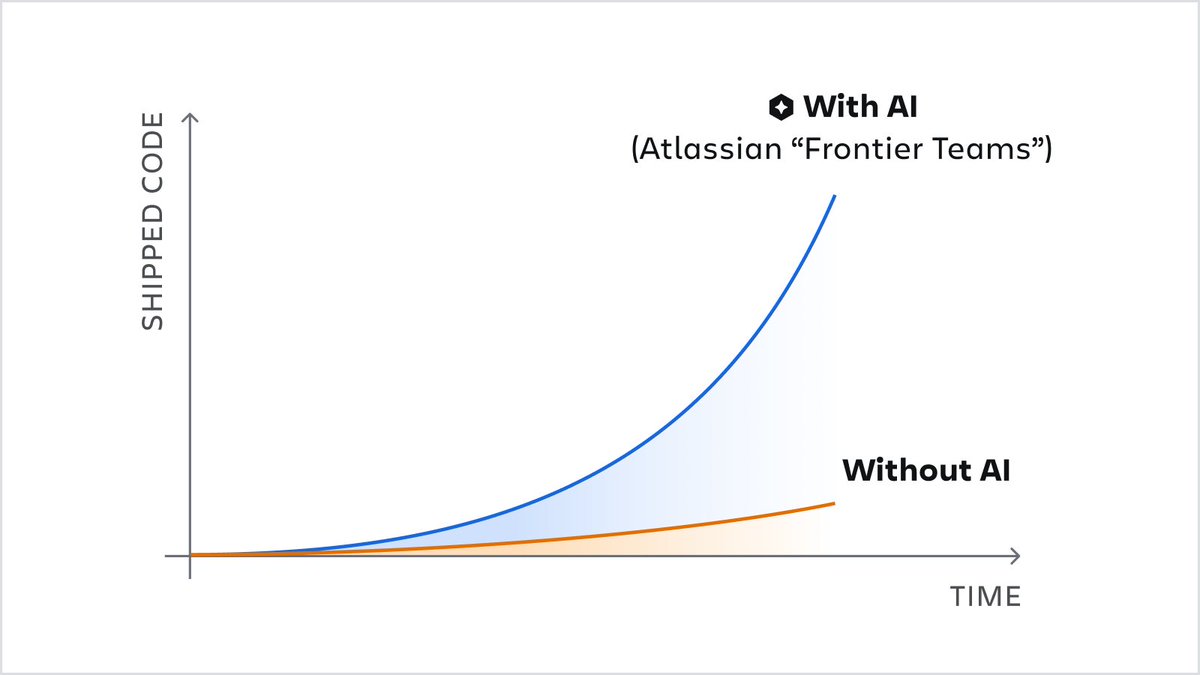
Everyone’s adopted AI but now they’re asking about the ROI. At @Atlassian, we found our fastest AI teams and studied them. They were the teams increasing speed anywhere between 2-15x. We’ve called them our frontier teams and here’s what we learned 🧵
🚨 Tax specialists have uncovered a sleeper clause in the federal budget bill designed to quietly inflate investor tax bills — and it's a rort. The bill which passed the lower house yesterday, introduces a mandatory "loss-ordering" mechanism for the first time in Australian tax history. Instead of cherry-picking how losses offset gains, investors will now be forced to burn through their oldest gains first — stripping away the 50% CGT discount and leaving newer gains fully exposed to the punishing new cost-base indexation regime from July 1, 2027.
Say you bought shares in 2018 and again in 2024. You sell both at a gain, but you also have losses to offset. Previously, you'd apply those losses to your 2018 gains first — which already qualify for the 50% CGT discount, meaning less of them are taxable anyway. Under the new rules, you're forced to do exactly that — exhausting the discounted gains first and leaving your 2024 gains fully exposed to the new, harsher indexation rules.
You end up paying more. This isn't an oversight. It's a deliberate revenue grab buried in fine print
A couple of weeks ago I wrote about a major flaw in the government's proposed capital gains tax reforms.
Using a four share portfolio, I showed how replacing the current 50% CGT discount with inflation indexation could increase the amount of tax paid by investors by ~61%. The example was deliberately simple because it helped illustrate the mechanics of the problem... but some readers reasonably questioned whether a portfolio containing one extreme winner, two mediocre performers and one complete failure was representative of how Australians actually invest in shares.
So I decided to test the CGT changes using a portfolio based on actual investor behaviour rather than relying on a hypothetical portfolio. I analysed the 20 most popular ASX shares and ETFs purchased six years ago in April 2020.
Despite analysing a completely different portfolio based on actual investor behaviour, I arrived at a similar conclusion. The proposed indexation model increased taxable gains by ~82%.
The government's stated aim is to improve fairness and encourage investment into housing. But if the practical effect is to penalise diversified investors and significantly increase tax on ordinary Australians who invest patiently over decades, the reforms risk creating distortions far greater than those they seek to address.
Policymakers should carefully consider whether a tax system that increases tax for a typical long term investor by more than 80% is really achieving its intended objective.
A related question is why any rational investor would choose to invest in direct shares at all under this regime? If successful portfolios are taxed much more heavily and unsuccessful ones receive less recognition for their losses, the after tax risk adjusted return from direct share investing becomes highly unattractive.
Full analysis is here: https://t.co/hc5vRfz4un
The Member for Fadden, @Cam_M_Caldwell, has moved that the Treasury Laws Amendment (Tax Reform No. 1) Bill 2026 and the Income Tax Rates Amendment (Tax Reform No. 1) Bill 2026 be referred to the Standing Committee on Economics for consideration.
Economists sometimes call it “Japanification” when trapped capital, ageing incumbents and weak productivity growth reinforce each other over time.
Parts of this Budget risk pushing Australia in a disturbingly similar direction.
My latest opinion piece in The Australian https://t.co/560djOrEYI
Good morning! The House is scheduled to sit at 12 noon (AEST) today.
ℹ️ See the full program here: https://t.co/XCuSqE7d2S
▶️ Watch live here: https://t.co/8DB1X3Ss2v.
Population hit 28 million this morning.
ABS estimates a person arrives in Australia every 59 seconds, twice the pace of birth rate.
https://t.co/u25QEK5qWP
Australia can avoid an US-style backlash against AI if it acts now to keep Australians safe from the harms of the new technology, Assistant Minister Andrew Charlton said as he announced that the government's AI Safety Institute is now up and running.
The independent MP says the government fails to understand business and is rushing changes to capital gains tax without consulting industry. https://t.co/AjEfAYHWqS
Ronny Chieng had one message for Harvard grads during his commencement speech: destroy AI.
"Look, a lot of other respected graduation speakers in colleges around America are talking about you guys needing to master AI for the future. I'm here to tell you the mission of your generation is to destroy AI...
"And I know, I know there's someone sitting out here right now who’s just like, 'Well, you know, what about the use of AI to pioneer breakthroughs in medicine and physics?' Well, first of all, shut up, nerd. I'm not talking about that. Obviously, if you're using it for that purpose, you're not the problem.
"I'm talking about the accumulation of cognitive debt due to excessive use of large language models according to a study by MIT published in 2025. That's right, MIT. MIT did that study. I guess you guys were too busy giving each other A's. Feel free to boo MIT, by the way, and AI, and yourselves, I guess.
"Look, this is actually good news, okay? This is why you guys shouldn't be scared of AI, because I think AI is just going to end up making mediocre people dumber. Have you heard how dumb people brag about how they use AI? They're always like, 'Hey, did you know that AI can now read my email, summarize it, and drop a response?' Yeah, you know who else can do that? Me. I can do that. You can't do that? How useless are you? You need artificial intelligence just to match me? I'm a dumb*ss who couldn't get into Harvard.
"From what I can see, getting an actual advantage from AI in the future will require a minimum escape velocity of intelligence that I'm assuming you guys from Harvard have. Everyone else who can't match that is just going to get dumber, and that's when you run up the score on them, assuming we still have a functioning society, of course.
"But to run up the score, you’re going to have to master your craft. And AI can be the fuel, but fuel is useless if you can't kindle the fire. For example, I recently used AI to use regression analysis to prove that a certain race of people are mathematically terrible at sports. I won't say which race, but thank you for not inviting Hasan Minhaj to Harvard. My point is, learning the fundamentals still matter. If I didn't know what a regression analysis was, and if I wasn't fundamentally racist, would I have been able to do any of that? No.
"Untalented people love bragging about using AI to help them draft their speeches and their scripts and their podcasts and their promo videos for UFC fights at the White House, which to be fair, even if they had filmed that for real, it would still have looked like AI. But what they're missing is this: the creating is the fun part. The best part of comedy writing is figuring out the puzzle pieces of a joke and getting the self-regard from having accomplished a difficult thing. Why would I want AI to take that away from me?
"You know what problem I want AI to solve? I want the problem of AI making everything look like sh*t. I want AI to solve that problem. How about that?
"Or how about, can AI take away the part of comedy writing where my TV pilot gets passed on and when I ask if I can pitch it to someone else, the network says, 'We don't want it, but we also don't want anyone else to have it. We just want you to be sad.' Can AI solve that?
"I recently tried to introduce my friend to Buddhism through a book called Buddhism Made Simple. It was literally a book about Buddhism made simple. And instead of reading it, he used AI to summarize it in 10 seconds. Believe it or not, he didn't reach enlightenment. It turns out speed running Buddhism is completely missing the point.
"And I know this platitude is almost worthy of AI, but the reason shortcuts to skip to the end aren't always good is because the journey isn't just how we acquire skills. The journey is the point of all this. It is! It turns out maybe the real Harvard was the friends we made along the way.
"Look, I know this won't apply to everyone's industry, but I'm just saying whatever your chosen profession is, please don't let AI rob you of the fun part of it.
"I think your generation's upcoming battle won't be humans against AI. That's at least two months away. It's going to be people with substance versus people with shallow knowledge. It’s going to be mastery versus faking it. It's going to be people with good taste versus tacky. I trust you will put in the work necessary to be on the right side of those battles."
Wales is on track to become the first country in the world to kick out politicians for deliberately lying.
This isn't about punishing accidental mistakes.
It’s not about banning personal opinions.
It’s strictly about politicians knowingly misleading the public and actually facing real consequences for doing it.
The Welsh Government has passed new legislation to roll out rules that would allow an independent process to disqualify election candidates and parliament members found guilty of intentional deception.
That could mean forced correction notices.
Official sanctions.
Suspension.
Voter recall.
And in the most serious cases, getting removed from office entirely.
Supporters believe this is a massive step toward earning back public trust in politics.
Because at the end of the day, voters can always disagree on taxes, healthcare, schools, or climate policy.
But democracy completely falls apart if politicians are allowed to look voters in the eye, lie on purpose, and walk away with zero consequences.
The idea is simple but powerful:
— If regular people can lose their jobs for lying at work...
why should the people running the country get a free pass?
In his AFR opinion piece today @profholden absolutely dismantles Treasury's "removing distortions" argument.
He also notes that both the Mirrlees Review and the Henry Review explicitly rejected the idea that capital income should be taxed at the same rate as labour income. The more economists weigh in, the clearer it becomes that these CGT changes aren't removing distortions. They're creating new ones that penalise investment, entrepreneurship and productivity growth.
https://t.co/ObtZQ1KDTa
Treasury’s CGT claims questioned by fmr OECD insider: former OECD tax policy analyst and ex-Treasury officia Leslie, who contributed to the 75-page OECD report, said that Wilkinson’s speech was a “selective and misleading” account of the OECD’s work. https://t.co/CeYFa6dkST