Karnataka health dept raids 5 star hotels in Bengaluru, over 30 teams probing hygiene standards in their kitchens & storage facilities. Officials are inspecting for adulterated, expired and banned food items. Over 20 litres of expired milk, rotten veggies etc recovered already.
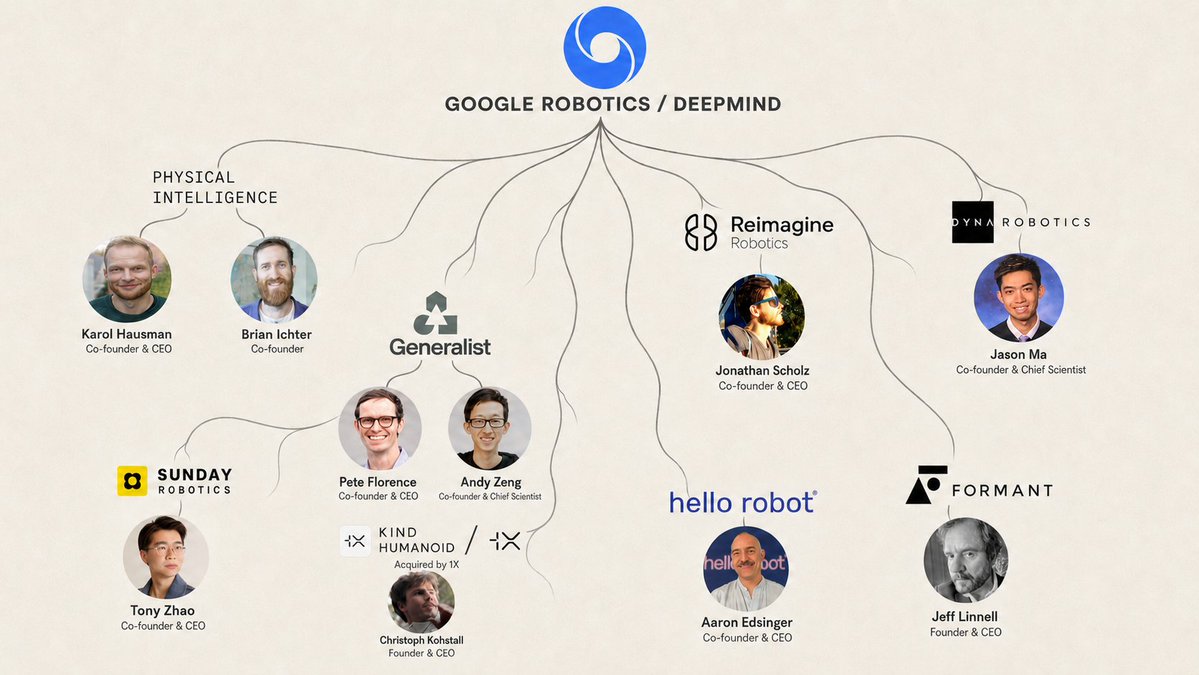
Google became robotics’ unofficial founder factory.
Startups founded by its former researchers:
🇺🇸 Physical Intelligence: CEO Karol Hausman
🇺🇸 Generalist: CEO Pete Florence
🇺🇸 Dyna Robotics: Co-founder Jason Ma
🇺🇸 Sunday Robotics: CEO Tony Zhao
Global GDP: ~$105–110 trillion.
Global Labor Compensation: Human wages and benefits account for roughly 25–30% of global GDP, coming out to ~$25 trillion to $30 trillion annually.
SpaceX has said total addressable AI market in globe is 26 trillion dollars.
Do you know where this $26T is coming from?
The total global payroll of all the workers in entire world coincidentally happens to be $25 trillion.
Figure, Tesla and 1X are racing to make robot fingertips more sensitive. What makes a fingertip sensitive is also the part that wears out the fastest. Factory work needs five million grasps. Thin-film sensors are only rated for a hundred thousand. Gel sensors fail in the thousands. A fingertip has to squash to feel anything, and elastomers never fully recover from that. Permanent set accumulates, microcracks open in the conductive filler, and the signal drifts off zero. 1X put more sensing into the skin while others are taking it out of the contact zone. Tesla also reads grip force from the tendon, so the sensor sits in the forearm where nothing touches it. In July, Queen Mary in London built a skin that changes color under pressure, read by camera. The National University of Singapore built one that turns pressure into fluid flow with no electronics. But tendon terminations and harnesses fatigue too, in the low millions of cycles. Cameras and joint sensors already handle warehouse work. Touch is the limit on delicate work, and anywhere the robot cannot see what it holds. Neura Robotics raised up to $1.4 billion. Sensetics, which does only touch, raised $1.75 million. Nobody has solved the wear problem yet. They just relocated it. Tactile sensing is the next bottleneck for robotics.
As our CFO @_balaji_km mentioned at earnings today, we’re seeing some very interesting trends on AI costs. I think it’s another signal that we’re coming to the end of the so-called ‘tokenmaxxing’ era.
Here’s what’s been happening behind the scenes.
Since the beginning of the year we’ve more than quadrupled the number of people using frontier AI tools. That’s thousands of engineers using them every single day. During that same period, our cost per token has declined.
You might expect costs to rise as adoption accelerates. We've seen the opposite. Not because we've restricted access, but because we've treated efficiency as an engineering problem rather than a budget problem. A few examples:
• Caching and reuse: We use optimizations to improve our prompt cache hit rate that reduce our input token spend.
• Better defaults and tooling: We tuned default model settings, context sizes and developer workflows so teams get the same results with fewer tokens and lower-cost inference.
• Visibility drives efficiency: We gave engineers real-time visibility into their AI usage and costs per hour.
• Experimenting with open-weight models: we continuously evaluate new models and deploy the best option for each use case.
This is the future of applied AI at enterprise scale. The next phase, whatever we call it, will not be characterized by who spends the most tokens, but about how people use them as efficiently as possible.
Credit to all the engineers at @Uber who are helping to build this future. 🚀
A dual-arm robot for under $1,700.
Nori Robotics opened pre-orders for Nori L3.
It has 20 DoF, a mobile base and open-source tools.
Deliveries are planned for fall 2026.
D1. A compact humanoid you can order today in 🇯🇵
We build the hardware, the OS, and the manipulation intelligence — in Japan.
129.3cm tall. 48cm wide. Designed for Japan's tight spaces.
Where the labor shortage is already here and the field is ready.
From ¥5M ($33K).
Physical AI is coming to San Francisco. First look at our newest hardware: mobile manipulation, teleoperation, and handheld data capture. All demo-able live, or join us virtually if you can't be there in person. Reserve a spot: https://t.co/9uWhKQdY4p
#PhysicalAI#Robotics#SF
Busy weekend! MetroPod in La Cañada this time.
No matter the yard size. No matter the terrain.
Autonomous Pod is designed to stand solid on 4-6 adjustable feet.
Three sizes to fit your yard and needs:
https://t.co/TeL9h6yg01
We set out to collect 10M hours of on-embodiment data as a starting point for robotics models, but couldn’t find a robot reliable enough at a price that made it possible. So, we built one.
Meet Pandroid: an accessible hardware platform for AI. Small enough to safely experiment with, durable enough to run in fleets. Connect it to any model or coding agent over SSH to let it interact with the world.
Join the waitlist:
Traders have to come to terms with the fact that a major part of trading is the non-stop process of building, breaking, rebuilding, rising, falling, getting back up, shaping, reshaping, learning, unlearning, relearning; rinse, repeat, etc...
It's not for everyone which is why having a mentor(s) to guide you through it is so vital.
This is why the real traders who have truly been through this arduous process tend to be humble in nature.