@tgnlnv To be fair, it is humiliating how often US navy ships malfunction or get lost. If the flag is a mark of pride, they probably dont deserve to carry one
@MathMatize Oftentimes in AI, the simplest solutions (when scaled up) work the best. Having too much math in your ML can lead to more complicated, less scalable results
@KordingLab Thinking particularly of a talk by Dr Jonathan Wolpaw about a conceptually convincing theory of motor learning. It could be a shortcut to understanding, but what proportion of negative studies is unacceptable? If not hypot-driven incremental, how do you convince funders?
@KordingLab Great blog thanks for writing. How would we evaluate simple neuro models if they’re disproved in some contexts? And how would sponsors evaluate grants based on pursuit of simple models?
2/end of thread
I hope not, opinion polls are wrong enough, but AI opinion is even worse. If you get news or analysis from AI, read more human-produced text. If you’re a commentator doing this, quit.
1/🧵
2 examples of LLMs used as neutral party arbiters of “truth” or “public opinion”. As we’ve increasingly seen journalists influenced by social media rhetorical strategies, will this be a disruptive shortcut for news networks?
Social Security keeps 18 million seniors out of poverty every year. Trump and Musk are lying about it for one reason: so they can cut, privatize & dismantle it.
We must EXPAND Social Security benefits, not cut them. And I am introducing a bill to just that.
10 kHz Spinal Cord Stimulation has encouraged research into new mechanisms of action, as 10 kHz would be low-pass filtered by neuronal membranes and cannot pace action potentials 1 pulse-per-action potential. Using bioheat models and phantoms we suggested 10 kHz (by virtue of its associated high duty cycle and inevitable joule heat) moderately heats the spinal cord, leading to temperature-based neuromodulation (a, b, c).
Now, Sergei Karnup and colleagues carefully test this hypothesis in a mouse spinal cord slice (in vitro) models. https://t.co/eKWhUPtbfb . They report temperature increases consistent with theory but not correlated to dorsal horn neuron polarization. Karnup et al conclude "during relatively short stimulation (<10min), spinal neurons are not sensitive to a byproduct of the kHz frequency electric field, such as joule heat." Notably, Karnup et al are careful to avoid the technical pitfall / artifacts of electrophysiology at 10 kHz (see also d).
Open questions:
1) Given SCS is applied continuously and clinical benefits can emerge slowly, what is the impact of *sustained* temperature increases in the spinal cord?
2) In vitro slices lack vasculature. I am interested if vascular responses (blood flow increases) in response to heating can have a therapeutic mechanism? Part of the larger theory of NeuroVascular modulation (https://t.co/Qqbk1UpEFR)
a. General principles of SCS heating https://t.co/tl0uWos59F
b. Heating by a commercial 10 kHz SCS system https://t.co/GXms7baPKR
c. Heating by (voltage controlled) High-Density SCS https://t.co/YAmDq5OpHN
d. https://t.co/0zofQEJ7CU
Understanding the nuances of quasistatic approximation (QSA) is essential for #neuromodulation modeling. Our Review on QSA in neuromodulation is out today in Journal of Neural Engineering! It outlines QSA assumptions and its distinctions from general EM
https://t.co/roCQDnW2pi
For anyone introducing students to networks of spiking neurons in #compneuro, I have a very simple LIF simulator in #Matlab that is flexible enough for almost any demo and runs in one or two lines of code. Easy to play with and has a graphic output.
Blog:
https://t.co/fzQ8d3gt6f
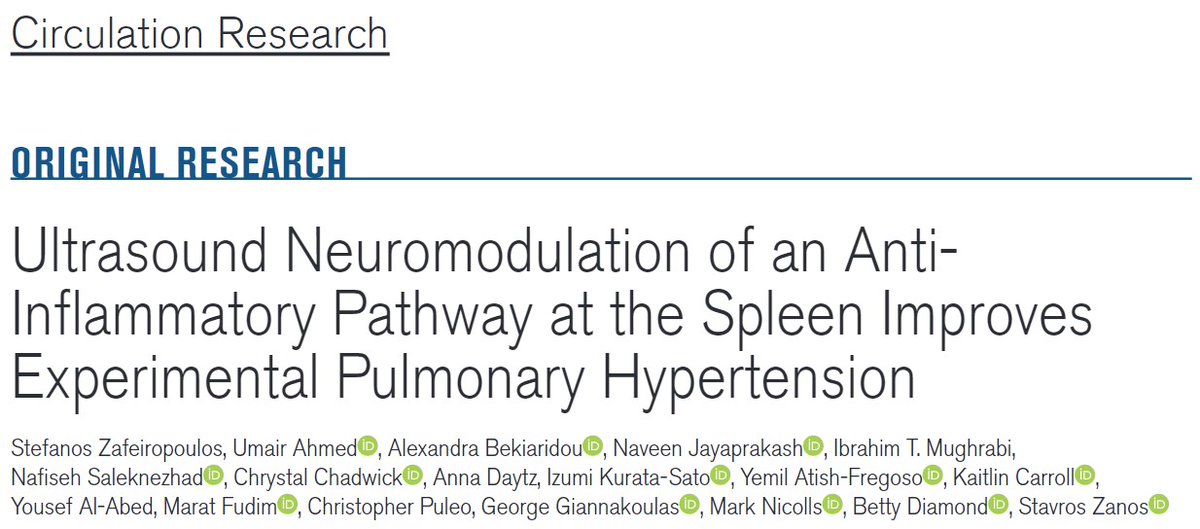
New paper out! Anti-inflammatory spleen ultrasound neuromodulation improves pulmonary hypertension, suggesting new, possibly disease-modifying, therapeutic option in pts with #PAH. Great work by @Cardiaficionado, with help from @UmairAhmedMD1@hightroponin https://t.co/p9fAtS8D1P