Many mahalos to lead author Rebecca J. Ward and the co-authors on this study @terincox@Anuinhawaii Florybeth Flores La Valle @JPhilippoff Jessica L.B. Schaefer @ianmware, the OPIHI project, and all the students and teachers that made this work possible!
https://t.co/aJKHRfwAJs
We're hiring! Tenure-track Assistant Professorship in Genetics/Genomics in the Dept of Biology at UH Hilo. Our department and university have a strong commitment to recruit and retain diverse applicants. Please share broadly.
https://t.co/wMgZAERq8M
Dr. Colin Averill recently wrote a guest piece for @mcjpod 's Climate Voices series, presenting Funga's vision for accelerating natural climate solutions by rewilding the forest microbiome. Read more at:
https://t.co/GUv7ystufz
Introducing, the ✨Funga Blog ✨. In our inaugural post, we're breaking down how we make forest + fungi = additional carbon storage. #forestmicrobiome#carboncapture#ClimateTech
https://t.co/Tv8VgwJ3pH
Soil microbiome restoration has the potential to massively accelerate natural climate solutions, while also protecting invaluable soil biodiversity resources. I take the @TEDTalks stage to present the science and vision so many in our field are building.
https://t.co/HTdH5Ex3fZ
Integrating stacked distribution models with genetically-based trait diversity of Populus angustifolia reveals how phenological variation can change differently across populations in response to climate change. @shanbay, @ianmware, @Schweitzer_JA, @UTK_EEB https://t.co/UJexXzZzdI
Great to see work led by @shanbay out in @CommsBio where we identify areas expected to lose genetically-based variation in #phenology in response to future climate change scenarios.
This work improves our ability to prioritize the conservation of future genetic climate refugia.
We found that more than 10% of genetic diversity may already be lost for many threatened and nonthreatened species, surpassing the United Nations’ post-2020 targets
https://t.co/MHNzwWchnx
Kuddos to @MExpositoAlonso and the team
Postdoc position in Rytas Vilgalys's lab at Duke on a collaborative project with @ORNL! -- Genetics of forest mycorrhiza interactions --https://t.co/iFL1FUlLpB
Check out our new paper addressing how the #phyllosphere#microbiome can enhance seeding survival while also contributing to long-term forest carbon capture and biodiversity conservation. Thanks coauthors @colinaverill , Abbey Neat, George Newcombe
https://t.co/L5WbvCWZOj
Pleased to see that our review on soil microbiomes and one health with @sbanerjee2018 is out now. Never thought I would publish in a journal with an impact factor of 78 😀 MvdH
https://t.co/6RVfubvrE0
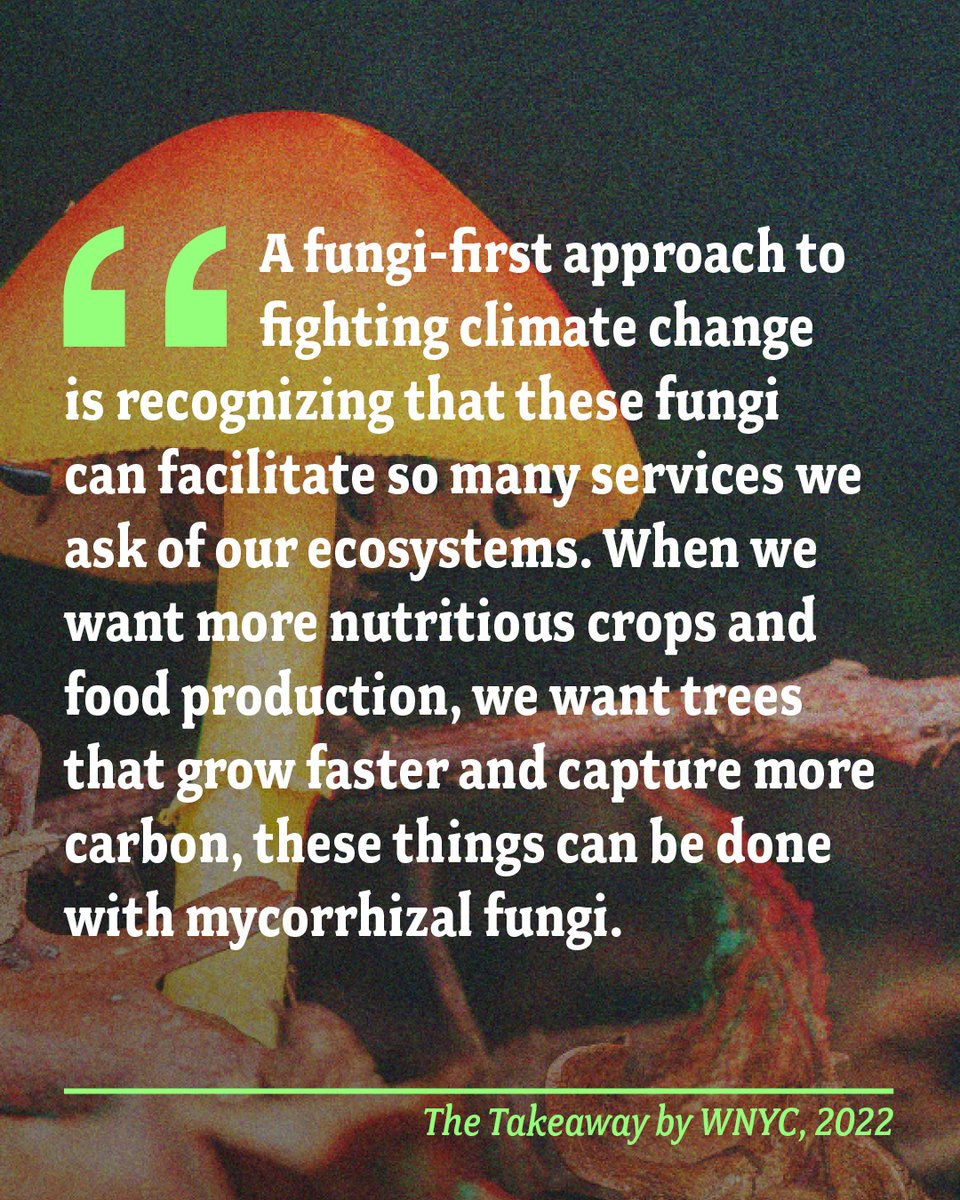
This week our founder Dr Colin Averill spoke with WNYC's The Takeaway to discuss the forest microbiome's potential to help mitigate #climatechange. Listen at: https://t.co/uslBiUFJvJ
Interested in careers beyond academia? We're searching for a data scientist with a passion for biodiversity, climate action, and connecting the fungal microbiome to the forest carbon cycle.
Apply to the open Data Scientist position @FungaPbc!
https://t.co/Bah0Oey3Cd
We’re looking forward to a dynamic and diverse applicant pool that is excited by team science. Arctic charr have a special place in my heart, as evidenced by the 20 year mark-recapture, trait, and genetics dataset we’ve collected and committed as part of this team effort.
Job alert! Interested in fungal ecology, phyllosphere microbiome assembly, plant disease? The Busby lab at Oregon State University is searching for a postdoc to contribute to a new NSF CAREER project. https://t.co/T48w9lbdp6
A major piece of our reseearch program is live today - Alternative stable states of the forest mycobiome. Here we show whether or not a tree can form a comptabile symbiosis with its neighbors can determine whether it lives or dies. 🧵🧵🧵
https://t.co/0KPKOYGBrK