This study presents a structure-based approach to improve the prediction of phytoplasma effector secretion signals, revealing unique features of their signal peptidase machinery and providing new insights into how these minimal pathogens manipulate their hosts.
Our paper is just published in Nature Communications @NatureComms !
We have engineered FoF1 ATP synthase with multiple peripheral stalks, enabling a remarkable H+/ATP beyond the highest found in naturally occurring FoF1s.
Bacteria with a twist!🚀
Our latest study on bioRxiv reveals how bacteria squeeze through super tight passages by flagellar wrapping like a screw thread! This unique motility could be the key to navigating confined spaces in nature. #Microbiology#Symbiont https://t.co/KaoftbGbmk
Rock and dust samples brought back from the near-Earth asteroid Bennu contain organic matter, including amino acids and all five DNA and RNA nucleobases, according to two papers in @NatureAstronomy and @Nature.
https://t.co/jsPwhx0GlT
https://t.co/TYF0D5O2Ly
Samples from the asteroid Bennu that our #OSIRISREx mission returned to Earth have unlocked major new clues about how life may have begun. This is one of the main reasons we study asteroids. Explore these time capsules of the solar system: https://t.co/zc9OaH9G3m 🧵
Tomohara-san (@ktomohara) 's manuscript is now published online from @NatureComms!
We created droplet-in-droplet structures through #LLPS to spatially design #cell_free transcription and translation processes in #artificial_cells
New work from our lab in @IPMBSinica
Delineating bacterial genera based on gene content analysis: a case study of the Mycoplasmatales–Entomoplasmatales clade within the class Mollicutes
In Microbial Genomics @MicrobioSoc#taxonomy#Mycoplasma
https://t.co/TZlaa4AhDD
Very proud to be associated with this work. It's a collective efforts from specialists of the field to revisit the taxonomy of the group of bacteria we have been working on for decades (talking about myself).
@Mollicutes_Lab
BREAKING NEWS
The Royal Swedish Academy of Sciences has decided to award the 2024 #NobelPrize in Chemistry with one half to David Baker “for computational protein design” and the other half jointly to Demis Hassabis and John M. Jumper “for protein structure prediction.”
The 2024 #NobelPrize laureates in chemistry Demis Hassabis and John Jumper have successfully utilised artificial intelligence to predict the structure of almost all known proteins.
In 2020, Hassabis and Jumper presented an AI model called AlphaFold2. With its help, they have been able to predict the structure of virtually all the 200 million proteins that researchers have identified. Since their breakthrough, AlphaFold2 has been used by more than two million people from 190 countries. Among a myriad of scientific applications, researchers can now better understand antibiotic resistance and create images of enzymes that can decompose plastic.
Read more about their story: https://t.co/nWxcZs6wqC
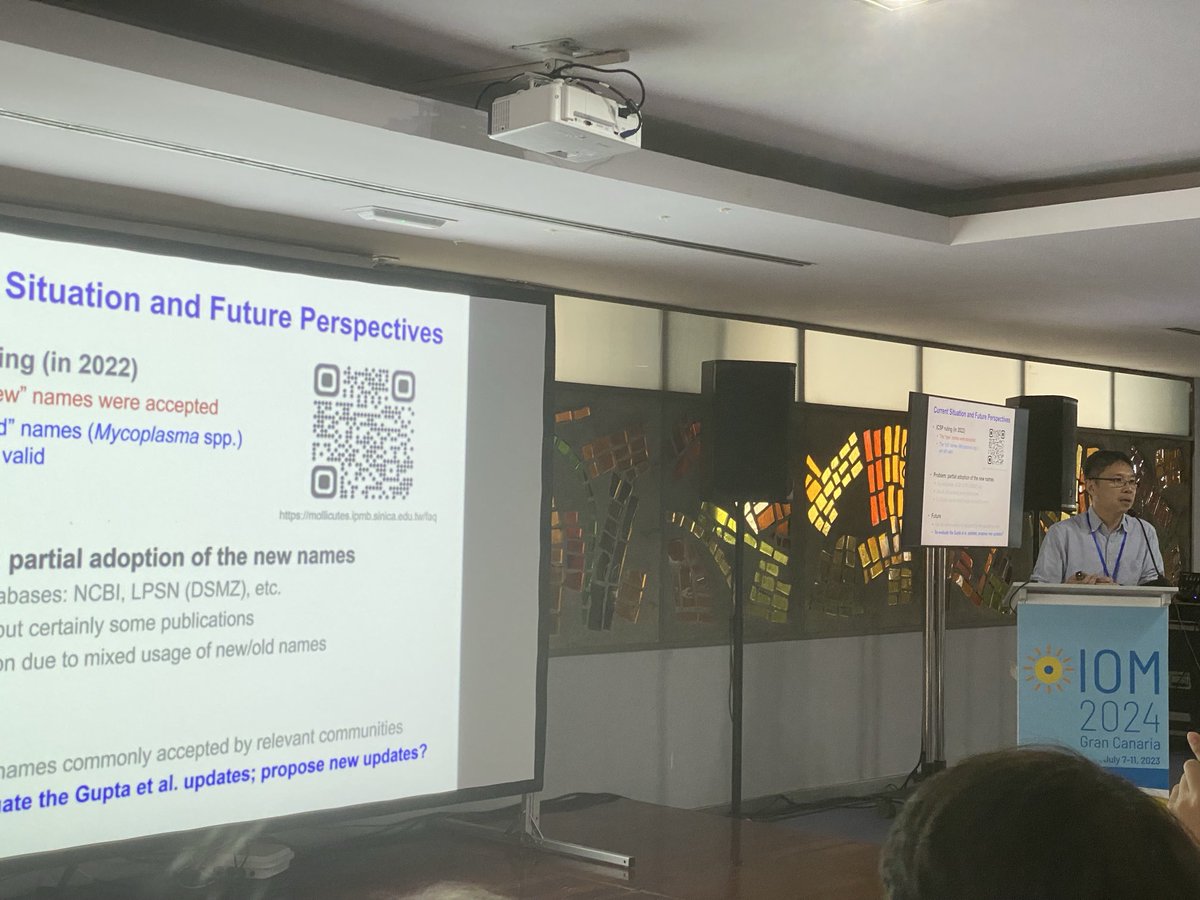
Finally... IOM 2024 Gran Canaria has ended...
Don't cry because it's over. Smile because it happened.
Next edition has been announced : IOM 2026, see you in Krakow 🇵🇱🇵🇱
It’s great to find after some decades the explanation from 3Dstructure for the unusual high specific activity of Ureaplasma urease. Beautiful work! @ONeyrolles https://t.co/SLkFMkXDUY https://t.co/zIA9QLkSQz
Soft kitty, sick kitty, little ball of pus...Glenn Browning introduces his work on the characterisation and comparison of the genomes of feline mycoplasmas