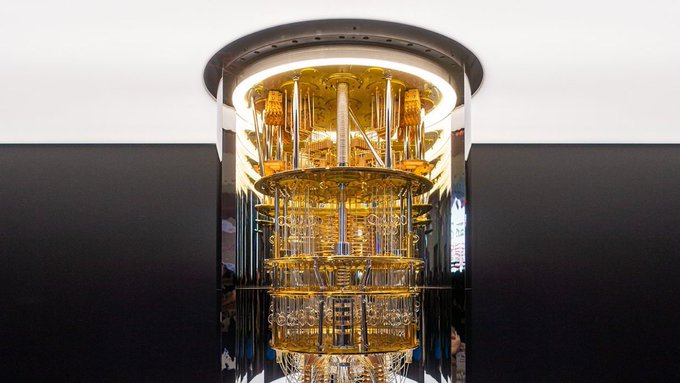
$IONQ “We leverage the flexibility of a trapped-ion quantum computer to demonstrate nine quantum error-correcting codes with starkly different qubit connectivity requirements on a single device without any hardware reconfiguration. These experiments span three families of quantum error-correcting codes: qLDPC codes, topological codes, and concatenated codes.
With a qLDPC code encoding 4 logical qubits into 18 physical qubits, we achieve a logical error rate up to
9× better than a previous demonstration of a similar code on superconducting solid-state qubits.
Moreover, our implementation exhibits breakeven performance, with some instances achieving qubit lifetimes comparable to or slightly exceeding that of our trapped-ion qubits. We use a novel implementation of the optical-metastable-ground (OMG) architecture for addressable mid-circuit measurement and reset, which enables us to perform these experiments without any ion transport or dedicated coolant ions, requirements that typically consume a large fraction of the runtime or ion count of trapped-ion quantum computers.”
Wow, congratulations to the team at $IONQ!
We’re proud to share our latest advance in fault-tolerant quantum computing using high-rate quantum low-density parity-check (qLDPC) codes, which we have found directly reduce qubit overhead.
With our trapped-ion hardware, we can demonstrate logical qubits with a high encoding rate on a single device, which requires much lower qubit overhead than other popular approaches like the surface code. This result represents substantial progress toward IonQ’s large-scale quantum architecture.
Congratulations to the team who have been working across labs on this research: Edwin Tham, Michael Goldman, Shantanu Debnath, Ashay Patel, Jyothi Saraladevi, Jason Nguyen, Erik Nielsen, Neal Pisenti, Kenneth Wright, John Gamble, and Nicolas Delfosse.
Read the paper → https://t.co/iHILkT5XiC 🔶
#IonQ #QuantumComputing #FutureOfQuantum
“As part of the U.S. Department of Energy Reactor Pilot Program, Antares Nuclear’s advanced reactor design, the Mark-0, successfully completed a zero-power fueled criticality demonstration at DOE's Idaho National Laboratory”
$OKLO is next.
IEA data center electricity demand is set to rise from ~290 TWh today to ~1,200 TWh by 2035, a ~4x increase, with AI-optimized servers driving the majority of incremental load.
The investable implication: power generation, grid infrastructure, and cooling become the binding constraint on AI buildout, not chips. We view this as the early innings of a multi-decade #electrification capex cycle.
⚡ International Energy Agency
Honeywell’s $QNT IPO is reportedly 20x oversubscribed.
Quantinuum is seeking up to $1.46B at a $14B valuation in what could be the largest quantum IPO to date.
Quantum is taking a major step forward. ⚛️
IBM announced that they are investing $10 billion USD in quantum computing over the next five years, spanning R&D, capital expenditure, manufacturing scale, ecosystem partnerships, and M&A. The goal is to accelerate IBM’s quantum roadmap and strengthen quantum leadership anchored in the United States.
Discover more here → https://t.co/hv6TifsjpT
$IONQ “Microsoft today unveiled Majorana 2, its newest topological quantum chip featuring a next-generation materials stack and qubits that are 1,000 times more reliable than their predecessors.
With this progress, the team now expects to achieve a scalable quantum computer by 2029, cutting its original timeline in half.
By applying recent advances in agentic AI specially designed to speed the scientific process and accelerate collaboration, Microsoft’s quantum team is overcoming key barriers in reliability, speed and size that have limited the application of quantum computing to real-life scenarios.”
Wow.
Announced today at #MSBuild: Microsoft unveiled Majorana 2, a next-generation topological quantum chip developed with the help of Microsoft Discovery’s agentic AI. https://t.co/esVcmeWdgh
$OKLO latest short interest data as of 5/15/2026:
- Short Percent of Float: 24.86%
- Current Short Interest: 35.1M shares
- Previous Short Interest: 28.75M shares
- Change vs. Previous Month: 22.04%
- Dollar Volume Sold Short: $2.18B
- Short Interest Ratio: 2.6 Days to Cover
$OKLO latest short interest data as of 4/15:
- Short Percent of Float: 20.32%
- Current Short Interest: 28.6M shares
- Previous Short Interest: 24.1M shares
- Change vs. Previous Month: -18.54%
- Dollar Volume Sold Short: $1.81B
- Short Interest Ratio: 3 Days to Cover
$IONQ latest short interest data as of 5/15/2026:
- Short Percent of Float: 20.71%
- Current Short Interest: 73.3M shares
- Previous Short Interest: 83.7M shares
- Change vs. Previous Month: -12.47%
- Dollar Volume Sold Short: $3.81B
- Short Interest Ratio: 2.0 Days to Cover
$IONQ latest short interest data as of 4/15:
- Short Percent of Float: 24.18%
- Current Short Interest: 84M shares
- Previous Short Interest: 80.9M shares
- Change vs. Previous Month: -3.82%
- Dollar Volume Sold Short: $3.63B
- Short Interest Ratio: 2.8 Days to Cover
Honored to be part of @LDNTechWeek's Quantum Showcase with esteemed researchers and founders in the global quantum ecosystem.
At #LTW26, our CEO @NiccoloDeMasi and President of Quantum Computing Chris Ballance will share insights on how the UK can strengthen its position in quantum to stay competitive on the global stage.
#LTW #LondonTechWeek #IonQ
$IONQ
Quantinuum’s demand was so strong they had to raise the price range and add more shares.
It’d be interesting to see how the market will move on Thursday.
HONEYWELL BACKED QUANTINUUM $QNT JUST UPSIZED ITS IPO TO AS MUCH AS $1.46 BILLION
Demand was so strong they had to raise the price range and add more shares.
Here's everything you need to know:
THE DEAL:
- 26.5 million shares at $53 to $55 each
- Up from 21 million shares at $45 to $50 previously
- Implied market cap at top of range: $14.3 billion
- IPO orders came in at a double-digit multiple of shares available
THE COMPANY:
- Backed by Honeywell $HON
- Quantum computers capable of solving problems beyond traditional processors
- Platforms for chemistry, machine learning, cybersecurity, finance, and drug discovery
- Set to receive $100 million from the Trump administration's $2 billion quantum computing initiative in exchange for a government stake
THE TIMING:
- Pricing Wednesday after market close
- Trading begins Thursday on Nasdaq under $QNT
$IONQ $IBM $GOOG $HON $QBTS $MSFT $AMZN $XNDU $INFQ $RGTI $HQ
The quantum era won't be won by whoever builds the best qubit. It'll be won by whoever owns the entire stack — and almost no one is analyzing the race that way. So I built the analysis that does. "The Quantum Full Stack: Defining the Quantum Tech Era" evaluates the four leading vendors across hardware, cloud, software, fault-tolerance, and networking — every score reproducible, no vendor reviewing a single line.
Why does this matter? Simple: whoever controls the full stack position will control the chess board. And with the quantum tech market maturing faster than expected, this might be critically important to both operators and investors. 120+ pages of primary-sourced analysis on the question the field has been getting wrong. This is the framework the next phase will be measured against.
Read the report: https://t.co/de0iSTqm7i
Our CEO @NiccoloDeMasi at the Reagan National Economic Forum on the impact of quantum technology across industries; where it dovetails with classical computing, GPUs and AI; how a century of the computing revolution has been leading to this point; and what it means for the world.
#IonQ #QuantumIsNow #RNEF @ReaganInstitute@RonaldReagan
President Trump is unleashing the American Nuclear Renaissance—aiming to have multiple nuclear reactors critical by July 4th on our nation's 250th anniversary.
@SecretaryWright: “This summer you will see multiple next generation nuclear reactors running...America is back!"
$IONQ “In a striking demonstration of the method's capabilities, the AI independently rediscovered the textbook circuit for the Quantum Fourier Transform, a fundamental building block of many quantum algorithms, without being told what the solution should look like. This demonstrates the promising use of AI across the quantum computing stack.”
AI is unlocking breakthroughs in quantum computing.
🤝 We collaborated with the University of Innsbruck to tackle a core challenge in building useful quantum supercomputers: automatically designing efficient quantum circuits.
Using NVIDIA CUDA-Q, we built a multimodal diffusion model to synthesize quantum circuits from scratch, optimizing circuit structure and gate parameters simultaneously to produce shorter, lower-error circuits.
💡 The standout result: the AI model independently rediscovered the Quantum Fourier Transform — without being told what the solution should look like.
🔗 Learn more: https://t.co/y0nh9i7Tiu