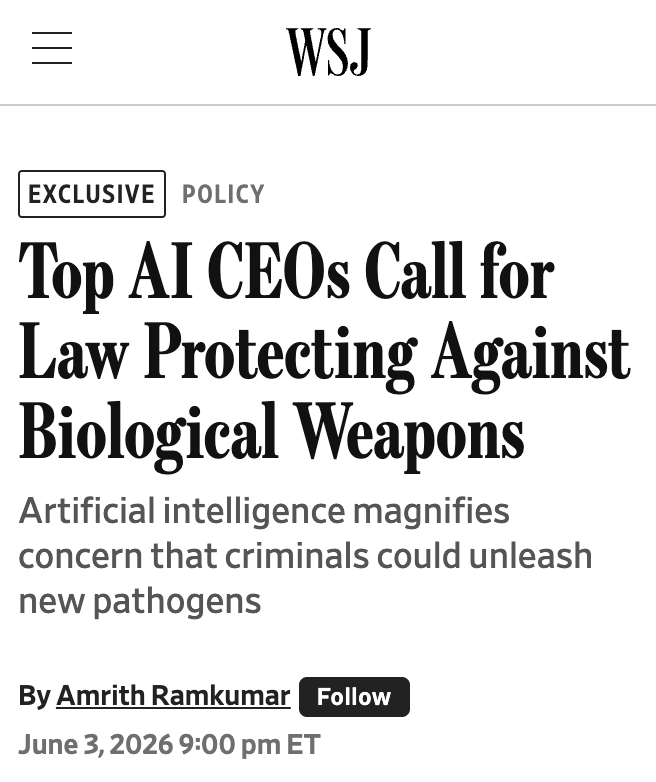
No one should be able to order a bioweapon through the mail.
@IFP & @JoinFAI are proud to co-lead an open letter calling for mandatory DNA synthesis screening & recordkeeping.
Signatories include:
- Sam Altman, CEO & Co-Founder, OpenAI
- Dario Amodei, CEO & Co-Founder, Anthropic
- David Baker, Director, Institute for Protein Design; 2024 Nobel Prize in Chemistry recipient
- Patrick Collison, CEO & Co-Founder, Stripe
- Paul Graham, Founder, Y Combinator
- Demis Hassabis, CEO, Google DeepMind; 2024 Nobel Prize in Chemistry recipient
- Emily Leproust, CEO & Co-Founder, Twist Bioscience
- Lawrence Lessig, Roy L. Furman Professor of Law and Leadership, Harvard Law School
- Gerald W. Parker, former Special Assistant to the President for Biosecurity and Pandemic Response
- Mustafa Suleyman, CEO, Microsoft AI
- Alex Tabarrok, Professor of Economics, George Mason University
- Alexandr Wang, Chief AI Officer, Meta; Founder, Scale AI
- Christine E. Wormuth, President & CEO, Nuclear Threat Initiative; 25th Secretary of the Army
Read the letter and see the full list of signatories: https://t.co/BwZiJXw3JT
Many DNA synthesis companies voluntarily screen orders to mitigate biosecurity risks, but no law requires them to do so.
Leaders in AI, biotech, life sciences, national security, and the nucleic acid synthesis industry agree that Congress should act to strengthen safeguards against biological threats.
@deanwball put it well in the WSJ:
“If you’re synthesizing the stuff that yields biological life and viruses, we’re asking you to screen to see whether it is dangerous in some way. That seems like a reasonable thing for society to insist upon.”
It’s SO cool to see our maps and graphs get the @WorksInProgMag treatment! Thank you to @bswud, @salonium, @pietergaricano, and everyone else who helped our piece get to publication!
There are some projects that can only succeed if they can last through changes in admin. Both parties rely on continuity.
"For science, where projects often span several years, facing a risk of cancellation every time there's a change in administration would be damaging."
The proposed OMB rule “Regulation for Federal Financial Assistance” is a big deal. I’ve seen lots of focus on the role of political appointees in selecting grants, but less on a massively important part of the rule: the expansion of the government’s ability to terminate in-process grants (i.e., “termination for convenience”).
For science, where projects often span several years, facing a risk of cancellation every time there's a change in administration would be damaging.
I wrote about this in December: what was happening in terms of grant cancellations (even before the proposed rule), the harm uncertainty causes, what we risk if this becomes a norm, and ideas for how to avoid tit-for-tat political terminations. https://t.co/uqKk8bZ5HO
Great article by Zigmund Forrest & Maxwell Tabarrok on how environmental regulations have shut down an important channel for growth in cities: land reclamation
Half the land area of Boston, a quarter of NYC, and 15% of San Francisco were raised from the sea before 1970.
Since then, land values have grown by 30x but land reclamation has ground to a halt.
This failure follows the spread environmental law around the world rather than any geographic, technological, or economic constraint.
Thus, our lack of land reclamation and the severe land constraints in our most important cities are self-imposed and avoidable. We should make more land!
https://t.co/J9zghvLkz2
Land reclamation was common practice in American cities in the 19th and 20th centuries. Seattle, Chicago, Boston, Charleston, San Francisco, New York, Philadelphia, Norfolk, DC, Oakland, and LA all had major land reclamation projects that extended residential living space or infrastructure or both.
The Bay Area alone reclaimed an area of land equivalent to ten Manhattans between 1850 and 1957, at an inflation-adjusted cost of $330,000 per acre. Today, an acre of single-family-zoned land in San Francisco County averages $24 million. Even if the cost of land reclamation grew faster than inflation, despite technological leaps in dredging and construction technology, there should be plenty of room for profitable arbitrage.
And yet, land reclamation is extinct in the Bay Area as well as in every other American city. This isn’t because we ran out of good spots to reclaim: Two thirds of the San Francisco Bay is shallower than Boston’s Back Bay was when it was reclaimed in the 1860s. Nor is it because of better transportation: We’ve used up all of the easy suburban expansions enabled by the train and the automobile so prices are rising even in outlying suburbs.
Instead, land reclamation’s death is due to environmental law. Evidence for this claim shows up in the coincident timing of land reclamation’s demise across dozens of cities in the US and in the environmental compliance process of the few reclamation projects still inching along today, but the best evidence is found internationally.
No country has more experience or more reason to reclaim land than the Netherlands. The Dutch built 5% of their country out of the sea over the first half of the 20th century and by 1975 they had another artificial lake in the Zuiderzee ready to drain at the flip of a switch, which would have made tens of thousands of acres of land just east of Amsterdam. But a 1969 environmental review law, similar to NEPA in the US, stopped the project before it was finished and the site is now a protected bird sanctuary. Their one major reclamation since, the Maasvlakte 2 extension of the port of Rotterdam, took 11 years and 6,000 pages of environmental review before construction began.
Inversely, countries without these laws, like China, Singapore, and Japan have continued major land reclamation projects into the 21st century. China has reclaimed over 5,000 square kilometers since 2000, including a city of half a million outside Shanghai and Singapore has grown by a quarter since 1975.
Every major American city has a land shortage. But we have more than enough shallow water, dredging capacity, and market incentive to make more land, just like we did 150 years ago. The only obstacle is our own choice to make making land illegal. The benefits of more land in our most productive cities are large enough to justify the effort of reforming the laws that currently prevent it. Let’s make more land!
This week on Construction Physics, a piece I wrote for IFP's Transit Abundance Playbook: US Subways Build Too Many Cross Passages.
https://t.co/YBOa67yeym
We have a national housing crisis.
Congress just passed the biggest federal housing reform bill in a generation by overwhelming bipartisan margins.
Refusing to sign this bill is an embarrassing own goal.
Take a look here for more details- eight out of nine of the best pro-supply reforms from the House and Senate made it in to the final package! https://t.co/Pjrj4eUexB
This is the first national housing supply package to pass in my lifetime. Members and staff did an incredible job getting to yes on a combined bill includes more than either chamber passed on its own.
Among ROAD to Housing's over 40 provisions:
1. It removes the onerous steel chassis requirement from manufactured housing.
2. It preserves new build-to-rent housing supply for renters.
3. It exempts infill housing from environmental review.
4. It penalizes expensive communities that don't build and rewards communities that allow more homes, putting federal spending on the side of pro-housing policy.
5. It provides technical assistance for communities seeking to reform their zoning and land use regulations.
6. It authorizes resources for housing preservation, funding repairs for low-income homeowners and small landlords.
7. It includes rental assistance, disaster recovery, and public housing reforms.
There are too many good things in here to count, and too many people to thank.
This bill is a start, there's still lots to do, most of the action is at the state/local level, implementation matters, etc etc etc
BUT
It's genuinely remarkable that Congress is passing this basket of wonky housing policies. Kudos to everyone involved. It's time to build.
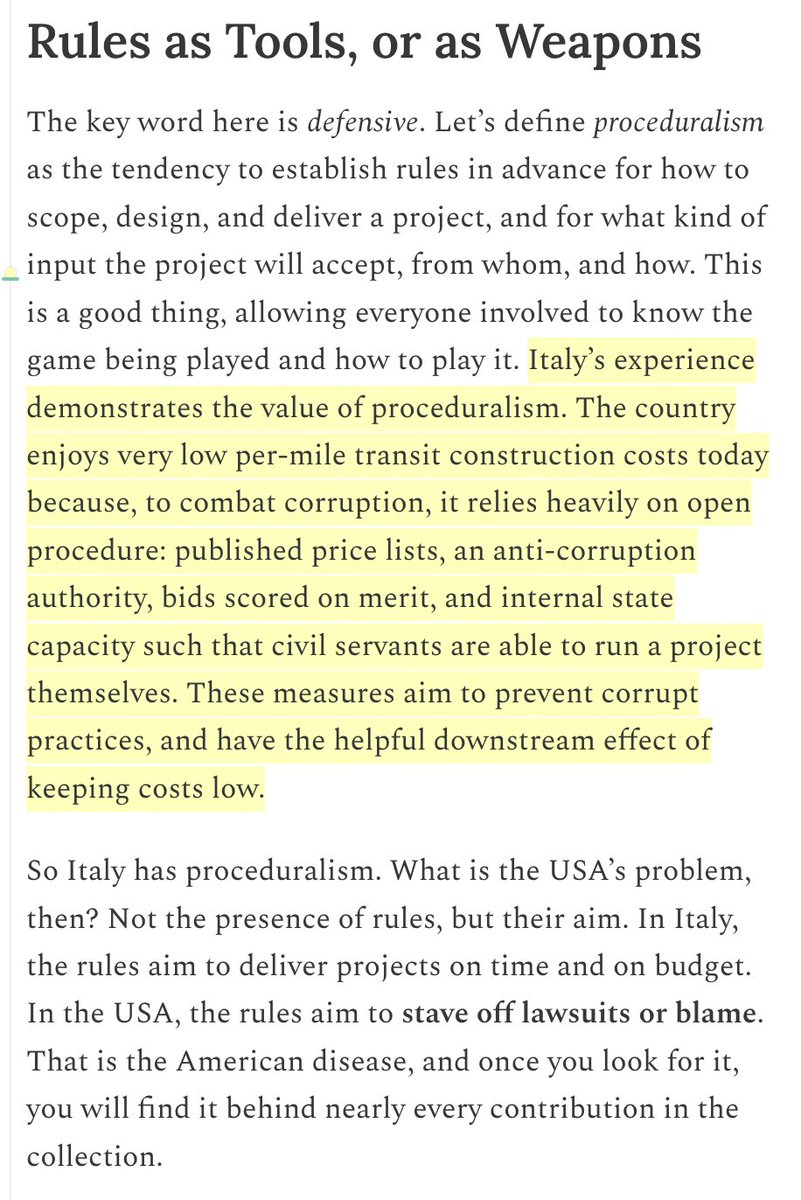
Important point from @AndrewMillerYYZ:
"Proceduralism" isn't per se bad.
Proceduralism can help keep costs low & fight corruption. But defensive proceduralism intended to curb lawsuits is pathological and leads to higher costs.