Our heavily updated final version of ROCKET for experiment-guided structure modeling is out in @naturemethods!
New frontiers like high-throughput fragment screening and mid-res tomography are forcing a rethink of how experiments are modeled. ROCKET+OpenFold proposes a solution👇
PXDesign is now Open-Source (Apache 2.0)!
SOTA hit rates. Efficient binder generation.
🔹 Updated Wet-lab data: up to 82% SR
🔹 Positive feedback from Web Server users
🔗 Code: https://t.co/rSa5GsaEit
🔗 Server: https://t.co/bIpzPiha8v
#ProteinDesign#OpenSource#GenerativeAI
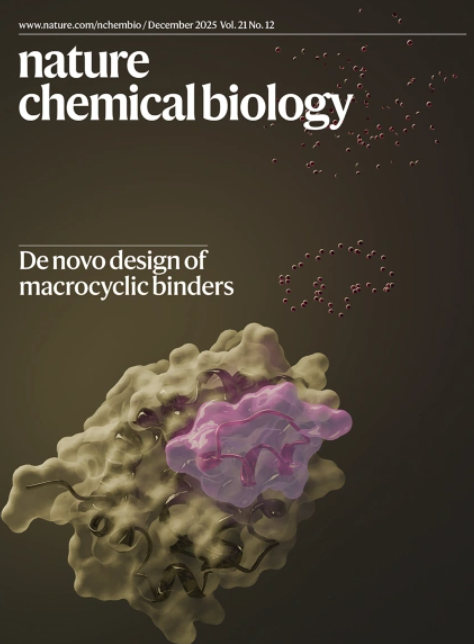
Our December issue is live!
https://t.co/c5TML265lN
The cover depicts a diffusion-based generative deep learning pipeline for de novo design of a macrocyclic peptide targeting the protein, myeloid cell leukemia 1
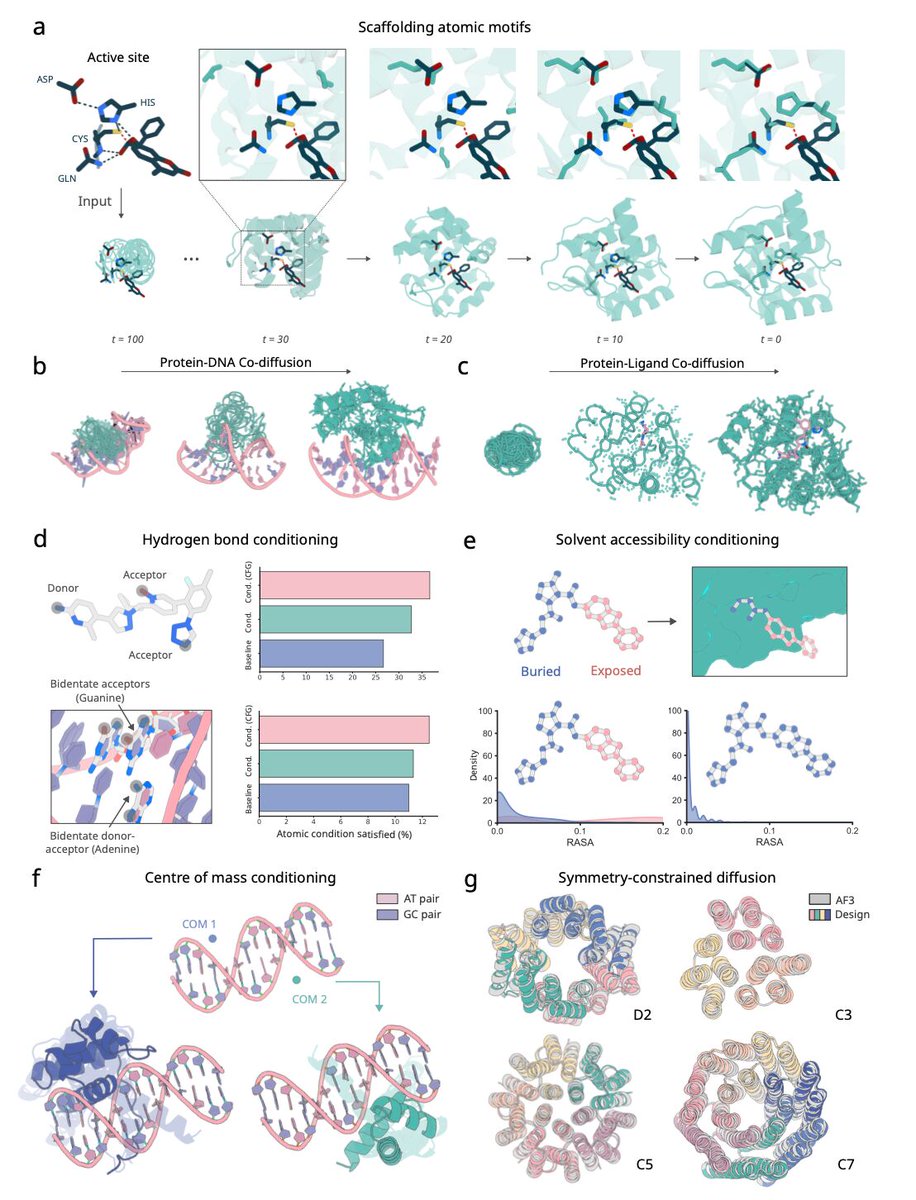
RFdiffusion3 now available! De novo protein design against any molecule
Try it on @tamarindbio today
RF3 shows success in designing de novo proteins against all-atom targets, including proteins, DNA and small molecules with diverse applications.
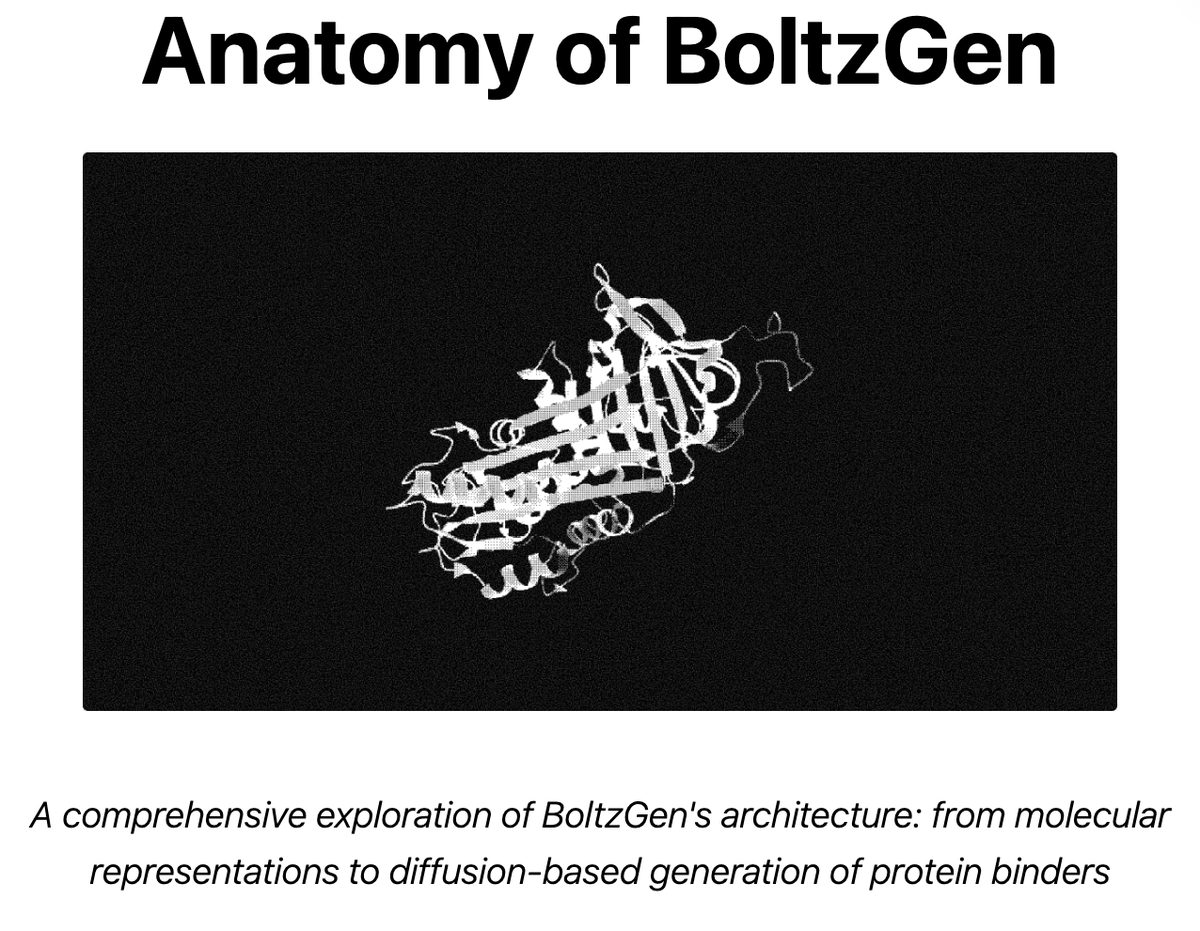
incredibly detailed technical blog just dropped on the anatomy of BoltzGen 🧬
made for ML people, but covering everything from molecular representations to diffusion-based generation of protein binders
+ crazy good interactive visuals
👏👏 @ludocomito
Fantastic work by Michael Plainer and friends. Energy-based diffusion models to ensure that the denoising distribution equals exp(-u(x)), with the energy u(x). A keystone for connecting molecular dynamics, statistical mechanics and generative AI.
BoltzGen: New generalized binder design protocol, with wet lab validation on diverse targets! (From Boltz team+collaborators)
On @tamarindbio right now!
The authors test only 15 nanobody designs against each of 9 targets. These targets are selected for their high dissimilarity from any protein with an existing bound structure. With 6 of the 9 finding nanomolar binders. This 67% success rate holds for protein designs.
Thrilled to finally see BoltzGen, our new state-of-the-art all-atom binder design model, coming out fully open-source after a very extensive experimental validation with many top academic and industry labs! 🧬
The diversity of the experiments is unprecedented, spanning binder modalities from nanobodies to disulfide-bonded peptides and including targets ranging from disordered proteins to small molecules. These experiments demonstrate state-of-the-art performance, for example, a 67% success rate at designing nanomolar nanobody binders against several novel targets with only 15 or fewer designs. 🚀
Incredible work from an amazing team led by @HannesStaerk! 🤗
Researchers have discovered a mechanism that keeps the physiologically important Wnt signaling pathway from becoming overly active, which can occur during the initiation and metastasis of various types of #cancer. @SciSignal https://t.co/EuD7y2C0LC
A Foundation Chemical Language Model for Comprehensive Fragment-Based Drug Discovery
1. FragAtlas-62M is a groundbreaking chemical language model specifically designed for fragment-based drug discovery. It is trained on the largest fragment dataset to date, comprising over 62 million molecules from the ZINC-22 database. This model achieves an impressive 99.90% chemical validity in generated fragments, making it a powerful tool for medicinal chemistry.
2. The model not only maintains a high coverage of known ZINC fragments (53.55%) but also generates 22.04% novel structures with practical relevance. This balance between rediscovery and novelty is crucial for fragment-based drug discovery, as it ensures both the reliability of known fragments and the potential for new discoveries.
3. FragAtlas-62M is built on a GPT-2 architecture with 42.7M parameters. It uses a 128-token context window and is trained using HuggingFace Transformers. The model's architecture and training methodology are optimized for fragment-level SMILES modeling, ensuring efficient and high-throughput generation capabilities.
4. The model's performance is validated across 12 molecular descriptors and three fingerprint methods. The generated fragments closely match the training distribution, with all effect sizes being less than 0.4. This indicates that the model generalizes well and maintains the key properties of the training set without systematic bias.
5. FragAtlas-62M demonstrates substantial overlap in chemotype space between novel and rediscovered molecules, as shown by t-SNE visualizations and distance analysis. The distance ratios (NR/NN and NR/RR) are consistently near 1.0 across all three fingerprint types, indicating minimal distributional shifts.
6. The model is released with training code, preprocessed data, documentation, and model weights, making it accessible for further research and practical applications. This open release lowers the barrier to entry for groups with modest computational resources and encourages rapid follow-up work and experimental validation.
7. While FragAtlas-62M is a significant advancement, it has limitations. It does not explicitly model stereochemistry, geometric relationships, or fragment-to-fragment connectivity rules. Future work should focus on integrating conditional controls, structural information, and methods for automated molecule construction to broaden its practical applications.
📜Paper: https://t.co/psbsES6aCP
#FragAtlas62M #ChemicalLanguageModel #FragmentBasedDrugDiscovery #MedicinalChemistry #AIinDrugDiscovery #OpenSource #Research
µProtein framework: Deep learning + RL for smarter protein engineering
Engineering proteins with new or improved functions could transform medicine, agriculture, and biotechnology. The challenge is that the space of possible mutations is astronomically large, and experiments can only probe a tiny fraction of it. While high-throughput methods like deep mutational scanning help, they mainly cover single mutations, leaving the vast landscape of combined mutations unexplored. This is where computational methods and AI step in.
In a new work, Haoran Sun and coauthors introduce µProtein, a framework that combines two components: µFormer, a deep learning model that predicts how mutations affect protein function, and µSearch, a reinforcement learning algorithm that uses µFormer’s predictions to navigate the mutational landscape efficiently. Together, they enable the discovery of multi-mutation protein variants with improved properties, starting only from single-mutation data. The team applied µProtein to optimize the enzyme TEM-1 β-lactamase against the antibiotic cefotaxime, identifying novel multi-mutant variants with activities surpassing all previously known ones.
This work demonstrates how combining machine learning with experimental biology can accelerate protein engineering. By efficiently searching through enormous mutational spaces, µProtein opens new opportunities for enzyme optimization, antibody design, and anticipating drug-resistance mutations. It provides a strong step toward a future where AI not only interprets protein data but also guides the creation of new biological functions.
Paper: https://t.co/nYkB9nZ6LQ
MIT Course announcement: Machine Learning for Computational Biology #MLCB25
Fall'24 Lecture Videos: https://t.co/tA3zeuIF7g
Fall'24 Lecture Notes: https://t.co/C3WmXZuQur
(a) Genomes: Statistical genomics, gene regulation, genome language models, chromatin structure, 3D genome topology, epigenomics, regulatory networks.
(b) Proteins: Protein language models, structure and folding, protein design, cryo-EM, AlphaFold2, transformers, multimodal joint representation learning.
(c) Therapeutics: Chemical landscapes, small-molecule representation, docking, structure-function embeddings, agentic drug discovery, disease circuitry, and target identification.
(d) Patients: Electronic health records, medical genomics, genetic variation, comparative genomics, evolutionary evidence, patient latent representation, AI-driven systems biology.
Foundations and frontiers of computational biology, combining theory with practice. Generative AI, foundation models, machine learning, algorithm design, influential problems and techniques, analysis of large-scale biological datasets, applications to human disease and drug discovery.
First Lecture: Thu Sept 4 at 1pm in 32-144
With: Prof. Manolis Kellis @manoliskellis, Prof. Eric Alm @ejalm, TAs: Ananth Shyamal, Shitong Luo @luost26
Course website: https://t.co/ateGr6xKLM
@MIT@MITEECS@MITdeptofBE@MITCSBPhD@MIT_CSAIL@Harvard@HarvardMed@BroadInstitute
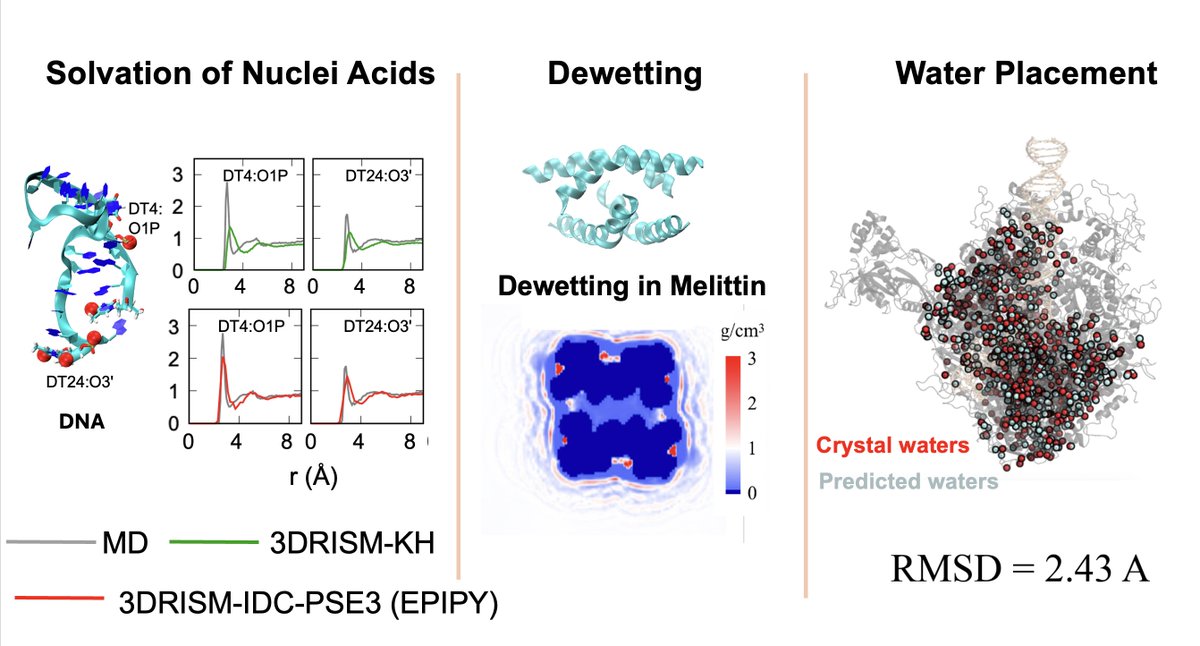
Check out our new Python package, EPIPY!
It streamlines 3DRISM calculations—great for studying RNA/DNA solvation, predicting dewetting, and placing water molecules, etc.
Github: https://t.co/f6xVVbPWPH
Preprint: https://t.co/BL1wqX5JxD
Congs to @p_swanson123@SiqinCao!
Accelerating Protein Design by Scaling Experimental Characterization
🚀 New preprint from David Baker!🚀
1. This preprint introduces a novel workflow called Semi-Automated Protein Production (SAPP) that significantly accelerates the experimental validation of de novo protein designs. SAPP enables rapid, modular, and cost-effective protein production and characterization, allowing for the purification and analysis of hundreds of protein designs per day.
2. The SAPP protocol leverages a standardized cloning approach and optimized purification pipeline to achieve at least a tenfold increase in throughput compared to traditional methods. It reduces the total hands-on time to just 6 hours for end-to-end execution, making it highly efficient for large-scale protein design campaigns.
3. A key innovation is the use of a background-suppressing cassette in the cloning process, which eliminates the need for colony isolation and sequencing, thus bypassing traditional multi-day cloning protocols. This approach ensures that the correct clone is the dominant construct in most cases, with a clonal purity of over 90% in many instances.
4. The authors also developed a scalable demultiplexing protocol (DMX) to further reduce costs. DMX converts DNA oligo pools into sequence-verified clonal constructs, enabling the purification and characterization of over 1000 designs at a cost of $5 per construct. This protocol integrates seamlessly with SAPP and is particularly useful for large design campaigns.
5. The SAPP and DMX protocols have been successfully applied to characterize tens of thousands of de novo designed proteins, including mini-protein binders, enzymes, and large protein assemblies. These workflows are designed to be widely adoptable, making large-scale experimental testing more accessible and affordable.
6. The integration of these protocols with computational protein design methods is expected to drive the development of new protein design models informed by experimental data. This could also enable active learning approaches, where experimental feedback is used to iteratively improve protein designs.
💻Code: https://t.co/GItaUdeJSf
📜Paper: https://t.co/vPmE99ZQ6m
#ProteinDesign #ExperimentalValidation #SAPP #DMX #ComputationalBiology #HighThroughput #CostEffective #ActiveLearning
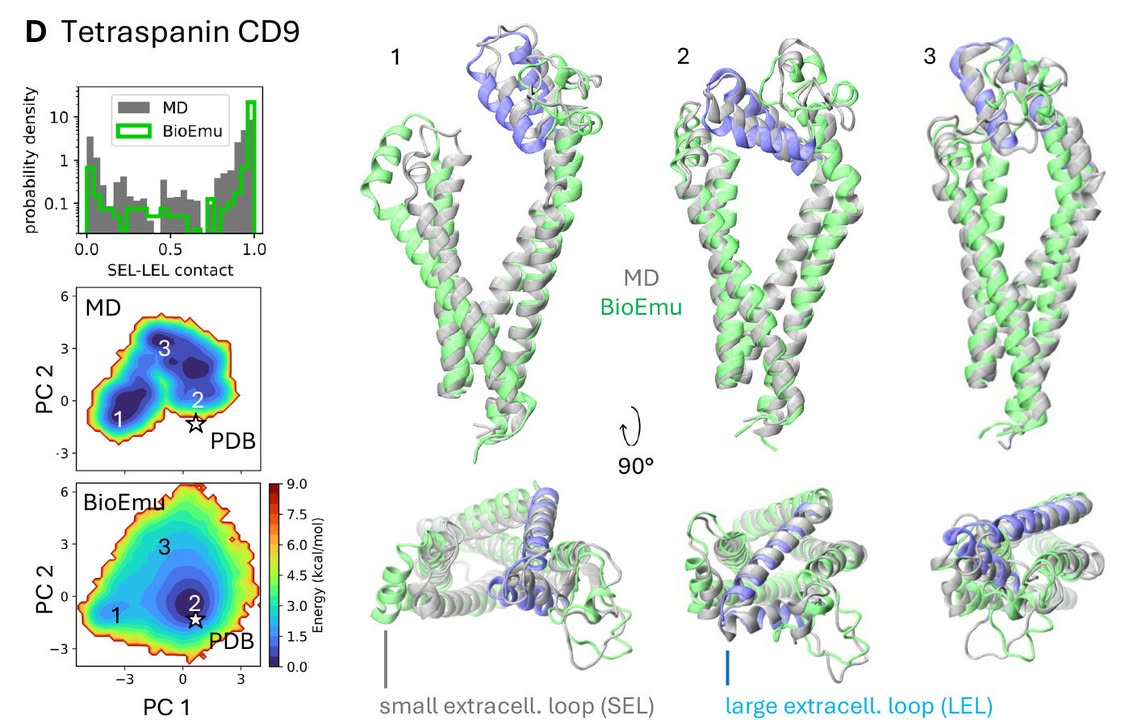
In Science, researchers present BioEmu—a new #AI model that rapidly and accurately predicts the full range of shapes a protein can adopt, offering a faster, cheaper alternative to traditional molecular simulations.
Learn more: https://t.co/5bSsSmIXX5