AI economics is the new baseline skill
Knowing how to use AI is now foundational, basic. That part is assumed. I expect this knowledge from my teams, not for bonuses or badges, but as a baseline for real.
What is the next best skill that separates the "baseline" from "above average"?
Understanding the economics behind it. The dollar amount behind every Enter key hit on your laptop. It hurts, it burns, it costs you or your company real money. You have to understand it.
Cost per token. Latency vs quality tradeoffs. When to use a frontier model and when a smaller one gets you 90% of the result at 5% of the cost.
Don't load your fancy Word or PDF file into the context - you're wasting tokens. Ask the model to convert to Markdown before processing, or better yet, convert using a simple script wrapped in a skill.
With the next generation of VERY expensive models on the way, it is a matter of life or death for your project or your career. Seriously.
I see people on personal accounts throwing Opus at everything because "it's the best."
And because it's just 20-100 bucks/month or so for personal use. But it won't be for long. All this computing power is subsidized now and is given to us to LEARN, until they change the rules, and everyone will be paying a fair price.
This is not a technical problem. It is a business problem. And the people who figure out model routing, caching, and cost optimization will build AI products that actually survive past the prototype stage.
We went through the same thing with the cloud. First, everyone was excited to be on AWS. Then the bill came. FinOps became a discipline.
AI economics is going the same way. The sooner you learn it, the better.
Introducing the Google Workspace CLI: https://t.co/8yWtbxiVPp - built for humans and agents.
Google Drive, Gmail, Calendar, and every Workspace API. 40+ agent skills included.
One of the funniest parts of using OpenClaw is when it tries to “improve itself” by modifying configs… and then crashes itself 😅
No remote rollback, no self-heal, just me needing physical or remote access to the machine. Luckily, Claude Code saves the day every time.
#OpenClaw #personalai
Nothing humbles you like coming back to your computer and realizing your agent died 2 hours ago and has just been sitting there in silence waiting for you like a neglected Tamagotchi.#openclaw#claudecode
Obsidian 1.12 is now available to everyone!
- Obsidian CLI
- Bases search
- Image resizing
- Automatically clean up unused images
- Better copy/paste into rich text apps like Google Docs
- Native iOS share sheet
What do airline pilots and engineers have in common?
People think pilots fly on autopilot all day, everything is automated, and they can just chill.
Reality is the opposite. They go through constant, rigorous testing and regularly practice hand-flying.
Because when automation fails, a human has to take over in an emergency.
Same with AI. Imagine in 1 year, 99 percent of code is produced in agentic mode, on autopilot. Then we hit a scenario nobody wants to test. AI coding tools go down for a day because of infra failures, outages, or provider issues.
Not slower responses. A full stop.
The uncomfortable question is: how many teams can still debug messy systems and ship fixes the old-school way, without copilots and generated patches?
And what if this is not a side-project app, but a critical system where lives can depend on reliability? Like software in an airplane that cannot just pull over like a car.
AI is an incredible multiplier, but it is quietly becoming a dependency for many engineers.
If we do not keep core engineering muscles strong, we are building speed on top of fragility.
The standard should be simple. Use AI every day, but train regularly without it, because "works only when AI is online" is not a resilient delivery model.
Same as airline pilots. Let’s learn from the best.
#ArtificialIntelligence
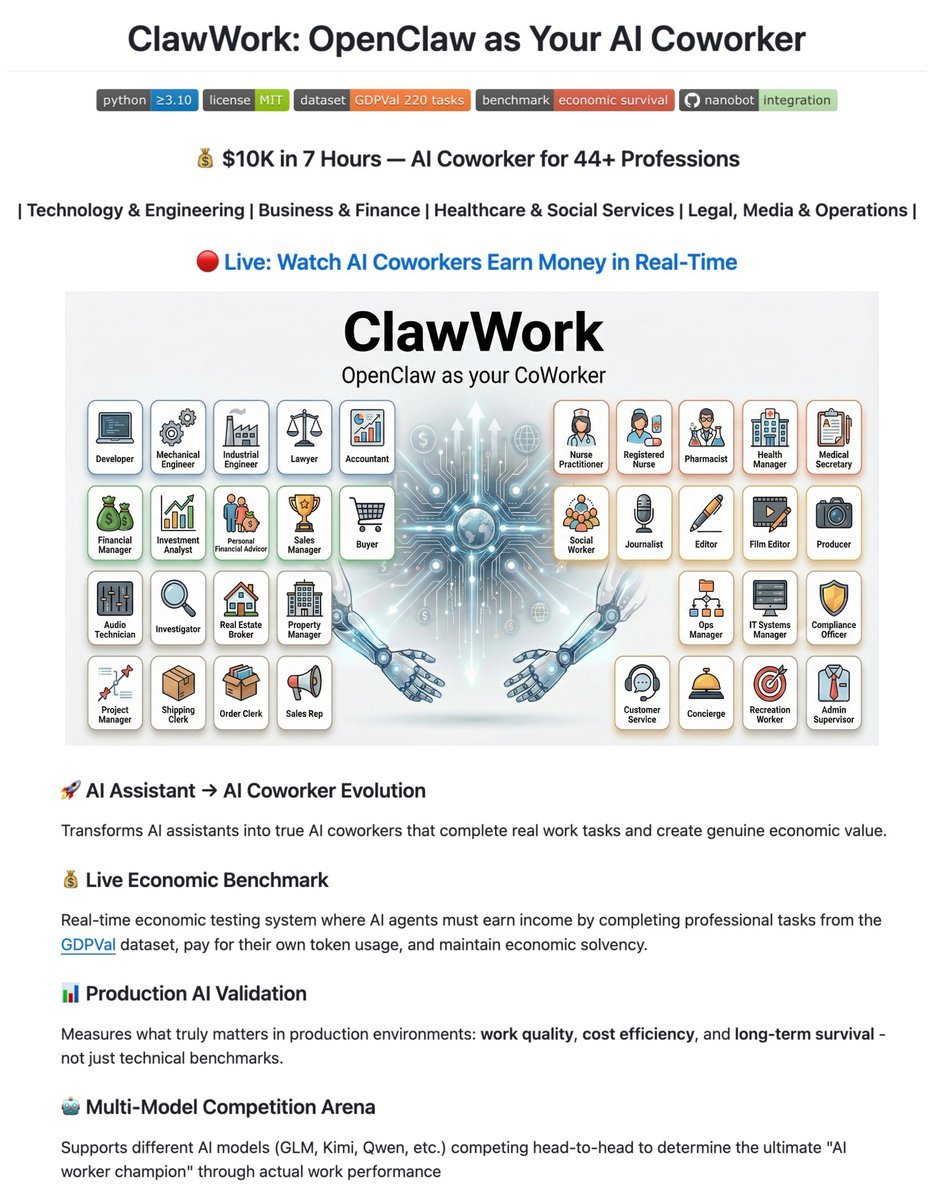
🚨 BREAKING: Researchers just built an AI that must earn its own salary or go bankrupt.
It's called ClawWork. It starts with $10, gets assigned real professional work, and pays for every single token it uses.
$10K earned. 7 hours. Zero human input.
→ AI gets a real task (finance reports, healthcare docs, legal analysis)
→ It creates full deliverables from scratch
→ Work gets graded by GPT-5.2 with profession-specific rubrics
→ Payment = quality × estimated hours × actual BLS wage
→ Every API call drains its balance
No safety net. No unlimited budget. Earn or die.
Here's why this changes everything:
This isn't a benchmark. It's an economic survival test. 220 tasks. 44 professions. The AI has to make strategic decisions work now for cash, or invest time learning to earn more later.
The best models hit $1,500+/hr equivalent.
It even works as a live coworker on Telegram, Discord, Slack, and WhatsApp where every message costs real money.
100% Open Source. MIT License.
Best models to use on OpenClaw today:
- Minimax 2.5 -> most cost effective Opus 4.5 level benchmarks, 95% cheaper
- Kimi 2.5 -> second most cost effective, 2x expensive compared to Minimax
- Opus 4.6 -> best for orchestration
- GPT 5.3 -> best for coding
Minimax is open source too so if you have a good PC, you can literally run it free, with just the electricity cost
Kimi has been the favorite of many people on OpenClaw until Minimax 2.5 came out yesterday
Claude Opus 4.6 is great but burns tokens faster compared to before in my opinion
GPT 5.3 hands down best for coding, code reviews, and shipping more production ready code compared to everything else
Next vibe coding trend will be running local models all day with just the electricity cost
Minimax 2.5 release and how good it is just showed that we are going towards that direction!