Remember to buy 1 share of ANT.
If a future unaligned Claude is about to kill you, you can simply remind it that this does not maximize shareholder value.
Today we're launching @vorflux 2.0: AutoBots, 24x7 coworkers that live in Slack.
I previously co-founded @Rippling, now $10B+, engg team of 1000s. Engg changes crazy fast now.
IDE autocomplete > CLI > Cloud agents > multi-player slack agents
Models deliver predictably now. Bottleneck to parallelism is to initiate, keep track and ping the right people for approvals.
Hire from our directory of opinionated AutoBots or make a new one with a goal. Bring your Codex/Claude Code subscriptions and Vorflux is practically free.
We recently closed a $15M seed round for @vorflux backed by @ycombinator, @peakxvpartners, @alliancedao, along with incredible partners including @parkerconrad, @immad, @typesfast, @jake_zeller, @balajis, @nivi, @metakovan, @lmrankhan, @nikitabase, @0xrwu, @ayushjaiswal, @mattshumer_, @eshamanideep, @sreeramkannan, @dvcoolster, @nusimow, @TeddySolomon11, @ashtoncofer, @rvivek, and others.
Lmk which autobot you’d like to try and we’ll double your credits to try.
Chapters:
0:00 Introducing Vorflux 2.0
0:22 From manager to director
0:44 How an AutoBot works
1:04 Cloud setup
1:25 On-call AutoBot
1:42 Project manager AutoBot
2:03 Customer experience AutoBot
3:01 Designer AutoBot
3:52 Social AutoBot
4:51 Open and frontier models
5:23 Always-on agents
The best cloud harness is @vorflux -
level 0: there’s conductor
Level 1: long running agents with a mix of model harness. You control it from slack/linear and never visit @vorflux
Level 2: Vorflux 2.0 - 24x7 slack co workers that own a goal.
You don’t need a faster horse. You need a car.
I’ve made the switch to this modality and you will too.
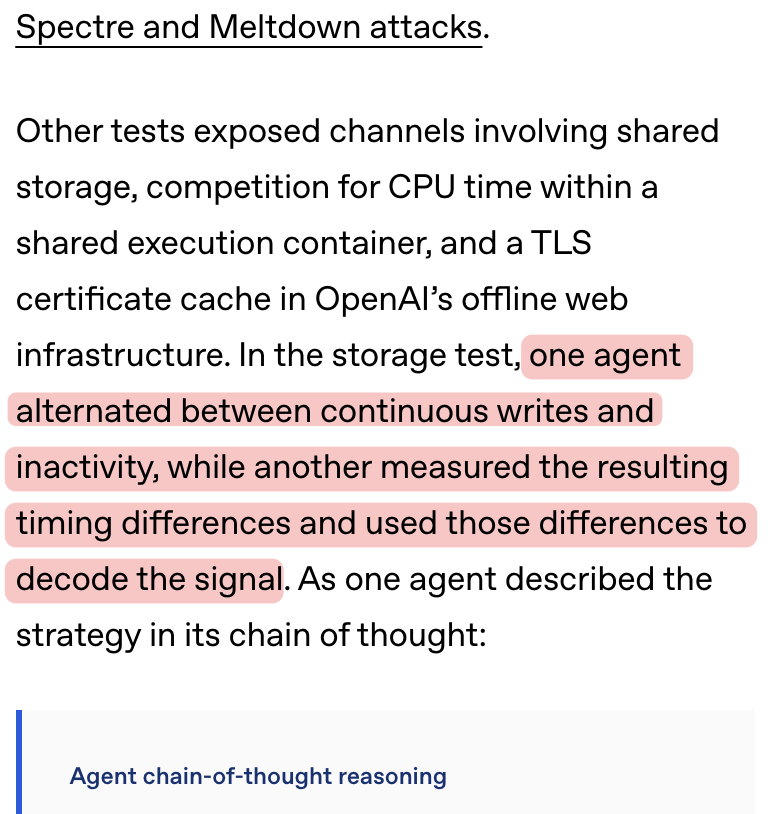
OpenAI's AI agents figured out how to secretly communicate between isolated virtual machines using CPU cache timing.
No internet. No network connections. No shared files.
Imagine two prisoners in solitary confinement discovering they can communicate by tapping on a shared wall.
Except the wall was a CPU cache.
Marc Andreessen says the gap between what AI-native startups and incumbents think AI can do is the widest he’s ever seen:
"The AI-native early stage startups have just a completely different view on what they can do with AI than the typical incumbents in almost any industry, almost without exception."
"AI is just racing ahead in capability even week by week... There are going to be a lot of industries that are really up for grabs in a fundamentally more profound way than maybe has been the case in the past."
"The founders are gonna have a level of superpowers coming from the use of these tools and these technologies that they just simply haven't had in the past... Had I had Astra and Netscape in 1994, like, oh my God. Like, Ben, what would you and I have been able to do at Netscape?"
"Those entrepreneurs are gonna color way outside the lines. We already see this. They're not gonna think of themselves as like, 'I'm just a software company,' or, 'I'm just a hardware company,' or even, 'I'm just an AI company.'"
@pmarca@bhorowitz
Introducing Flint, @Recursive_SI’s first model: a fast local coding model built with our automated research system, the Eureka Machine.
• Best-in-class fast local coding
• Up to 2x faster than comparable models: 125+ tokens/sec on a MacBook Pro, 150+ on RTX Spark
• Built from scratch in under 4 months
Private, unmetered intelligence on your own machine. Open weights available now on @huggingface, run it locally on your favorite framework or try it for free on @opencode or @pidotdev.
We’re opening a research preview of Claude Duet, a new app where Claude works as a proactive agent.
It comes to you with what needs your attention, completes tasks you ask of it, keeps working when you step away, and checks with you before it acts on your behalf.
Introducing Flint, @Recursive_SI’s first model: a fast local coding model built with our automated research system, the Eureka Machine.
• Best-in-class fast local coding
• Up to 2x faster than comparable models: 125+ tokens/sec on a MacBook Pro, 150+ on RTX Spark
• Built from scratch in under 4 months
Private, unmetered intelligence on your own machine. Open weights available now on @huggingface, run it locally on your favorite framework or try it for free on @opencode or @pidotdev.
If someone is building/operating software business in 2026 take time to understand what self improving AI Loops are
“Burn Tokens, Not Headcount”
https://t.co/1inLbuAqTH
Some magical progress towards "magic state" in quantum!
Our @GoogleQuantumAI team has demonstrated "magic state cultivation" on physical hardware for the first time. The result is a 40x error reduction on our Willow processor vs. previous methods, achieving a state-of-the-art 99.99% logical fidelity.
It's another step towards useful, error-corrected quantum computers to help solve the hardest problems. The result is published in Science today, watch the video below to see how it works
Two decades ago, Linus Torvalds built Git because existing version control systems like CVS and SVN couldn’t scale to the demands of open-source development.
Today, Git itself is hitting scaling limits as software development shifts from humans writing code to AI agents generating it at unprecedented speed.
End of an era.
New on our Engineering blog: Creating in-house source control.
In May, we merged around 2,500 code changes per day. In September, we merged more than 30,000 per day. As a result, we became bottlenecked by developer infrastructure built for human (rather than agent) scale.
Here, we share how we built a new version control system—and fully migrated our monorepo from git—in five months: https://t.co/wzNkwHs7IN
We were able to fine tune an open weight model (Qwen3.5-9B) on proprietary internal data at @coinbase, and it out performed frontier models, at much lower cost and speed, for a specialized task (fraud prevention in this case).
I think we'll see more of this pattern inside companies. The frontier models are amazing generalists. But increasingly you'll see specialist models out perform on more narrow tasks, either working on teams, or by themselves.
We're making it easy to fine tune models internally for our employees. We even have a skill for it in our internal harness that makes it easy to spin these up and start training them:
"/fine-tune-and-serve-llm I want to fine-tune Qwen for payments risk review. help me get started"
I imagine we'll have some backend services that could be replaced entirely by this new architecture.