The Human Retina Cell Atlas v1.0 is out!
Read the full paper freely via this link: https://t.co/U5AvStWtt7
Thank you to Jin Li, all co-authors, the Rui Chen and @fabian_theis labs, and the @humancellatlas community. Deep gratitude to the donors who made this 4-million-cell multimodal resource possible.
Data available at the HCA Data Portal: https://t.co/tAeIJnxhkK
Excited to share that UniversalEPI is officially published in @OxfordJournals Nucleic Acids Research! 🚀
Check out the final paper and use the model here:
📄 Paper: https://t.co/OqwpTJjlQx
💻 Code: https://t.co/MTVQhVbFaE
(1/3) 🧵
📣 We're #hiring a #PhD student! - Innsbruck - computational - 3 years - fully funded - Deadline: Feb 11th
💼 Project: scRNA-seq analysis on in-house developed cancer atlases
🔍 Looking for: candidate with experience in cancer and R/Python
🚀 Excited to share new paper in Nature Genetics: Human Retina Cell Atlas (HRCA) with ~4M cells, >130 retinal cell types, deep scRNA/ATAC integration. Enables cross-species comparisons & GWAS cell-type enrichment. Huge thanks to Ignacio Ibarra & Chen lab.
https://t.co/WM58pjTJCX
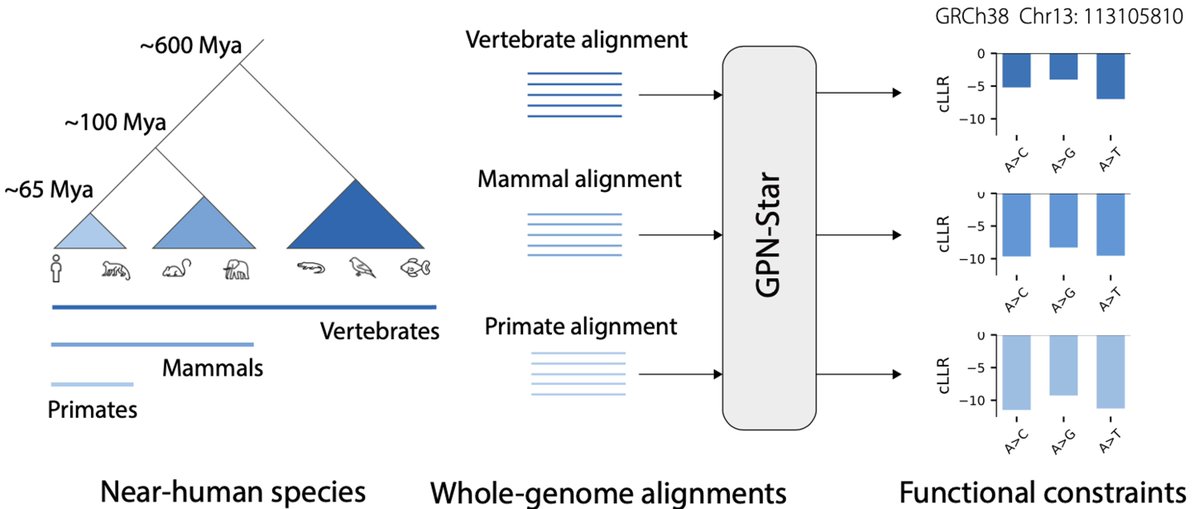
We are excited to share GPN-Star, a cost-effective, biologically grounded genomic language modeling framework that achieves state-of-the-art performance across a wide range of variant effect prediction tasks relevant to human genetics.
https://t.co/FTm3byYp67
(1/n)
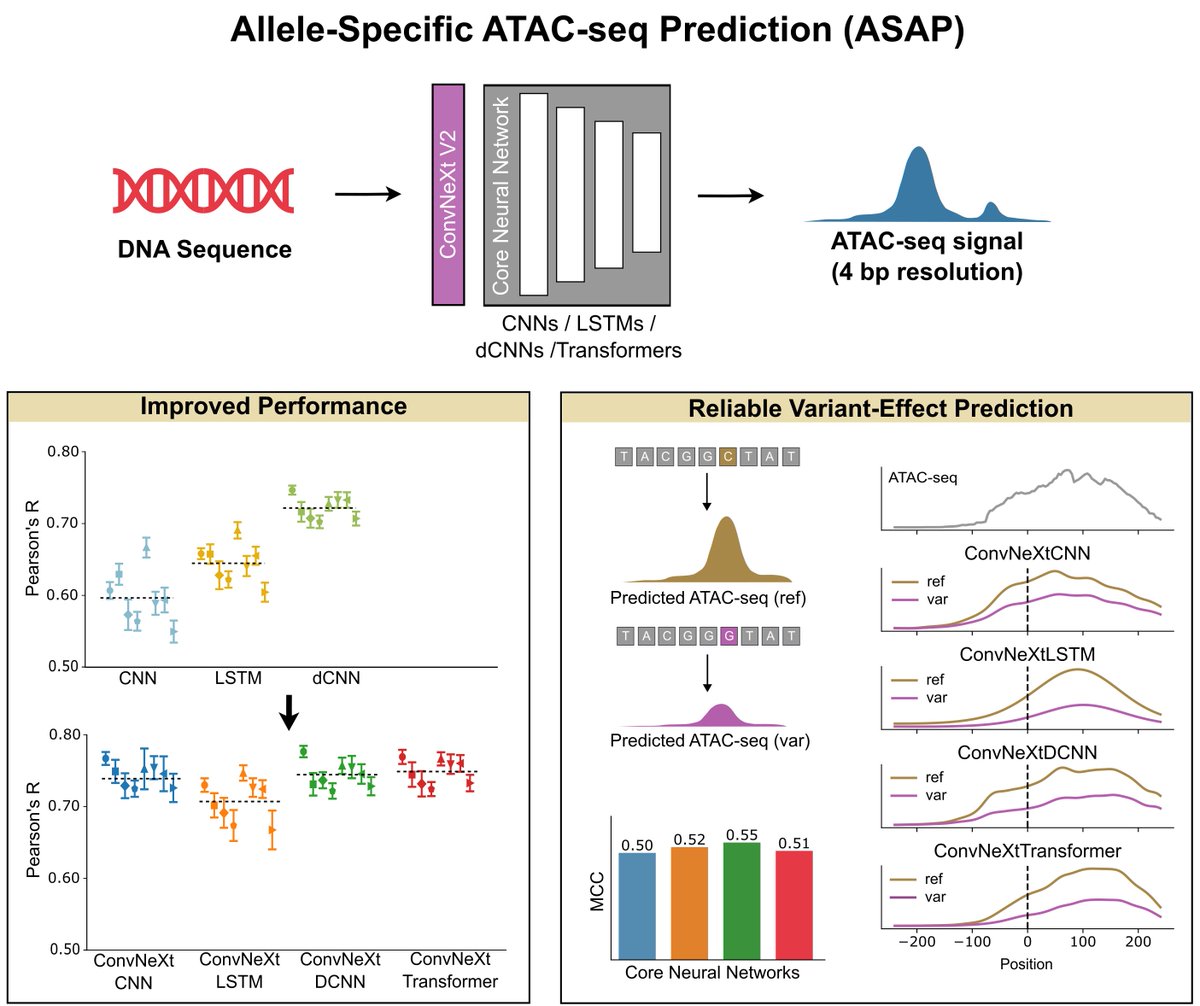
🚨 New preprint out!
We studied deep learning models for high-resolution DNA accessibility prediction from DNA sequence!
Key takeaway: ConvNeXt V2 blocks consistently boost accuracy.
📖 Preprint: https://t.co/fANivJfdAX
🔗Code: https://t.co/gPoEUxo7cM
📦 pip install atac-asap
How can causal machine learning help answer causal questions in single-cell genomics—like how genes interact and influence phenotypes? Our latest @NatureGenet paper explores this challenge, along with approaches to generalizability, interpretability, and modeling cell dynamics.
our work on the molecular differences between transcription factor isoforms is out now in @MolecularCell!
key point: 2/3rds of TF isos differ in important properties like DNA binding & transcriptional activity
many are "negative regulators" that are misexpressed in cancer
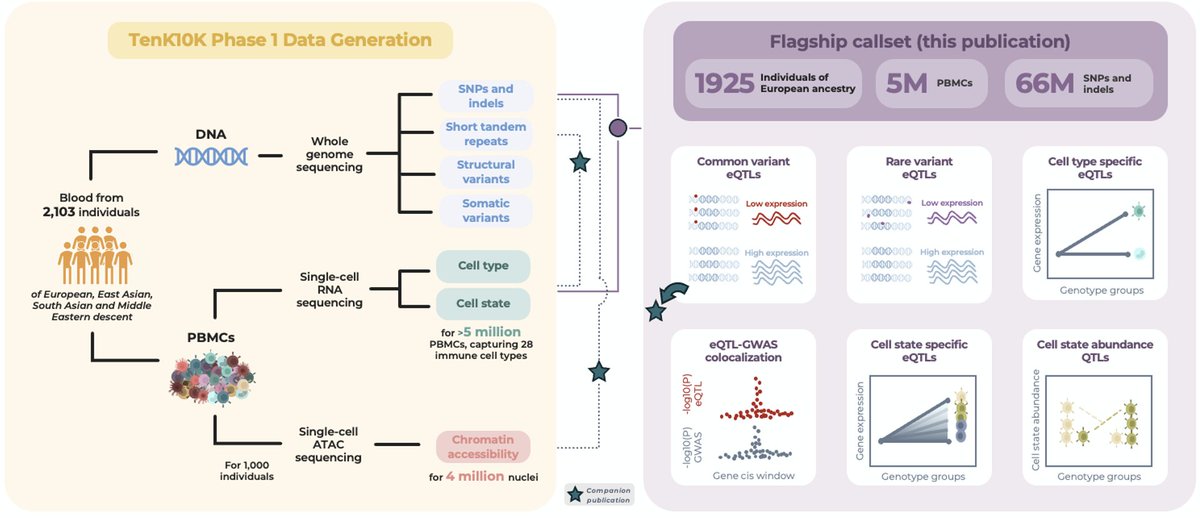
📢 new preprint alert: So so excited to share our analysis on the impact of common and rare variants on single-cell gene expression in blood, using WGS and scRNA-seq data from nearly 2,000 individuals and 5.4m cells as part of TenK10K phase 1 🧬https://t.co/pOb86zbfDd
🧵👇 (1/n)
After 4y in the making, I am super excited that my main PhD project is published 🎉🥳🎉🎉🥳
https://t.co/LCL2Dj1SOK
LEMUR is a tool to analyze multi-condition single-cell data and model differential expression as a continuous function of the cell-state space.
Some highlights⬇️
#CellPlasticity—the ability of cells to change their identity—is vital for tissue growth and repair. But when it goes unchecked, it can fuel #cancer. Our latest study examines how to block #LiverCancer by actively suppressing plasticity. https://t.co/ddl4mJGvhA #CancerBiology
🚀 New preprint from our lab, @ekrym2 and @fabian_theis : UniversalEPI, an attention-based method to predict enhancer-promoter interactions from DNA sequence and ATAC-seq🌟
🔬 Key Highlights:
- Predicts chromatin interactions across unseen cell types with no retraining.
- Outperforms state-of-the-art models like C.Origami and ChromaFold with Spearman’s Rho > 0.92 in unseen cell types.
- Tracks chromatin dynamics in processes like macrophage reprogramming and cancer transcriptional states.
- Scalable for both bulk and single-cell chromatin accessibility data.
🧬UseUniversalEPI for in-silico 3D chromatin modeling in your favorite model! Examples of applications: studies on genetic diseases, cell differentiation, and the regulatory impacts of non-coding variants.
📄 Read the full preprint: https://t.co/vT1FvxAnQV by @AayushGrover8@ekrym2@ilibarra@fabian_theis et al.
Excited to share that Spapros, the first end-to-end probe set selection method for targeted spatial transcriptomics, is now out in nature methods https://t.co/gB2YD5sO3g , a collab of the labs of @MDLuecken, @MariePiraud, @hpke1980, @erturklab, C. Samakovlis, @fabian_theis 🧵1/17
Excited to have our work out now in @NatureGenetics.
@BartDeplancke
https://t.co/Nk6DBD4CGk
Few important changes compared to the preprint! see 🧵 below
Excited to share our first preprint with @zauggj@embl! We screened 1,296 transcription factors for repressors that block unwanted plasticity and found many putative tumour suppressors. PROX1 stands out as hepatocyte safeguard that prevents #livercancer. https://t.co/qayayMO6xd
Excited to share our new preprint on PROX1’s role in safeguarding hepatocyte fate and preventing #livercancer, from my second PhD project! Big thanks to @MoritzMall, @zauggj, @DKFZ, @EMBL, and a special shoutout to @ecyrblim for all I’ve learned. Grateful for this journey!
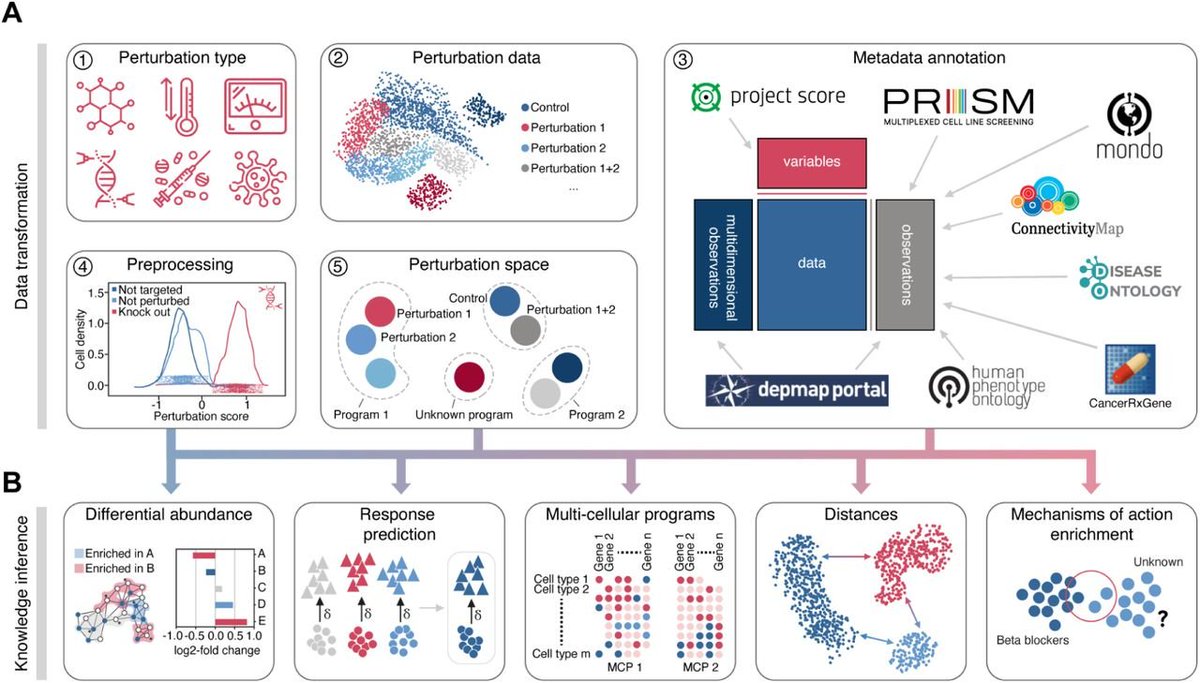
I'm stoked to announce our new end-to-end framework for perturbation analysis! Our scverse advisory committee highlighted that a maintained and well-documented framework for perturbation analysis is missing. Pertpy is our attempt to satisfy this request
https://t.co/eaNB41HuOt
Do you run functional assays? Wish you could get more results without having to scale?
If you’re not using Prophet, you’re leaving potential on the table.
(Warning: pitch not tweetorial)