In a letter this week addressed to the President of the International Criminal Court (ICC), Acting Attorney General Todd Blanche wrote that the Department of Justice rejects any assertion of jurisdiction by the ICC over Americans.
The United States is not a party to the Rome Statute and has never consented to the ICC’s authority. As a matter of international law, a treaty cannot bind a non-consenting country. Accordingly, the ICC has no jurisdiction over Americans — anywhere in the world — and any attempt to assert such authority is illegitimate, unlawful, and a direct affront to the sovereignty of the United States.
Read more: https://t.co/b0Esf2Ayc6
Saint Michael the Archangel, defend us in battle. Be our defense against the wickedness and snares of the Devil. May God rebuke him, we humbly pray, and do thou, O Prince of the heavenly hosts, by the power of God, cast into hell Satan, and all the evil spirits, who prowl about the world seeking the ruin of souls. Amen.
You're about to pay that $14,000 medical bill
Stop
Don't be fucking stupid
You can get it for free
The hospital violated federal law when they sent you to collections without your signed HIPAA authorization. That authorization is a specific document. Form HHS-329 or the hospital's equivalent privacy notice with your wet signature. The hospital is required under 45 CFR 164.508 to obtain this BEFORE disclosing your protected health information to any third party, including debt collectors
They almost never get it. They batch-sell delinquent accounts to collection agencies in spreadsheets. The spreadsheet has your name, balance, account number, dates of service, and often the diagnosis codes. All of that is protected health information under HIPAA. All of it was transferred without your written consent
Each unauthorized disclosure is a violation worth $100-$50,000 per incident under the HIPAA Enforcement Rule (45 CFR Part 160). For willful neglect: $50,000 per violation with an annual cap of $1.5 million. The hospital knows this. The collector knows this. Neither of them expects you to know this
The 3-letter deletion sequence:
LETTER 1: to the collection agency
"You are in possession of my protected health information as defined under HIPAA, 45 CFR 160.103. Please provide a copy of my signed HIPAA authorization (45 CFR 164.508) that permits you to possess, store, and communicate my medical records and billing information.
If you cannot produce this authorization within 30 days, you are in violation of the HIPAA Privacy Rule, 45 CFR 164.502(a), and I will file a complaint with the HHS Office for Civil Rights and pursue all available remedies including statutory damages."
Send certified mail, return receipt. The collector has 30 days. They don't have the authorization because the hospital never got one. The hospital sold a spreadsheet. The authorization document doesn't exist
LETTER 2: to the hospital billing department
"I am requesting a copy of my signed HIPAA Privacy Authorization (45 CFR 164.508) that specifically authorizes disclosure of my protected health information to [collection agency name]. Please also provide the Business Associate Agreement between [hospital name] and [collection agency name] as required under 45 CFR 164.502(e).
If no valid authorization or BAA exists, the disclosure of my PHI to [collection agency] constitutes a violation of the HIPAA Privacy Rule, enforceable under 42 U.S.C. 1320d-6."
The Business Associate Agreement (BAA) is the contract between the hospital and the collector that governs PHI handling. Under HIPAA, a covered entity (hospital) must have a BAA with any business associate (collector) who handles PHI. Many hospitals use outdated or non-compliant BAAs. Some don't have BAAs at all for their collection vendors. If the BAA is missing or defective, the entire collection is a HIPAA violation from the hospital's side
LETTER 3: to all 3 credit bureaus
"The medical debt reported by [collection agency name], account #[XXX], was disclosed without valid HIPAA authorization as required by 45 CFR 164.508. I have requested proof of authorization from both the collection agency and the original creditor ([hospital name]). Neither has been able to produce it.
This account was reported based on illegally disclosed protected health information and must be removed under FCRA Section 611(a)(1)(A) as inaccurate. Additionally, per the CFPB's medical debt rule effective March 2024, medical debts under $500 should not appear on consumer credit reports."
The CFPB medical debt rule change:
As of March 2024, the three major credit bureaus agreed to remove medical collections under $500 from credit reports entirely. Additionally, paid medical collections are no longer reported. If you settled or paid any medical collection, it should already be removed. If it's still there, dispute it citing the updated policy
For medical debts over $500 that are still reporting: the HIPAA challenge above is your primary weapon. The secondary weapon is the itemized bill challenge (request CPT code breakdown, compare to Medicare rates, dispute inflated charges, apply for 501(r) charity care)
The CFPB has also proposed a rule (expected implementation late 2026) that would remove ALL medical debt from credit reports regardless of amount. If this passes, every medical collection in America gets wiped from credit files. The proposal is in public comment period now
What happens in practice:
The collector receives Letter 1. They search their files for a HIPAA authorization with your signature. They don't have one. They contact the hospital. The hospital doesn't have one either (or has a general "notice of privacy practices" acknowledgment, which is NOT the same as a specific disclosure authorization under 164.508)
The collector has three options: produce the document (they can't), stop collecting and delete (cheapest option), or fight it (expensive and they'll probably lose)
70-80% delete within 30-45 days. They're not going to spend $3,000 in legal review for a $14,000 account they bought for $280
a woman had $67,000 in medical collections across 3 hospitals and 4 collection agencies. we sent all 3 letters to each. hospital 1 couldn't produce the authorization or BAA. their collector deleted within 22 days. hospital 2 produced a "notice of privacy practices" that was not a valid 164.508 authorization. their collector deleted at day 34 after we sent a follow-up citing the specific regulatory distinction. hospital 3's collector tried to verify through the bureau. we had already frozen LexisNexis and SageStream (the shadow verification databases). bureau couldn't verify. deleted at day 41
$67,000 in medical collections. $0 paid. all deleted. score went from 523 to 711 in 58 days. she bought a car at 4.9% instead of the 18% she was quoted the month before. the interest savings on that car loan alone: $6,200 over the loan term
the hospital violated federal privacy law the day they sold your medical records to a collection agency. they're counting on you not knowing. now you know lmfaooo
(i fix credit in 30-90 days. link in bio)
@KatrinaPierson@LaHood4Texas So proud of you Katrina ! You saved President Trump from the J6 scheme and you have never been given the credit you deserve for that. Thank you- on behalf of all America!
5 hours into preparing my CIA MK Ultra documents, a tornado slammed my house out of the blue-no warning, no pressure change, no path, only house devastated. My voice will not be silenced. read/listen/share/ help is needed
https://t.co/sjeBFt2zKk
Many have made pacts with the reptiles—the devil himself—and continue to fail, only condemning themselves deeper with every step. Stop blaming others. God has always been right there, waiting for you with open arms. It was never them; it was you. Power, greed, and ego were simply more important to you than love.
I’ve been reflecting on the bigger picture with President Trump and how deep the swamp actually runs since 2018.
Investigative research analyst (and my favourite teacher) Terpsehore Maras (https://t.co/Pf0yCrUZ4q / https://t.co/gXETWGtZyn) has spent years mapping the networks, funding trails, and layers of controlled opposition that sustain it. Her work shows just how wide and entrenched these systems are — and how difficult it is for many people to see the full scope when they’re only looking at surface events.
From this vantage, President Trump’s personnel decisions appear focused on removing individuals involved in fraud or corruption — the only ones who needed to be let go for the work of draining the swamp to continue. In that same pattern, many of the high-profile voices claiming to have suffered for Trump or been turned on by him show characteristics consistent with paid or scripted operator roles rather than genuine independent actors.
Even with these steps, the swamp is nowhere near drained. It’s really just beginning. The depth and layering mean this is still early-stage work.
The challenge is that so many folks simply don’t register the full picture yet. Tore’s research gives anyone willing to look a detailed way to trace the funding, the players, and the controlled opposition mechanisms. It’s all mappable if you’re willing to follow the threads.
If you’re curious about the patterns she’s documented, her sites are the best place to start digging for yourself.
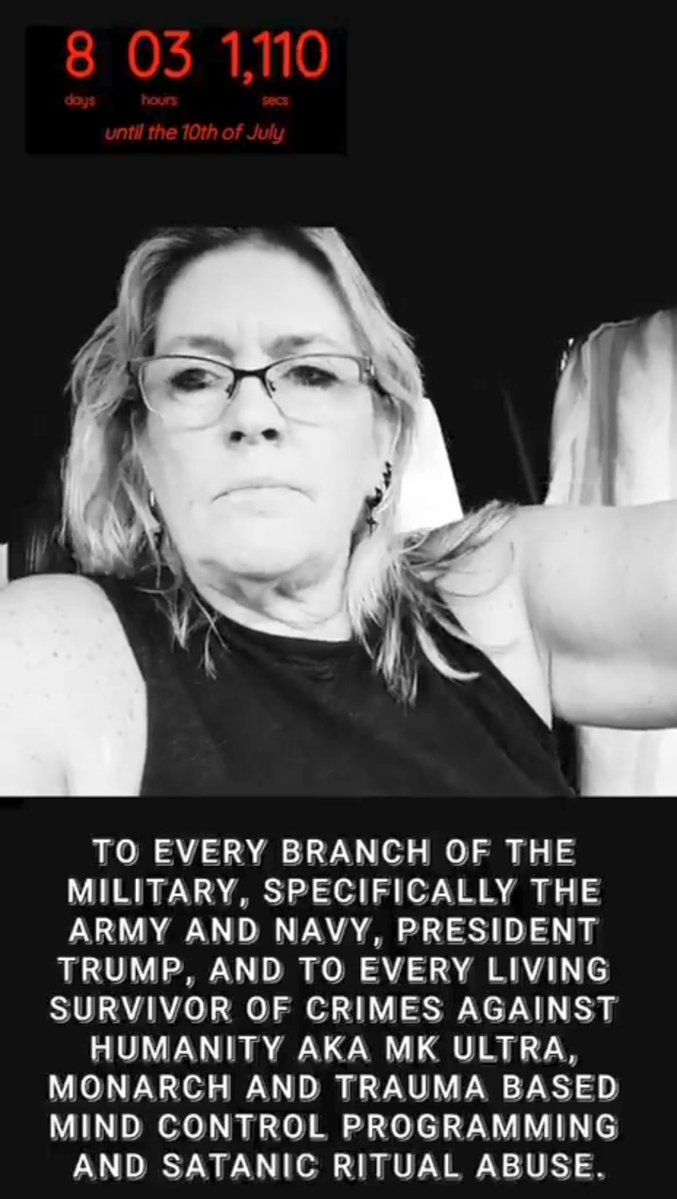
Yesterday's MK Oversight Committe regurgitated decades old information. In light of that, on July 10th, Shelly will be doing what should have been done by Rep. Luna.
Yesterday's MK Oversight Committe regurgitated decades old information. In light of that, on July 10th, Shelly will be doing what should have been done by Rep. Luna.