Today, the Attorney General of India told the Supreme Court that E20 is still an experiment — with results expected only next year.
This is the Union of India's own sworn submission.
Team Bharat began this research with one thesis: that E20, as structured, was never built to benefit Indian farmers. It was built to open a permanent market for American corn, ethanol and DDGS.
We have not found anyone else, anywhere, who traced this specific chain before: the DDGS export contradiction, the GAIL joint venture with a company holding DuPont's conversion patents, the undefined import quota with no reprocessing restriction. Team Bharat connected those dots first.
The evidence for who actually benefits is no longer speculative. Mark Mueller, President of the Iowa Corn Growers Association, called India's $500 billion trade commitment "a win for corn farmers." The US Grains Council said, plainly, that they need more "export homes" for DDGS. Indian sugarcane farmers, meanwhile, are still owed arrears that have tripled in a year, now being pushed toward maize — the one feedstock this very programme made more expensive.
>Forex saved? Not correct — the figure ignores the dollar liability India is now taking on.
>Self-sufficiency? Not correct — we traced a new dependency forming, not less of one.
>Farmers benefit? Not correct — sugarcane farmers remain unpaid, now pushed toward a costlier crop.
>Environment protected? Widely reported that the water and soil cost has not been honestly accounted for either.
We don't know what moved the government to tell the Court this is still an unproven experiment. What we know is that it confirms everything Team Bharat has documented.
None of this reached the public on its own. Heartfelt thanks to @tehseenp brother — your voice carried this further than any of us could alone. Thanks to @factswithdinesh, @nachiket1982, to everyone who asked questions, @ShivrattanDhil1, and filed RTIs. This is your win as much as anyone's.
Team Bharat is asking for course correction, not confrontation — pause the mandate until the results the government itself promised arrive, and restore E5-E10 as a choice.
https://t.co/fAifr83k9p
— Team Bharat
@badjourno@sanket@sabeer@bsindia@ajeetbharti@INCIndia
Fixing Windows, one kilobyte at a time.
Back in the NT days, Notepad was lean, fast, and stayed in its lane. Today? It wants an account, cloud sync, and Copilot’s opinion.
So I did what any retired OS engineer would do: rebuilt it from scratch.
2,686 bytes. Full features. Zero bloat. Pure Win32.
All in assembly language.
No telemetry. No nonsense. Just the Notepad you remember — only smaller than the thumbnail image!
Would love to hear what you think — and what other “impossible” tiny apps we should tackle next.
Last Night in Guwahati Fan Fark Screening, Japan Lost. Assam Won.
Football has always been more than football in Assam. I still love listening to the stories of Bordoloi trophies from my uncles, who would skip college just to watch Assam Police play the mighty clubs that would come to Guwahati.
Last night, during the CM Fan Park screening of Brazil vs Japan at Latasil, Japan lost, although they played with such heart. But the whole of Assam won. Because the same atmosphere and emotions were felt after a long time.
I spent the evening speaking to people in the crowd. Most were young Gen Z students living in hostels and PGs. One teenager from Mizoram smiled and told me, "I'm just grateful we have a place like this in the Northeast where we can watch football together at this hour of the night."
That sentence stayed with me.
The younger lot, raised on anime and Japanese pop culture, naturally backed Japan. The older Uzanbazar dadas sitting behind me never had that confusion. For them, Brazil wasn't a country. Plus, you can't debate with them and leave Uzanbazar in one piece.
It was Ronaldo. Ronaldinho. Rivaldo. Cafu. Bebeto. For them.
Their generation woke up at odd hours as children because Doordarshan or radio gave them only two choices, Brazil or Argentina. Supporting Brazil had stopped being a football decision long ago. It had become an inheritance.
And somewhere between these two generations, Latasil found common ground.
Young boys screaming for Japan. Senior citizens smiled every time Brazil touched the ball.
Before kick-off, a local band played Free Fallin' by Tom Petty. I don't remember the last time I heard that Rock Music performed live by local bands on an open ground.
The cool monsoon wind drifted through the trees, strangers sang along, and for a brief moment, Guwahati didn't feel like a city rushing somewhere.
This is why public spaces matter. Not because they screen football matches. But because they create conversations between generations who otherwise believe they have nothing in common.
As I was leaving, I noticed a few senior dadas watching the match quietly from inside their parked cars, each holding a warm liquid in a glass.
But that...
...is a Guwahati story best left untold.
I’m truly touched by the support we have received for the Neville D’Souza Football Arena in Bandra.
The bjp’s regime in the @mybmc has arbitrarily decided that the playground must be now converted to a convention centre.
After snatching away playgrounds of the youth of this country, and sporting associations, we wonder why we can’t ever make it to those world cups.
Staying up late at night, watching other countries play the @FIFAWorldCup … is that only what India supposed to do? Never dream of playing it?
Access to sports infrastructure is being shut down by the government itself.
The reason behind the bjp doing this is almost 40 years ago, the bjp convention was held there and on grounds around it!
Therefore now, a convention centre with the name of a bjp leader.
Imagine if all political parties start converting their favourite grounds into convention centres across India.
To everyone who supports sports, supports football- I have a humble request: please make sure our voice reaches everywhere!
Also to all the players (at all levels) do help us to amplify our voice!
Imagine on one end, we have politicians wanting to click pictures and share stage with @TeamMessi at a cricket stadium, and at the same time, a football ground is snatched away by the very same political party.
There are open plots around this ground but they want to shut this ground down- because it has young people playing there!
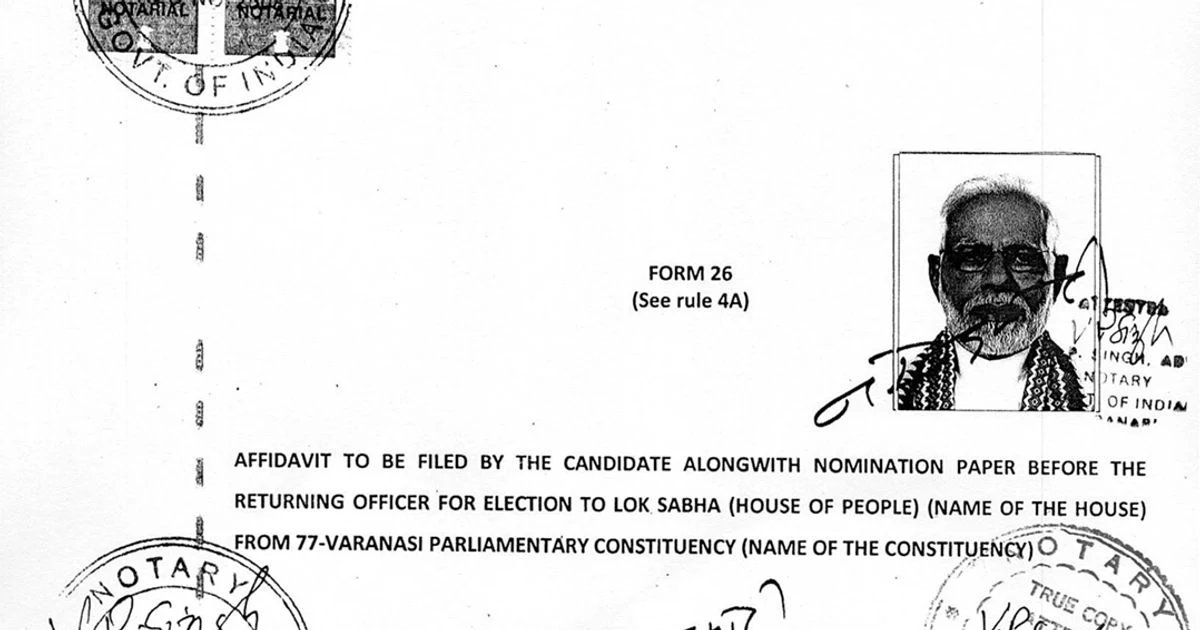
26 अप्रैल 2019 को प्रधानमंत्री नरेन्द्र मोदी ने वाराणसी सीट से लोकसभा उम्मीदवार के तौर पर नामांकन भरा था. नामांकन के साथ दायर हलफनामे में दी गई जानकारी और हालकी उनकी सार्वजनिक घोषणाओं से इस बात की पुष्टि होती है कि बतौर गुजरात के मुख्यमंत्री नरेन्द्र मोदी ने गांधीनगर के एक पॉश इलाके में खुद को जमीन उपहार में दी थी. इस जमीन की कीमत आज एक करोड रुपए से ज्यादा है जो इसके लिए चुकाई गई कीमत से तकरीबन 100 गुना अधिक है. इसके अलावा प्रधानमंत्री ने जो वक्तव्य दिए हैं उसमें इस बात का संकेत है कि 2007 में राज्य की ओर से सुप्रीम कोर्ट को दी गई जानकारी में मीनाक्षी लेखी ने इस तथ्य को सुप्रीम कोर्ट से छुपाया था. लेखी ने सुप्रीम कोर्ट को बताया था कि साल 2000 के बाद गुजरात सरकार ने इस प्रकार का भू आवंटन नहीं किया है. जमीन पाने की पात्रता मोदी को 2001 में मिली जब वे गुजरात के मुख्यमंत्री नियुक्त हुए. फरवरी 2002 में राजकोट दो निर्वाचन क्षेत्र से उपचुनाव जीत कर मोदी राज्य विधानसभा में चुने गए थे.
2007 में दायर चुनावी हलफनामे में मोदी ने घोषणा की थी कि वह गांधीनगर के सेक्टर 1 में प्लॉट 411 के एकमात्र मालिक हैं.
इसके बाद दायर किए गए हलफनामों में इस प्लॉट की जानकारी गायब है और प्रधानमंत्री की आधिकारिक वेबसाइट में प्रकाशित जानकारियों में भी इसके बारे में नहीं बताया गया है. बल्कि मोदी ने प्लॉट 401/ए के “एक चौथाई हिस्से” का मालिक होने का दावा अपने शपथपत्रों में किया है. यह प्लॉट उसी सेक्टर में स्थित है. मोदी ने प्लॉट का क्षेत्रफल 14125.80 वर्ग फीट बताया है जो सेक्टर 1 के मानक प्लॉटों से 4 गुना अधिक बड़ा है. मोदी ने इस प्लॉट में अपनी हिस्सेदारी 3531.45 वर्ग फीट बताई है जो 328.08 वर्ग मीटर के बराबर है.
हमारी रिपोर्टिंग से पता चला है कि प्लॉट 401/ए का कोई सार्वजनिक रिकॉर्ड उपलब्ध नहीं है. गुजरात राजस्व विभाग के गांधीनगर के भू रिकॉर्ड से यह प्लॉट गायब है. हमने इस बारे में विभिन्न जिला प्रशासनिक विभाग सहित कलेक्टर ऑफिस, उपरजिस्ट्रार ऑफिस एवं मामलातदार ऑफिस से भी पता लगाने की कोशिश की. अधिकारियों ने हमें बताया कि इन प्लॉटों के रिकॉर्ड उपलब्ध नहीं हैं या उन्होंने हफ्तों पहले पूछे गए हमारे सवालों का जवाब देने से इनकार कर दिया. सार्वजनिक तौर पर उपलब्ध रिकॉर्ड बताते हैं कि मोदी प्लॉट 411 के वर्तमान और एकमात्र मालिक हैं.
पढ़ें अप्रैल 2019 का कौशल श्रॉफ और निलीना एम एस का यह लेख: https://t.co/aLPiBzH59c #modikavisionyogikamission
Sarthak Goswami has brilliantly exposed how Ethanol production is ruining a beautiful city.
He went to Byrnihat to investigate why a city with less than one lakh people is more polluted than Delhi, Ghaziabad & Lahore.
The reason? There are more than 80 factories in a small area, that are constantly pumping dust particles in the air.
The worst part is that these factories are producing Ethanol, the same product that is being sold as a solution to pollution.
I hope Gadkari can explain this without calling Sarthak a traitor.
The Union Government has launched "Abhigyan", a mobile application that allows police officials to capture fingerprints on a smartphone and match them against the National Automated Fingerprint Identification System (NAFIS) within seconds. The app significantly expands the reach of biometric identification in India. 1/n
Read More: https://t.co/q1OTycUJJB
वाराणसी में बीजेपी पार्षद की नाव पर चिकन और शराब पार्टी करने वालों को 24 घंटे के अंदर वाराणसी कोर्ट से जमानत मिल गई !
मार्च में कुछ मुस्लिम युवकों ने भी नाव पर इफ्तार पार्टी की थी , जिसमें बिरयानी खाई गई थी ,
इस मामले में गिरफ्तार सभी लोगों की जमानत याचिका वाराणसी कोर्ट ने रद्द कर दिया था , और लगभग दो महीने जेल में रहने के बाद हाईकोर्ट से जमानत मिली थी !
हैं न देश की कानून व्यवस्था मजेदार !
Here’s a cartoon by Soumyadip Sinha highlighting Keir Starmer's resignation as U.K. Prime Minister over failures, while Union Education Minister Dharmendra Pradhan continues to hold his post despite demand for his resignation following the failures of the NTA.
@sinha_soumyadip
#India #Government
The discussion sparked by a recent statement on Passport Seva Divas has generated more heat than light.
The Ministry of External Affairs stated that a passport is a travel document, not a document of citizenship. Legally, that is correct. A passport is issued under the Passports Act, while citizenship is governed by the Citizenship Act, 1955. One law regulates the document; the other regulates the legal status.
But law and public understanding are not always the same.
For most Indians, the passport is the most authoritative document the Republic issues. It bears the name of the Republic of India, carries the holder’s identity, and is accepted around the world because foreign governments trust that India has verified the bearer’s nationality before issuing it. It is therefore entirely understandable that many people asked: if a passport is not proof of citizenship, then what is?
The answer requires some nuance.
A passport does not create citizenship. Nor is it the legal instrument that finally determines citizenship if that status is challenged before a court. Like many democracies, India distinguishes between citizenship law and passport law. In rare cases involving fraud, disputed parentage or illegal acquisition, citizenship may have to be established through the provisions of the Citizenship Act and supporting evidence. That is why a passport is not regarded in law as conclusive proof in every conceivable circumstance.
But that should not be confused with its practical significance.
A passport is issued only after the Government has satisfied itself that the applicant is entitled to one. In everyday life, and in international travel, it is the strongest evidence of Indian nationality that most citizens will ever possess. Nothing said by the MEA changes that. No immigration officer abroad will suddenly regard an Indian passport with suspicion because of a legal clarification made in New Delhi.
The episode does, however, remind us of a larger challenge.
India’s systems of civil registration developed unevenly over many decades. Millions of older Indians were born when birth registration was incomplete. Names were recorded differently across school certificates, land records and electoral rolls. The painful experience of the Assam NRC showed how documentary inconsistencies can create profound hardship when citizenship itself becomes the subject of legal scrutiny.
The lesson, therefore, is not that passports have somehow lost their value. It is that India needs stronger and more comprehensive civil registration, universal birth registration and reliable archival records so that citizenship can never become hostage to missing or inconsistent paperwork.
Sometimes a legally precise statement can create unnecessary public anxiety if it is not accompanied by explanation. A better way of putting it might have been this:
A passport is issued only after the Government has verified that the applicant is an Indian citizen. While citizenship itself is governed by the Citizenship Act, the passport remains the Republic’s most trusted document for international travel and, in ordinary life, the clearest evidence of Indian nationality.
That is both legally accurate and reassuring. The law need not be diluted, but neither should public confidence in one of the Republic’s most important documents.
To distil the argument:
A passport is issued because the Government has satisfied itself that you are an Indian citizen. It is therefore powerful evidence of citizenship in ordinary life and in international travel. But in a legal dispute over citizenship itself, the governing law remains the Citizenship Act, and a passport is not conclusive proof that overrides all other evidence
All those are who are interested in knowing history of ISKCON provided mid-day meal, please read this article from 2018.
187 of ISKCON's tested meal samples failed to meet prescribed nutrition standards, with negative feedback from 75% of children and teachers surveyed — and serving grain quantities far below the mandated 100–150g per meal (children were getting roughly 40g).
https://t.co/aIgVrpX6WB
Important for public information!
I would like to update that the third paper on cow research, funded using India's public money under the SUTRA-PIC (Scientific Utilization through Research Augmentation - Prime Products from Indigenous Cows program) has undergone exhaustive post-publication peer review.
The paper was published in Biochemical Engineering Journal this year. The authors are from Indian Institute of Technology (IIT) Dhanbad (Jharkhand).
This is the paper:
https://t.co/9niHoCSvEO This study was done in Jharkhand and the total amount of public money given was INR 36,16,859/- (~38500 USD).
As per the study, the researchers transformed ordinary cow dung into a specialized carbon material that highly effectively soaks up toxic chromium pollution from water. Instead of throwing away this metal-filled waste, they successfully reused it to build a working, long-lasting energy storage device called a supercapacitor.
Well, they did not. They made it all up.
Here is a plain-language summary of the fatal flaws found in the paper:
🟡The authors claim their material successfully absorbed a massive amount of toxic chromium—roughly 22% of its total weight. However, their own chemical scan shows the final product contains almost zero chromium (0.09%), making their main conclusion physically impossible.
🟡After testing this material in a battery setup that contains absolutely zero chromium, the reported amount of chromium inside the material mysteriously multiplied by 47 times (from 0.09% to 4.24%). Elements cannot spontaneously generate out of thin air, which strongly indicates the data was fabricated.
🟡The fundamental thermodynamic math used to prove how the material captures pollutants is entirely broken. The reported numbers for energy, heat, and entropy literally do not equal each other when plugged into standard physics equations, heavily suggesting the results were manually made up.
🟡The paper claims hard statistical proof that one type of cow dung is superior to another, but the actual difference between them is a fraction of a percent and mathematically insignificant. Furthermore, the statistical "p-values" they reported are mathematically incorrect for the tests they claim to have run.
And one more point which requires professional image manipulation software for checking - which me or the helping team did not have access to)...
🟡The photos intended to show the physical "coated" battery electrodes appear to be digitally faked. The frayed edges and tape cuts match the uncoated metal so perfectly that it looks like solid black boxes were simply photoshopped over the original image (this is only a basic allegation, needs confirmation).
With this review, I am stopping further such analysis on these so-called cow-research science papers glorifying Indian tradition. These "researchers" and "scientists" should be ashamed of themselves. Real science requires truthful validation, not beggarly applause or promotions from the hands of the "agenda-driven" masters that feed you.
All three papers criticisms have been uploaded to Pub-Peer and official notifications sent to the respective journals and their research integrity teams. Two papers are already under investigation by respective journal.
Please see here: https://t.co/C5cHlJZUas and here: https://t.co/bhNYt0khLv
The science community in India must fight tooth and nail to prevent AYUSH pseudoscience infiltration into their revered STEM institutions. This is not a good thing, moving forward.
मुज़फ्फरनगर में मजदूरों की बंधुआ मजदूरी का मामला बेहद चौंकाने वाला है।
बिना मज़दूरी दिए काम करवाने के अलावा, मजदूरों को कुत्तों से कटवाया गया, भाले से गोदा गया, कोड़े मारे गए, और उन्हें मवेशियों का चारा खिलाया गया। यह इंसानी गरिमा पर हमला है - पीड़ितों को न्याय के साथ पुनर्वास और दोषियों को कड़ी से कड़ी सजा मिलनी चाहिए।
साथ ही हमें यह भी पूछना ज़रूरी है कि मज़दूर ऐसी खतरनाक परिस्थितियों में किन मजबूरियों में फंस जाते हैं।
जब रोज़गार ख़त्म हो जाते हैं, आमदनी ठहर जाती है, और सबसे कमज़ोर वर्गों के लिए बने मनरेगा और श्रम कानूनों जैसी सुरक्षाएं कमज़ोर कर दी जाती हैं, तो हताशा बढ़ती जाती है। जिन लोगों के पास कोई और विकल्प या सुरक्षा नहीं होती, वो ऐसे शोषण का आसान शिकार बन जाते हैं।
यह कोई आम आपराधिक घटना नहीं है - यह एक धराशाई हुई अर्थव्यवस्था का मलबा है।
With all the forced pseudoscience projects with questionable outcomes emerging from Indian Institutes of Technology across India, degrading decades of scientific credibility, mostly from political and religio-cultural agenda from the BJP and the Ministry of Ayush, this is a timely piece. Never before seen kind of "secret war" for those who really love this nation. Science community in India needs to be stronger than ever and come together to fight this spreading blight and growing rot. The hapless public deserve our candles in the dark.
The world is racing towards quantum computing, advanced semiconductors, AI and deeptech.
Meanwhile, some of India's premier institutions are being nudged towards researching reincarnation, astrology-linked past life memories and cowtech.
Modi govt allocated Rs 98 cr for ‘cowpathy’ research. There is even a dedicated programme under the Union Ministry of Science and Technology called SUTRA-PIC (Scientific Utilization through Research Augmentation - Prime Products from Indigenous Cows).
IITs are hosting sessions on the "science" of reincarnation. Mythology is being repackaged as science and ideology is being dressed up as research.
There is nothing wrong with studying our history, traditions or knowledge systems. The problem begins when pseudoscience is institutionalised.
India is not short of capable institutions. It is not short of brilliant scientists.
It is short of one thing: the political will to let them do real science.
A Trojan horse has breached the IITs
https://t.co/mmrKZlqPIQ
Good morning. This is urgent, for public information.
The second paper on cow research funded using India's public money under the SUTRA-PIC (Scientific Utilization through Research Augmentation - Prime Products from Indigenous Cows program) has undergone exhaustive post-publication peer review.
The paper was published in Applied Biochemistry and Biotechnology last year. The authors are from Indian Institute of Technology (IIT) BHU-Varanasi and Birla Institute of Technology (BITS)-Pilani.
This is the paper: https://t.co/InN4H9safh
This study was done in Uttar Pradesh and the total amount of public money given was INR 31,04,162. The authors studied cow urine of different breeds and found "special" components in the cow urine that they claim will have major use applications in healthcare, technology and engineering.
They are wrong. The paper is a third-rate publication with poorly performed and grossly misinterpreted and falsified results of basic analytical chemistry. An official email for Expression of Concern and investigation into scientific integrity has been mailed to: @SpringerNature Ethics Team and Journal Editors-in-Chief (personal email) - Matthew P. DeLisa PhD
at Cornell University, Ye Ni PhD at Jiangnan University and Benedict Okeke PhD at Auburn University.
Here is the lay summary of the paper's forensic analysis:
Lab contamination has been (un)intentionally ignored by authors. The researchers mistook common lab contaminants, like plastic chemicals and solvents, for natural cow urine compounds. They failed to run basic control tests to catch these obvious errors.
Impossible chemicals claimed to be found in cow urine by authors. The paper claims to have found impossible synthetic chemicals in the urine, such as a banned pesticide, human prescription drugs, and toxic metals. This shows the authors blindly trusted computer software without checking if the results even made biological sense.
Fake health claims made by the authors. The authors boast about the amazing health benefits of over twenty different chemicals, claiming they fight cancer and bacteria. However, none of these specific chemicals were actually found anywhere in their own data or in the urine of various cows they tested.
Contradictory results are all over the place. The written text of the paper directly contradicts its own data tables. The researchers claim to have found certain groups of chemicals, like steroids, that are completely missing from their actual results.
Terrible referencing throughout the paper. The study's citations are completely mismatched, scrambled, and duplicated. They even cite unrelated plant studies and reviews on toxic chemicals to support their claims about the "benefits" of cow urine.
Zero statistics and flawed setup degrade the conclusions. The study lacks basic statistical analysis, sometimes testing as few as one cow per breed. They also failed to separate the cow's breed from its age, diet, or location, making their "breed-specific" conclusions totally invalid.
Misleading graphs are plastered all over. The graphs that are supposed to show specific, individual chemicals actually show messy mixtures of dozens of different compounds. These graphs look suspiciously identical to each other, raising serious concerns about image manipulation.
Thanks to the Government for destroying the scientific fabric and the rational temperament of its science instituitions. We wont forget.