IT Architect @ Cisco. I am currently spending copious time going down the LLM rabbit hole. Views expressed here are my own and not the views of my employer.
I apologize to any of my twitter followers who are not interested in the union of:
* Information Technology
* Energy Technology
* Physics, Chemistry, and Mathematics
* Love, Laughter, and Kindness amplifiers
Thank you for tolerating my (re)tweets!
I noticed that @Airbnb just open-sourced Skipper, its durable workflow engine. It's great to see another major tech company adopting the idea of building durable execution as a library on top of the database you already have, without requiring a separate orchestration service.
As one article put it: "Skipper's closest relative is, perhaps, DBOS Transact."
Skipper currently supports MySQL and SQLite, while DBOS supports Postgres (and SQLite in select language SDKs).
Another data point showing that durable execution doesn't have to mean adding another complex infrastructure stack.
On November 21, 2026, @boomsupersonic (W16) fired their prototype engine core for the first time.
They're developing a shared core for two products: Superpower, a natural-gas turbine for AI data centers, and Symphony, the engine intended for the Overture supersonic airliner. The turbine business could help fund Overture while giving Symphony years of real-world operating data before it ever flies.
In this episode of Hard Tech, Boom founder and CEO @bscholl shows @snowmaker around their new Superpower Superfactory in Colorado and explains how they’re building a jet engine from scratch.
On the factory floor, we explore in-house manufacturing, the challenge of making turbine blades survive extreme heat, and the custom software Boom uses to design and iterate on engine parts.
00:00 — Boom’s New Engine Core
01:37 — Why They Built Their Own Engine
03:37 — How AI Could Fund Supersonic Flight
06:27 — The Turbine Supply Bottleneck
08:45 — Inside the Superpower Superfactory
11:04 — Making Blades for Extreme Heat
12:21 — Software, Speed, and Small Teams
13:59 — First Fire and What’s Next
Writing code got cheap. Cleaning up the pile didn't.
@Steve_Yegge on software factories, runaway context and the work of keeping agents useful.
His full Code Summit talk: Software Factories: Escape from Trash Mountain.
Watch here: https://t.co/osOCB84VMH
Grok Bot tip of the day: Turn your device into a remote server
Install bot and flip "execution on this computer" and "route traffic through this computer"
Grok Bot will be able to update your files from anywhere and access sites and devices from your local network.
Multiple devices = multiple servers!
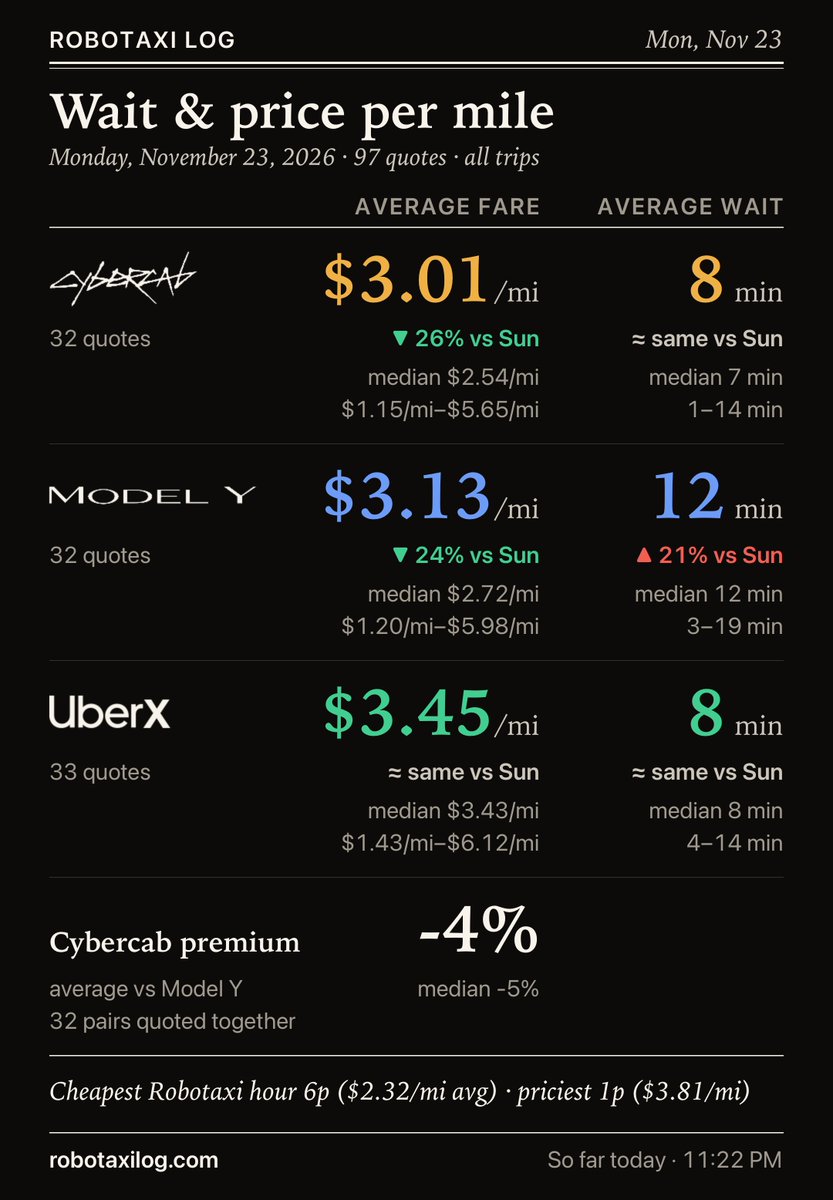
I can’t believe Tesla robotaxi prices are dropping this fast in Austin. I mean Uber is dropping too but that means they are screwing themselves over by trying to compete. I did not think prices would go down this fast this quickly tbh
Reality view is incredible and addictive, but I do think some will find it overstimulating after a while. Tesla UI team did an incredible job of delivering something for everyone. If it’s too much, you can go full screen map. If you’re FSDing and want total peace, you can hit the moon icon and make your cabin more peaceful than ever.
Or if you want half and half, the oldschool map view is still there.
This update was a total homerun by the UI Team. Their best yet.
Now we need to update the mobile app :)
The latest footage of Terafab’s construction, overlaid with its site plan. Things are moving fast.
I’ve placed Intel’s and TSMC’s largest fabs alongside it for scale, TERAFAB is fucking incredible
We've redesigned the side panel in Claude Code on desktop.
Files, Changes, Terminal and your other tools now open as tabs beside your session. You can still move a tab to see several at once, or pop it out into its own window.
Rolling out on Mac. Windows and Linux coming soon!
Fun fact: it's harder to make a jet engine than a nuke.
There are 9 countries that have succeeded in making a nuclear bomb and 5 that can produce high end jet engines. And of those 5, only 4 can produce both commercial and fighter engines.
The reason is the turbine blades which power the entire engine. They need to withstand some of the harshest conditions of any machinery on the planet. Temperatures inside reach ~3600F which melts steel, there are about 10 tons of force on each blade, and they need to be durable enough to run for tens of thousands of hours.
The only way anyone has gotten them to work is with custom nickel super alloys cast as a single metal crystal. Typically when you melt metal into a mold, it forms into many smaller crystals, but at the temps a turbine blade is subjected to, that creates weak points. So companies spent decades and billions of dollars perfecting processes to create these rotor blades that results in 1 singular crystal for the entire blade.
It feels so normal taking a flight these days, but it's truly one of the greatest materials engineering achievements we've ever seen. I love aerospace man.
You don't need to memorize algorithms. You need to see them move.
So I made an app to visualize data structures & algorithms.
Helps you build better apps, write better prompts, and ace interviews.
86 lessons. 21 languages.
https://t.co/7v6gEKlKzP
Last week’s S&P 500 decline of 8.6% ranks among top ten worst weeks since 1990 (all prior incidents other than in 2025 were during bear markets)
[Past performance is no guarantee of future results]
GDP Per Capita in 2000 ( USD )
USA - $ 36,330
Japan - $ 40,000
China -$ 970
Russia - $ 1,900
India - $ 440
Germany- $ 23,950
GDP Per capita in 2026⬇️⬇️