Every administration since Reagan has talked about addressing the deficit through future growth. If only it were so easy.
Reagan: "Strong and steady economic growth is the best way to reduce deficits."
Bush 41: "we were going to grow our way out of the deficit problem." -- CEA Chair Boskin
Clinton: "economic growth could take the deficit down even more quickly"
Bush 43: "let’s just be patient about solving this federal deficit… let’s grow our way out of it."
Obama: "We can’t just cut our way out of the problem; we’ve also got to grow our way out of the problem"
Trump 1: higher GDP growth would be “helping to erase our fiscal deficit" -- Treasury Sec. Steve Mnuchin
Biden: "the best way to responsibly reduce the deficit is to grow the economy"
Trump 2: "the way you take care of debt is with growth… The growth will take care of that very easily."
A broke Italian gambler in 1560 wrote a short manual on how to win at dice. Nobody in finance read it for four hundred years.
The nine-trillion-dollar insurance industry runs on his equation.
His name was Girolamo Cardano. The book was called Liber de Ludo Aleae. He scribbled it in Milan to settle a card debt. Every dollar of premium ever collected on Earth is a footnote to that scribble.
Nobody connected the dots until 1996. A ninety-year-old man in New York wrote a book called Against the Gods and traced every modern risk model back to Cardano's manual. Wall Street called him the historian of risk.
His name was Peter Bernstein. In 2008 a small production company filmed him for thirteen minutes. He walked through the entire five-hundred-year arc. Cardano to Pascal to Fermat to Black-Scholes.
Then he stopped and said the industry had built glass towers on the back of an idea a broke gambler scribbled to shave the house edge.
He died the following summer. Age ninety.
There are only four ways to make money. Labor. Capital. Arbitrage. Insurance. Insurance is the oldest and the least visible. Every actuary on Earth still prices catastrophe risk with Cardano's framework.
The video is thirteen minutes long. Free on YouTube. Twenty-nine thousand people have watched it.
This skateboard trick may never be eclipsed.
Danny León, a Spanish Olympic skateboarder, set up this shot and landed it during today's eclipse in Spain.
Perfect planning!
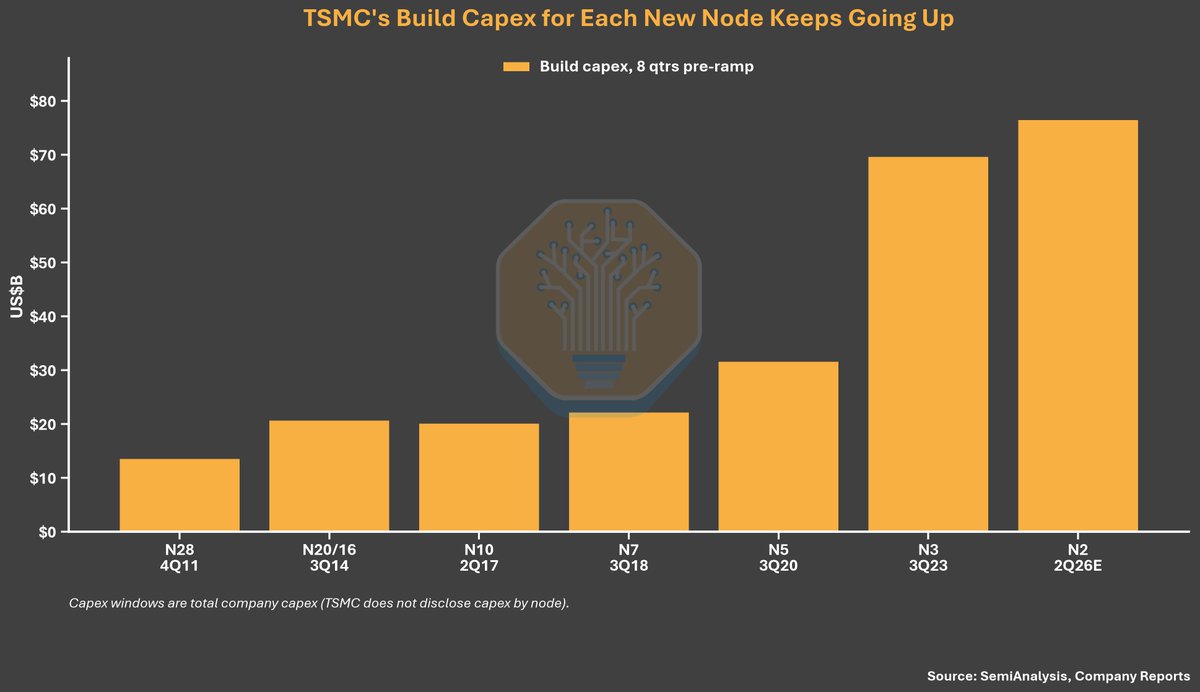
- TSMC spent about $14B in the two years before 28nm ramped in 4Q11 and about $76B in the two years before N2's 2Q26 ramp, a 5.7x increase across seven node generations
- The largest single jump came at N3
- TSMC does not disclose capex by node so a total capex over the 8 quarters before each ramp a good proxy though not all that capex goes to that node
- Leading-edge costs keep going up by double-digit %
TLDR, 7 ways to drop cortisol and slow the clock:
1. Sauna (15-20 min, 4x/wk)
2. Cold exposure (1-3 min, 3x/wk)
3. Lift heavy (3x/wk)
4. Cool bedroom (64-67F)
5. Protein within 90 min
6. Sunlight first 30 min
7. 4-8 breath (5 min, 2x/day)
.@danawhite says one of the keys to longevity is to block out all negativity:
“It never even crosses my mind that something's not going to work. I just keep going until it does work.”
“There's this Bruce Lee quote where he says, ‘Never say negative things about yourself or what you're working on even if you're joking, because your body doesn't know the difference.’”
“I never take in any negativity.”
Izzy Englander started Millennium with $35 million in 1989 - today it manages $84 billion - and has lost money in only one year out of 35
his only interview ever - how he built the most consistent hedge fund in history from a specialist desk on the floor of the American Stock Exchange
"in the land of the blind the one-eyed is king - the options market was in its infancy - and it just produced a lot of business"
"the primary piece is the ability to deliver what you say you're going to deliver - from there you need to control risk - risk becomes very very critical"
bookmark & watch the full conversation ↓
Maverick Capital, Lee Ainslie's Tiger cub, co-PMs Ben Silver and David Tykocinski on how durable the AI buildout is and where they're focused now.
Their thoughts here (save/watch this):
1/ The co-CIO model came from Lee Ainslie, who had watched their chemistry and bet that their differences would help. Tykocinski says Ainslie had a read on their natural chemistry approaching critical decisions together well before he executed the transition, and a view that the similarities and differences between the two of them would give the culture a useful counterpoint. The handoff was deliberate, built on a couple of years of incubating ideas about organization and investment philosophy.
2/ Their styles split along the sectors they came up in, and the split is the point of pairing them.
Tykocinski frames the difference as a function of different sector universes rather than personality.
> Silver came up in healthcare and cyclicals, where end-market secular growth is thinner, managerial decisions swing earnings power, and you oscillate around a macro operating cycle that has run for seven decades. His focus is highly specialized, idiosyncratic, novel ideas.
> Tykocinski came up in TMT, where secular trend, operating momentum, and thematic dominance govern, because when a sector trend is in your favor the multiples re-rate in the same direction as the fundamental revisions. His mold is closer to classical thematic investing.
3/ They manage to the optimal portfolio, not the optimal sector allocation, and the risk machinery is unrecognizable from the early days. Tykocinski says risk is run holistically and at the sector level, together with Ainslie and two other longstanding members, but what they solve for is the whole portfolio. When Ainslie started he watched net and beta-adjusted net exposures by sector. They now run a 20-plus-page risk report on idiosyncratic contribution to volatility, sliced every way, across every factor, including factors they build themselves.
4/ More has stayed the same than changed in 30-plus years, and the main change was pulling back to first principles. Tykocinski says the first slide of the marketing deck is unchanged since inception, alpha rather than market timing or big sector bets, long-term view, deep diligence, partnering with good management. The one real course correction came in the roughly five years since they took over, reversing a stretch when near-term valuation metrics had become pervasive, a deviation from Maverick's first 15 years or so.
5/ The AI trade is no longer just GPUs, it is the whole hardware, energy, and software complex on both sides of disruption. Asked about the sustainability of the four-year rally, Tykocinski reframes the surface area. The trade now spans the broader hardware infrastructure and energy ecosystem, plus all the services and software perceived to sit on the other end of disruption. That breadth is why the durability question is the critical one.
6/ The cleanest difference from the dotcom bubble is who funds the spend, though the gap is tightening.
Tykocinski puts numbers on the contrast and then concedes the offset.
> In the dotcom bubble, cumulative CapEx ran roughly 200% of operating cash flow, so it was almost definitionally externally funded.
> Over the last couple of years the AI figure has run well under 100%, funded by the largest, most well-capitalized companies in the world.
> The offset arrived recently, a multi-trillion-dollar market cap company tapping equity markets for the next tranche of the buildout, so the difference holds but a little tighter than before. (they can't name on a public broadcast but it is almost certainly $GOOG)
7/ The risk a believer should respect is an air pocket in the handoff from training infrastructure to real applications. Tykocinski says the heart of the question is the ROI on the spend and how it translates, and that the danger sits in the interim as money moves from building training infrastructure to the applications that are actually transformational for productivity. So far the pickup in agentic inference like coding has been commensurate with the second-derivative slowing in training, but that use case still has to break into the broader knowledge workspace to support the out-year projections.
8/ The way to monetize the trade has been to chase the bottleneck upstream as demand outran capacity.
Tykocinski lays out the migration as a sequence.
> Early on, with demand still inside existing production capacity, the explosive growth showed up in downstream physical outputs like GPUs.
> Once demand crossed industry production capacity, the bottleneck moved up to fabrication, then to the tools that make the chips, then even to obscure materials listed on a Japanese stock exchange.
> The sharpest revision torque now sits in those upstream names, frequently companies that started from a very low margin basis.
9/ Their forward call is that the migration swings back downstream, toward servicing AI and the application layer. Tykocinski says they are starting to see the bottleneck begin to move the other way, back toward infrastructure and applications where the work is transforming businesses with productivity gains. In practice AI agents are not islands, they are LLMs integrated into the preexisting enterprise workflow and stack, which makes CPUs and the databases they talk to the critical chokepoints and pushes value closer to the edge and the end user. That is where they are heavily focused now.
10/ Capital has drained out of healthcare into AI, but Silver likes life-science tools as both an AI and a reshoring winner. Silver describes a large sucking sound of money leaving healthcare, then points to the companies that supply the products to discover and manufacture complicated drugs.
> A shift to reshore drug manufacturing from outside the US to the US should drive a CapEx boom in manufacturing equipment, starting to show roughly three to six months out and driving a strong revision cycle.
> Early-stage drug discovery is already showing a pickup in consumable usage.
> More discovery leads to more drugs manufactured downstream, which Silver casts as a modern mercantilist winner alongside the AI angle.
11/ The same space has consolidated for 20 years, and the left-for-dead survivors look ripe for M&A. Silver says the life-science-tools group has been consolidating for two decades and the remaining companies are priced as if dead, but there are real-money buyers, three to five big consolidators depending on definition. A number of names in the $5-10 billion range look ripe for M&A if fundamentals do not turn fast enough, and the historical pattern is that when biotech sells off, pharma comes in and rights it within six months to a year.
12/ Asked the one risk they worry about most, they name US political polarization and China as an industrial counterweight. This is the host's direct reframe, and both answer.
> Silver leads with the division inside the US and the difficulty of making rational long-term decisions against short-term political incentives.
> Tykocinski's concern is China as an industrial counterweight to the infrastructure trade, because root hardware and materials commodify over time while IP historically lived at the application layer.
> He worries specifically about spaces ripe for Chinese competition, lasers and optics and analog semiconductors and the maniacal hunt for the next bottleneck like memory, and about investors underrating the structural industry differences of the businesses driving so much of today's equity appreciation.
13/ The partnership holds because each wants a counterweight against his own excesses. Tykocinski says almost every investor believes his own style is the right one, and that he is glad to have someone who might see things differently to protect him from his excesses in one direction, with Silver getting the same protection in return. They agreed from day one to disagree and commit, with Ainslie as a third sounding board, on the view that no single investment philosophy is perfect in a vacuum.
14/ The investors they admire are also the lesson, that the great ones are entrepreneurs who build real businesses. Asked which investor they admire most, both first name Stan Druckenmiller and "Uncle Steve" Cohen, the Mets owner, before Silver puts Ainslie and Keith Meister of Corvex, where he previously worked, in his personal hall of fame, both unusually quick on hard concepts and very commercial. The underrated trait he flags is that the best investors build genuinely good businesses, that they are phenomenal business builders as much as investors.
15/ What they are most excited about is AI itself, over a 10-to-20-year horizon they call hard to fathom. Silver says he is willing to go with consensus when it makes sense, and that the impact of AI on the world over the next 10 to 20 years will probably be more profound than we can imagine, a mix of exciting and a little scary. Tykocinski adds that the conversation is too often flattened into monetary terms or a dystopian frame, when the open-ended upside optionality is the part that excites him.
Lastly, the lightning round. David Tykocinski names his strength as balancing fundamental analysis with commercial intuition, neither too academic nor too much of a trader, while Silver names getting deep in the weeds on how businesses make money and then pulling back to the strategic picture. Tykocinski's best advice came from his oldest sister, that no one is really thinking about you all that much, which he finds freeing at key decisions. Silver's came from a grandfather who survived the Holocaust, an attitude of keep going, persevere, and be grateful for what you have. Outside the office it is mostly young kids for both, with Tykocinski keeping up an interest in the humanities and Silver in watching and playing sports.
Atreides' @gavinsbaker says that once Starship is reusable, the economics of orbital compute crush the economics of terrestrial compute.
He lays out the math:
"Once $SPCX can reuse Starship, the math for orbital compute becomes pretty compelling."
"It's $60B to bring on a GW terrestrially. $25B is power and cooling — you don't need that in space. And so the right comp for that $35B in IT equipment — GPU, CPU, switches, memory, storage — is that $25B [in power and cooling] vs. the cost of launch."
"And once Starship is reusable, I think the cost to launch is $5B. So that means you can put a GW into space for [$40B]. The GW on earth is $60B."
India’s battery energy storage system (BESS) sector is facing mounting financial stress, with nearly 75% of allocated two-hour standalone storage capacity in 2025 falling below viability benchmarks. Average discovered tariffs dropped to ₹1.48 lakh per MW per month, far below the benchmark viability tariff of ₹2.3 lakh. While standalone BESS capacity expanded sharply from 6.8 GW in 2018 to 90.7 GW by 2025, tariff declines outpaced battery pack cost reductions.
Analysts warn aggressive bidding, rising supply-chain costs, and weak project returns are hurting project economics. Around 60% of projects are considered financially at risk, with financing and execution delays of 9–18 months expected.
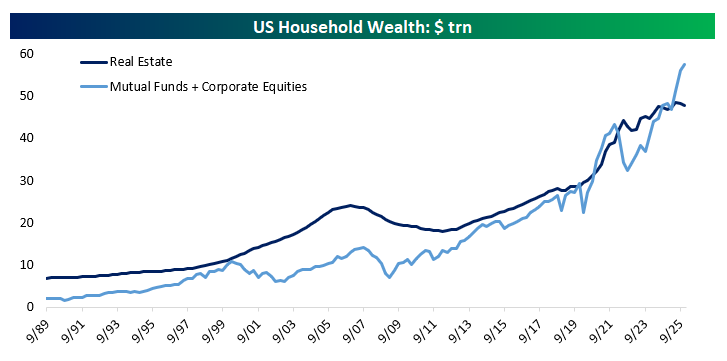
US household ownership of corporate stocks and mutual funds now totals $58 trillion, which far exceeds real estate assets totaling $48 trillion
@bespokeinvest
🇯🇵 Japan was absolutely unstoppable in the 1980s
Walkmans, VHS players, Sony TVs, and Honda cars were everywhere. Japan had become the world’s factory. The US was in panic mode — smashing Japanese cars, slapping tariffs, and starting trade wars. Sound familiar?
Here’s the full story.
After WWII, America deliberately flooded Japan with technology and patents to create a strong ally against communism. Japan didn’t just copy it — they refined and improved everything. Soon their products were cheaper, higher quality, and dominating global markets.
By the mid-80s, Japanese carmakers were eating into Detroit’s lunch. Reagan was furious. Even Trump was publicly complaining that Japan wasn’t buying enough American goods.
Then came the Plaza Accord of 1985.
The US, Europe, and Japan agreed to weaken the dollar and strengthen the yen. It worked — but too well. Japanese exports suddenly became expensive. Money poured into Japan, inflating a massive bubble in stocks and real estate. Japan started buying Hollywood studios and flaunting its wealth.
Then the bubble burst.
What followed was decades of stagnation. “Zombie companies” were kept alive on cheap government credit. Innovation dried up. Apple, Microsoft, and Samsung rose while Japan faded.
China watched closely, copied the model — but made sure to keep control of its currency.
History doesn’t repeat, but it sure rhymes.
The 1973 oil embargo first had no effect on the market, it even gained ~2% within the first week.
Then slowly reality hit.
Over the next six months the S&P lost ~15% until the embargo was lifted... just to crash another ~40% afterwards.
Everyone anticipates a rally when Hormuz reopens.
But what if the damage to the global economy is already so severe that it kicks off the next stagflationary period?
How two hedge fund analysts can take opposite sides of a trade and both build competitive advantage:
Kirk McKeown — ex-Head of Proprietary Research at Point72, previously Glenview & Tudor.
Kirk McKeown explains:
"You and I both get a 10-K, a couple 10-Qs, the last two transcripts, and a comp sheet on Lululemon."
"You take a two-year view. New CEO, closing underperforming stores — $10 goes to $25. Two-and-a-half bagger. You buy on dips."
"I come in and say it always takes longer. Alo and Vuori just launched new products. Stock's going to $6 from here. I short it."
"You're long. I'm short. We're both right."
"You need persistence of capital. I need timing."
"We're looking at the same information and bringing in different context to create competitive advantage."
Arnold Schwarzenegger on his love life:
"A conflict grew up in our relationship. She was a well-balanced woman who wanted an ordinary life, and I was not a well-balanced man and hated the very idea of ordinary life.
She thought I would settle down, that I would reach the top in my field and level off. But that's a concept that has no place in my thinking.
For me, life is continuously being hungry.
The meaning of life is not simply to exist, to survive, but to move ahead, to go up, to achieve, to conquer.
I wanted to grow. I wanted to continue on. The life she wanted would not permit that."
— from the new episode on Arnold. Available right now!