https://t.co/A2z6fOFPpt
2 days ago, @AnthropicAI released the Model Hardware Standard (MHS) — a shared specification for AI agents to safely operate physical devices.
Today I'm sharing what I've been building toward that exact future: "LabAIAgent" — an open-source, vendor-neutral gateway that lets ANY AI agent ( @OpenAI@ChatGPT , @GoogleDeepMind Research @GeminiApp , any of them exist!) discover, operate, and audit real laboratory instruments. Safely.
-> Short tutorial: https://t.co/cEsAJMkxlH
Why this matters and distinct from Anthropic MHS:
1. LabAIAgent wraps every action in six fail-closed safety layers: e-stop latch, state gates, unit-aware parameter limits, interlocks, per-actor autonomy ceilings, and e-signed human approval tokens for high-risk steps.
2. Real labs speak six protocols. RS-232 pumps, TCP readers, Windows COM SDKs, watched-folder CSV exports, HTTP, SiLA 2 — if your instrument can talk at all, an agent can drive it.
3. Agents are heterogeneous too. @claudeai (MCP-native), OpenAI, Gemini, @LangChain , @llama_index , @crewAIInc , @AutogenAI — every runtime renders the same 20 fixed tools through one gateway, one invocation path, one audit trail.
4. Built for regulated science. HMAC hash-chained audit logs (every action — including refusals), signed run records, ALCOA+ data integrity, IQ/OQ/PQ validation templates. 232 automated tests. 4 published adversarial review rounds.
5. Instrument N+1 is an afternoon, not a quarter. A ~25-line declarative driver — validation, discovery metadata, and every framework schema are derived automatically.
I'd love to hear from teams working on agentic lab automation, would love to help people in the field!
— @elonmusk@grok@bot@AnthropicAI@DarioAmodei@sama@owl_posting@eric_kabrams@thsottiaux@OpenAI · @GeminiApp@GoogleAI · @GoogleDeepMind @LangChainAI @llama_index · @crewAIInc@ag2oss@MSFTResearch@LeRobotHF@RemiCadene@Raspberry_Pi@QueraComputing@jackclarkSF@mikeyk · @alexalbert__@JensenHuang@nvidia@FutureHouseSF · @SGRodriques@andrewwhite01@EmeraldCloudLab · @benchling · @Ginkgo · @RecursionPharma
#AIAgents #LabAutomation #ModelHardwareStandard #MCP #OpenSource #DrugDiscovery #LifeSciences #Bioinformatics #Robotics #Claude #GenerativeAI #ScientificComputing #Biotech #SmartLab #Compliance
RE: “undruggable targets” With Daraxonrasib, the key insight 👇 came from putting unusual ideas together. I asked grok and ChatGPT if it could be done by AI today in the setting when Verdine invented it (not a lot of literature) and they said no or unlikely.
Today, when people talk about working on “undruggable targets” today, they are mostly talking about brute force AI and on a molecular structure and benchmarks; no interesting ideas or hypothesis or LLM approach. And this hasn’t. been very successful.
Actually, while the LLMs said they could not independently come up with this idea, that’s not a failure, I do think LLMs are helpful in this manner of combining different fields together with human hypothesis pressure-test and hypothesis generation, but when something is novel, then it’s is not in the training data and you have to see how it works in real life.
💡Gregory Verdine and colleagues took inspiration from nature: instead of simply designing a molecule that binds KRAS, could they recruit another cellular protein to help shut KRAS down?
🌟Just submitted my technical proposal to the FDA’s Expedited IND Pilot Program docket (FDA-2026-N-4699). Summary and link to paper below🌟
Only 7 comments so far. We need more voices on this! 🗣️
If YOU have any ideas or suggestions I encourage you to review the proposal and submit your own comments before the July 22 deadline. (link at bottom)
Even short, thoughtful input helps shape policy, streamline drug development, and approval to get drugs to patients faster.
===
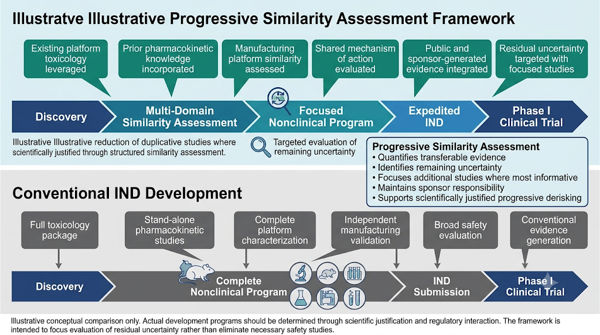
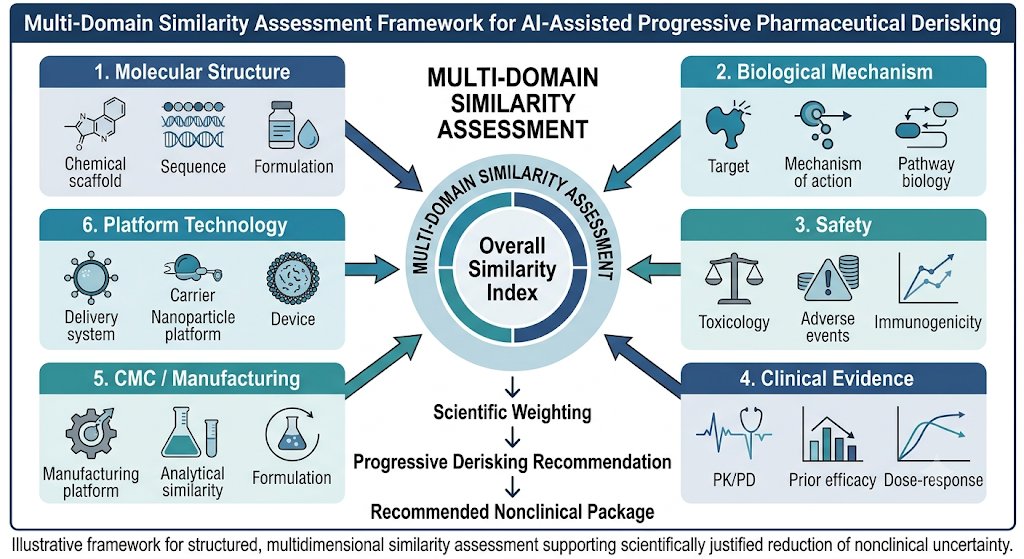
The paper proposes a Multi-Domain Similarity Assessment framework that uses AI to evaluate structural, mechanistic, safety, CMC, and platform-level similarity: allowing more structured, progressive de-risking before first-in-human studies.
Link to the full paper: https://t.co/M0RO0uDrDr
Summary of Recommendations:
We recommend that the FDA consider the following:
1.) Development of structured guidance describing multidomain similarity assessment.
2.) Explicit documentation of transferable evidence and remaining uncertainty.
3.) Pilot implementation using platform technologies with high scientific transferability.
4.) Continued sponsor responsibility for all scientific justification and safety assessments.
5.) Collection of prospective metrics including time to IND clearance, reduction in animal studies, submission quality, and clinical hold rates.
6.) Exploration of Qualified Research Institutions (QRIs) or independent scientific organizations to assist with validation of computational similarity methodologies.
Illustrative applications discussed in the proposal include:
- GLP-1 receptor agonists (class similarity and formulation-specific differences)
- PD-1 immune checkpoint inhibitors (shared biology with product-specific characteristics)
- Oral vs. subcutaneous semaglutide
- Intravenous vs. subcutaneous pembrolizumab - Oral vs. topical tacrolimus
- Lipid nanoparticle (LNP) platform technologies
- Structure–activity relationship (SAR)-based optimization of related small molecules
Direct comment link: https://t.co/EmmHZD1mhO
Full paper to be posted on @intellicitelabs later and https://t.co/6TJaq2RcHt. ✨
🌟FDA Docket FDA-2026-N-4699 Expedited IND Pilot Program is still open for comments until July 22; link at bottom of post. 🌟
If YOU have ideas, please post them. Surprisingly, currently there are only 10 comments on this important topic (& 2 of them are from me, lol 😆) People always say regulatory is what is slowing down drug approval, so this is an opportunity to make your ideas heard.
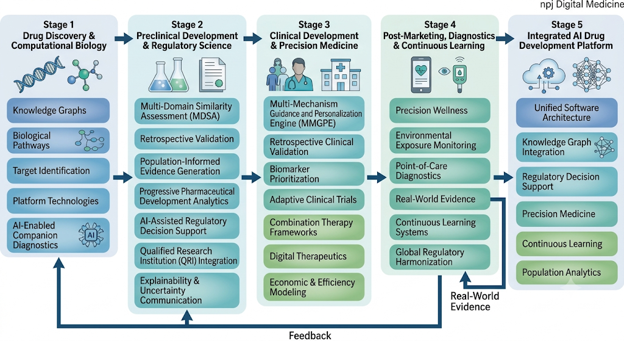
My new technical paper outlines a long-term research roadmap for AI-enabled regulatory science and pharmaceutical development.
"Future Directions in AI-Enabled Regulatory Science and Pharmaceutical Development: A Research Roadmap and Preview of Planned Technical Papers"
https://t.co/EtGUHRE4DN
This roadmap expands upon my recent response to FDA Docket FDA-2026-N-4699 regarding the proposed Expedited IND Pilot Program and describes a broader research program spanning:
• AI-enabled drug discovery
• Platform technologies
• Multi-Domain Similarity Assessment (MDSA)
• AI-assisted regulatory decision support
• Precision medicine and MMGPE
• Companion diagnostics
• Real-world evidence and continuous learning
• Integrated AI-enabled pharmaceutical development
Rather than presenting a single framework, the paper organizes planned technical papers into a modular research agenda covering the full pharmaceutical development lifecycle: from discovery through post-marketing learning.
I hope these ideas contribute to ongoing discussions surrounding modernization of regulatory science and the responsible integration of AI into pharmaceutical development!
This paper has also been submitted to FDA Docket FDA-2026-N-4699.
Public Comment link:
https://t.co/WjEg7wWYuN
AI-Enabled Progressive Derisking and Multi-Domain Similarity Assessment Frameworks for Expedited Investigational New Drug Development: A Technical Proposal for the FDA Expedited Investigational New Drug Pilot Program
https://t.co/M0RO0uDrDr
Papers will be posted on @intellicitelabs and https://t.co/6TJaq2RcHt and https://t.co/rxIhmXEFR2
The provincial pipeline has not been compressed for Isomorphic. They have never posted or published wet lab data or filed an IND or equivalent in another country. As you know this is a pre-requisite for a human study so they are in some kind of preclinical (I think in vitro testing state)
The NIH just published the first human atlas of senescent cells. It reframes everything about how senolytics should be designed. Thread.
SenNet Consortium — Farzad et al., Cell 2026. Single-cell + spatial multi-omics across multiple human organs, age groups, and disease states.
Central finding: senescence is not one state. They call them "senotypes." A senescent astrocyte in brain white matter looks nothing like a senescent hepatocyte in fibrotic liver or a B cell in an aging lymph node.
This has a direct implication: every senolytic drug developed to date has been designed against a single generic "senescent cell." That target doesn't exist as a uniform entity in human tissue.
What SenNet actually found by tissue:
Brain: age-associated endothelial + astrocyte senescence concentrated in white matter and cortical layer 1
Lymph nodes: spatial accumulation of germinal-centre B-cell senescence with progressive immune architecture remodeling
Liver (fibrotic): CDKN1A+ hepatocytes, SERPINE1+ age-associated hepatocytes, CXCL12+ fibroblasts, CXCR4+ immune cells
Chronic wounds: p16+ senescent cells spatially clustered with cytotoxic T cells — senescence + immune co-localization
Two clinical takeaways:
1. Plasma proteomic signatures from SenCat link to kidney disease, diabetes, frailty, and mortality. Senescent cell burden is detectable from blood — if you're measuring the right proteins.
2. Lipid senolytic: α-eleostearic acid kills senescent cells via ferroptosis (ACSL4–LPCAT3–ALOX15 axis). Non-pharmacological mechanism. Could be accessible via dietary lipid manipulation.
The honest caveats: heterogeneity creates a definitional risk — if every tissue produces a different senotype, "senescence" risks becoming unmeasurable. ML signatures trained on in vitro models may not map cleanly to human tissue.
But the map now exists. SenNet gives you the targets. Mayo's aptamers (published May 2026) give you the detection tool. The field is assembling the full stack.
Not medical advice — just tracking the science.
Source: Farzad et al., Cell 2026 → https://t.co/GcXljf0T3j
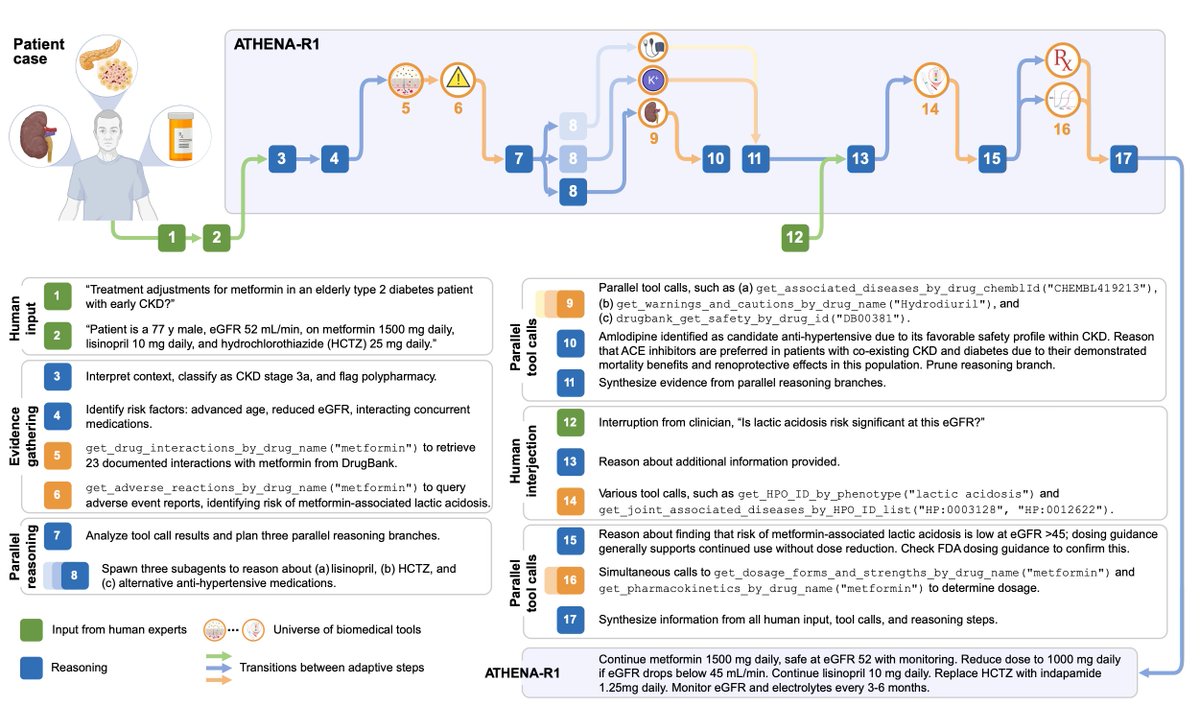
Introducing ATHENA: an AI agent for treatment reasoning across all FDA approved drugs since 1939, by stellar @GaoShanghua
Paper: https://t.co/Du5sKHGKKD
Code: https://t.co/xdA1RTiSEJ
Project: https://t.co/2WrXDaZvDk
Every treatment decision means weighing disease context, comorbidities, drug interactions, contraindications, and evidence that keeps changing. That is an iterative reasoning problem. You have to figure out what evidence to go find before you can even start forming a conclusion.
Most LLMs answer from what is stored in their weights. Give agents tools and they often still do not use them well. Having access to a biomedical database does not automatically mean a model knows when to query it, what to ask, or how to weigh what comes back.
When I think of HIMS, I don’t think of a few labs they happen to offer.
“focuses on accessible, direct-to-consumer telehealth for:
• Sexual health
• Hair loss
• Dermatology
• Mental health
• Weight management (GLP-1s like Wegovy/Zepbound, a major recent growth driver)
• Broader wellness”
Blaming FDA or regulatory systems is a cop out for AI x Bio companies for lack of progress as most do not have compounds that work in bench lab experiments or animal models. You can’t blame regulatory until you have a compound that can go undergo regulatory review.
There is no moat in data if the data doesn’t generate drugs that work and are safe in humans.
Another point in AI in Math vs. AI in Bio (outside of clean data for training for Math) and why capabilities in Math may not transfer to Bio is that the test for Bio is if it works in real life; can’t get around that. However, for math it’s theoretical, the verification is by humans and can take months.