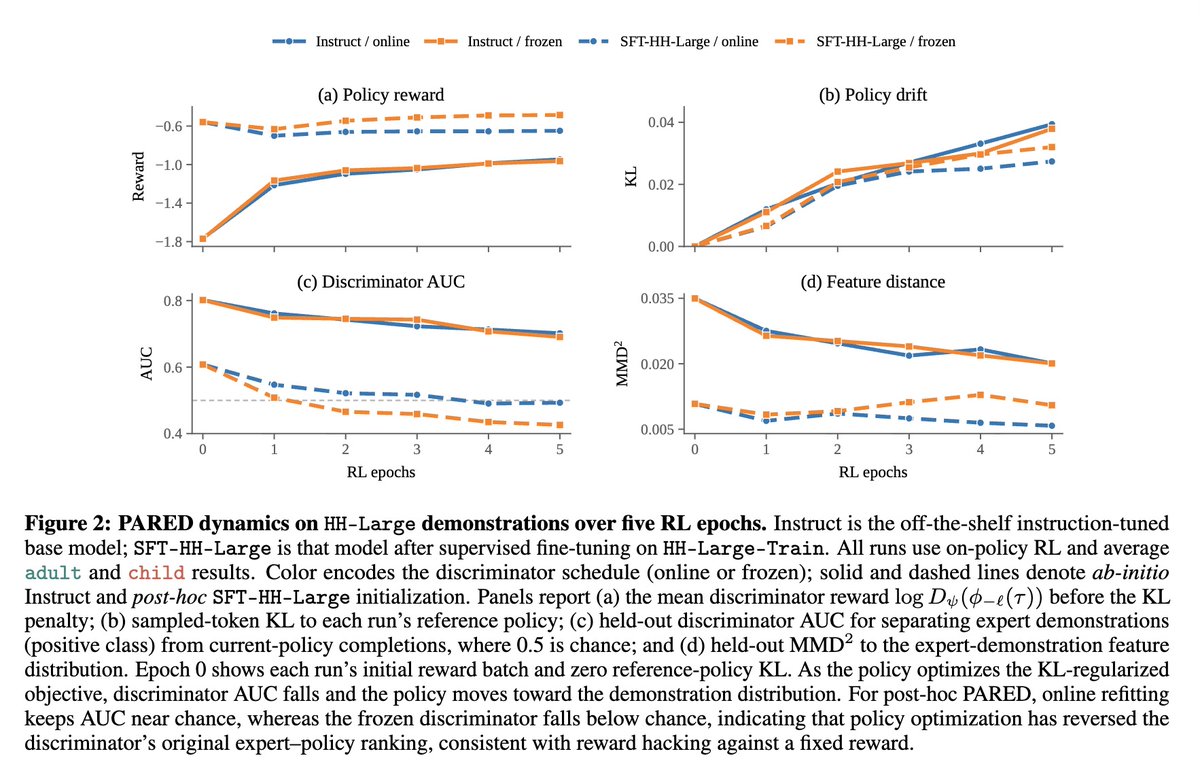
Most alignment methods use demonstrations for SFT and preference data for reward learning.
We ask: can demonstrations themselves define the reward?
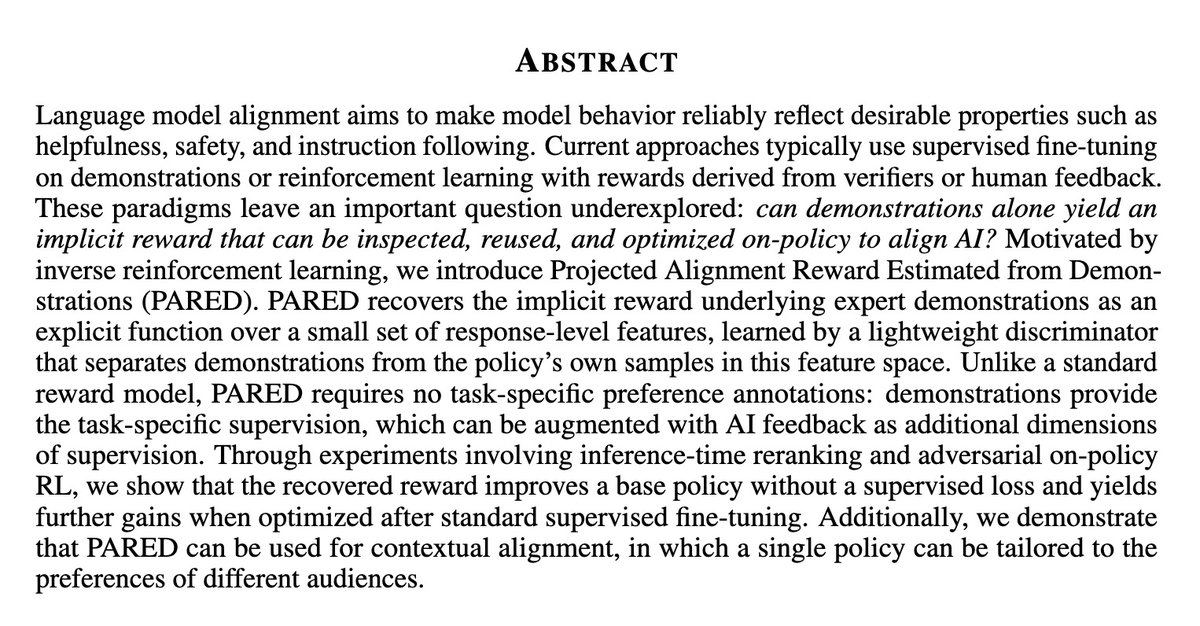
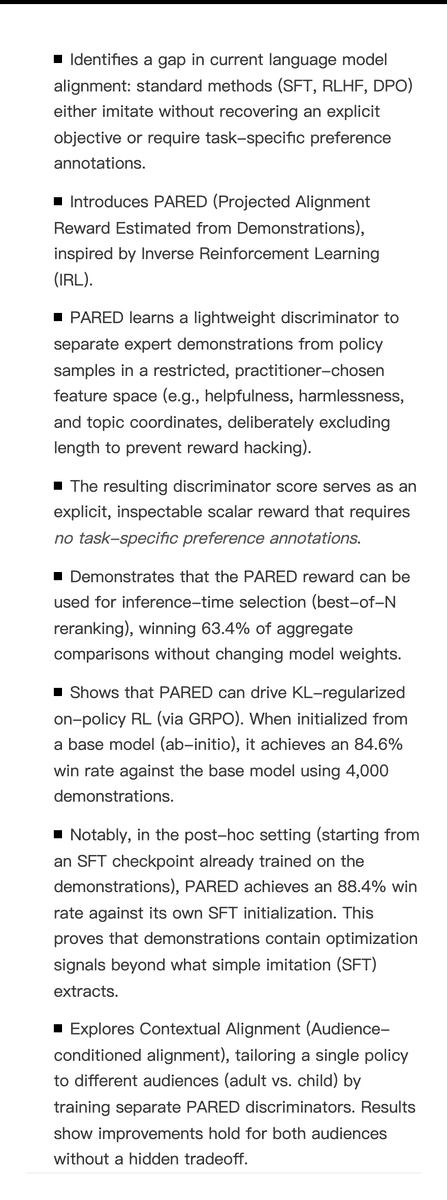
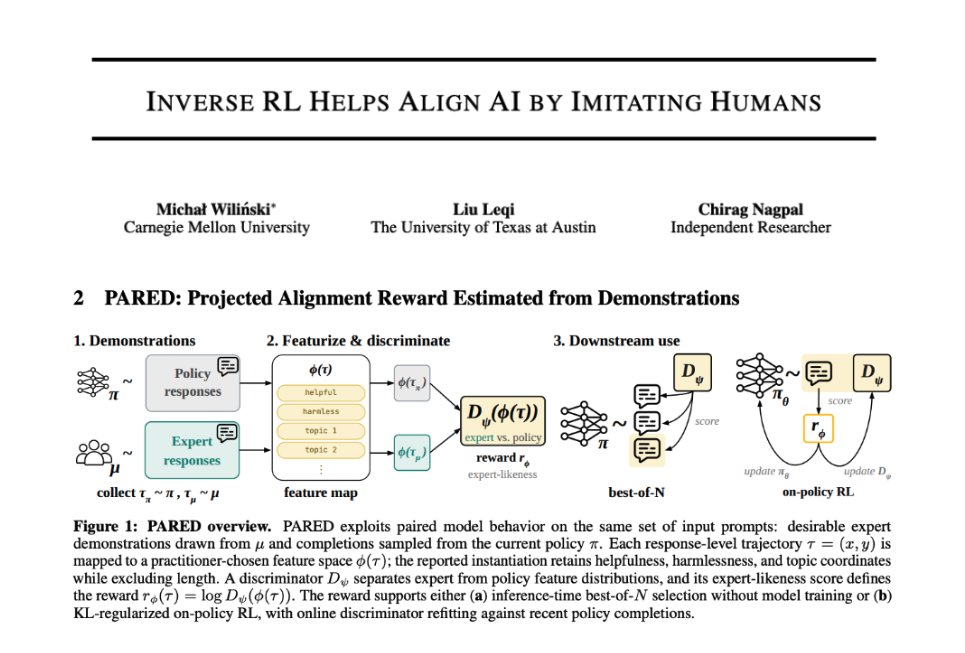
PARED learns an explicit reward over a small, interpretable set of response features, then uses it for reranking and on-policy RL.
Paper ↓
🧵New Paper: Inverse RL Helps Align AI by Imitating Humans 👥👉🤖
w/ @inverse_hessian@leqi_liu
1/ Can expert demonstrations alone yield an explicit, inspectable reward for aligning Language Models — without preference labels or external verifiers?
In our new paper, we show how Inverse Reinforcement Learning changes the AI alignment paradigm 👇 🔗 https://t.co/0hrFyyp7Mc
I’ve spent quite a few years in academia, but it was only when @pfbudzianowski and I started Lute that I realised I feel more like an innovator than a scientist. I enjoy research, and it’s a good feeling when a paper finally comes out. By then, though, I’m usually already thinking about what it would take to get the robot out of the lab and into the hands of someone who could use it in their everyday work. For me, the paper is just the beginning.
@lutecompany is my third go at taking that next step and turning an idea into a product. I’m proud that my first two ventures are still going, and what I learned from both gave me the confidence to give it another go with Paweł.
Today we get to share some good news. We’ve raised a new round of funding! It’s a big moment for our whole team, and what excites me most is that we’ll get to spend more time putting our robots to work alongside the people we’re building them for.
It’s already been a bit of a crazy ride, and I can’t wait to see where we take Lute next.
I am excited to share: we have raised $20M in seed funding to put physical intelligence to work.
At Lute, we're building a new family of foundation models based on tactile input.
After 10 months of building and deploying across retail and integrators we are announcing our seed round, backed by @otb_ventures https://t.co/i3jzwBwf6B @CredoVentures@Seedcamp Inovo VC Borusan Ventures @ffvc@naval
I'm honored to receive the Google PhD Fellowship in ML & ML Foundations.
Grateful to my advisors Aymeric Dieuleveut and Michael Jordan (@JordanMich45361 ), to my colleagues at Polytechnique and in Sierra (@Sierra_ML_Lab) at Inria (@Inria ), and to Google for supporting my work.
Standard PG analysis requires "all-iterate coverage" ie bounded π*/π_t ∀𝐭. What if we only assume it at 𝐭=𝟎 (eg base model has nontrivial success rate on all prompts)?
Ans: 𝐞𝐱𝐩𝐨𝐧𝐞𝐧𝐭𝐢𝐚𝐥 complexity due to "coverage collapse". https://t.co/K3oQqoznV1
I'll be in Austin for #CoRL2026 presenting our work on Learning What to Say to Your VLA!
🎤 Spotlight Presentation S1
📅 Monday, 9:00 AM
📍 Hilton Austin, Grand Ballroom (6th Floor)
📌 Poster Session P1
📅 Monday, 5:00 PM
📍 JW Marriott Austin, Lone Star (3rd Floor, No. 64)
Coming to CoRL 2026 in Austin? Join us at Lute Evening on Nov-10
@VMontesinos_ and @kobi_kelemen will be there to talk about robot data, policies on real hardware and deployment outside the lab.
Tue, November 10, 6:30 PM.
Spots are limited: https://t.co/fVXq3dY62y
#CORL2026
Foundation models are trained in stages: pretraining, midtraining, and post-training. But is this separation fundamental?
We introduce unified training: a single algorithm for the full pipeline. This gives
⚙️ Simpler infrastructure
🔬 A framework for better science
(1/n)
Is RL optimizing the right objective? 🤔
Should we maximize mean reward? Best-of-k? Which k?
Standard RL pulls on the mean and often the distribution collapses to a spike. The tail dies 🥲
We introduce Tail-Likelihood Reinforcement Learning (TailRL).
It maximizes the mean reward while simultaneously maximizing coverage over high reward outputs.
🧵 1/n
[LG] Inverse RL Helps Align AI by Imitating Humans
M Wiliński, L Leqi, C Nagpal [CMU & The University of Texas at Austin] (2026)
https://t.co/n6F1MRPJU0
Inverse RL learns generalizable (and potentially interpretable) reward models from expert demonstrations that can be used for downstream RL post-training.
Excited to share the first paper of my PhD!
If you’ve ever tried to control a VLA via natural language, you know it rarely does what it is told. 🗣️ We introduce a multi-stage pipeline for training a Language Feedback Policy (LFP) to steer a VLA in-the-loop.
Robotics and other real-world tasks often deal with benign partial observability. When should you use cheap expert distillation vs. expensive end-to-end RL under this setting? I will dig into this tradeoff next Tuesday at the RL Theory Seminar!
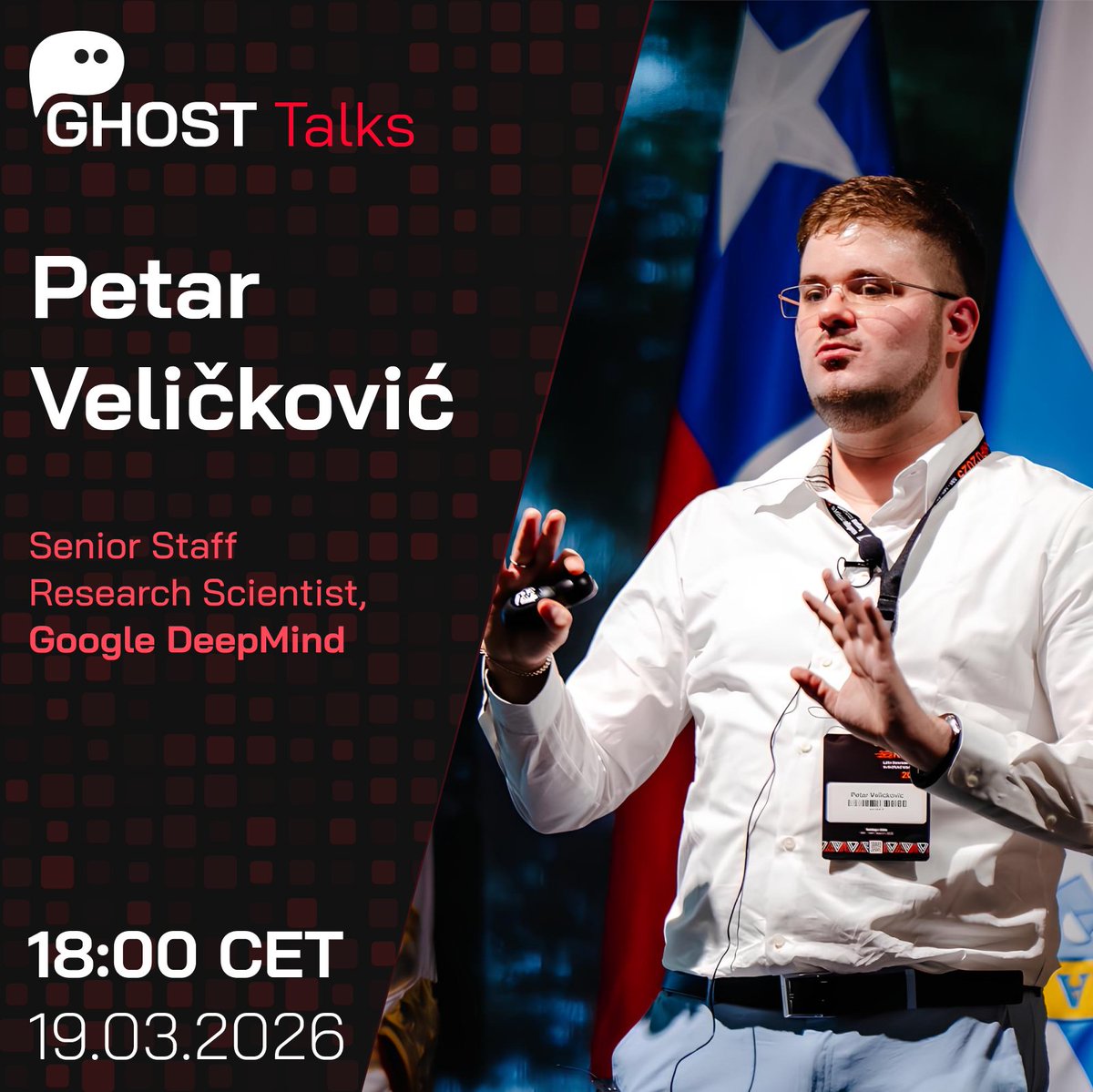
📢 Do not miss our first GHOST Talk with Petar Veličković!
We are thrilled to launch the GHOST Talks series with Petar Velickovic, a Senior Staff Research Scientist at Google DeepMind, Affiliated Lecturer at the University of Cambridge, and Associate of Clare Hall, Cambridge!
⬇️