@edstromandrew My guess: Apple/Amazon/Meta care about “harvest now, decrypt later.” Encrypted data can be stored today and broken years later, so they need PQ now.
People keep saying AI coding agents can only build basic, cookie-cutter apps. I decided to prove them wrong.
For my first major public demo, I spent some time pushing @Replit 's AI agent to its absolute limit. The result? I rebuilt macOS entirely on the web. No templates. No imported UI libraries. 100% vibecoded using natural language.
As the AI Chief of Staff at Replit, I spend my days building enterprise-grade platforms for our internal teams, but I wanted to see how far a solo developer could take a passion project just by talking to an AI.
What’s inside:
💻 A functional VS Code replica with an integrated terminal and multi-agent AI copilot.
🔌 Custom MCP servers hooked up to fetch, PostgreSQL, Stripe, and GitHub.
🤖 A rebuilt "Siri" that actually controls the OS -changing wallpapers and opening apps via voice or text.
🕹️ Parallels Desktop running Windows XP, Ubuntu, and games like Mario Kart.
📱 AND... I asked Agent 3 to turn it into an iOS mobile app in one shot. It actually worked.
The ceiling for software creation has been completely blown open with Agent 3. And 4 those who know... greater things are coming soon :)
We are way past basic web apps.
What are you building? 👇
Very interested in what the coming era of highly bespoke software might look like.
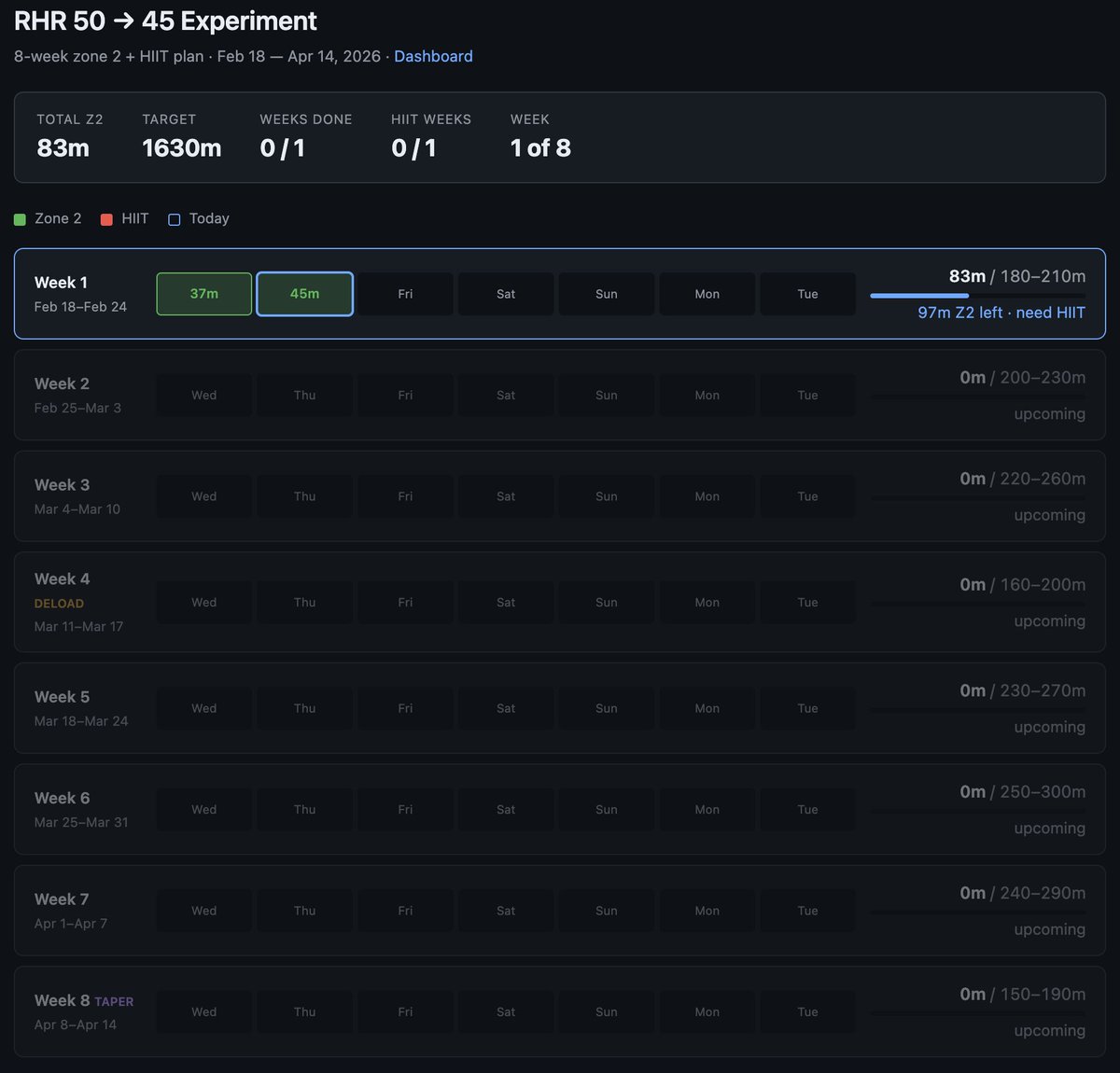
Example from this morning - I've become a bit loosy goosy with my cardio recently so I decided to do a more srs, regimented experiment to try to lower my Resting Heart Rate from 50 -> 45, over experiment duration of 8 weeks. The primary way to do this is to aspire to a certain sum total minute goals in Zone 2 cardio and 1 HIIT/week.
1 hour later I vibe coded this super custom dashboard for this very specific experiment that shows me how I'm tracking. Claude had to reverse engineer the Woodway treadmill cloud API to pull raw data, process, filter, debug it and create a web UI frontend to track the experiment. It wasn't a fully smooth experience and I had to notice and ask to fix bugs e.g. it screwed up metric vs. imperial system units and it screwed up on the calendar matching up days to dates etc.
But I still feel like the overall direction is clear:
1) There will never be (and shouldn't be) a specific app on the app store for this kind of thing. I shouldn't have to look for, download and use some kind of a "Cardio experiment tracker", when this thing is ~300 lines of code that an LLM agent will give you in seconds. The idea of an "app store" of a long tail of discrete set of apps you choose from feels somehow wrong and outdated when LLM agents can improvise the app on the spot and just for you.
2) Second, the industry has to reconfigure into a set of services of sensors and actuators with agent native ergonomics. My Woodway treadmill is a sensor - it turns physical state into digital knowledge. It shouldn't maintain some human-readable frontend and my LLM agent shouldn't have to reverse engineer it, it should be an API/CLI easily usable by my agent. I'm a little bit disappointed (and my timelines are correspondingly slower) with how slowly this progression is happening in the industry overall. 99% of products/services still don't have an AI-native CLI yet. 99% of products/services maintain .html/.css docs like I won't immediately look for how to copy paste the whole thing to my agent to get something done. They give you a list of instructions on a webpage to open this or that url and click here or there to do a thing. In 2026. What am I a computer? You do it. Or have my agent do it.
So anyway today I am impressed that this random thing took 1 hour (it would have been ~10 hours 2 years ago). But what excites me more is thinking through how this really should have been 1 minute tops. What has to be in place so that it would be 1 minute? So that I could simply say "Hi can you help me track my cardio over the next 8 weeks", and after a very brief Q&A the app would be up. The AI would already have a lot personal context, it would gather the extra needed data, it would reference and search related skill libraries, and maintain all my little apps/automations.
TLDR the "app store" of a set of discrete apps that you choose from is an increasingly outdated concept all by itself. The future are services of AI-native sensors & actuators orchestrated via LLM glue into highly custom, ephemeral apps. It's just not here yet.
one of the biggest realizations I've had working on Claude Code is that you fundamentally have to design agents for prompt caching first, almost every feature touches on it somehow
I wrote this in a day but it's the culmination of months of learnings, hope you enjoy it
It’s time for bitcoiners to step up and build. You don’t need to know anything about software development anymore, you just need to know how to write words!
We have a golden opportunity to build out agentic payments based on open money, rather than letting agentic payments be captured by megacorps yet again. But we’re squandering it arguing about useless crap instead of building.
Play with openclaw, give it a bitcoin wallet (moneydevkit makes this super easy! Also Lexe and phoenixd!), make it do things. If it fails to do what you want, go fix it! Have your agent build that bitcoin domain reseller, that bitcoin airline ticket reseller, or whatever it is you want!
Bitcoin doesn’t just happen, it’s built. Join in.
@futurism This article is such a horrible take and doesn’t follow your stated belief in “clearheaded news coverage.”
Rather than take an objective look at @SteaknShake’s innovative approach to investing in their employees futures, the author tells the reader just how much they despise #bitcoin. Why do you write for a “Future” oriented publication when you can’t be open to a technological movement Bitcoin that gives millions globally optimism and hope for the future?
Instead, the author clearly suggests Bitcoin is likely to “collapse” and is used to buy drugs—no suggestion whatsoever that the outcome could be positive or that Steak ‘n Shake’s Bitcoin payments rollout has been a success. This just shows how closed off and one sided the author is.
https://t.co/6YhjTAjRCg
Sure, achieving consensus is potentially harder than updating encryption across countless centrally controlled apps and services. The motivation to achieve PQ security will only get greater with time. And if we don’t manage to get consensus, then we’ll likely fork (likely because of differing opinions on what to do with Satoshi’s coins).
I’m not saying there shouldn’t be more investment into integrating quantum resistant signatures; I just don’t believe we (all actors in the network) will fail to upgrade BTC and let it wither and die. Of course that doesn’t mean we shouldn’t sit idly on our hands.
@Wealth_Theory Bad take IMO. Bitcoin has more awareness than ever. We are in a transitional phase. AI is going to empower Bitcoin builders like never before.
Eight months ago today, Steak n Shake launched its burger-to-Bitcoin transformation when we started accepting bitcoin payments. Our same-store sales have risen dramatically ever since.
All Bitcoin sales go into our Strategic Bitcoin Reserve.
Today we increased our Bitcoin exposure by $10,000,000 in notional value.
We have created a self-sustaining system — growing same-store sales that grow the SBR. Improving food quality expands Steak n Shake's reach and leverages Bitcoin into a new and delicious dimension. 🚀
If you like vibecoding, bitcoin, and on-the-nose metaphors: being inspired by your peers to make better projects faster starts with a spark. Flint is a curated community for vibecoders building with bitcoin, AI, and experimental tech. Join us: https://t.co/QQX6vQjEaZ