This is a very good example of how democracy works at a local level in China 👇
To explain succinctly, at every administrative level in China, they have a "people's congress" (人民代表大会 - rénmín dàibiǎo dàhuì).
At the county, district and township level, representatives are directly elected by voters in their constituencies. Above that (prefectural cities, provinces, and the National People's Congress) - representatives are elected by the congress one level below.
Depending on the location, local people's congresses have more or less oversight power on local spending, appointments, and policy.
Zhejiang province is one of the places in China where people's congresses have the most power after an official named Xi Jinping - you may have heard of the guy - established a framework called "do practical things for the people" (为民办实事 - wèi mín bàn shí shì) when he was provincial party secretary in the early 2000s.
What "do practical things for the people" established was a principle that local people's congress representatives should have a direct say in how local public money got spent. Over time, this evolved into a formal voting system where representatives vote on proposed government projects.
They just exercised this power in a major way: the Huangyan District People's Congress (黄岩区人大) in Taizhou, Zhejiang voted on 16 major government investment projects for 2026 but killed two of them on the spot - a sports center and an irrigation megaproject, totaling over a billion yuan - with roughly 80% voting against.
This doesn't mean these 2 projects are dead forever but they're sent back to the drawing board. The responsible departments have to address whatever concerns representatives raised, bring in experts for further review, and resubmit when they're ready.
This is a level of local democracy that many people will probably be surprised exists in China: it's genuine democratic oversight, they can actually block government spending, and the executive has to go back and try again.
It's also - and this is where China is complex - something that surprised many people in China.
As I mentioned above, not all people's congresses have this sort of power and the story generated a lot of national interest - with many national outlets writing about it, such as Guancha (https://t.co/Ad94EJH3vt) or The Paper (https://t.co/EPPcXQxXRV).
So much so that the Zhejiang People's Congress deleted their original WeChat post about it. We don't know why - the story wasn't suppressed since so many state media outlets carried it - but the Zhejiang People's Congress probably didn't love being the face of a national debate about why other provinces aren't doing this too, as it amounts to throwing shade on their peers. I genuinely don't know, just a hypothesis.
Anyhow, that's China in all its complexity and why sweeping narratives about it are always wrong: a country where elected local representatives can genuinely exercise oversight power over the government thanks to reforms initiated by Xi Jinping himself, and where mainstream media boast about it, but where the provincial organ that broke the story would rather avoid the publicity.
The World Cup is exposing an uncomfortable truth about international relations: citizens of countries in the Global South face systemic discrimination in visa and immigration procedures.
The US government, citing national security authorities, has issued an export control directive to suspend all access to Fable 5 and Mythos 5 by any foreign national, whether inside or outside the United States, including foreign national Anthropic employees.
The net effect of this order is that we must abruptly disable Fable 5 and Mythos 5 for all our customers to ensure compliance.
Access to all other Claude models is not affected.
We apologize for this disruption to our customers. We believe this is a misunderstanding and are working to restore access as soon as possible.
Read our full statement: https://t.co/bwn0sximKZ
Indeed, China GDP exceeded it the US around 2015. It is now 22% vs 16%. The gap will obviously increase if China grows faster than the US. And by the Balassa-Samuelson effect, the yuan will tend to appreciate which will bring China's GDP in exchange rate closer to the US. (The graphs below are all in PPPs; notice India vs. UK; it is from my GGT; Chapter 1).
Introducing Claude Fable 5: a Mythos-class model that we’ve made safe for general use.
Its capabilities exceed those of any model we’ve ever made generally available.
China's industrial subsidies are overwhelmingly in the form of below-market borrowing.
These subsidies rely on financial repression: artificially low interest rates, capital controls, and forcing institutional investors to hold domestic government bonds.
It would be difficult for the West to emulate this because Western economies have become so financialised — heavily shaped by the interests of for-profit capital — and so thoroughly convinced that entrepreneurship is an individual rather than a collective endeavour.
If the West is serious about industrial policy, it should look to learn from China's model: one built on collective entrepreneurship and the disciplining of private capital.
But this is clearly not what is happening. Instead, Western countries simply complain that China's industrial subsidies are “unfair.”
Eu acho incrível como o design gráfico angolano perdeu qualidade artística ao longo dos anos, especialmente em capas de música/álbum que em teoria seria o lugar ideal para experimentação. Olha só para a qualidade e diversidade disso aqui
The African continent doesn’t need more entrepreneurs. It’s full of them.
What it needs is a specific class of entrepreneurs called industrialists: business people who build value-adding firms in export-oriented job creating sectors, not rent capture.
Automakers around the world are partnering with Chinese EV companies for their tech:
- Volkswagen + XPeng
- Stellantis + Leapmotor
- Toyota + BYD
- Audi + Huawei
- Tata + Chery
- CATL + everyone
According to data from the World Bank, the share of the population living in extreme poverty ($3/day PPP) is now higher in the United States than in China.
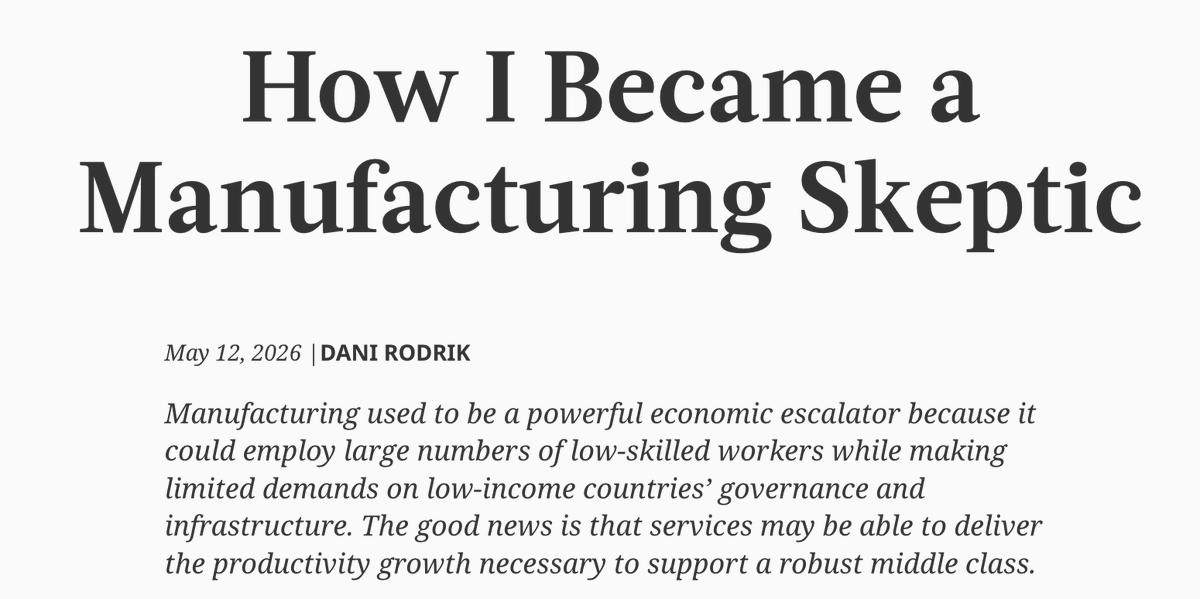
I believe Dani Rodrik's manufacturing scepticism is misguided. In this post, I'll explain why.
Rodrik is increasingly endorsing a view that developing countries must look to high-value services, because, according to him, manufacturing-led development has become harder and less feasible.
I think he misreads the evidence. Manufacturing-led development has *always* been hard.
And, crucially, among major economies that have transformed their economies from poor to rich, all of them have done so via developing a strong manufacturing sector.
This continues to be the case. The two fastest-growing economies in the 21st century, China and Vietnam, have put manufacturing front and centre of their development strategies.
Why do countries need manufacturing to transform their economies from poor to rich? Here are three important reasons:
1. Manufacturing provides the material foundation for innovation. In fact, manufacturing is attributed to 53% of global R&D activity, far higher than services.
2. Manufacturing activities lend themselves more easily to mechanization and chemical processing. This, combined with the ease of spatially concentrating manufacturing production, enhances the potential of productivity growth through economies of scale.
3. Export of goods (dominated by manufactured goods) accounts for roughly 80% of all global exports. Exports allow countries to specialize, achieve scale, and become competitive, all of which accelerate productivity growth and technological development. A factory can produce for millions of global consumers; most services remain constrained by local demand.
This being said, we should not dismiss the growing importance of services for development. Together with Rohan Sandhu, Rodrik has done some important research on the development potential of some services. In particular, small countries can afford to take a service-led path — and have done so historically.
But advising countries to dismiss manufacturing-led strategies runs counter to what the evidence on economic development consistently shows.
The United States will slash the number of embassies in Africa that process visas by more than half, the Associated Press reported on Monday, citing sources. https://t.co/dUkAPfucRX
EUA decidem classificar PCC e Comando Vermelho como organizações terroristas.
O governo brasileiro é contra essa designação. Teme que a classificação possa representar um risco de intervenções militares estrangeiras e um risco à soberania brasileira e de sanções.
Confira reportagem completa: https://t.co/HBVR17rwxV
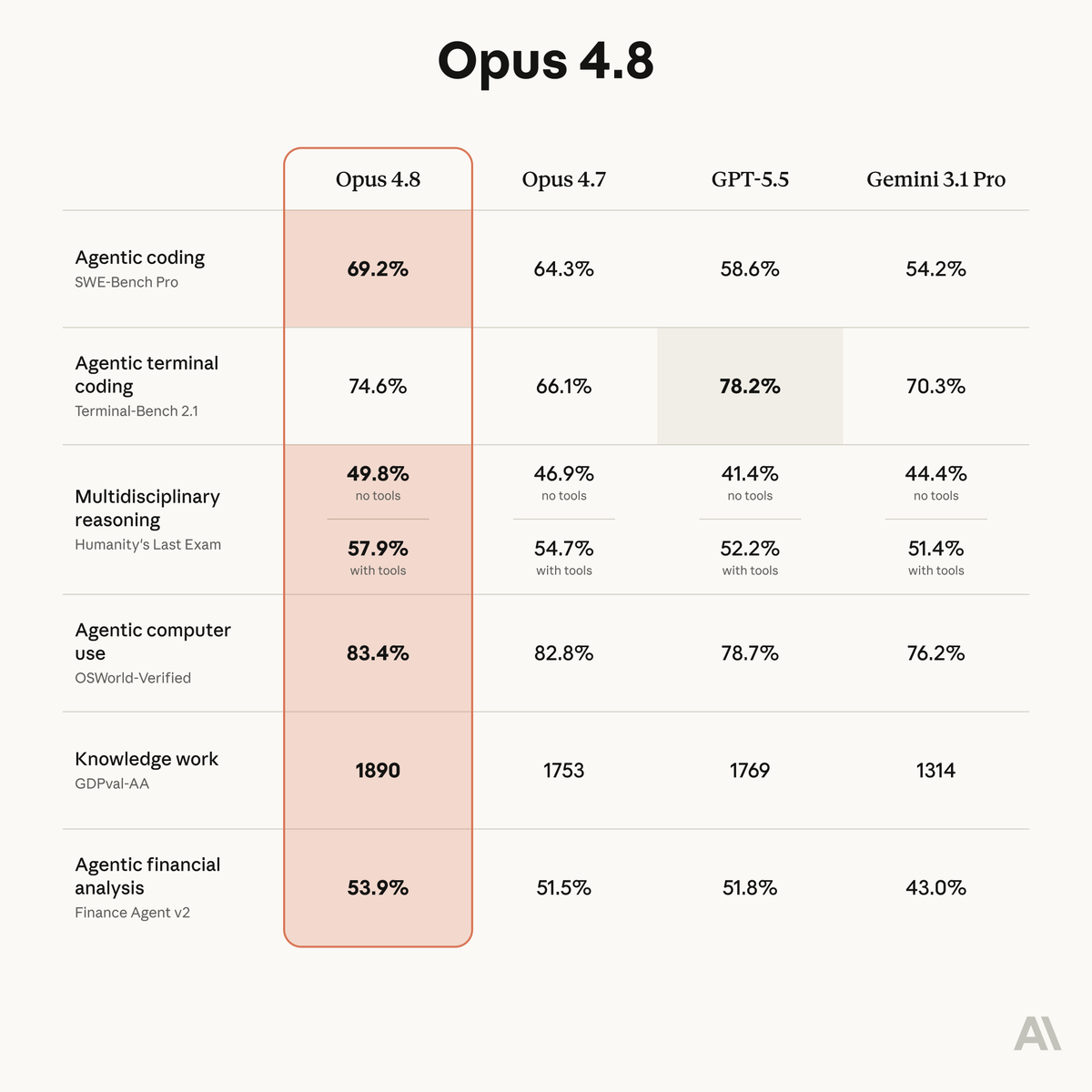
Introducing Claude Opus 4.8: it builds on Opus 4.7 with sharper judgment, more honesty about its own progress, and the ability to work independently for longer than its predecessors.
Available today at the same price.
In his latest @BrankoMilan calculates that, measured in terms of population-weighted-growth points, China’s growth was 20 times larger than that of boom-time Japan and more than 290 times larger than the growth of gilded age America.
#AfDBAM2026: Congo’s President @SassouNGuesso_ announced visa-free access for all Africans on #AfricaDay 2026 and urged further action to deepen unity across Africa. His announcement at the @AfDB_Group Annual Meetings in #Brazzaville, marks another major step forward for continental integration.
More from the #AfricaDay2026 session: https://t.co/dLcvoWhgm9
“In the report's most striking finding, Morocco has overtaken South Africa as the continent's leading industrial economy, driven by sustained industrial upgrading, export diversification, and strong industrial policy.”https://t.co/uebZv2JcNB