Exciting news to kick off London Tech week: Londoners can now sign up to experience @wayve_ai autonomous rides on @Uber which are launching soon (pending final regulatory approval). 🇬🇧
Join our interest list today: https://t.co/LiNPED5Sku
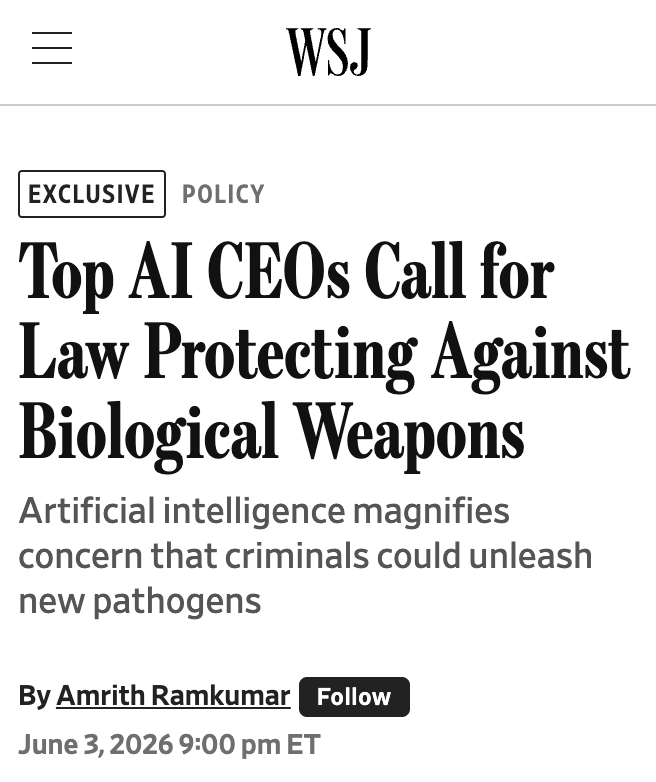
No one should be able to order a bioweapon through the mail.
@IFP & @JoinFAI are proud to co-lead an open letter calling for mandatory DNA synthesis screening & recordkeeping.
Signatories include:
- Sam Altman, CEO & Co-Founder, OpenAI
- Dario Amodei, CEO & Co-Founder, Anthropic
- David Baker, Director, Institute for Protein Design; 2024 Nobel Prize in Chemistry recipient
- Patrick Collison, CEO & Co-Founder, Stripe
- Paul Graham, Founder, Y Combinator
- Demis Hassabis, CEO, Google DeepMind; 2024 Nobel Prize in Chemistry recipient
- Emily Leproust, CEO & Co-Founder, Twist Bioscience
- Lawrence Lessig, Roy L. Furman Professor of Law and Leadership, Harvard Law School
- Gerald W. Parker, former Special Assistant to the President for Biosecurity and Pandemic Response
- Mustafa Suleyman, CEO, Microsoft AI
- Alex Tabarrok, Professor of Economics, George Mason University
- Alexandr Wang, Chief AI Officer, Meta; Founder, Scale AI
- Christine E. Wormuth, President & CEO, Nuclear Threat Initiative; 25th Secretary of the Army
Read the letter and see the full list of signatories: https://t.co/BwZiJXw3JT
Many DNA synthesis companies voluntarily screen orders to mitigate biosecurity risks, but no law requires them to do so.
Leaders in AI, biotech, life sciences, national security, and the nucleic acid synthesis industry agree that Congress should act to strengthen safeguards against biological threats.
@deanwball put it well in the WSJ:
“If you’re synthesizing the stuff that yields biological life and viruses, we’re asking you to screen to see whether it is dangerous in some way. That seems like a reasonable thing for society to insist upon.”
One of the most amazing things I’ve ever seen: a standing ovation for the full Daraxonrasib results
I feel inspired and energised, to put it mildly — we have a targeted therapy for pancreatic cancer now, and nothing is undruggable anymore
it’s a bit ridiculous to say “the time you spend scrolling could be spent building a business/writing a novel/reading the classics”. sometimes that’s true but usually scrolling happens as a result of cognitive fatigue, and the idea that you can just “swap in” another intellectually demanding task means you’re treating your body/mind as a machine
a better approach would be “the time you spend scrolling could be spent taking a stroll/napping/staring out the window/having a meandering conversation with a friend”. that’s both more palatable and probably what we’re actually craving when we reach for our phone: a brief break from the demands of life, and a time to let our mind relax
Taylor Swift became a billionaire by selling a billion dollars’ worth of music to willing buyers. It’s true that, for instance, she used a microphone made by someone else, but that person got compensated as part of the process of her becoming a billionaire.
Finally, best news of the morning (and something you didn't expect so soon)...
Revolution Medicines $RVMD daraxonrasib Ph3 results in second-line pancreatic cancer.
Median overall survival in ITT patients (KRAS mutants + wild type combined) Dara 13.2 months vs chemo 6.7 months.
OS Hazard ratio 0.40
“Corporate farming methods” are why you don’t have to do backbreaking work as a farmer anymore and why starvation is the exception rather than the rule around the world today
This is such a good example of the "men are beings with agency and responsibility inside them, while women's agency and responsibility comes down from their environment" view
If you call yourself a progressive, and you’re not even a little excited by the prospect of a woman-hating, gay-hating, Jew-hating neanderthal regime that in no way represents the will of its people being crushed, you’re not actually a progressive.
🏡 New policy paper from @ASI! ⚛️
Last week, @M_W_Palmer and I released the Growth Agenda, our appraisal of the British economy.
We calculated that, in 10 years, we could make every British household £6,800 better off.
🧵 [1/12]




![JasperOstle's tweet photo. 🏡 New policy paper from @ASI! ⚛️
Last week, @M_W_Palmer and I released the Growth Agenda, our appraisal of the British economy.
We calculated that, in 10 years, we could make every British household £6,800 better off.
🧵 [1/12] https://t.co/lAHuv4X3nW](https://pbs.twimg.com/media/G_7fpwKXMAAQx1A.jpg)


