New @AJR_Radiology Accepted Manuscript:
"Out-of-the-Box Large Language Models for Detecting and Classifying Critical Findings in Radiology Reports Using Various Prompt Strategies"
By Dr @ishtalati & team @StanfordRad
https://t.co/kHUgn2k2iB
In collaboration with Stanford, implemented an open-source two-phase, weakly supervised fine-tuning approach for LLM #npj to extract critical and incidental findings from radiology reports https://t.co/pQbEyn7pQZ @MayoRadiologyAZ@StanfordAIMI
A multimodal foundation model for medical images from 15 million image-text pairings https://t.co/Xcqu4Xj3pL @NEJM_AI open-source, open-access paper
@hoifungpoon@MSFTResearch
We have a strong belief that radiology reports need to be explainable to patients that receive them. We have been working to make this technologically possible. Our work, ReXplain describes our approach and delighted to share today that it will be published in Proceedings of Machine Learning Research (PMLR), through the AIMedHealth AAAI bridge program.
Led by Luyang Luo in my group, and with @TherealDoctorJ, @XiaomanZhang99 , Abhinav Kumar, Ramon R. Ter-Oganesyan, Stuart T. Schroff , Dan Shilo, Rydhwana Hossain, Michael Moritz.
Paper here: https://t.co/Dvlpp2oQT5
@harvardmed
Imagine tracking a disease's every move.
Traditional AI views medical images as single snapshots.
But what if we could enable AI to see not just a snapshot, but the entire story?
We're introducing RadGraph2, to enable radiology AI models to track disease changes over time.
1/
"From basic research to the bedside, precise terminology is key to advancing medicine and ensuring optimal and appropriate patient care."
Leonid Chepelev, David Kwan, @cekahn, Ross Filice, Kenneth Wang
https://t.co/ntkEE76gF1
📣 CRFM announces PubMedGPT, a new 2.7B language model that achieves a new SOTA on the US medical licensing exam. The recipe is simple: a standard Transformer trained from scratch on PubMed (from The Pile) using @mosaicml on the MosaicML Cloud, then fine-tuned for the QA task.
Dear ImageNet pre-training, you're out of fashion. Enter self-supervised learning (SSL) for chest X-ray interpretation, no matter what your task or dataset.
We show *much better* generalization on a range of datasets and tasks from around the world https://t.co/3QX5VdLAGB
A 🧵
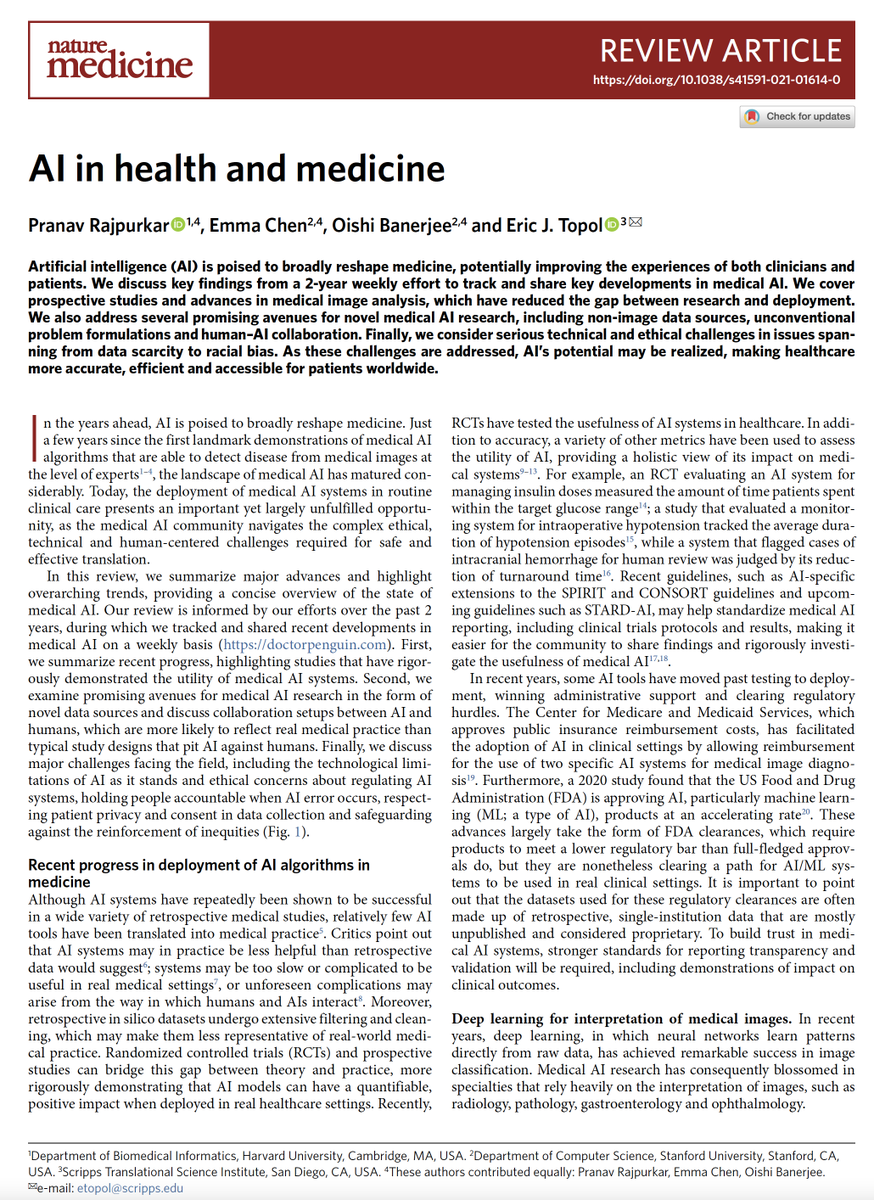
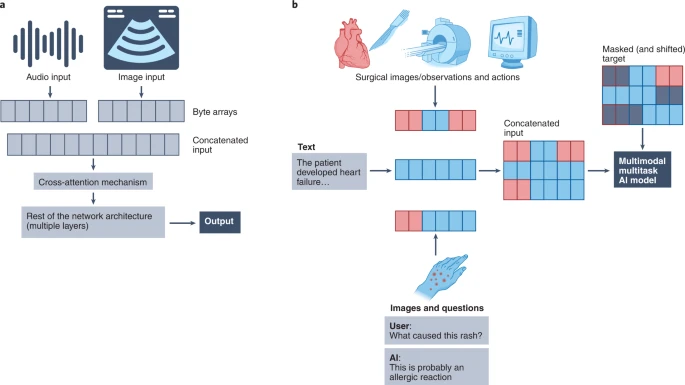
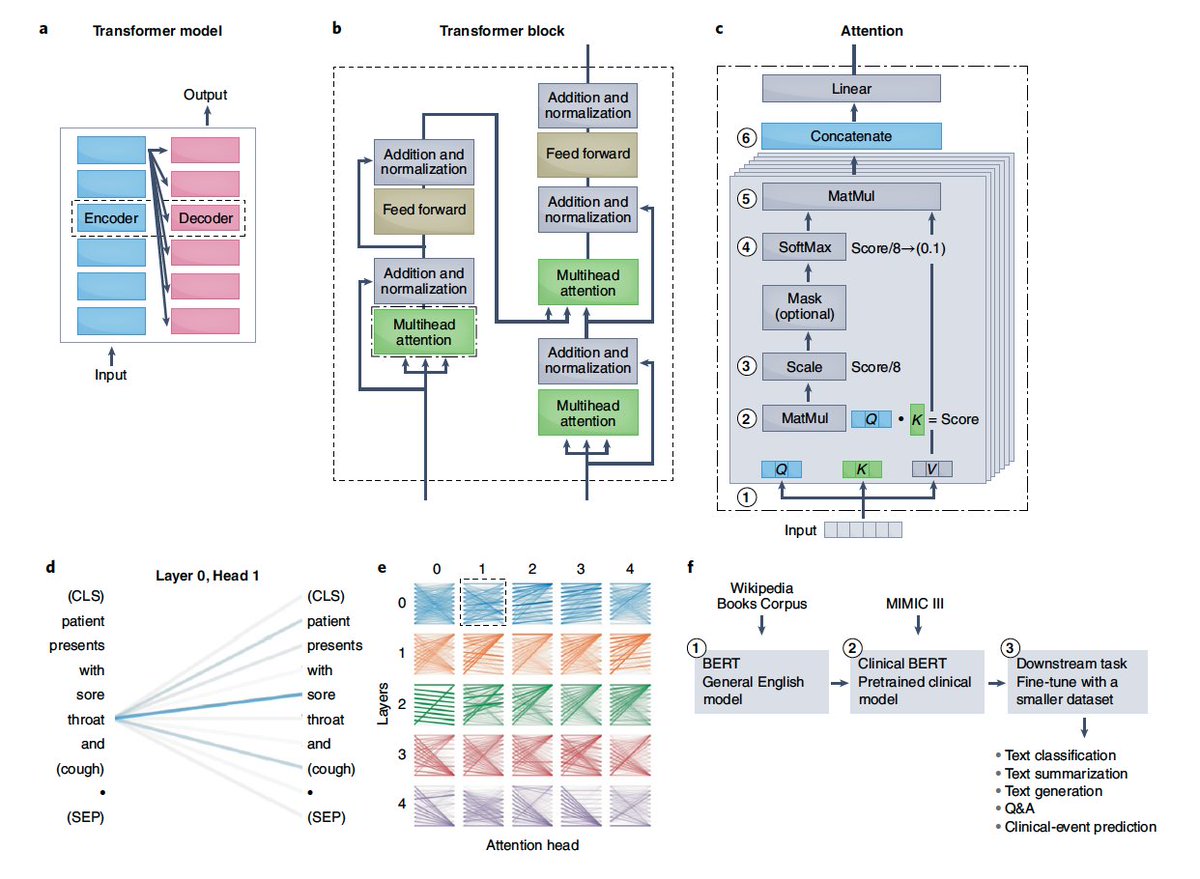
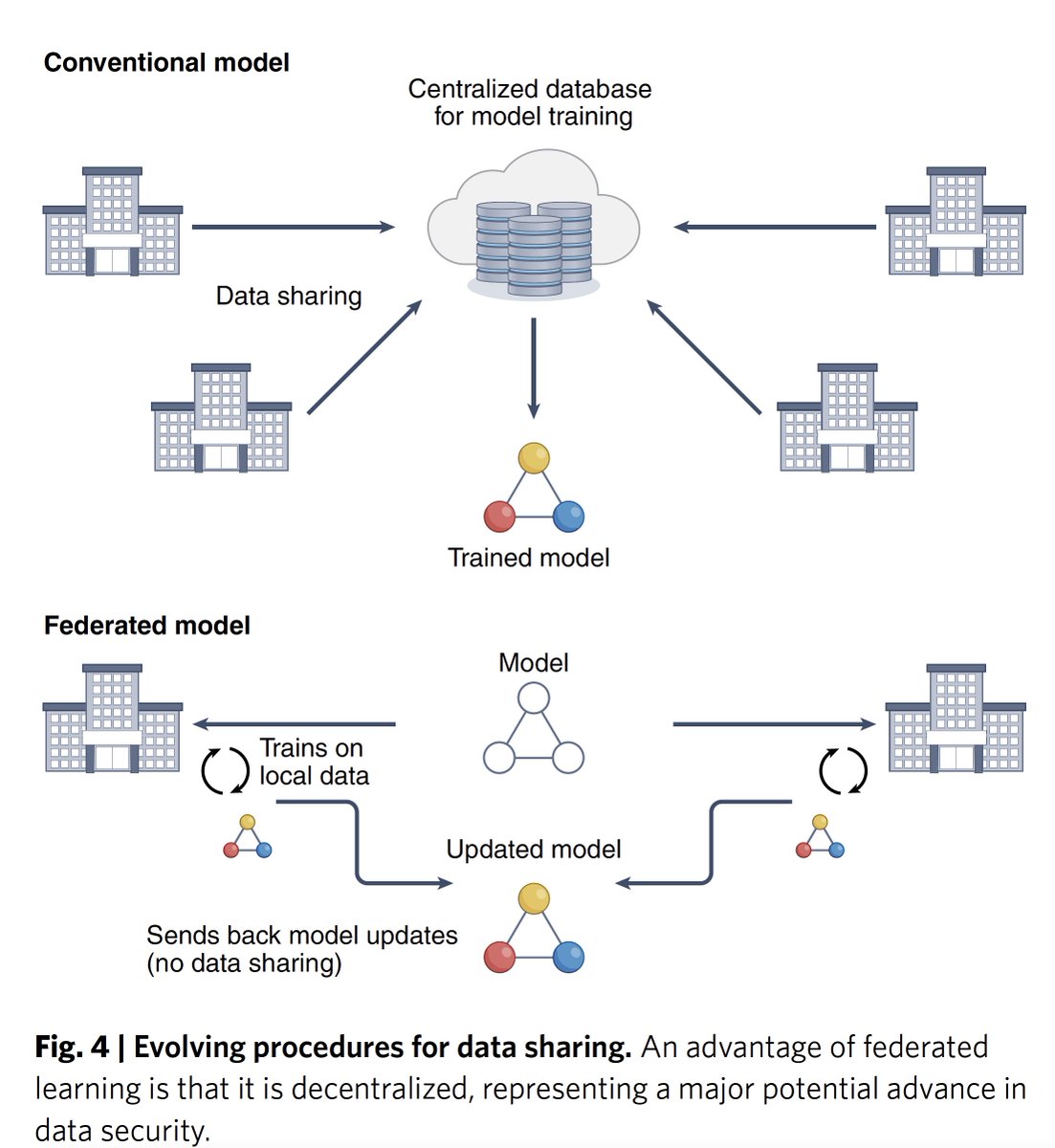
Delighted to share our @NatureMedicine review on multimodal biomedical AI!
We cover personalized medicine, digital clinical trials, remote monitoring, pandemic surveillance, digital twin technology & health assistants.
With @EricTopol@jn_acosta
https://t.co/I8AEvzTbVk
Since pivoting to venture capital from medical/grad school, I've had a lot of conversations with MD and PhD students about getting into VC.
Long thread on my thoughts/advice on how to 1) prepare for, 2) break into, and 3) succeed in VC:
1/40
Sun 11/28, 2:30pm:
If you ever need to figure out what body part are in a slice from a panscan CT (trust me, you will), @IshTalati & @drfilice from @MedStarGUH will hook you up.
#RSNA21
https://t.co/ZPlLoqqhCC
Quite pleased that our paper is finally out in @NatMachIntell! Our hope is that clinicians and data-scientists will find this perspective informative as a template for approaching #deeplearning in high-dimensional medical imaging. https://t.co/KPGMUJpjwx @StanfordCTSurg
.@rohanshad et al develop a video AI system trained to predict post-operative right ventricular failure @stanfordctsurg@stanfordaimi
https://t.co/HV98SVZ9ZT
Continual learning of ML models is hard enough to implement technically (data pipelines, concept drift, performance degradation, etc), without regulation getting in the way. An open convo between ML developers and regulators is a good start https://t.co/tlc0qjYn2O