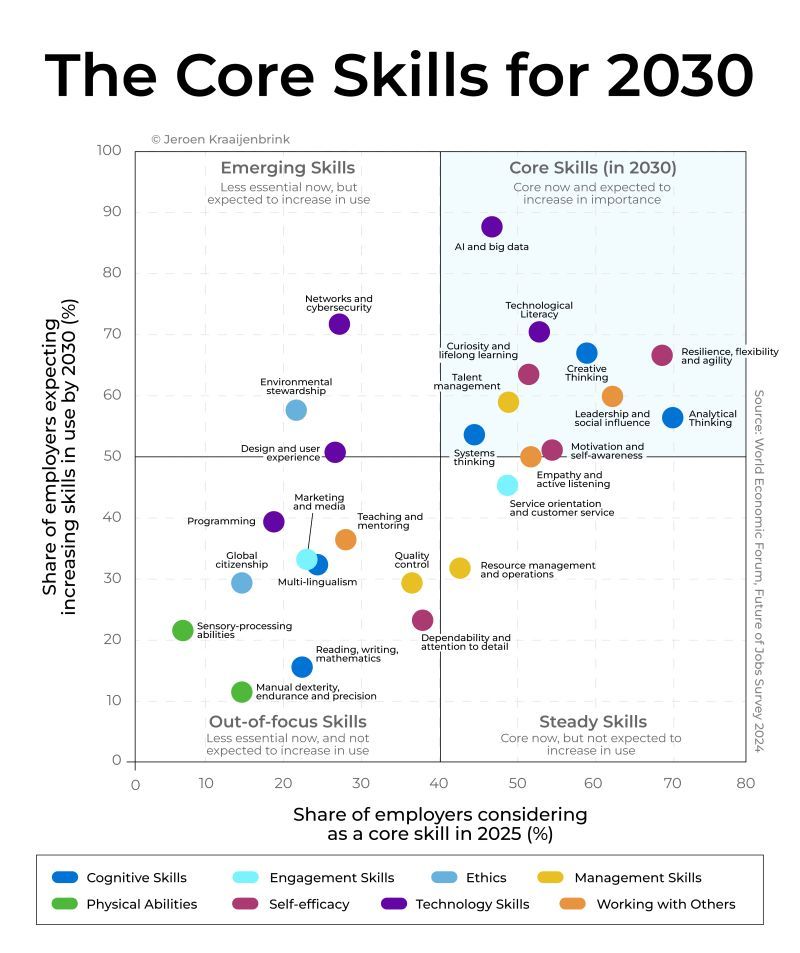
The most valuable skills by 2030 won’t be technical.
They’ll be human.
Sharing great insights from Jeroen Kraaijenbrink and the World Economic Forum.
The people who thrive will be able to:
Think clearly.
Adapt quickly.
Lead effectively.
The highest-impact skills include:
A) Systems thinking
B) Creative thinking
C) Analytical thinking
D) Self-awareness & motivation
E) Leadership & influence
F) Resilience & adaptability
G) Curiosity & lifelong learning
These skills are becoming essential.
AI will keep getting better.
But tools don’t make decisions.
People do.
The real advantage in 2030 will come from:
Better decisions.
Faster execution.
Stronger leadership.
That’s what will separate top performers from everyone else.
P.S. Which of these skills are you working on right now?
♻️ Repost to help someone prepare for the future.
----
📌 Get my top 100 infographics for free:
1) Follow me.
2) Subscribe to my free newsletter at https://t.co/jTnaNRaV2d.
You’ll receive all 100, directly in your welcome email.
We'll be spending a lot more time trying to understand the outputs of language models. A few thoughts, tips & tricks:
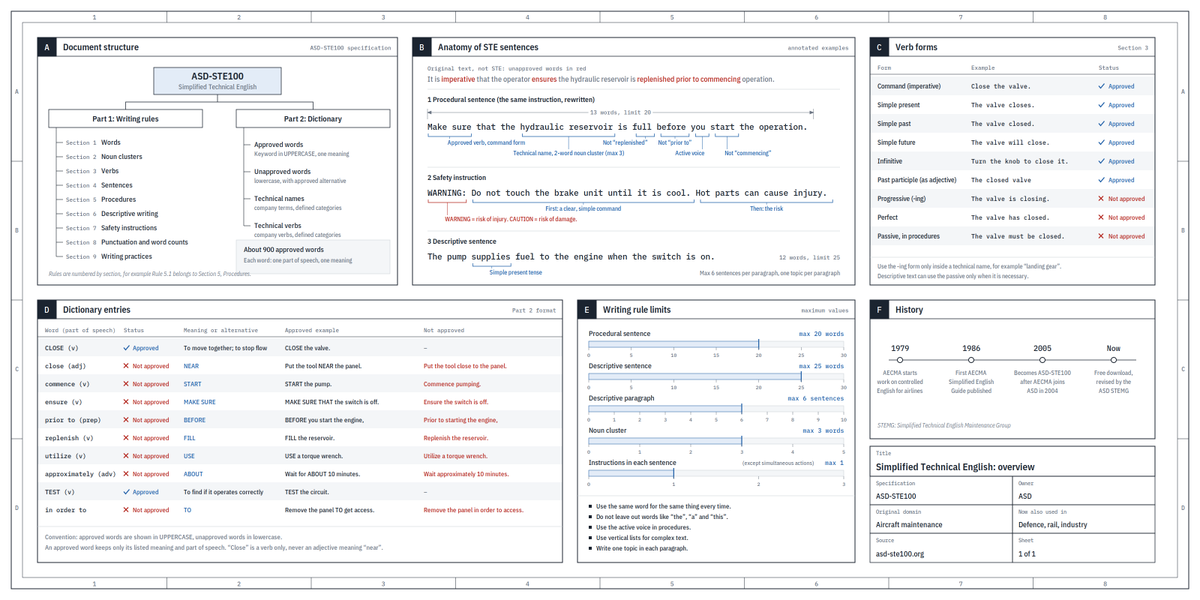
Writing. Something I've had success with: Ask your LLM to explain something in ASD-STE100, it's a controlled language specification originally developed for aerospace maintenance documentation. LLMs well-versed in this language and it comes with heavy constraints on clean writing style that I often find a lot more readable. Sometimes I've tried to soften it a bit e.g. ask for "80% of the way to ASD-STE100" because the spec is quite stringent. But even better:
Diagrams / images. Instead of writing, ask your LLM to create a diagram. These can be a lot easier to process, parse, and understand. But even better:
Web pages. Ask for output "in HTML" to get a beautiful, interactive webpage. LLMs are getting really good at frontend and can create beautiful experiences, animations, etc. But even better:
Explainer videos. The output format I am most bullish on is fully custom / bespoke explainer videos generated on any arbitrary topic. Experiment with things like "Create a 3b1b style video explainer on X. Use my ElevenLabs API key for audio narration". (you'd need an API key for the latter or you can ask your LLM to find you decent free alternatives that use your local compute). This is actually starting to work!
In summary:
- As LLMs get better, they will do more and more of the legwork autonomously, and a lot more of our work will rise up the abstractions into oversight and understanding.
- Luckily, LLMs can help here too because as intelligence and code are increasingly abundant, you can ask for large, custom, discardable software artifacts (e.g. web apps, video explainers) that would have never made sense to create before. Push the boundaries here and you'll be surprised.
The anti-memorization movement has left millions of students unable to think because every elementary operation consumes working memory.
Solving equations feels smooth when basic arithmetic is automatic. It's like moving puzzle pieces around, and you just need to identify how they fit together.
But without automaticity on basic arithmetic, each puzzle piece is a heavy weight. You struggle to move them at all, much less figure out where they're supposed to go.
It’s the same all the way up the ladder of math: from arithmetic, to algebra, to calculus, to all sorts of university-level math and beyond.
How can you NOT believe in God when octopuses dream and otters have a favorite rock they carry around in a little skin pocket and cows have best friends and bees are out there communicating the coordinates of flowers through dancing and they have regional dialects?
Cats are purring at frequencies associated with bone healing? Forests get absolutely incinerated and respond by growing flowers? Dolphins literally invent names for themselves and yell them across the ocean? Penguins are waddling around Antarctica looking for the perfect rock to give their partner?
CROWS REMEMBER YOUR FACE. THEY TELL OTHER CROWS ABOUT YOU. THEY TELL THEIR CHILDREN ABOUT YOU. YOU CAN HAVE GENERATIONAL BEEF WITH A BIRD. I NEED YOU TO UNDERSTAND THE SIGNIFICANCE OF THIS.
Goats have accents. Rats laugh when you tickle them. Elephants mourn their dead. Whales make songs and then OTHER WHALES LEARN THE SONG and suddenly everybody across the ocean is singing the new song.
Monarch butterflies are born knowing how to fly thousands of miles to a place they have never been.
Sea turtles hatch out of an egg, immediately sprint toward an ocean that they have never seen, disappear into it for like 3 decades and then somehow come back to the same beach they hatched on.
Birds can see colors that we humans can’t see. There are colors out there right now that we don’t even get to know about.
There are sea slugs that eat algae and use the chloroplast/chlorophyll and then are just like…photosynthesizing. And they’re super adorable.
There are mushrooms communicating underground. There are seeds sitting in the dirt for decades like “no actually I will wait. It’s fine.”
Squirrels plant trees because they forget where they put their snacks. Relatable.
A CATERPILLAR GOES INTO A LITTLE BAG THAT IT CREATES ITSELF AND DISSOLVES MOST OF ITS BODY INTO ORGANIC GOO AND REARRANGES ITSELF, GROWS WINGS AND THEN LEAVES. WHY IS THIS NOT MORE BEAUTIFULLY TERRIFYING TO PEOPLE??
And you’re telling me a tiny acorn knows how to become a huge tree? It just has a blueprint inside itself?
Your body started as ONE CELL.
ONE.
And that cell divided itself into a brain that can think about its own existence and eyes that can look at stars and hands that can hold somebody else’s hands and a heart that runs on electricity without you even asking it to?
The iron in our blood was made inside a star??
We are walking around on a wet rock covered in bioluminescent oceans and singing whales and laughing rats and birds holding lifelong grudges and flowers exploding out of fire and somehow we’re supposed to act like this is a normal place to live?
We’re supposed to act like this is all just a random, accidental sequence of events?
Nearly all your mistakes in life come from choosing short-term over long-term
Delayed gratification is the cheat code.
Play long-term games with long-term people
Homeschooling a five-year-old has made it increasingly clear to me that moving away from memory work was an absolute disaster for education: doing memory work *increases the ability to remember stuff in general, which makes learning faster!*
The more you pick the more it grows. It’s completely counter intuitive to the modern scarcity model. But if you don’t pick beans they stop growing. The more fruit you pick the healthier the tree. The seeds fall from everything and just more grows and grows.
The idea of man being a plague on the earth is completely inverted. We actually make everything more fertile the more we cultivate and grow. It’s one reason why rural agrarians can appear low ambition or “simple.” It’s because there really isn’t anything to worry about. The more you take the more you receive. It’s mind blowing.
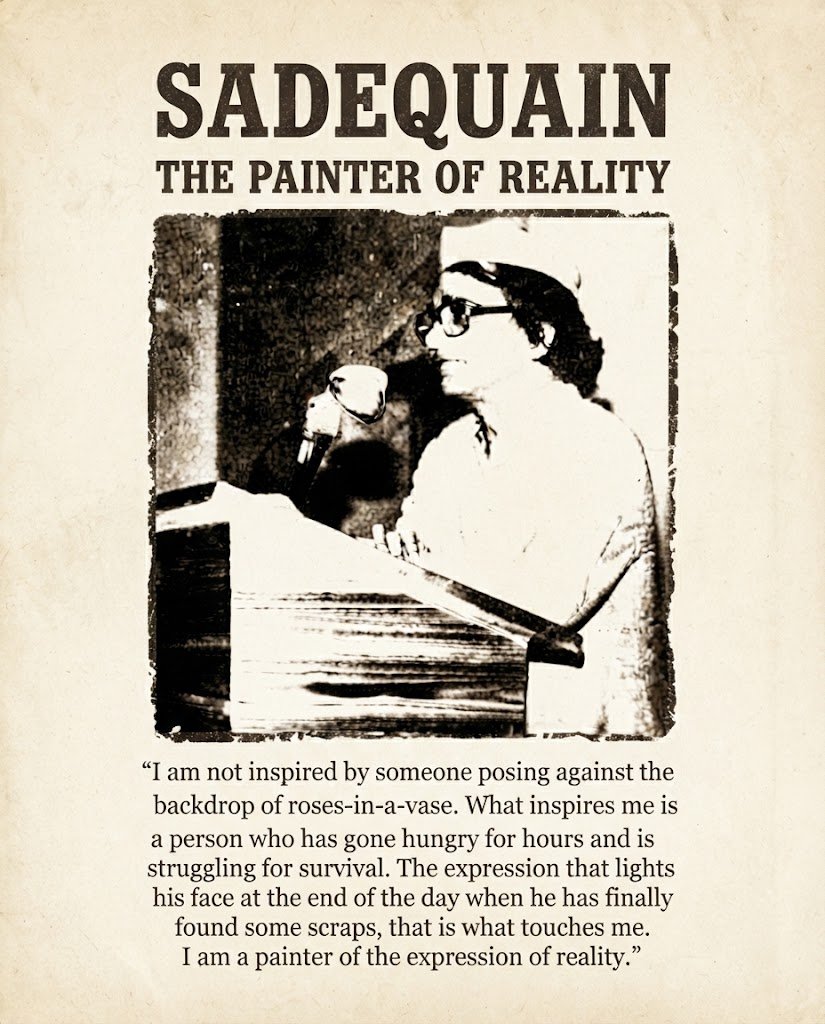
"I am not inspired by someone posing against the backdrop of roses-in-a-vase... What inspires me is a person who has gone hungry for hours and is struggling for survival.
_SADEQUAIN
HUANG: “.. Try getting a kid to do long division right now. Multiplication tables are starting to be forgotten. Doing square roots? My goodness. ..
.. Does it matter? .. I don’t think it does.”
@ezraklein@JensenHuang
Underrated life advice: Become difficult to rush. The world will pressure you to rush into everything. Rushed decisions. Rushed relationships. Rushed conversations. Rushed timelines. There's power in rejecting that trend. Pause. Slow down. Create space to think clearly.
The banana in your kitchen is a sterile mutant that can't reproduce. Every single one is a clone, and nearly the entire global export supply traces back to one plant raised in an English greenhouse in the 1830s.
Wild bananas are stuffed with hard seeds the size of peppercorns. Barely any flesh. Around 7,000 years ago, farmers in New Guinea stumbled on rare mutants carrying three sets of chromosomes instead of two. An odd number can't split evenly during reproduction, so seed-making fails and the plant pours everything into flesh. Those tiny black specks in the middle of your banana are the remains of seeds that never developed.
Perfect fruit, one catch. No seeds means no planting. Growing another one requires cutting a shoot off the base and sticking it in the ground.
A clone.
Back in the 1830s, the Duke of Devonshire's gardener raised one of these plants at Chatsworth House. His family name was Cavendish. Cuttings descended from that greenhouse now make up 99% of bananas exported on Earth, genetically identical from Ecuador to the Philippines.
Identical genes means a fungus that kills one plant kills all of them. And it already happened. Gros Michel, the banana everyone ate before 1960, was wiped out commercially by a soil fungus called Panama disease. The industry quietly swapped in the Cavendish, a lookalike that resisted it, and most shoppers never noticed their banana had been replaced.
A new strain called TR4 kills Cavendish too. No cure exists, the spores survive in soil for decades, and it has spread to more than 20 countries. Late 2025 it reached Ecuador, the world's biggest exporter.
The world already lost its banana once and got handed a body double. The body double is dying the same way.
En 1927, une jeune chercheuse russe entra dans un café berlinois pour déjeuner et remarqua quelque chose d'étrange dans le comportement du serveur, ignorant que cette simple observation allait changer la psychologie à jamais.
Je me suis approché du serveur et je lui ai demandé quelque chose de très simple…
Quelques semaines plus tard, cette observation fortuite s'est transformée en l'une des découvertes les plus célèbres de la psychologie au cours du XXe siècle.
Aujourd'hui, cette coïncidence permet d'expliquer pourquoi de nombreux adultes ressentent une fatigue légère et persistante, même lorsqu'ils ne pratiquent aucune activité physique particulièrement intense.
La chercheuse s'appelait Bluma Zegarnik. Elle avait 26 ans. Elle était arrivée à Berlin pour étudier dans le laboratoire de Kurt Lewin, l'un des psychologues les plus influents de l'époque.
Lewin étudiait le fonctionnement de l'esprit dans la vie réelle, au quotidien, et non pas seulement dans des conditions artificielles de laboratoire.
C’est cette approche qui a conduit Zegarnik à une observation qui a radicalement changé notre compréhension de la mémoire et de l’attention.
Ce soir-là, Zigarnik est allée dans un café avec un groupe de collègues. Ils ont commandé beaucoup de plats. Le serveur s'est souvenu de toutes les commandes sans rien noter et les a servies correctement, sans aucune erreur.
Après avoir réglé l'addition, tout le monde s'apprêtait à partir. Arrivée à la porte, Zegarnik se souvint qu'elle avait oublié quelque chose sur la table et fit demi-tour.
Je me suis approché du même serveur et je lui ai simplement demandé :
Pourriez-vous nous retourner ce que nous avons commandé aujourd'hui, s'il vous plaît ?
Le serveur la regarda avec surprise. Il ne se souvenait d'aucun détail concernant la commande.
Quelques minutes auparavant, il avait parfaitement mémorisé toutes les informations. Mais maintenant, le compte clôturé et l'argent encaissé, toutes ces informations avaient disparu comme si elles n'avaient jamais existé.
Pour Zegarnik, cet incident a été le point de départ d'une importante question de recherche : pourquoi le cerveau se souvient-il des choses inachevées et oublie-t-il celles qui sont terminées ?
De retour au laboratoire, elle mit au point une expérience simple.
Les participants ont reçu une vingtaine de tâches différentes. La moitié d'entre eux ont pu les mener à bien, tandis que l'autre moitié a été interrompue à mi-chemin et invitée à passer à une autre activité.
Je leur ai ensuite demandé : Quelles tâches avez-vous accomplies aujourd'hui ? Veuillez les énumérer.
Les résultats ont été cohérents et clairs dans toutes les itérations de l'expérience.
Les participants se souvenaient des tâches interrompues (incomplètes) presque deux fois plus souvent que des tâches terminées.
Les tâches en suspens ne s'évanouissaient pas facilement. Elles continuaient d'occuper une partie de la mémoire et de l'attention, comme si elles exigeaient d'être reprises et achevées.
Zeigarnik a publié ses résultats dans une revue de psychologie allemande en 1927. Aujourd'hui, ce phénomène est connu sous le nom d'« effet Ziegarnik ».
Près d'un siècle s'est écoulé. L'adulte d'aujourd'hui vit dans des conditions que Zygarnik n'aurait jamais pu imaginer.
Il a des dizaines de choses inachevées en même temps : une lettre sans réponse, une conversation importante reportée, un projet inachevé, un problème familial non résolu.
Tout ce qui reste inachevé occupe une partie de l'esprit en arrière-plan, comme une commande oubliée par un serveur. Et plus les choses inachevées s'accumulent, moins il reste d'énergie pour vivre normalement.