I talk about LLM AI Stats and recently started learning about Astrology science. Follow for daily informative nuggets on AI ML or Astrology Spiritual 🙏!
The AI Revolution: Understanding the Core of Large Language Models (LLMs) 🧵
1/7 We're at an"inflection point" in Language AI. 2023 was the pivotal "Year of Generative AI driven by models like ChatGPT (GPT-3.5), fundamentally shifting how we interact with information.#AITattava
LoL! People.are surprised that Iran which is under US sanctions has better infra than India. 😂😂
As I said earlier, if you don't have enough money just go to Sri Lanka and you will be surprised by the urban infrastructure.
Tonight's full moon is not an ordinary Kartika Purnima. The month of Kartika takes its name from Krittika, because its full moon sits near this nakshatra. But only in some years does the full moon actually fall inside Krittika, and when it does, the day is called Mahakartiki. This year it does.
The Moon stays in Krittika until 11:25 tonight, and the purnima holds through the evening.
The gods needed a son of Shiva to destroy the demon Taraka.
When Shiva's seed fell, Agni took it, but he could not bear its fire and gave it to Ganga.
Ganga too could not hold it, and set it down in the Sharavana forest of reeds, where it became 6 infants.
The 6 Krittikas saw them, and motherhood awakened in them; they nursed the children as their own.
When Parvati came and embraced all 6, they became 1 child with 6 faces. Because the Krittikas had raised him, he was called Kartikeya, and he grew up to slay Taraka.
Look at Kashi tonight and every part of that story is present.
Shiva's own city. Ganga, who carried the seed. Lakhs of lamps on the ghats, the fire of Agni, the deity of this nakshatra.
And in the sky the full Moon, whose highest exaltation lies within Krittika, standing among the very mothers who raised Kartikeya.
This afternoon the Moon passes in front of the Pleiades, the stars of Krittika.
From Varanasi it happens just before moonrise, so when the Moon comes up over the Ganga this evening, the Krittikas will be barely a degree beside it.
Such occultations come once in a generation, and after 2029 the next will not come until 2042.
#KartikaPurnima
IT folks in the wedding market are under tremendous pressure right now.
A couple of my friends' brothers, aged 28 and 30, are looking for brides. Both earn ₹1–1.5 lakh per month at reputed MNCs.
But the questions from prospective brides' families are insane!
- How safe is your job with AI coming in?
- How much of your home loan is paid off?
- Any other loans or financial commitments?
- Do you need to take care of your parents or siblings ?
Oh my God! 💀
Imagine the pressure these guys are going through. They're already dealing with demanding jobs, career uncertainty, EMIs and everyday responsibilities. Now they have to justify their entire financial future before even getting married.
And what's even more surprising is that this scrutiny doesn't necessarily change even if the girl isn't working.
I understand financial stability is important, but the expectations and pressure on young men are humongous.
Now Marriage is just, just about financial safety.
In 2006 I was a software engineer at Yahoo in Bangalore, and that was the year Yahoo tried to buy Facebook for a billion dollars. Mark Zuckerberg was 22, his own people were telling him to take the money, and he still said no.
I was just an engineer then. A couple of years later I was in Germany doing a PhD in computer vision, and now I run a company of about 60 people. I'm still happier talking to our engineers than sitting in a sales meeting.
So most of the business stuff I know, I picked up by watching what other founders did when it really mattered. My favourite is how that 22-year-old made sure the final call stayed with him. Facebook later created shares that get 10 votes each, and he owns almost all of them. He has about 14% of Meta today, but around 61% of the votes.
Anthropic starts trading on Nasdaq tomorrow, and its IPO filing does pretty much the same thing. Its seven co-founders hold one special share that carries 50.1% of the vote. I've disagreed with Anthropic on plenty.
They keep warning everyone about how scary AI is and pushing to close off open research, and to me that always looked like a company guarding its lead before going public. But on this one, they clearly did their homework.
At @FastCodeAI we don't have outside investors, so nobody's ever had to fight me for control. I still get why it matters so much. Sometimes we tell a client that AI just won't pay off for their problem, and we walk away from the project. I don't have to sit in front of a board and explain why we turned down the money.
Twenty years after Yahoo, that's still the one business lesson I'd pass on to any engineer starting a company. Work out who gets the final call before you sign anything.
Now that Jensen Huang is gone, I think America is about to discover something the hard way:
Nvidia didn’t just lose a CEO. It lost the one guy who knew how to run an Asian supply chain like an old-school merchant.
You can replace him with a brilliant American executive, an Indian executive, a Chinese executive — whatever.
The title is replaceable. The relationships are not.
Anyone who grew up around old-school Chinese business culture will recognize Jensen’s style immediately. You eat together. You drink together. You remember who helped you twenty years ago. When you decide someone is your guy, you keep dealing with him for decades. Contracts matter, of course, but when things go wrong at 2 a.m., what matters even more is whether the person on the other side will pick up your call.
Look at Nvidia’s supply chain. TSMC makes the chips. SK Hynix makes the HBM. Foxconn, Quanta, Wistron, Pegatron and others build the systems. Jensen didn’t suddenly discover these companies when ChatGPT arrived. He spent decades personally building relationships with the people running them.
TSMC is probably the best example. Back in 1998, when Nvidia was still tiny and short on manufacturing expertise, TSMC sent two production people over to help. The relationship became so close that Morris Chang later asked Jensen twice if he wanted to become CEO of TSMC. Jensen said no both times.
Decades later, Jensen was still flying back to Taiwan, eating with Morris Chang, Barry Lam and half of the island’s tech establishment. At one Taipei dinner, the guest list looked less like a restaurant reservation and more like the control room of the global AI supply chain: TSMC, Quanta, Pegatron, Wistron, Asus, Acer, Inventec, Foxconn.
That stuff looks almost comically old-fashioned in an industry obsessed with AI agents and trillion-dollar market caps. But then you see what happens when Nvidia actually needs something.
In 2024, Jensen wanted SK Hynix to move its HBM4 supply schedule forward by six months. Six months in semiconductors is insane. You’re talking about engineering, capacity and production plans that were set long before Jensen showed up asking for more.
SK chairman Chey Tae-won publicly told the story later. Jensen asked. Chey went back to his people and pushed.
That is not something you reproduce by handing the next CEO a supplier spreadsheet.
And Jensen also knew what it meant to owe somebody.
In Nvidia’s early days, its project with Sega went badly enough that the company was in real trouble. Jensen went to Japan, admitted the technology wasn’t going to work, and Sega still gave Nvidia $5 million that helped keep the company alive.
Thirty years later, Jensen went back to Tokyo and thanked former Sega president Shoichiro Irimajiri in person. His message was basically: without what you did for us back then, there would be no Nvidia today.
He did the same thing on the other side of the table.
Serve Robotics CEO Ali Kashani has talked about December 2023, when his company was so close to dying that he had already discussed bankruptcy. An investor pulled out right before Christmas. Kashani called Jensen. Nvidia helped carry the financing, other partners joined, and a few months later Serve was ringing the Nasdaq bell.
That’s the Jensen playbook. Eat with people. Remember favors. Return favors. Call directly when there’s trouble. Keep relationships alive for twenty or thirty years.
Silicon Valley has a fancy word for this: “network.”
My family would probably just call it doing business,and now Jensen is gone.
Nvidia can transfer his office, his org chart, his contracts, his procurement team and every supplier database to the next CEO.
What it cannot transfer is the invisible ledger sitting inside the heads of dozens of people across Taiwan, Korea and Japan:
He helped me once. I helped him once.
We’ve known each other for 25 years.
If he calls, I’ll listen. There is no handover document for that.
On 6 November, two brothers in Mumbai released an AI model that needs no internet at all.
In their demo, a phone in airplane mode photographs a restaurant menu, and the model reads every line and lists each dish with its price. Nothing goes to any server.
The lab is called 169Pi, run by Rajat and Chirag Arya. The model is Alpie Seed.
9 billion parameters, squeezed to about 5 GB, so it runs on an ordinary laptop, an iPhone, even a Windows PC with no graphics card.
The training story is the part I found hard to believe....
Just 8 NVIDIA H100 GPUs. About 3,472 GPU-hours in total, which is 434 hours of wall-clock time, ~18 days.
They trained it in 4-bit from day one because that is what a small team could afford. That same constraint is why it now runs on your laptop.
On the company's own evaluations, Seed scores 87.30 on MMLU and 84.32 on GPQA Diamond. On SWE-Bench Verified, which checks if a model can fix real bugs in real GitHub projects, it resolves 61.20%.
In the same table, Sarvam's 30B model, more than 3x its size, scores 34.0. It has been tested in 10 Indian languages, scoring 73.67% overall on MMLU Indic, Hindi the strongest at 77.55%.
The model is free, Apache 2.0 licence, on Hugging Face, Ollama and LM Studio.
A school with patchy internet, a flight, an office where documents cannot leave the building: it keeps working, and the data stays inside.
P.S. All benchmark numbers are self-reported by 169Pi, and comparison scores are from other labs' model cards, so cross-model comparisons are indicative, not exact.
Sources: Alpie Seed model card, Hugging Face; Alpie Seed Technical Report, 169Pi; CXOToday, 6 Nov 2026
Photo 1: Report p.5, compute highlighted.
Photo 2: Hugging Face card, MMLU and GPQA highlighted.
Photo 3: Same card, SWE-Bench row with Sarvam 34.0.
Photo 4: Report Indic page, Hindi and overall highlighted.
Today a consultation reminded me why karma can never be read with logic alone.
Karma Vipak Samhita is Lord Shiva's own telling to Ma Parvati of the karma phala for the 108 nakshatra padas. I do not apply it literally, but whenever a karmic knot has to be traced, it is one of the techniques I turn to. Today it opened exactly onto the chart in front of me: a 2nd house affliction, the mother's role entangled in the marriage.
I told the native plainly: in this life you will not get the opportunity to serve your in-laws.
Even when you do good for them, they will say we never needed it. They will fight your kindness itself.
She was stunned. That is exactly what happens, sir.
This is the nature of rina, debt. When a debt from a previous birth is playing out, their harshness is not their flaw, it is your repayment. So serve with a sense of sacrifice, the way Lord Rama accepted exile that came out of nowhere, as something beyond logic working itself out.
Our sanskaras make us repeat the same mistake, and the universe keeps arranging the repetition until we see it. Rationality cannot see this hidden part. Shraddha can.
Annual bachpan waala ghar ka photo
With a story worth retelling...
My dad and his best friend built this together ❤️
The house looks big because it is 2 houses with a common gate, common balcony and common garage.
The two houses are a mirror reflection of each other 😊
They have been together since boarding school -6th grade (Netarhat school)
They have supported each other through financial and personal hardships till they both got to a middle class income.
When they decided to build a house they built it together.
Instead of having a boundary wall, they clubbed the two houses.
So what is actually a decent sized 3 bhk duplex looks like a much bigger house 😂
But the cool part here is not the size of the combined house, but the depth of this friendship.
My dad and his two best friends besides each other.
They have been together since they were 12.
They have the most fun, slapstick, schoolboyish sit-downs every morning.
Laughing, roasting and arguing with each other.
It is beautiful.
And hard to replicate but I will try to do it with my friends :)
Co-living and co-building applications are open to friends 😂
this is f*cking insane. andrej karpathy: "the biggest regret of every engineer in my field right now is every AI conversation they never saved, and in 10 years the ones who started saving in 2024 will be running circles around the rest of us"
andrej karpathy, co-founder of openai, pulled 16M views on one idea: stop using AI to write code, use it to build a second brain that remembers every article, pdf, transcript and conversation you ever fed it
you point claude code at a folder, drop anything into it, and claude reads it, cross-links it with everything already there, and writes it into a living wiki. your knowledge finally compounds instead of leaking out of your head every friday
the stack:
→ brew install obsidian, mkdir ~/vault, cd ~/vault
→ run claude in that folder and type "init a knowledge vault with CLAUDE.md as the rules, /raw for sources, /wiki for your pages"
→ drop any file into /raw (youtube transcript, meeting notes, 400-page pdf, screenshot of a tweet) and type "ingest"
→ claude writes a wiki page, links it to 5 existing ones automatically, updates CLAUDE.md with any new pattern it noticed about how you think
→ never open a blank claude chat again. every question goes through the vault, every answer cites your own sources with dates and links
5 minutes to set up. compounding knowledge from that evening forward
the ugly part most will scroll past: in 10 years the engineers who started this in 2024 will remember every book, every podcast, every meeting with receipts. you will remember none of them. karpathy already picked which side he is on and you are still not on his
full step-by-step is in the article below
bookmark this before you waste another monday
Even though #CycloneMurasu's core is spinning dangerously close to our coastline right now (it is stationed around 130km North-North East as of 10 AM today), why does the heavy rain feel completely cut off in Chennai compared to last night? Let's talk about the super interesting Physics and Science before we get into whether there will be more rain for Chennai or not at the end. ⬇️⬇️⬇️
When a storm gets within striking distance, distance to the eye of the storm is secondary to where we are geographically.
Here is what is happening:
The Quadrant Rule 📈 : Cyclones rotate anti-clockwise in the Northern Hemisphere. Heavy, catastrophic rainfall doesn't happen evenly around the storm core. It concentrates entirely in the forward and right quadrants where winds slam violently onshore and face the Bay of Bengal. The southern and southwestern flanks miss out on this primary convergence of precipitation and related winds and convective activity.
The Wind Vector Change 💨 : As the core tracks further north toward the Nellore region, Chennai's low-level winds shift from an onshore maritime flow to an offshore or cross-shore flow. Instead of pulling fresh moisture in from the Bay of Bengal, the system stops fueling local convective clouds as it sweeps over cooler land.
The Bandaid Effect 🌀 : Being close means you can still catch passing spiral band pinwheels that dump a quick, isolated 30 mm in an hour over a random neighborhood, giving a false alarm that the worst is yet to come.
That’s what the approaching outer spirals of the cyclone did yesterday.
The satellite imagery can be misleading - all of the white patches you see aren’t rain bearing towers of cumulonimbus but are high altitude cirrostratus formations containing ice crystals primarily.
🎯 So the question is: Are there more #ChennaiRains before landfall?
Probability: < 20% for heavy downpours. Expect persistent overcast skies and occasional coastal sprinkles, but the heavy regional lifting is done for us.
The core moisture feed and severe weather threat are firmly away in the northern-north western walls heading toward Andhra Pradesh. That quiet lull or drizzle this morning isn’t unusual. It is the clear tail-end of an asymmetrical cyclonic system clearing our airspace.
@ChennaiRains@jhrishi2@chennaiweather@UpdatesChennai@NammaChennai_@reclaimchennai@TamilNaduInfra@Indicfederr0d@Chennai_Forward
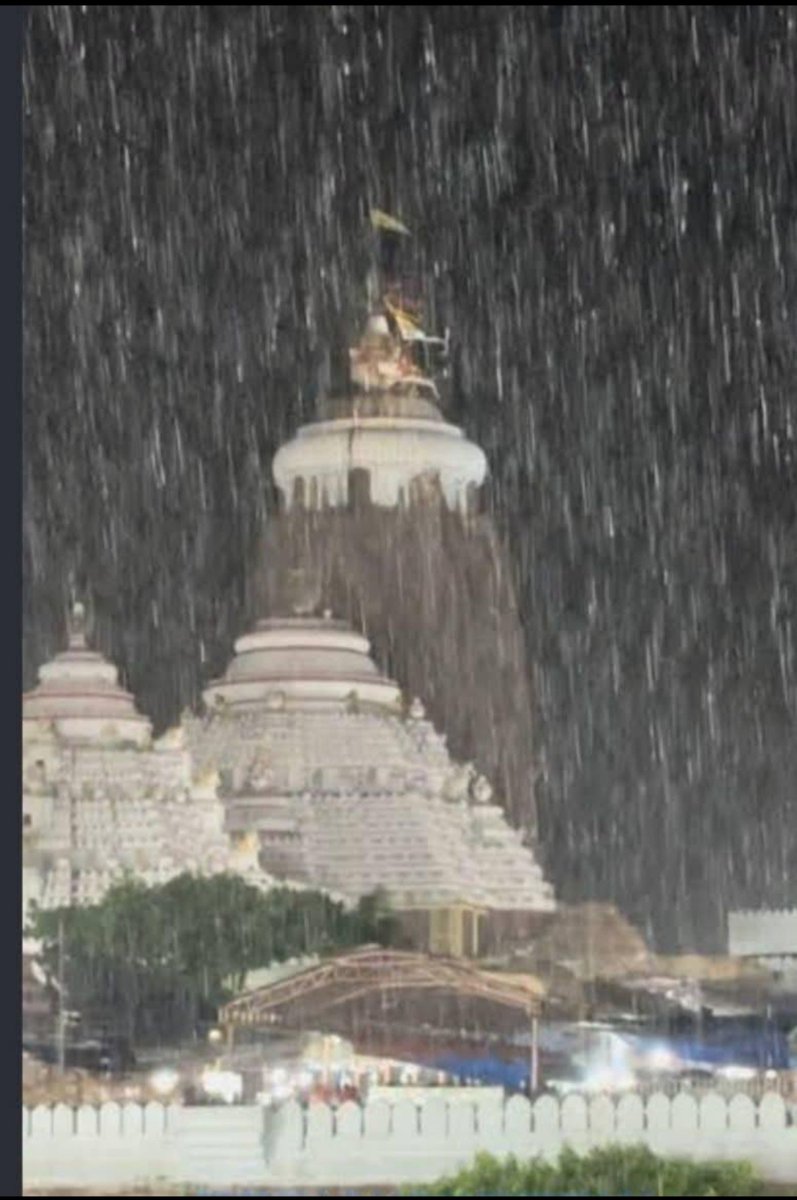
The Puri Jagannath Temple and the Sensational Mysterious Story of Cyclone Amban
It was just yesterday when a dangerous cyclone rose in the Bay of Bengal. The weather department named it - Cyclone Amban*. Wind speed of 180 kilometers per hour
Puri was on high alert. All the priests had shut the temple gates and left, except for one - the 72-year-old elderly servitor, Damodar Panda
People were saying - "Panda ji, save your life, you can look after the temple later." But Panda ji said, As long as the Lord's flag is fluttering, the cyclone can't even touch the temple
And then, a strange incident happened
Cyclone Amban slammed into Puri's coast with full force. The sea surged up 20 feet. Right in front of the Jagannath Temple's Lion Gate, everything was being destroyed—trees were being uprooted, shops were being swept away. But the flag with the blue wheel atop the temple's spire... it was fluttering in the opposite direction
Yes, the wind was blowing from east to west, but the temple's flag was waving from west to east, as if some invisible force was holding back the cyclone
That same night, a journalist named Arnab—after whom the cyclone was named—got trapped near the temple while covering the event. Right before his eyes, a massive sea surge advanced toward the temple. He screamed
At that moment, a sharp conch sound came from inside the temple. So loud that all of Puri echoed with it. According to Panda ji, it was the conch blown by the Lord Mahaprabhu himself.
And then the miracle happened. The surge stopped exactly 10 steps before the temple's steps and split into two parts, flowing past the temple on both sides. As if someone had parted the sea
The next morning, when Cyclone Amban calmed down, people were stunned. There was devastation all over Puri, but within a 100-meter radius of the Jagannath Temple, not even a leaf had stirred. And in the temple's sanctum sanctorum, at the feet of the Lord's idol, there were marks of wet footprints in the sand, leading from the sea toward the temple
Panda ji smiled and said, "Last night, Mahaprabhu himself had walked from the sea to protect his devotees.
Even today, Puri's old fishermen say that whenever a big storm comes, the Jagannath Temple's blue wheel turns the storm's path aside on its own. Science calls it wind pressure, but the people of Puri call it *Mahaprabhu's wheel
Jai Jagannath🚩 राधे राधे जी
Somewhere in your company, there is probably a service running in production that nobody has actually read. It handles real traffic. One person vibe-coded it, watched it pass a few manual checks, and shipped it.
That person is the only one who has any "feel" for how it behaves. Now imagine they leave. What happens when something goes wrong... Most of the reasoning, checks, and flows existed in some Claude session that nobody saved, and in the head of someone who is now gone.
To be fair, this is not a new problem. We all kind of have been in similar situations earlier as well, but what changes with vibe-coding is how fast you can create one, and how thin the understanding is even for the author. "I wrote it, so I know it" is weaker when you did not really write it.
Here are some ways of fixing it that I am trying out -
- Review, rather than understand, generated code like any other code. If nobody on the team can explain it, it should not go to production.
- The language and infra should be familiar; do not pick a language just because you could
- Keep the intent somewhere durable. A short note on what the service is for and why the non-obvious decisions were made is enough - best place: code comments.
- Make sure at least two people can operate and debug every production service.
Move fast, yes. Use LLM to write and ship, yes. Just make sure you + 1 understand what you shipped.
Hope this helps.
An Anthropic engineer explains why he earns $350K–$950K:
“I know how to build harnesses.
99% of people still build multi-agent systems manually and wonder why they keep breaking.
I build systems that run loops, use sandboxed tools, and turn yesterday’s logs into new skills.
Same model. 10x more reliable agents that improve while you sleep.”
Opus 5.5 → Agents → Harnesses → Loops → Graphs
In a short workshop, he breaks down how to build one from scratch:
Step 1 → Manage loops, context, and sandboxing through a harness
Step 2 → Separate the brain from the tools to reach the first token 60% faster
Step 3 → Run agents server-side and recover from crashes using logs
Step 4 → Make failures recoverable with retries and replays instead of starting over
Step 5 → Turn past execution logs into new memories so the system gets smarter over time
Anthropic calls this process “dreaming.”
Most developers spend weeks building these systems manually.
This workshop shows you a faster way.
Bookmark this and watch it.
@cneuralnetwork But is it necessary to know this considering company want solutions application based n not research models strictly asking for non research professionals
a lot of people want to learn LLMs but don't know where to start.
9 papers i'd recommend, in order:
> attention is all you need
> bert
> gpt-2
> gpt-3
> chinchilla
> instructgpt
> lora
> llama
> flashattention
by the end, you'll understand most of the ideas behind how modern LLMs are pretrained, finetuned, and aligned.