I am honored to receive this recognition by Yale! Thank you to @CIDEIM, without whom my dissertation would not have existed, and to my many collaborators&mentors across @YaleSEAS, @YaleSPH, @YaleCLAIS, @YaleMed, @YalePharm & @YaleGH who supported my vision
https://t.co/qLPCBqC14X
Congrats to our recent graduate student Becky Byler @itsbecks for winning the Yale U John Addison Porter Prize for her thesis. And Dr Rich Carson for his Graduate Mentor Award @YaleBme @YaleSEAS @yalepathology
Join us on April 15 for the 1st International Symposium on Chagas Disease at Yale University! The event includes scientific sessions and networking opportunities to increase understanding and collaboration in the fight against this disease. https://t.co/021kqJdE1c
In 2025, the US National Institutes of Health terminated some 2,291 active research grants, withdrawing $2.45 billion in funding. A study finds that these cancellations disproportionately affected women investigators and early-career researchers. In PNAS: https://t.co/s1UGOkS57u
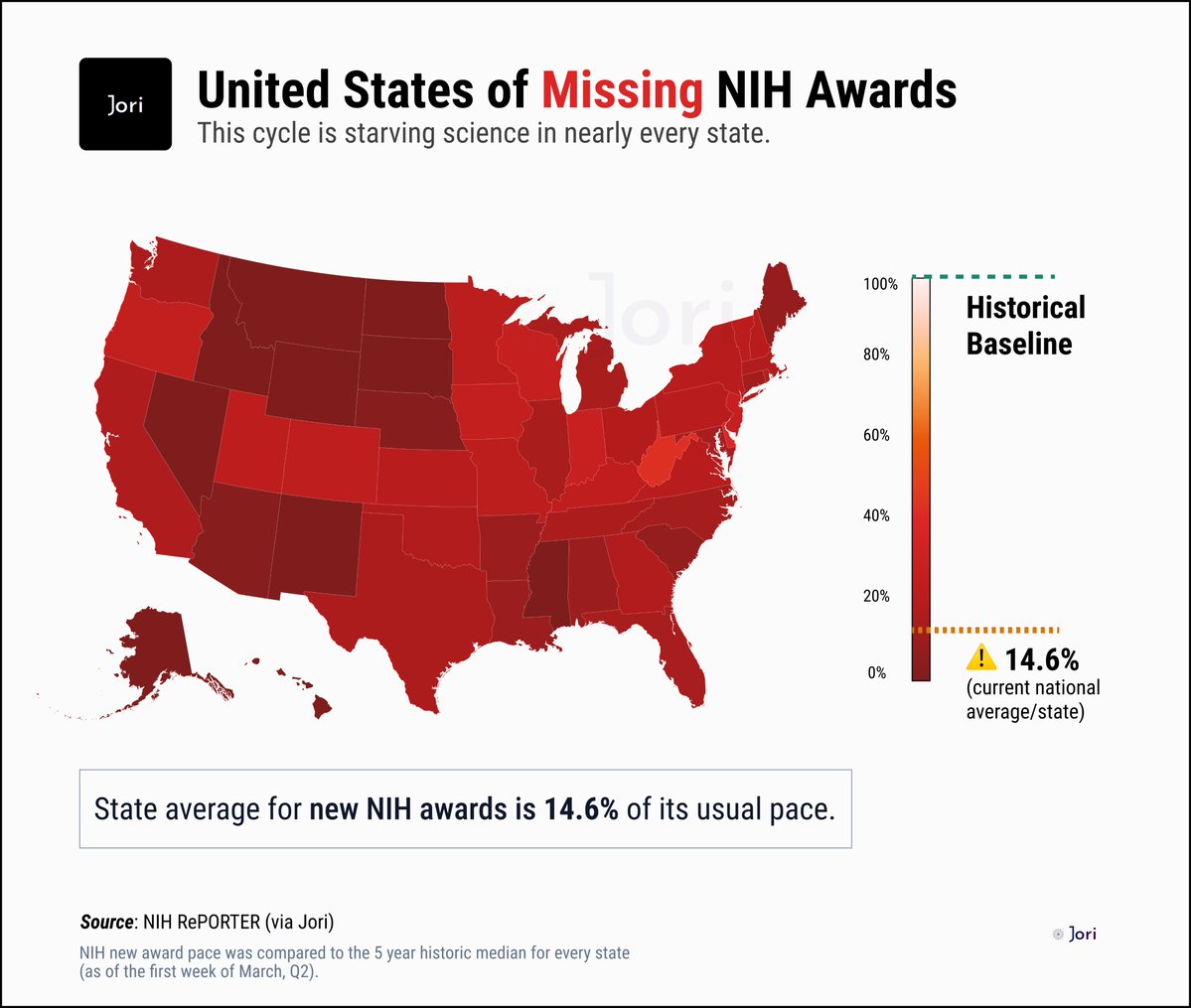
U.S. bioscience research is collapsing.
This is the map of a systemic rot.
NIH new award pace this year: 14.6% of normal.
If you wanted to stall science, you don't pick & choose states.
You just freeze the entire map.
In case you missed it:
▫️ ~95,000 scientists gone (@nytimes)
▪️ ~$2.4B in NIH research wiped out
▫️ ~$6B in economic loss (@DrCatharineY / PNAS)
This is what (predictably) follows next:
⇣ early-career scientists exit for good
⇣ breakthrough discoveries never made
⇣ trials that never open
⇣ labs that quietly shut down
⇣ global talent choosing other countries
⇣ the next decade of innovation erased before it starts
Sadly, you don’t "bounce back" from 14%
you just hollow out the system.
For a country that leads in science, this is the mo(u)rning after “National Science Appreciation Day”
==========
Source: NIH RePORTER via @Jori_health
Plot note: NIH new-award counts were compared to the 5-year historic median for every state (as of the first week of March, Q2).
==========
Every one of the 14 research agencies Science analyzed lost far more STEM Ph.D.s in 2025 than in 2024, before Trump took office.
The National Institutes of Health tops the list with more than 1100 departures, compared with 421 in 2024.
On average, the agencies lost roughly three times more of these experts in 2025 than in 2024, with the highest percent increase in departures at the National Oceanic and Atmospheric Administration, the Environmental Protection Agency, and the U.S. Forest Service.
At the same time, the number of STEM Ph.D.s hired at every agency was dramatically lower last year than in 2024.
Learn more: https://t.co/kwrz7SNc2p @NewsfromScience
@MuniCba y @MundoSano evaluaron el primer año de la “Estrategia Municipal hacia el Control de la Transmisión Materno-Infantil de #Chagas”, por el que Córdoba (#Argentina) fortalece el diagnóstico temprano, seguimiento y acceso a tratamiento de personas gestantes y recién nacidos.
A new study found that NIH grant terminations disrupted at least 383 clinical trials, including 74k+ patients, with international and infectious disease trials hit notably hard. Long term, these disruptions could limit future US-backed tools in key areas.
https://t.co/90oHGyVJsE
JUST RELEASED: Open science in a closed world 🌍📘Our new policy report shows how open, collaborative science and pro-access IP approaches can accelerate medical innovation & equitable access to health tools for all. Read more ➡️ https://t.co/saKK2ysClx #MakeScienceOpen
Scientists 🧑🔬 support the inclusion of the United States as an endemic country for #Chagasdisease
Recognition of this condition could strengthen the resources dedicated to addressing this neglected disease in the country
👉 https://t.co/tzUtsTSiCN
#BeatNTDs#NTDs#Chagas#USA
Healthcare technology should not only be functional and safe but also responsive to patient needs. Therefore, patients should be proactively involved from the earliest stages of the design process:
https://t.co/ltIyBLie5I
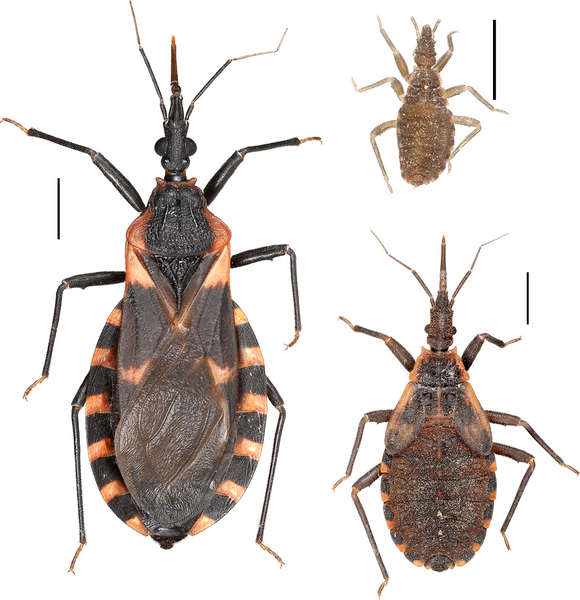
#Chagas disease isn’t just a tropical threat. Climate change is helping kissing bugs expand their range, raising the risk for people in the US living in rural and wooded areas ⤵️
https://t.co/OABoWNb6e2
This week, the House Appropriations Committee advanced out of committee a funding bill for FY26 that included some welcome surprises for #GlobalHealth research and development, despite significant global health cuts and the codification of the USAID's elimination.
Proposals in Congress would cut NIH funding, weaken ARPA-H, and dismantle NSF’s innovation engine.
But advocacy works. Your voice matters.
The deadline to act is July 21.
Sign on. Email Congress. Reach out. We must do everything we can to protect science.
Details below.
Not all violence screams. Some signs a budget. Some closes a clinic. Some lets poison seep into water. The unseen body count of systemic policy is real, because dying from poverty or neglect gets called “natural causes.”
Today is #WorldChagasDiseaseDay. Our faculty co-led a research trip to Argentina in collaboration with the University of Córdoba Private Hospital to exchange ideas, treat patients, and research new screening and treatments for Chagas disease: Learn more: https://t.co/y0UefOgOSd
Imagine being a university professor who just stands idly by for fear of upsetting the dean as your international students, the ones who dared to think or dissent, are snatched up by fascists and disappeared to remote US immigrant prisons known for blatant human rights abuses.
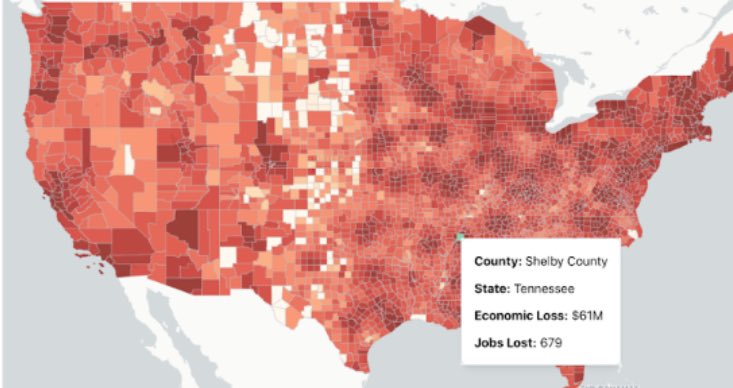
NIH funding cuts could cost the U.S. $16 Billion and 68,000 jobs. An interactive tool from @joshuasweitz and team shows the local impact across the U.S. - down to the county level. This isn’t abstract - these numbers affect real communities and real lives: https://t.co/2gPVnVwaLU