@green_jakuta@CanaryMediaInc@TrySingularity The CAMD data covers plants >25MW, some of which only report part of the year. While we've found that the CAMD data covers 92% of CO2 emissions, it only covers 57% of net generation and 64% of NOx emissions. One goal of OGEI is to fill in those gaps in the CAMD data
Singularity CEO Wenbo Shi says 24/7 clean energy needs open, transparent grid emissions data. The startup's Open Grid Emissions initiative has unveiled new data+methods to measure hourly U.S. grid emissions, and wants others to join the open-source party: https://t.co/TEwnVkoDP3
Excited to share the launch of the Open Grid Emissions Initiative, a dataset of validated hourly grid emissions data and platform for collaboration on ongoing power sector emissions research! Would love to hear from #energytwitter how you will use this data!
Today, we’re announcing the The Open Grid Emissions Initiative, which provides hourly grid & greenhouse gas emissions data, for free.
You can learn more about the initiative by reading our post here https://t.co/XcS7rGZwBm
Thanks to @CatalystCoop for kickstarting this project!
Hey @joshdr83 do you know any R/python enthusiasts that need a project? I have a pipe dream to convert the EPA's CAMD-EIA crosswalk code from R to Python...
@dcullenward @peterambiel@hausfath@chrisnelder@PeterGleick @PenCleanEnergy M-RETS has been working to remove many of the technical barriers to this and has put out some great papers on the topic, but not sure about specific policy barriers in WREGIS https://t.co/um9alyC0jz @TrackEnergy
Excited to share more about the 24/7 renewable energy research that I've been working on for the past year with @PenCleanEnergy. This new paper lays out the vision, and part 2 (coming soon) will share the results of the modeling I've been working on with the PCE team.
Since our 2016 inception, we've pushed the boundaries in clean energy procurement and deployment to reduce greenhouse gas emissions. That includes our unprecedented goal of delivering 24/7 renewable power by 2025. Why we’re doing it and what comes next: https://t.co/tifK85bR9P
You know it's the week after Halloween when every time a colleague asks "Any questions?" at the end of a presentation, all you can think of is them saying in the voice of David S. Pumpkins
@ArneOlsonE3@KevinSKrause@duncancampbell@drvolts I think some explicitly account for imports, but not all. But this is just directly what the ISO reported to be the fuel type(s) on the margin in each RT interval. The data might need some additional context, but it does raise important questions about some common assumptions
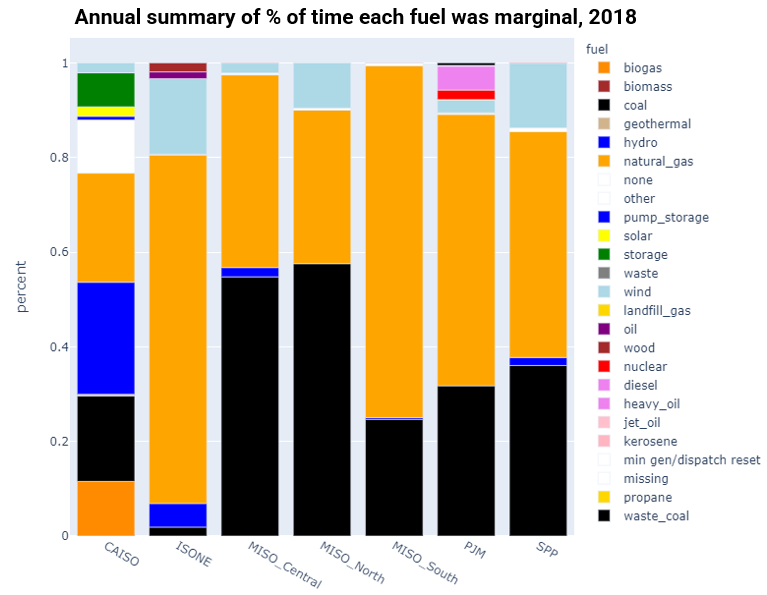
@ArneOlsonE3@KevinSKrause@duncancampbell@drvolts It depends by region. Many ISOs now publish fuel on the margin data for their realtime markets, which show that in some regions, gas is on the margin < 50% of the time. A chart summarizing these data from some of my research:
@carl_lenox@drvolts I'm not sure I understand the "other approach" - it still seems that to "offset" your emissions on grid A, you would use marginal emissions factors to calculate avoided emissions on grid B? I think that is the marginal approach as I understand it
@duncancampbell@ArneOlsonE3@drvolts That's the other side of market-based accounting: if you actually have supplier-specific mix data from your load serving entity, you'd want to use that rather than residual mix, since that LSE is retiring RECs on your behalf as one of its customers
@ArneOlsonE3@KevinSKrause@duncancampbell@drvolts I think it also depends on the market - if there is a demand for clean (but non-renewable) energy like hydro and nuclear, it is likely that someone will be claiming it as part of their portfolio, rather than it being part of the residual mix.
@drvolts@forachelP @PenCleanEnergy is targeting renewables-only. There should be an upcoming publication talking about their goal in more detail in the next month
@duncancampbell@drvolts Green-e publishes residual mixes, and PJM-GATS also publishes residual information. It would be great to have more granular information if REC tracking systems can help facilitate that.