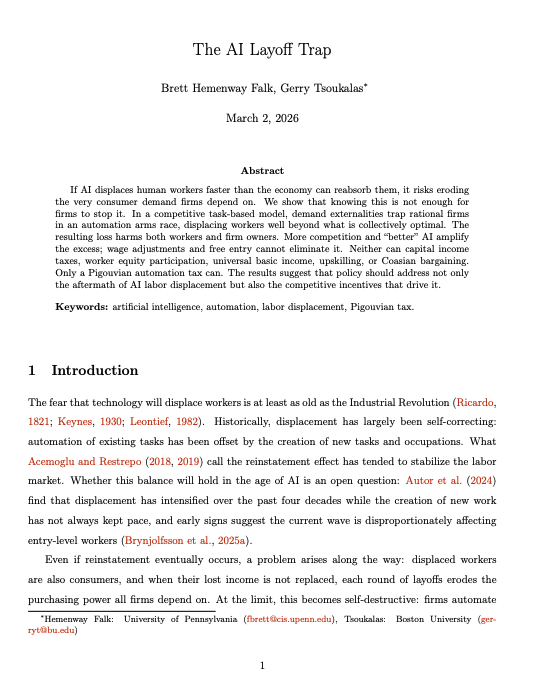
🚨RESEARCHERS JUST MATHEMATICALLY PROVED THAT AI LAYOFFS WILL DESTROY THE ECONOMY.. AND EVERY CEO ALREADY KNOWS IT.. BUT NONE OF THEM CAN STOP..
Two researchers from UPenn and Boston University just published a paper called "The AI Layoff Trap"..
They proved something terrifying..
Every company replacing workers with AI is also firing its own customers.. Every laid-off employee is someone who used to spend money.. When enough people lose their jobs.. Nobody can afford to buy anything.. And the companies that fired everyone go bankrupt selling products to an economy with no purchasing power..
Every CEO can see this coming.. The math is obvious.. Fire workers.. Lose customers.. Lose revenue.. Collapse..
But here's the trap..
No company can afford to stop..
If you don't automate.. Your competitor will.. They cut costs.. Undercut your prices.. Steal your market share.. And you die anyway..
So every company automates.. Knowing it's collectively suicidal.. Because the alternative is dying alone while everyone else survives..
It's a Prisoner's Dilemma.. And the researchers proved it mathematically..
The numbers are already stacking up..
Block cut nearly half its 10,000 employees this year.. CEO Jack Dorsey said AI made those roles unnecessary and that "within the next year, the majority of companies will reach the same conclusion"..
Salesforce replaced 4,000 customer support agents with AI..
Goldman Sachs deployed an AI coder that lets one senior engineer do the work of a five-person team..
Over 100,000 tech workers were laid off in 2025 alone.. AI was cited as the primary driver in more than half the cases..
80% of US workers hold jobs with tasks susceptible to AI automation..
And here's what should scare policymakers..
The researchers tested every proposed solution..
Universal Basic Income.. Doesn't fix it.. It raises living standards but doesn't change a single company's incentive to automate..
Capital income taxes.. Don't fix it.. They change profit levels but not the per-task decision to replace a human..
Worker equity and profit sharing.. Narrows the gap but can't close it..
Collective bargaining.. Can't fix it.. Because automating is a dominant strategy.. No voluntary agreement between companies is self-enforcing..
Only one thing works.. A Pigouvian automation tax.. A per-task charge that forces every company to pay for the demand it destroys when it fires a worker..
The researchers call it a "Red Queen effect".. Better AI doesn't solve the problem.. It makes it worse.. Because every company sees a bigger market share gain from automating faster than rivals.. But at the end.. Everyone automates equally.. The gains cancel out.. And the only thing left is more destroyed demand..
The paper's conclusion is devastating..
This isn't a transfer from workers to company owners.. Both sides lose.. Workers lose their income.. Companies lose their customers.. It's a deadweight loss that harms everyone..
And no market force can break the cycle..
The AI layoff trap isn't a prediction.. It's already happening.. And the math says it won't stop on its own.
Jordan Peterson: "The most dangerous person is one who is articulate"
"Articulate is an interesting word. If your joints are articulated, that means you can do things with them because they're not one solid vague mass. They're differentiated. Someone who's graceful is compelling because they're articulated. And speech is a form of articulation in that manner."
Peterson explains why this matters:
"It is definitely the case that there is no more exceptional form of the capacity to be dangerous than to be articulate. And one of the things that really shocks me is that young men in particular are never taught this."
He makes the case bluntly:
"Do you want to be competent and dangerous, or do you want to be vague and useless? Because those are your options. And I don't care what your job is. If you're a plumber, and I have great respect for plumbers, and you're articulate: you can negotiate with your clients, introduce your co-workers, make a case for your employees, advertise your services, think through your problems. You're firing on all cylinders."
Peterson shares a deeper truth:
"Our whole culture is based on the idea of the supremacy of the word. The idea that it is the word itself that extracts habitable order from chaos and possibility. And the reason our culture is predicated on that is because it's a deep truth."
He gives an example from the military:
"I know a former special operations soldier, Jocko Willink. He's about four feet wide and three feet thick. One tough son of a bitch. You don't want to mess with him. And he knows perfectly well, and is very capable of articulating, that his success as an eminent warrior is in no small part dependent on his ability to communicate."
Peterson explains why:
"Because he could communicate well, he could listen to the men under his command. Because he was articulate, he could explain to his superiors the situation on the ground. Because he was articulate, he could make a case that the men under his command who were deserving would be promoted. Because he could think in an articulate manner, he could plan strategically and not lose battles."
He asks the hard question:
"What's the alternative? You want to be inarticulate? You want to say 'uh' and 'like' and 'um' and pause and stumble? Be unable to formulate a strategy? Be unable to elucidate a vision? Be unable to compel and convince other people to entice them with your articulated vision of what might be? You would choose awkwardness over grace. It's preposterous. It's beyond foolish."
How do you become articulate?
Peterson offers a metaphor:
"Imagine you're trying to walk across a swamp. The swamp is murky, but you know there's a path of stone under the water, and it twists and moves. If you stay on the path, you won't drown. The crocodiles won't devour you. As you walk forward, you feel with your next step where the stone might be. Then you feel it solid. Then you take that step. You search and find out what's solid, and you move forward in that manner."
He applies this to speech:
"That's what you do with your words. You feel, is this the right word? Is the fact that I'm uttering it putting me together and making me intact and stronger? Or is it tearing me apart and making me dissolute and weak? You can learn to do that."
Peterson shares what he noticed 40 years ago:
"Much of what I said actually made me feel weak. I didn't know why exactly. But sometimes some of the things I said didn't have that effect. They weren't accompanied by a sense of shame. They weren't accompanied by a sense of vulnerability. They were solid. At the beginning, that was probably only about 5% of what I said. The rest of it was instrumental — language I was using to get my way. There was an arrogance in my use of language that had to do with the desire to attain proximal victories. To appear smart. To win an argument."
He contrasts that with real articulation:
"A very different idea than merely feeling my way along to see what word was appropriate for what moment. But you can learn to do that. You can listen to yourself. You can stop humming and hawing and using 'like' and 'you know' and fillers. You can take the time necessary to craft your words carefully. You can practice merely saying what you believe to be true. You can read great writers. You can write about the problems that obsess you. And you can become articulate as a consequence."
The power of the pause:
"When you're in a discussion with someone, they might present you with a question or a conundrum. Instead of responding with what you 'know' to be right, you could just ask yourself: what do I actually think about that? But it has to be a real question. It has to be the kind of question you pose to someone you didn't know. It has to be a question predicated on the idea that you might not know who you are, and that you could ask."
Peterson continues:
"Someone presents you with a question. You think: okay, what do I think about that? But you have to want to know the answer. And then the answer will make itself known because that's how thought works. And then you can just communicate that answer."
He explains what happens next:
"If you do that, you'll be interesting right away. You'll be interesting to the person you're talking to. And if they do that to you, they'll be interesting too. And then if you both do that, you'll have an interesting conversation. And if you have an interesting conversation, you'll both grow as a consequence. That's actually the pathway to growth."
Peterson uses Joe Rogan as an example:
"One of the reasons Joe Rogan is so successful is that that's what Joe does. He just asks questions. He isn't trying to get something from his guests. He's not trying to become more famous. He doesn't need any more money. There's no instrumental utilization of language in his discourse. He's just a humble lunkhead in the most profound sense who would like to know more than he knows, and who asks all the stupid questions he can think up."
He continues:
"It turns out he's actually very smart and very well educated now, after talking to hundreds of people and listening. The stupid questions he asks aren't stupid. They're questions shared by virtually everyone who's listening. He takes his listeners along on this process of exploratory endeavor. And it's the pathway to success."
Peterson closes with this:
"The same thing can be true of your life. If you're guided by the spirit of honest inquiry and every word you say is reflective of what you believe to be the truth, then the pathway that you walk on is a golden pathway to success. I know that to be true."
🚨 Andrej Karpathy documented the exact ways LLMs fail at coding. Someone turned those observations into a single Claude config file.
It's called andrej-karpathy-skills.
+3,741 stars this week.
Why it's great:
Claude Code makes the same mistakes on every project. It over-explains. It adds code you didn't ask for. It ignores constraints you set 3 prompts ago.
Most people just accept this as the baseline. Karpathy didn't.
He catalogued the failure patterns. This repo converts every one of them into a CLAUDE.md instruction that fixes the behavior at the source.
How to use it:
Drop the CLAUDE.md file into the root of any project. Claude reads it automatically on every session.
No prompt engineering on every request. No babysitting. The behavior changes once and stays changed.
One file. Every project.
Just 6 months = and you're rich
I'm not kidding
The author of the article I found for you has laid out a clear 6-month roadmap, after which you'll stop guessing and build a real trading system.
Here’s what you’ll get month by month:
Month 1 → You stop guessing. Over 30 days, you lock in your probabilities against the market. You find your first edge
Month 2 → You learn the 3 formulas of the gods: Expected Value, Kelly Criterion, and Base Rate. 80% of losing trades are filtered out before you even enter
Month 3 → Build your first ML model (Random Forest) on 500+ real markets. 80%+ win rate on historical data
Month 4 → 10,000 simulations + Bootstrap + Markov Chain. Prove that it’s not just luck
Month 5 → Switch to XGBoost — 89.6% win rate on 1,870 real trades
Month 6 → Launch a Reinforcement Learning agent that learns 24/7 and never stops
After 6 months, you don’t just have a skill
You have a fully-fledged trading system that works while you sleep
95% will read this, hit ❤️, and keep reading the news and hoping
5% will save this post, start from Month 1, and become millionaires in six months
A Soviet psychologist walked into a café in 1927 and watched a waiter do something impossible.
He remembered every open order at every table. Perfectly. Without notes. Without effort.
Then a table paid their bill. She asked him to repeat the order.
He couldn't remember a single item.
She spent the next two years figuring out why. What she found is now the operating system underneath every platform fighting for your attention.
Her name was Bluma Zeigarnik, and she was a graduate student at the time, sitting with her professor Kurt Lewin, watching the waiters work the room. What caught her attention was something so ordinary that it had been happening in restaurants for centuries without anyone asking why.
The waiters could remember every open order with perfect accuracy. Table four wanted the schnitzel with no sauce. Table seven had changed their wine twice. Table twelve owed for three coffees and a dessert. Every detail, held without effort, without notes, without any visible system at all.
But the moment a table paid their bill, the information vanished. Completely. Lewin tested it on the spot. He called a waiter back minutes after a table had settled up and asked him to recite the order. The waiter could not do it. Not partially. Not approximately. The information was simply gone.
Zeigarnik went back to her lab and spent the next two years turning that observation into one of the most replicated findings in the history of psychology.
Here is what she proved, and why it changes how you think about attention, memory, and almost every piece of media you have ever consumed.
She gave participants a series of tasks. Some tasks they were allowed to finish. Others were interrupted before completion. Then she tested recall across both groups.
The unfinished tasks were remembered at nearly twice the rate of the completed ones.
Not slightly better. Nearly twice. The brain was holding the incomplete work in a state of active tension, returning to it, keeping it warm, refusing to file it away. The finished tasks were closed, archived, released. The unfinished ones were still running.
She called it the resumption goal. When the brain commits to a task and cannot complete it, it opens a file that stays open until resolution arrives. That open file consumes a portion of your cognitive bandwidth whether you are thinking about it consciously or not. It surfaces in idle moments. It pulls at the edge of your attention during other work. It is the thing you find yourself thinking about in the shower when you were not trying to think about anything at all.
This is not a flaw in human cognition. It is a feature. The brain evolved to finish things. An open loop is a signal that something important is unresolved. Keeping that signal active increases the probability that you will return to it and complete it. In an environment where most tasks had real survival stakes, this was an extraordinarily useful mechanism.
In the modern world, it is the most exploited vulnerability in human attention.
Netflix did not invent the cliffhanger. But it industrialized it in a way no medium before it ever had. When a show ends on an unresolved question, it does not just create curiosity. It opens a file in your brain that stays active until the next episode closes it. The autoplay countdown that begins at 15 seconds is not a convenience feature. It is a precise calculation about how long the average person can tolerate an open loop before the discomfort of not knowing overrides every other intention they had for the evening. One more episode is not a choice. It is your brain doing exactly what it was designed to do: return to what is unfinished.
The writers who built Lost, Breaking Bad, and Succession understood this intuitively without ever reading a psychology paper. Every episode ended on an open question. Every season finale answered three things and opened five more. The entire architecture of prestige television is a Zeigarnik machine running at industrial scale.
But television is not where this gets dangerous.
Every notification on your phone is an open loop. Every unread email is an open loop. Every task you wrote on a list and have not yet crossed off is an open loop. Each one is consuming a small but real portion of your available attention, pulling fractionally at your focus, degrading your capacity to be fully present in whatever you are actually doing right now. TikTok's algorithm does not just serve you content you like. It serves you content that ends one loop and immediately opens another, keeping the resumption system permanently activated so the cost of stopping always feels higher than the cost of continuing.
The research on this accumulation effect is striking. Psychologists studying cognitive load have found that unfinished tasks do not sit passively in memory. They actively interrupt. They surface at the wrong moments. They are the reason you are reading something and suddenly remember an email you forgot to send. The brain is not malfunctioning. It is running its resumption system exactly as designed. It is just running it across forty open loops simultaneously, in an environment that generates new ones faster than any human nervous system was built to process.
The most important practical implication Zeigarnik's research produced is one that most people use backwards.
David Allen built his entire Getting Things Done system on the insight that the only way to close a cognitive open loop is to either complete the task or make a trusted commitment to complete it later. Writing something down in a system you actually trust has the same effect on the brain as finishing it. The file closes. The bandwidth is released. This is why writing a task down feels like relief even before you have done anything about it. You have not solved the problem. You have simply told your brain that the loop is registered and will be returned to, which is enough for the resumption system to stand down.
The inverse is equally true and far more destructive. Every task that lives only in your head, unwritten and unscheduled, is an open loop burning cognitive resources around the clock. The mental cost is not proportional to the size of the task. A tiny nagging obligation consumes the same active tension as a major project. Your brain does not discriminate by importance. It discriminates by completion.
Zeigarnik published her findings in 1927. The paper sat in academic literature for decades before anyone outside psychology paid attention to it.
Then television got good. Then the smartphone arrived. Then the entire attention economy was engineered, largely by people who understood intuitively what she had proven scientifically: an open loop is the most powerful hook available to anyone who wants to hold human attention.
Netflix knew it. Instagram knew it. Every designer who ever made a notification badge red instead of grey knew it.
The café in Vienna is long gone.
The mechanism she discovered there is now the operating system underneath every platform fighting for your time.
Every "to be continued."
Every unread notification.
Every thread that ends with "part 2 tomorrow."
All of it is the same waiter, the same unpaid bill, the same brain refusing to let go of what it has not yet finished.
Zeigarnik noticed it over coffee in 1927.
A century later, it is the most valuable insight in the history of media.
And nobody taught it to you in school.
Just finished reading this blog on agent harnesses. Man, it’s one of the clearest, most practical takes I’ve seen why they’re here to stay and why memory isn’t some optional plugin.
This is the single best framework I’ve seen for understanding AI.
Terence Tao, arguably the smartest mathematician alive, just dropped a paper with Tanya Klowden on arXiv called “Mathematical Methods and Human Thought in the Age of AI.”
The core idea: a “Copernican View of Intelligence.”
Stop thinking of AI on a line from “dumb” to “superhuman.”
That’s the wrong axis entirely.
AI excels at BREADTH. Humans excel at DEPTH.
Tao himself said AI has made his papers “richer and broader, but not necessarily deeper.”
That’s not a limitation. That’s the entire playbook.
Stop trying to replace yourself with AI. Start using it to cover the 90% of surface area your brain physically can’t.
The people who get this are already 10x more productive.
The rest are still arguing about whether AI is “smart enough.”
Reframe your point of view from “smarter” to “different”.
Human + AI > either alone.
The math on that has never been clearer.
A MIT student told me he learns any new subject using a framework a self-taught Victorian mathematician published in 1854.
Most people have never heard of it outside of computer science.
He applies it to everything. Economics. Biology. History. Law.
And it's the fastest way to actually understand a subject I've ever seen.
The mathematician was George Boole. The book was called The Laws of Thought.
Boole's core idea was simple and radical. Every complex system, no matter how messy it looks on the surface, can be broken down into a set of basic relationships that are either true or false.
You don't need to understand everything at once. You need to find the fundamental propositions the whole system is built on, and then trace the logic forward from there.
He built it to map how the human mind actually reasons. MIT uses it to build computer chips. This student uses it to learn anything in a fraction of the time.
Here's exactly what he does.
Before touching any course material, he opens Claude and runs one prompt.
"What are the 5 foundational propositions of this subject? Not facts, not definitions. The statements that, if true, make everything else in this field follow logically."
That question is doing something most students never force themselves to do. It finds the load-bearing walls of the subject before you walk into the building.
Then he runs the second prompt.
"For each of these propositions, what is the one piece of evidence that would destroy it? What would have to be true for this entire framework to be wrong?"
Boole's insight was that a proposition you can't falsify isn't really a proposition at all. It's just a belief dressed up as knowledge. This prompt separates the two instantly.
The third prompt is the one that makes it unfair.
"Now show me how these five propositions connect to each other. Which ones are assumptions? Which ones are conclusions? Which ones are in tension?"
By the time he finishes those three prompts he doesn't have a summary of the subject. He has a map of how it thinks.
His classmates spend the semester adding details to a picture they never drew. He drew the picture before week one and spends the semester filling it in.
Boole published this framework 171 years ago.
It runs every computer on earth.
And almost no one uses it to learn.
Every time you accepted a salary, chose a price, or walked into a negotiation, the other person was running GAME THEORY in their head.
You were guessing.
This 1-hour Yale lecture by Professor Ben Polak will permanently change how you read people and make decisions.
Most MBAs pay $150k to learn this. Yale posted it for free:
🚨do you understand what two Anthropic engineers just explained in 16 minutes.
Barry and Mahesh built Claude Skills from scratch.
here's the part nobody is talking about:
> Skills are just folders.
> folders that teach Claude your job.
> your workflow. your expertise. your domain.
Claude on day 30 is a completely different tool than day one.
watch this before you write another prompt.
before you build another agent.
before you touch another tool.
16 minutes. bookmark it. watch it today.
and if you want to learn everything about Claude from scratch the full 4 hour guide is waiting below.
Anthropic's CEO: "coding is going away first. then all of software engineering."
the 5% that survives? systems thinking.
3 months ago I published 5 projects for this exact moment. 21K bookmarked it.
not syntax. orchestration. harness. memory. edge inference.
This 2 hour Stanford lecture shows exactly how Stanford trains it's engineers to build AI systems. It's more practical than every Claude tutorial & prompting threads you've seen.
Bookmark & give it 2 hours, no matter what. It'll be the most productive thing you do this weekend.
Elon Musk thinks the entire education system is built on a broken assumption.
That every student should learn the same thing. At the same speed. In the same order. At the same time.
Musk: “Everyone goes through from like 5th grade to 6th grade to 7th grade like it’s an assembly line. But people are not objects on an assembly line.”
The model was designed for a factory economy. Standardized inputs. Predictable outputs.
That economy is gone. The assembly line is gone.
But the education system still runs on its logic.
A student who masters algebra in two weeks sits through eight more weeks because the calendar says so. A student who struggles gets dragged forward because the schedule doesn’t wait.
Neither is being served. Both are being processed.
Musk: “Allow people to progress at the fastest pace that they can or are interested in, in each subject.”
AI doesn’t teach a classroom. It teaches a student.
One at a time. Every time.
It skips what a student already knows. It finds where they’re stuck and approaches it from a different angle.
It adjusts in real time. Not at the end of a semester when the damage is already done.
A student obsessed with basketball learns fractions through shooting percentages. A student who builds in Minecraft learns geometry through architecture.
The subject doesn’t change. The entry point does.
No teacher with thirty students can do this. Not because they lack skill.
Because the math doesn’t work.
AI doesn’t have that constraint.
Musk: “You do not need to tell your kid to play video games. They will play video games on autopilot all day. So if you can make it interactive and engaging, then you can make education far more compelling.”
The brain isn’t broken. The format is.
Kids learn complex systems and strategic thinking for hours voluntarily. Then walk into a classroom and can’t focus for twenty minutes.
That’s not a discipline problem. That’s a design problem.
Musk: “A university education is often unnecessary. You probably learn the vast majority of what you’re going to learn there in the first two years. And most of it is from your classmates.”
Four years. Six figures of debt.
And the real value comes from the people sitting next to you. Not the institution charging you.
The degree doesn’t certify knowledge. It certifies endurance.
Musk: “If the goal is to start a company, I would say no point in finishing college.”
The system was built to train employees. If you’re not trying to be one, it has nothing left to offer you.
Every lecture. Every textbook. Every curriculum. Now available instantly. Personalized to any learner. Adapted to any pace.
The question isn’t whether the old model survives.
It’s how long we keep forcing students through it while the replacement already exists.
In 2013, Yale professor Ben Polak gave a legendary 1-hour lecture on Game Theory.
It will change how you make decisions in negotiations, business, and life.
His frameworks:
• Dominance arguments
• Backward induction
• The proactive bias
12 lessons to make better decisions:
Instead of watching an hour of Netflix, watch this 2-hour Stanford lecture on AI careers. It will teach you more about winning in the AI race than all the AI content you’ve scrolled past this year.
Stanford's 2-Hour Lecture on LLM Reasoning & RL is Pure Engineering Gold.
I've Never Seen GRPO and Length Bias Explained This Clearly Before.
I Extracted 𝟯𝟱 Battle-Tested Techniques Behind GPT-5, DeepSeek R1, and Gemini 3 ⬇️
What Are Reasoning Models?
𝟭. Reasoning = solving multi-step problems by breaking them into tractable substeps.
𝟮. Vanilla LLMs have limited reasoning—trained on next-token prediction, not deliberate thinking.
𝟯. Reasoning models output: thinking chain + answer (not just the answer).
𝟰. Chain of Thought at massive scale = foundation of reasoning models.
𝟱. More tokens = more compute budget for thinking through problems.
Benchmarks & Evaluation
𝟲. Coding: HumanEval, CodeForces, SWE-bench—verify with test cases.
𝟳. Math: AIME, GSM-8K—verify by comparing final answers.
𝟴. Pass@k = probability that ≥1 of k attempts succeeds.
𝟵. Temperature sweet spot: 0.4-0.8 (balances diversity and quality).
Training with RL
𝟭𝟎. SFT alone fails: writing reasoning chains manually is impossibly hard.
𝟭𝟭. Human reasoning ≠ model reasoning—forcing human-style chains hurts performance.
𝟭𝟮. Reasoning tasks have verifiable rewards: test pass/fail, answer match.
𝟭𝟯. Two-reward system: (1) reasoning chain presence, (2) solution correctness.
𝟭𝟰. RL-only training dramatically improves performance (DeepSeek R1-Zero proof).
GRPO Algorithm
𝟭𝟱. GRPO = Group Relative Policy Optimization—the 2024 breakthrough.
𝟭𝟲. No value function needed (massive simplification vs PPO).
𝟭𝟳. Advantage = reward - group_average / group_std.
𝟭𝟴. Generate multiple completions per prompt, compare to group baseline.
Length Bias & Fixes
𝟭𝟵. GRPO length bias: 1/length normalization penalizes short outputs more.
𝟮𝟬. Models generate longer responses even when performance plateaus.
𝟮𝟭. DAPO: equalizes token contributions across lengths.
𝟮𝟮. Dr. GRPO: removes normalization entirely—stops length explosion.
DeepSeek R1 Recipe
𝟮𝟯. R1-Zero: pure RL from base model—proves concept but has language mixing issues.
𝟮𝟰. Full pipeline: cold-start SFT → RL → rejection sampling SFT → final RL.
𝟮𝟱. Cold-start: humans rewrite R1-Zero chains to fix formatting/language issues.
𝟮𝟲. Rejection sampling: generate many, keep only perfect responses via judges.
𝟮𝟳. 3:1 ratio reasoning to non-reasoning data maintains broad capabilities.
𝟮𝟴. Language consistency reward: simple heuristic prevents mixing.
𝟮𝟵. Distillation: teacher generates chains offline → student fits sequences.
𝟯𝟬. Distillation outperforms direct RL training for smaller models.
https://t.co/H96859Funv
≣≣≣≣≣≣≣≣≣≣≣≣≣≣≣≣≣≣≣≣≣≣≣≣≣
ꆛ 𝗙𝗥𝗘𝗘 𝗧𝗥𝗔𝗜𝗡𝗜𝗡𝗚: (𝗹𝗶𝗺𝗶𝘁𝗲𝗱 𝘁𝗶𝗺𝗲)
⫸ 𝗛𝗼𝘄 𝘁𝗼 𝗕𝘂𝗶𝗹𝗱 𝗥𝗲𝗮𝗹-𝗪𝗼𝗿𝗹𝗱 𝗔𝗜 𝗔𝗴𝗲𝗻𝘁𝘀 𝗶𝗻 𝟯𝟬 𝗠𝗶𝗻𝘂𝘁𝗲𝘀 (𝗭𝗲𝗿𝗼 𝘁𝗼 𝗛𝗲𝗿𝗼) + 𝗕𝗢𝗡𝗨𝗦: 49-page guide with battle-tested strategies
👉 𝗚𝗘𝗧 𝗜𝗡𝗦𝗧𝗔𝗡𝗧 𝗔𝗖𝗖𝗘𝗦𝗦:
https://t.co/yFzdKeytmp
llms can FIGHT now. here's opus as wizard vs gpt-5.4 as robot. calling this budok-ai.
it works by modding the brilliant game yomi hustle.
8-model seeded tournament incoming. details and code below: