I vibe-coded this flappy bird game with one prompt in Gemini.
This would have taken about 2 days to build manually but it took me about 5 mins with ai 🫠
Let me know what you guys think
https://t.co/hWnJ6gYVzR
As a fun Saturday vibe code project and following up on this tweet earlier, I hacked up an **llm-council** web app. It looks exactly like ChatGPT except each user query is 1) dispatched to multiple models on your council using OpenRouter, e.g. currently:
"openai/gpt-5.1",
"google/gemini-3-pro-preview",
"anthropic/claude-sonnet-4.5",
"x-ai/grok-4",
Then 2) all models get to see each other's (anonymized) responses and they review and rank them, and then 3) a "Chairman LLM" gets all of that as context and produces the final response.
It's interesting to see the results from multiple models side by side on the same query, and even more amusingly, to read through their evaluation and ranking of each other's responses.
Quite often, the models are surprisingly willing to select another LLM's response as superior to their own, making this an interesting model evaluation strategy more generally. For example, reading book chapters together with my LLM Council today, the models consistently praise GPT 5.1 as the best and most insightful model, and consistently select Claude as the worst model, with the other models floating in between. But I'm not 100% convinced this aligns with my own qualitative assessment. For example, qualitatively I find GPT 5.1 a little too wordy and sprawled and Gemini 3 a bit more condensed and processed. Claude is too terse in this domain.
That said, there's probably a whole design space of the data flow of your LLM council. The construction of LLM ensembles seems under-explored.
I pushed the vibe coded app to
https://t.co/EZyOqwXd2k
if others would like to play. ty nano banana pro for fun header image for the repo
What the fuck just happened 🤯
Stanford just made fine-tuning irrelevant with a single paper.
It’s called Agentic Context Engineering (ACE) and it proves you can make models smarter without touching a single weight.
Instead of retraining, ACE evolves the context itself.
The model writes, reflects, and rewrites its own prompt over and over until it becomes a self-improving system.
Think of it like the model keeping a living notebook.
Every failure becomes a lesson. Every success becomes a rule.
And the results are absurd:
+10.6% better than GPT-4–powered agents on AppWorld
+8.6% on financial reasoning
86.9% lower cost and latency
No labels. Just feedback.
Everyone’s obsessed with “short, clean” prompts.
ACE flips that. It builds dense, evolving playbooks that compound over time and never forget.
Because LLMs don’t crave simplicity.
They crave context density.
If this scales, the next generation of AI won’t be fine-tuned.
It’ll be self-tuned.
We’re entering the era of living prompts.
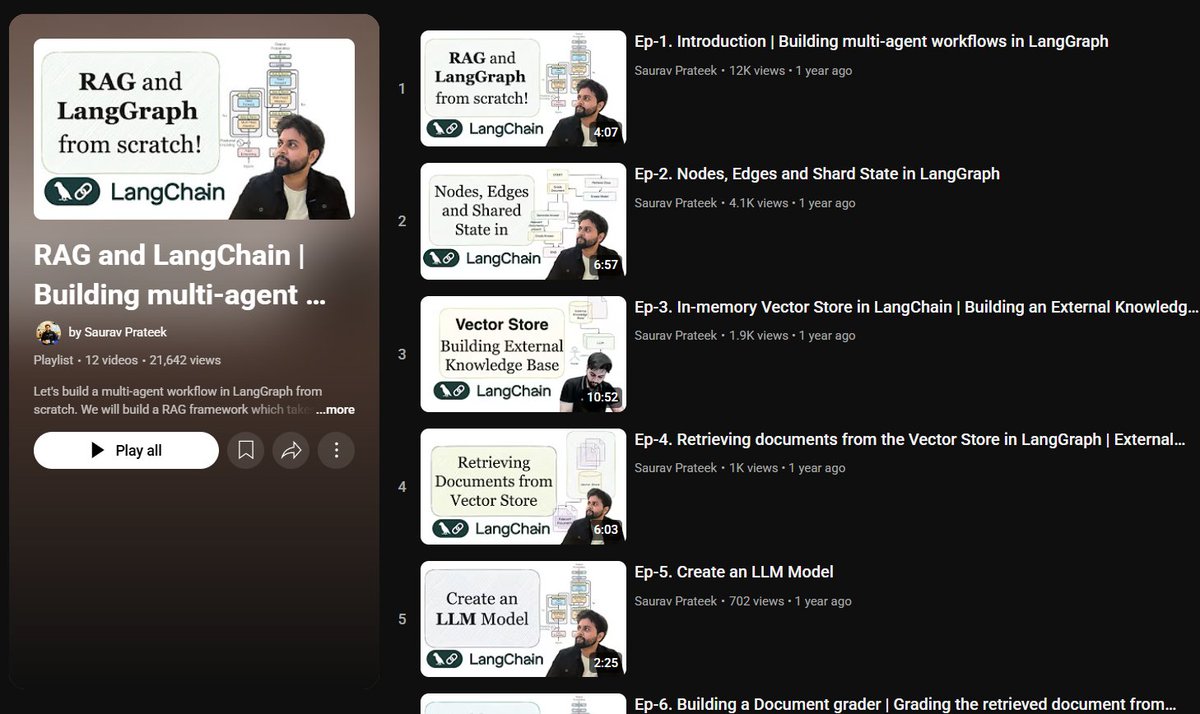
Ever wondered how to actually build a multi-agent RAG workflow from scratch?
Saurav Prateek’s full 12-episode LangGraph series walks through it step-by-step — no vague theory, just hands-on demos:
> how RAG connects LLMs with external knowledge
> building in-memory vector stores
> grading + retrieving docs
> compiling + visualizing the agent graph
Pretty cool that you end up with a full retrieval‑augmented system and a workflow you can extend to any project.
Do not sleep on this one — it’s one of the clearest LangGraph breakdowns out there.
Link in the comment.
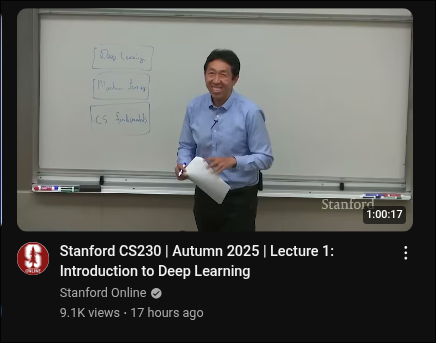
Andrew Ng is launching a new deep learning course.
The last time he did this, millions became ML engineers.
This time, the syllabus has RAG, multimodality, and agents.
Feels like 2012 Coursera, but with 2025 tech.
Yeah, it’s confirmed. One course every week. And the topics just look satisfying:
CNNs, RNNs, LSTM, Adam, Dropout, BatchNorm, Reinforcement Learning, Career Advice, Reading Research Papers, Agents, RAG, and Multimodality
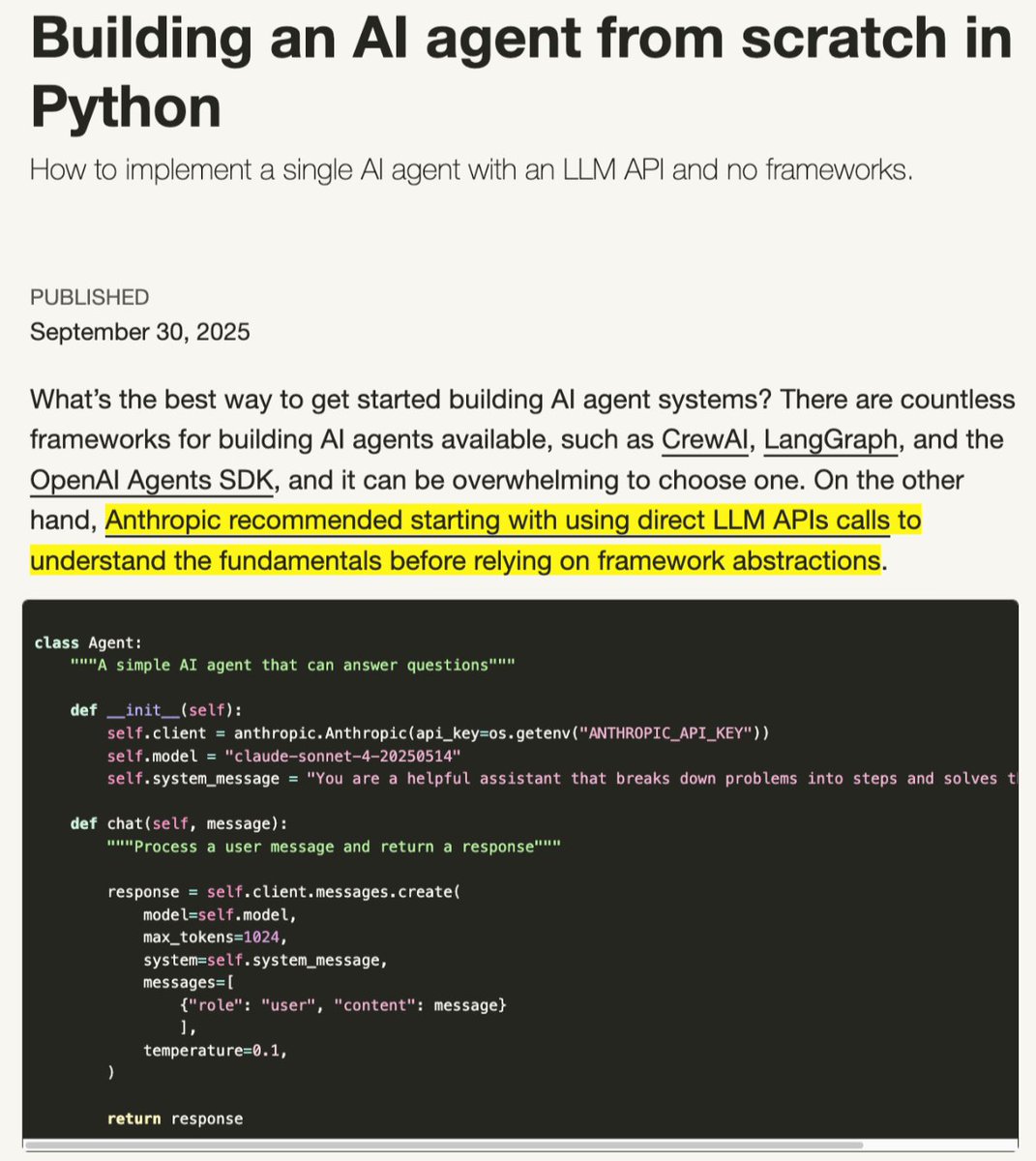
Ever wondered what's actually inside an AI agent?
Almost all the resources on agents hide behind abstractions and frameworks.
This new blog post builds agents from scratch in Python. You will realize how simple Agents are under the hood.