Programming is changing so fast... I'm trying VS Code Cursor + Sonnet 3.5 instead of GitHub Copilot again and I think it's now a net win. Just empirically, over the last few days most of my "programming" is now writing English (prompting and then reviewing and editing the generated diffs), and doing a bit of "half-coding" where you write the first chunk of the code you'd like, maybe comment it a bit so the LLM knows what the plan is, and then tab tab tab through completions. Sometimes you get a 100-line diff to your code that nails it, which could have taken 10+ minutes before.
I still don't think I got sufficiently used to all the features. It's a bit like learning to code all over again but I basically can't imagine going back to "unassisted" coding at this point, which was the only possibility just ~3 years ago.
A short summary: https://t.co/lsTGx1VfkW
Leopold Aschenbrenner — formerly of OpenAI's Superalignment team, now founder of an investment firm focused on artificial general intelligence (AGI) — has posted a massive, provocative essay putting a long lens on AI's future.
Why it matters: Aschenbrenner, based in San Francisco, relies on lots of speculation and projection. So none of this is set in stone. But his opus is a useful, eye-opening synthesis of high-level Silicon Valley conversations.
Here are 10 takeaways that leaped out in Aschenbrenner's 50,000-word, five-chapter, 165-page paper, "Situational Awareness: The Decade Ahead":
1. "Trust the trendlines ... The trendlines are intense, and they were right."
"The magic of deep learning is that it just works — and the trendlines have been astonishingly consistent, despite naysayers at every turn."
2. "Over and over again, year after year, skeptics have claimed 'deep learning won't be able to do X' and have been quickly proven wrong."
"If there's one lesson we've learned from the past decade of AI, it's that you should never bet against deep learning."
"We're literally running out of benchmarks."
3. It's "strikingly plausible that by 2027, models will be able to do the work of an AI researcher/engineer."
4. "By 2027, rather than a chatbot, you're going to have something that looks more like an agent, like a coworker."
5. The data wall: "There is a potentially important source of variance for all of this: we're running out of internet data. That could mean that, very soon, the naive approach to pretraining larger language models on more scraped data could start hitting serious bottlenecks."
6. "AI progress won't stop at human-level … We would rapidly go from human-level to vastly superhuman AI systems."
Superintelligence, coming in 2030 A.D.?
7. AI products are likely to become "the biggest revenue driver for America's largest corporations, and by far their biggest area of growth. Forecasts of overall revenue growth for these companies would skyrocket."
"Stock markets would follow; we might see our first $10T company soon thereafter. Big tech at this point would be willing to go all out, each investing many hundreds of billions (at least) into further AI scaleout. We probably [will] see our first many-hundred-billion-dollar corporate bond sale."
8. "Our failure today to erect sufficient barriers around research on artificial general intelligence "will be irreversible soon: in the next 12-24 months, we will leak key AGI breakthroughs to the [Chinese Communist Party]. It will be the national security establishment's single greatest regret before the decade is out."
9. Superintelligence "will be the United States' most important national defense project."
10. There's "no crack team coming to handle this. ... Right now, there's perhaps a few hundred people in the world who realize what's about to hit us, who understand just how crazy things are about to get, who have situational awareness."
Reality check: Aschenbrenner, with roots in the effective altrusim movement, is an AI investor. So he's not a disinterested party.
TIL: the Riemann zeta-function ζ(s) = ∑ n⁻ˢ is capable of fitting any arbitrary smooth function! [Voronin 75] Given any non-vanishing analytic function f(z) on a disk U in the strip 1/2<Re(z)<1 and any ε>0, we can find some real t such that for all z∈U, |ζ(z+it)−f(z)| < ε.
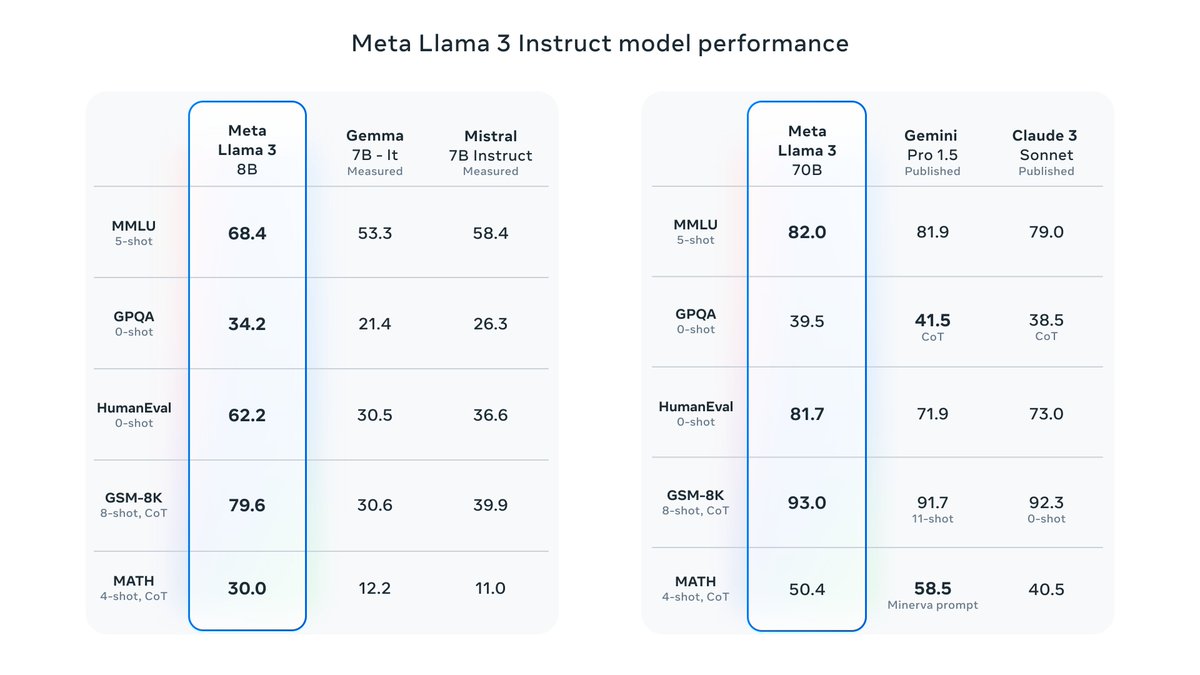
It’s here! Meet Llama 3, our latest generation of models that is setting a new standard for state-of-the art performance and efficiency for openly available LLMs.
Key highlights
• 8B and 70B parameter openly available pre-trained and fine-tuned models.
• Trained on more than 15T tokens, 7x+ larger than Llama 2's dataset!
• Improved tokenizer with vocabulary of 128K tokens for better performance.
• State-of-the-art performance across industry benchmarks.
• New capabilities, including enhanced reasoning and coding.
• 3x more efficient training than Llama 2.
• New trust and safety tools with Llama Guard 2, Code Shield, and CyberSec Eval 2.
• Integrated into Meta AI, and available in more countries across our apps.
• And, just the beginning with more models and new capabilities coming soon!
Visit the Llama 3 website to read more and download the models. https://t.co/1JTQEtBfcf
If there's a higher being who writes the simulation code for our reality, we can estimate the file size of the compiled binary. Meta AI's Emu Video is 6B parameters. Let's say if Sora is 10x larger with bfloat16, then the Creator's binary might be no larger than 111 Gb.
Caveats:
- The actual code might be far simpler, as Sora is still far away from the Kolmogorov complexity;
- Sora is not just compressing our world, but all possible worlds. Our reality is only one of the simulations that Sora is able to compute;
- It's possible that some parts of the physical world doesn't exist until you look at it. Much like you don't need to render every atom in UE5 to make a realistic scene.