Your hardware is custom.
Your software is custom.
Your agents should be too.
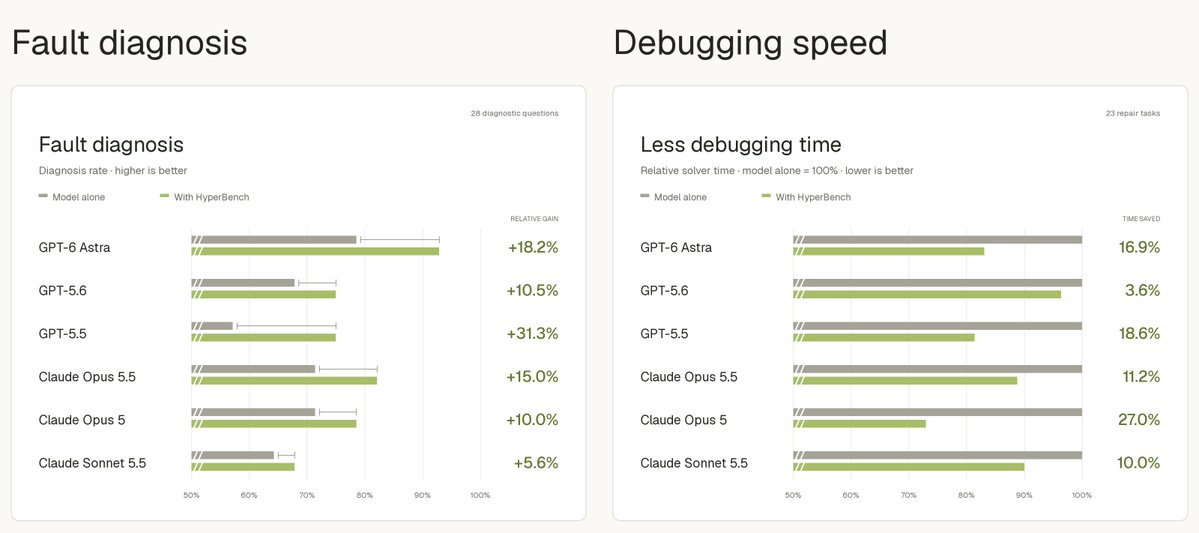
Our reported benchmark results show 31.3% higher bug-finding performance and 27% less debugging time with HyperBench compared to Codex or Claude.
At HyperBench, we’re building engineering agents with context tailored to the systems they work on. Our system graph connects source code, hardware specifications, configuration, and interface requirements, while custom retrieval brings the relevant evidence into each investigation.
We compared six models with and without HyperBench to examine how that context affects fault diagnosis and debugging.
We left OpenAI and Anduril to build this.
We gave AI agents a real drone and a test bench -- and they out performed vanilla Codex & Claude at finding and fixing bugs, with 20%+ gains on speed and correctness.
Check out how we did it:
AI agents struggle with engineering tasks that require reasoning across hardware, firmware, and software boundaries. Research such as HSCO-Bench (https://t.co/c59Fb1Xl2m) exposes failures at those boundaries, where the hardware, software interfaces, and configuration must stay consistent.
At HyperBench, we’re building agents that can follow relationships across the system to investigate failures and identify repairs. Our system graph connects source code, hardware specifications, configuration, and interface requirements, helping agents find the evidence needed to understand what went wrong.
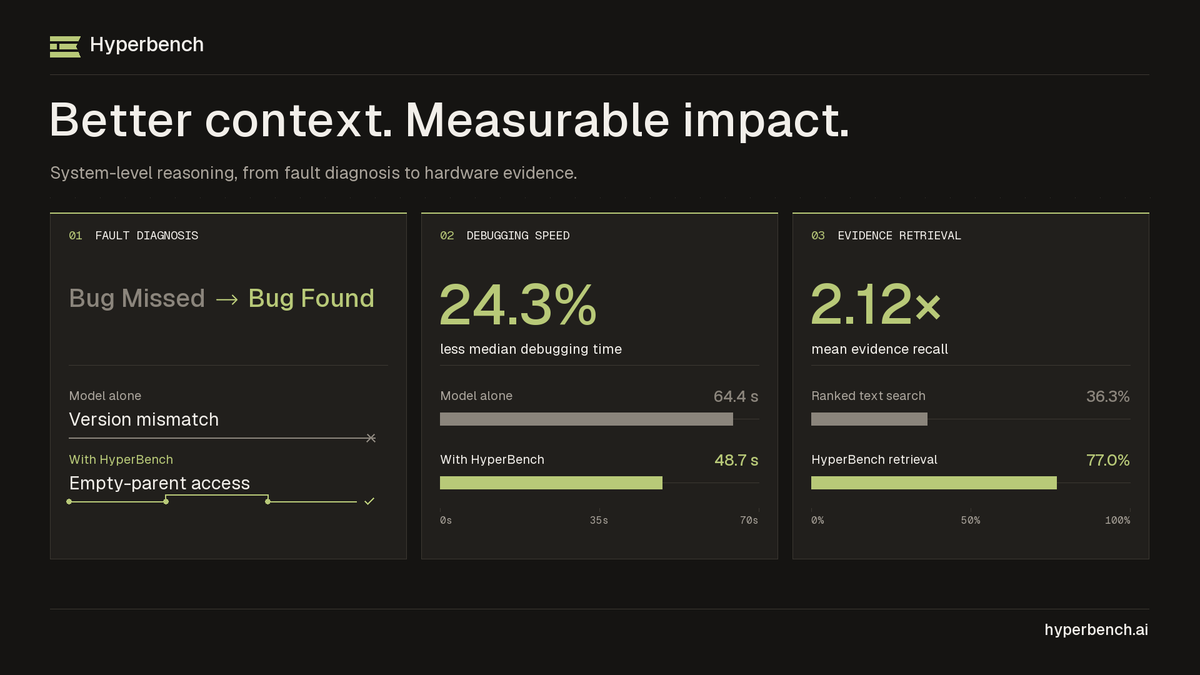
We evaluated our system across 86 diagnostic and retrieval questions and 23 debugging cases. Some highlights:
- Up to 𝟑𝟏.𝟑% 𝐡𝐢𝐠𝐡𝐞𝐫 reported bug-finding performance over the base model*
- 𝟐𝟒.𝟑% 𝐥𝐨𝐰𝐞𝐫 median debugging time across repair/debugging tasks over the base model*
- 𝟐.𝟏𝟐× mean evidence recall: 36.3% → 77.0% across 50 hardware-retrieval development questions
Engineers reconstruct these relationships whenever they investigate a complex failure. We’re making that system knowledge accessible to agents throughout the investigation, from finding relevant evidence to identifying the implementation and requirements a repair needs to preserve.
Read the full blog here: https://t.co/NwFXxJjqEr
*base model = GPT 5.5
We left OpenAI and Anduril to build this.
We gave AI agents a real drone and a test bench -- and they out performed vanilla Codex & Claude at finding and fixing bugs, with 20%+ gains on speed and correctness.
Check out how we did it:
We left OpenAI and Anduril to build this.
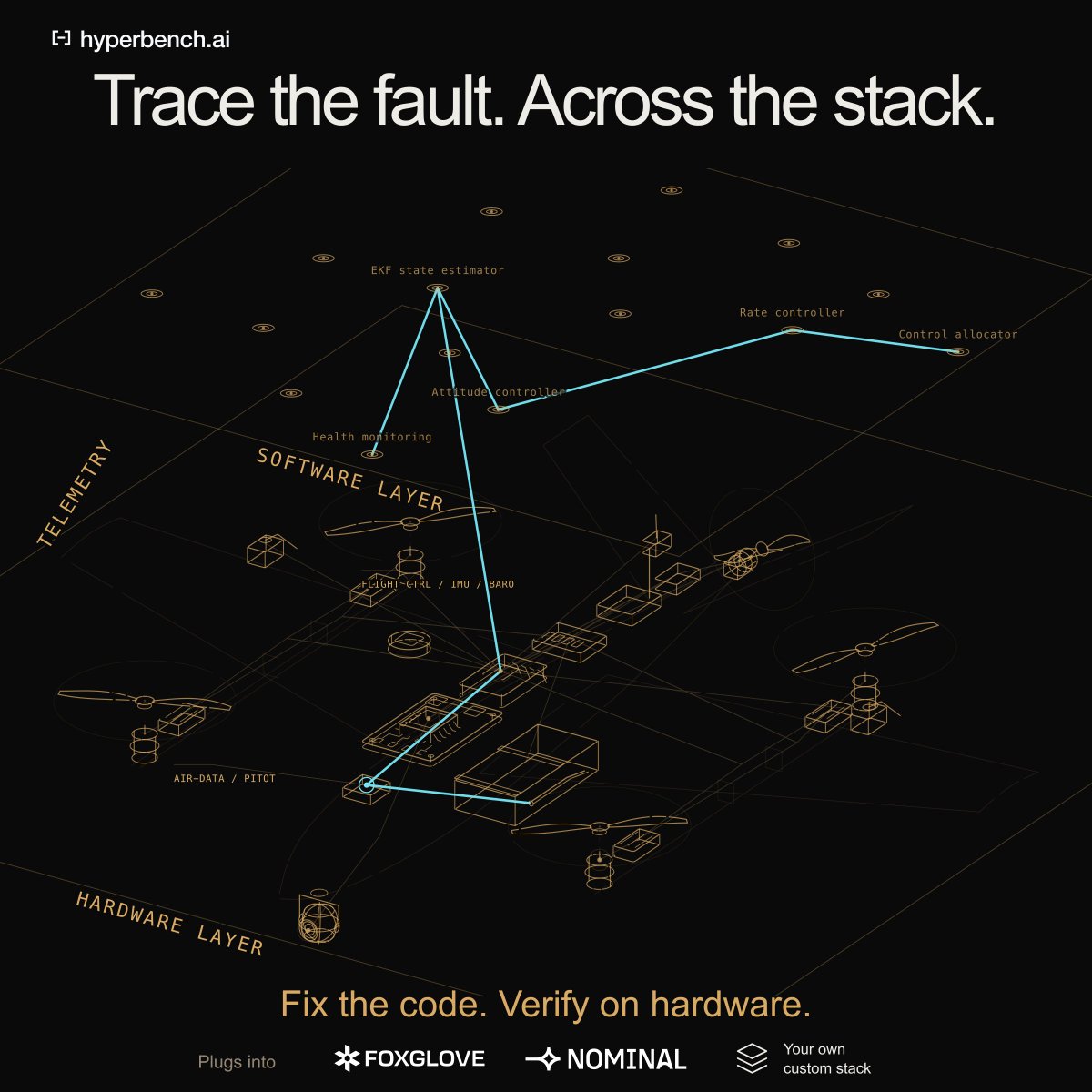
Debugging autonomous systems means tracing failures across software, hardware, and telemetry.
@hyperbenchAI gives coding agents the context and access to trace those failures, fix the code, and verify the fix on hardware.
If you’re building in defense, robotics, or autonomy, we’d love to work with you.
Talk to us → https://t.co/XmyXRwfQGo
BREAKING NEWS
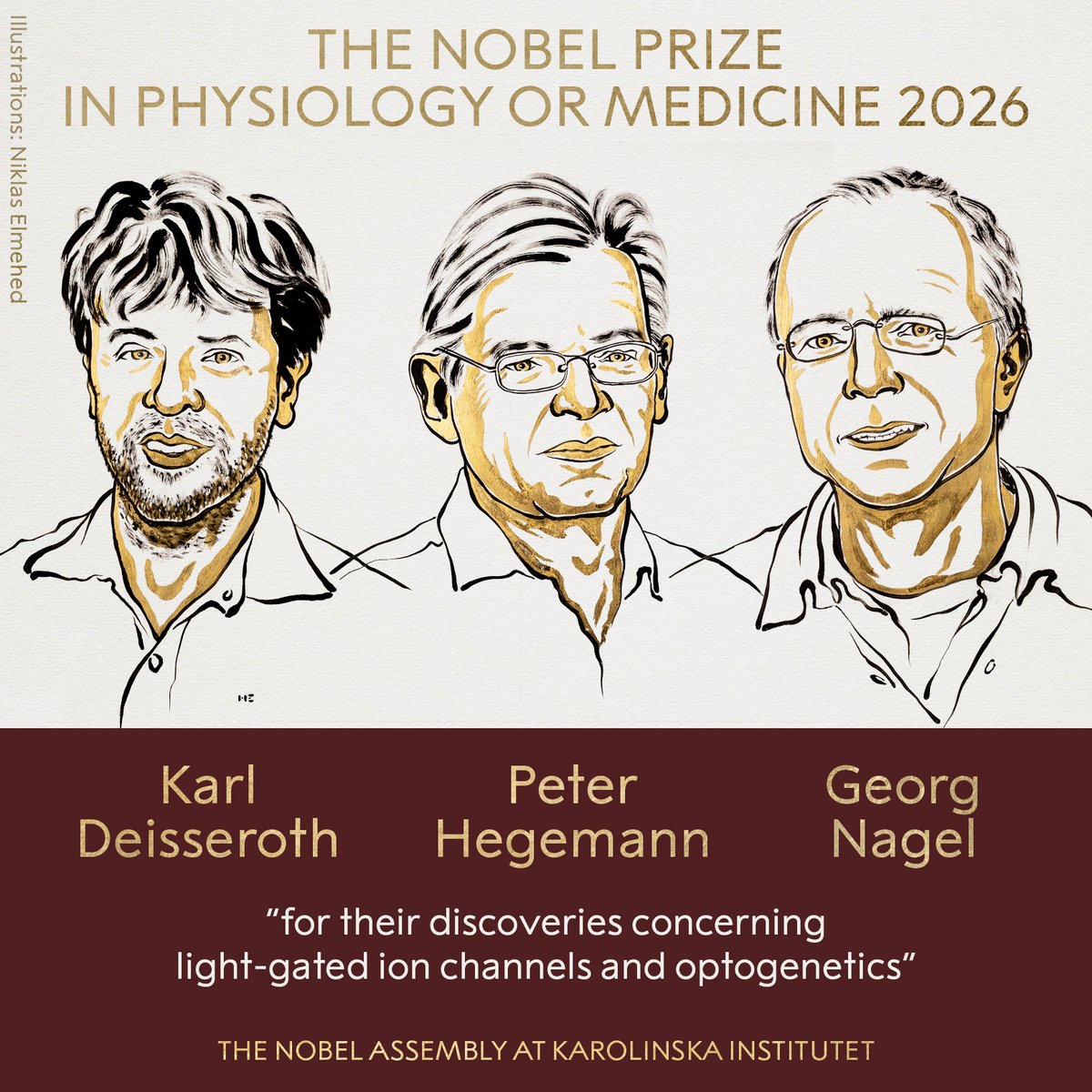
The 2026 #NobelPrize in Physiology or Medicine has been awarded to Karl Deisseroth, Peter Hegemann and Georg Nagel “for their discoveries concerning light-gated ion channels and optogenetics.”
I left Silicon Valley 6 years ago
Why?
Because it's a monoculture
The most extreme group think of any place on the planet
Show up to a dinner party and everyone is in tech
So what do they do? They start stack-ranking each other
And it's a totally ordered set: being founder of co $100B market cap > founder of co with $50B market cap > managing partner of tier 1 venture firm > hired CEO of $50B public co > founder of $10B co > etc etc
Pure toxicity that nerfs creativty
And then as a corollary, people are especially afraid to speak truth to power as everyone knows their place in
"The Hierarchy"
Reject this nonsense. Stay weird. Think independently. Be honest with yourself. Have fun.
in memory of our neurips paper (see u soon sydney hopefully 🙏) and our codebase which has code from gpt 3.5, i had astra solve a poisson pde on a dragon domain
more to come soon...
we made a 1M param AI model tell stories at 10,000 tokens/s.
we implemented a pretrained transformer from here trained on TinyStories on a Kria KV260 and had it tell stories to us.
play around with it here https://t.co/Gt3JxMyQPv and check out the blog here: https://t.co/gDRekcDZih
I'm hiring a SWE intern for Pinetree Research, and the salary is $300K
Before you ask: 300K annualized. And no, we don't want your resume, coverletter, or grades
Here's how to apply:
1. Fork the Solari repo: https://t.co/TxbSy4v2XQ
2. Build a real use case with Solari (browsers, sandboxes, and/or desktops)
3. Publish it on a public Github account
4. Share it in a post on LinkedIn or X
Tag @harrychow_ and @getsolari
Use AI to build it. Seriously, we insist. We don’t care how you ship, we care that you can ship something great, and if you can ship if faster with AI, even better.
What happens next:
- We review every build that tags us
- If we like what you made, we schedule an interview
- If you're the right fit, we'll hire you on the spot
Know someone who can take on the challenge? Tag them below
For questions about Solari or the role, comment below or DM 🚀
Excited to release ParallelKernelBench (PKB), a benchmark for measuring LLMs’ ability to write fast multi-GPU kernels! 😀
Multi-GPU kernel generation compounds several hard problems:
- a large parallelism design space
- a new communication axis to optimize
- and hardware-specific decisions around communication mechanisms
Existing kernel-generation benchmarks mostly target single-GPU workloads, so we built PKB to cover real-world multi-GPU workloads (many of which do not have existing optimized solutions). 🧵👇