Today is a hard day. I shared this note with the @linear team today: We’ve made the difficult decision to increase our workforce. This is not a cost-cutting exercise or a reflection of anyone’s performance. We’re simply reimagining every role for the agentic AI era. We’re hiring. We’re sorry about that.
software is still about thinking
software has always been about taking ambiguous human needs and crystallizing them into precise, interlocking systems. the craft is in the breakdown: which abstractions to create, where boundaries should live, how pieces communicate.
coding with ai today creates a new trap: the illusion of speed without structure. you can generate code fast, but without clear system architecture – the real boundaries, the actual invariants, the core abstractions – you end up with a pile that works until it doesn't. it's slop because there's no coherent mental model underneath.
ai doesn't replace systems thinking – it amplifies the cost of not doing it. if you don't know what you want structurally, ai fills gaps with whatever pattern it's seen most. you get generic solutions to specific problems. coupled code where you needed clean boundaries. three different ways of doing the same thing because you never specified the one way.
as Cursor handles longer tasks, the gap between "vaguely right direction" and "precisely understood system" compounds exponentially. when agents execute 100 steps instead of 10, your role becomes more important, not less.
the skill shifts from "writing every line" to "holding the system in your head and communicating its essence":
- define boundaries – what are the core abstractions? what should this component know? where does state live?
- specify invariants – what must always be true? what are the constants and defaults that make the system work?
- guide decomposition – how should this break down? what's the natural structure? what's stable vs likely to change?
- maintain coherence – as ai generates more code, you ensure it fits the mental model, follows patterns, respects boundaries.
this is what great architects and designers do: they don't write every line, but they hold the system design and guide toward coherence. agents are just very fast, very literal team members.
the danger is skipping the thinking because ai makes it feel optional. people prompt their way into codebases they don't understand. can't debug because they never designed it. can't extend because there's no structure, just accumulated features.
people who think deeply about systems can now move 100x faster. you spend time on the hard problem – understanding what you're building and why – and ai handles mechanical translation. you're not bogged down in syntax, so you stay in the architectural layer longer.
the future isn't "ai replaces programmers" or "everyone can code now." it's "people who think clearly about systems build incredibly fast, and people who don't generate slop at scale."
the skill becomes: holding complexity, breaking it down cleanly, communicating structure precisely. less syntax, more systems. less implementation, more architecture. less writing code, more designing coherence.
humans are great at seeing patterns, understanding tradeoffs, making judgment calls about how things should fit together.
ai can't save you from unclear thinking – it just makes unclear thinking run faster.
A few random notes from claude coding quite a bit last few weeks.
Coding workflow. Given the latest lift in LLM coding capability, like many others I rapidly went from about 80% manual+autocomplete coding and 20% agents in November to 80% agent coding and 20% edits+touchups in December. i.e. I really am mostly programming in English now, a bit sheepishly telling the LLM what code to write... in words. It hurts the ego a bit but the power to operate over software in large "code actions" is just too net useful, especially once you adapt to it, configure it, learn to use it, and wrap your head around what it can and cannot do. This is easily the biggest change to my basic coding workflow in ~2 decades of programming and it happened over the course of a few weeks. I'd expect something similar to be happening to well into double digit percent of engineers out there, while the awareness of it in the general population feels well into low single digit percent.
IDEs/agent swarms/fallability. Both the "no need for IDE anymore" hype and the "agent swarm" hype is imo too much for right now. The models definitely still make mistakes and if you have any code you actually care about I would watch them like a hawk, in a nice large IDE on the side. The mistakes have changed a lot - they are not simple syntax errors anymore, they are subtle conceptual errors that a slightly sloppy, hasty junior dev might do. The most common category is that the models make wrong assumptions on your behalf and just run along with them without checking. They also don't manage their confusion, they don't seek clarifications, they don't surface inconsistencies, they don't present tradeoffs, they don't push back when they should, and they are still a little too sycophantic. Things get better in plan mode, but there is some need for a lightweight inline plan mode. They also really like to overcomplicate code and APIs, they bloat abstractions, they don't clean up dead code after themselves, etc. They will implement an inefficient, bloated, brittle construction over 1000 lines of code and it's up to you to be like "umm couldn't you just do this instead?" and they will be like "of course!" and immediately cut it down to 100 lines. They still sometimes change/remove comments and code they don't like or don't sufficiently understand as side effects, even if it is orthogonal to the task at hand. All of this happens despite a few simple attempts to fix it via instructions in CLAUDE . md. Despite all these issues, it is still a net huge improvement and it's very difficult to imagine going back to manual coding. TLDR everyone has their developing flow, my current is a small few CC sessions on the left in ghostty windows/tabs and an IDE on the right for viewing the code + manual edits.
Tenacity. It's so interesting to watch an agent relentlessly work at something. They never get tired, they never get demoralized, they just keep going and trying things where a person would have given up long ago to fight another day. It's a "feel the AGI" moment to watch it struggle with something for a long time just to come out victorious 30 minutes later. You realize that stamina is a core bottleneck to work and that with LLMs in hand it has been dramatically increased.
Speedups. It's not clear how to measure the "speedup" of LLM assistance. Certainly I feel net way faster at what I was going to do, but the main effect is that I do a lot more than I was going to do because 1) I can code up all kinds of things that just wouldn't have been worth coding before and 2) I can approach code that I couldn't work on before because of knowledge/skill issue. So certainly it's speedup, but it's possibly a lot more an expansion.
Leverage. LLMs are exceptionally good at looping until they meet specific goals and this is where most of the "feel the AGI" magic is to be found. Don't tell it what to do, give it success criteria and watch it go. Get it to write tests first and then pass them. Put it in the loop with a browser MCP. Write the naive algorithm that is very likely correct first, then ask it to optimize it while preserving correctness. Change your approach from imperative to declarative to get the agents looping longer and gain leverage.
Fun. I didn't anticipate that with agents programming feels *more* fun because a lot of the fill in the blanks drudgery is removed and what remains is the creative part. I also feel less blocked/stuck (which is not fun) and I experience a lot more courage because there's almost always a way to work hand in hand with it to make some positive progress. I have seen the opposite sentiment from other people too; LLM coding will split up engineers based on those who primarily liked coding and those who primarily liked building.
Atrophy. I've already noticed that I am slowly starting to atrophy my ability to write code manually. Generation (writing code) and discrimination (reading code) are different capabilities in the brain. Largely due to all the little mostly syntactic details involved in programming, you can review code just fine even if you struggle to write it.
Slopacolypse. I am bracing for 2026 as the year of the slopacolypse across all of github, substack, arxiv, X/instagram, and generally all digital media. We're also going to see a lot more AI hype productivity theater (is that even possible?), on the side of actual, real improvements.
Questions. A few of the questions on my mind:
- What happens to the "10X engineer" - the ratio of productivity between the mean and the max engineer? It's quite possible that this grows *a lot*.
- Armed with LLMs, do generalists increasingly outperform specialists? LLMs are a lot better at fill in the blanks (the micro) than grand strategy (the macro).
- What does LLM coding feel like in the future? Is it like playing StarCraft? Playing Factorio? Playing music?
- How much of society is bottlenecked by digital knowledge work?
TLDR Where does this leave us? LLM agent capabilities (Claude & Codex especially) have crossed some kind of threshold of coherence around December 2025 and caused a phase shift in software engineering and closely related. The intelligence part suddenly feels quite a bit ahead of all the rest of it - integrations (tools, knowledge), the necessity for new organizational workflows, processes, diffusion more generally. 2026 is going to be a high energy year as the industry metabolizes the new capability.
I'm Boris and I created Claude Code. Lots of people have asked how I use Claude Code, so I wanted to show off my setup a bit.
My setup might be surprisingly vanilla! Claude Code works great out of the box, so I personally don't customize it much. There is no one correct way to use Claude Code: we intentionally build it in a way that you can use it, customize it, and hack it however you like. Each person on the Claude Code team uses it very differently.
So, here goes.
the old way of scaling teams is dead:
we used to hire specialists – designers, engineers, PMs – each in their lane, scaling by adding more people. but when Cursor can take you from idea to code in minutes, execution isn't the bottleneck anymore. taste and judgment are.
what matters now: people who can see the full stack, move between layers, but specialize deeply in something AI can't replicate yet. T-shaped but way wider – conversant across domains, expert in one thing.
AI doesn't just make you faster. it ties teams together differently. no more waterfall – designer codes the prototype, engineer extends it, both work in the same medium. the gap between disciplines disappears.
this raises individual ceilings. i'm a designer who built ryOS entirely in Cursor – couldn't have done that before. but i'm not replacing engineers, i'm just removing execution barriers while keeping my design taste and systems thinking.
you're not hiring for roles anymore. you're hiring for breadth + depth, taste, systems thinking, learning velocity. 5 people who can work across code/design/product beat 20 specialists coordinating handoffs.
the new bottlenecks are deeply human: taste, vision, judgment, context. AI explores options, but can't tell you which is right. that's where specialization matters now – in judgment, not execution.
small teams, fluid boundaries, everyone working in the same tools. roles still matter but as overlapping concerns with different depths, not separate silos. tools handle execution, you handle vision.
this is what we're building at Cursor – closing the gap between idea and reality. so your taste becomes the main thing, and teams have more freedom to explore crazy ideas.
Agency > Intelligence
I had this intuitively wrong for decades, I think due to a pervasive cultural veneration of intelligence, various entertainment/media, obsession with IQ etc. Agency is significantly more powerful and significantly more scarce. Are you hiring for agency? Are we educating for agency? Are you acting as if you had 10X agency?
Grok explanation is ~close:
“Agency, as a personality trait, refers to an individual's capacity to take initiative, make decisions, and exert control over their actions and environment. It’s about being proactive rather than reactive—someone with high agency doesn’t just let life happen to them; they shape it. Think of it as a blend of self-efficacy, determination, and a sense of ownership over one’s path.
People with strong agency tend to set goals and pursue them with confidence, even in the face of obstacles. They’re the type to say, “I’ll figure it out,” and then actually do it. On the flip side, someone low in agency might feel more like a passenger in their own life, waiting for external forces—like luck, other people, or circumstances—to dictate what happens next.
It’s not quite the same as assertiveness or ambition, though it can overlap. Agency is quieter, more internal—it’s the belief that you *can* act, paired with the will to follow through. Psychologists often tie it to concepts like locus of control: high-agency folks lean toward an internal locus, feeling they steer their fate, while low-agency folks might lean external, seeing life as something that happens *to* them.”
Underrated life skill: Pausing. Life doesn't slow down on its own. You have to do that part yourself. Take a walk with your spouse. Sit with your kid a little longer. Call your parents to hear the same story you've heard 1,000 times. Savor the days before the years pass you by.
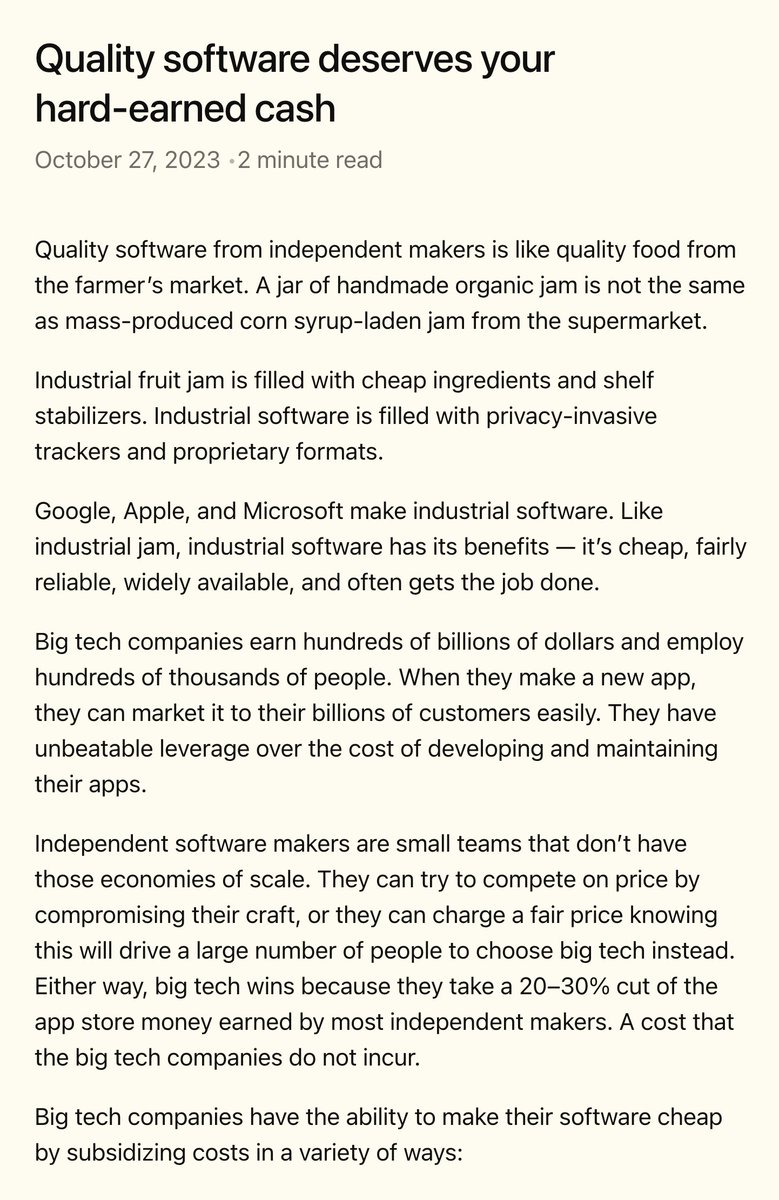
Quality software deserves your hard‑earned cash
Quality software from independent makers is like quality food from the farmer’s market. A jar of handmade organic jam is not the same as mass-produced corn syrup-laden jam from the supermarket.
Industrial fruit jam is filled with cheap ingredients and shelf stabilizers. Industrial software is filled with privacy-invasive trackers and proprietary formats.
Google, Apple, and Microsoft make industrial software. Like industrial jam, industrial software has its benefits — it’s cheap, fairly reliable, widely available, and often gets the job done.
Big tech companies earn hundreds of billions of dollars and employ hundreds of thousands of people. When they make a new app, they can market it to their billions of customers easily. They have unbeatable leverage over the cost of developing and maintaining their apps.
Independent software makers are small teams that don’t have those economies of scale. They can try to compete on price by compromising their craft, or they can charge a fair price knowing this will drive a large number of people to choose big tech instead. Either way, big tech wins because they take a 20–30% cut of the app store money earned by most independent makers. A cost that the big tech companies do not incur.
Big tech companies have the ability to make their software cheap by subsidizing costs in a variety of ways:
- Google sells highly profitable advertising and makes its apps free, but you are subjected to ads and privacy-invasive tracking.
- Apple sells highly profitable devices and makes its apps free, but locks you into a proprietary ecosystem.
- Microsoft sells highly profitable enterprise contracts using a bundling strategy, and makes its apps cheap, also locking you into a proprietary ecosystem.
Some tech companies raise hundreds of millions of dollars from venture capital investors, and use this money to subsidize pricing — until the money runs out, and the quality soon declines.
I’m not saying these companies are evil. But their subsidies create the illusion that all software should be cheap or free.
Industrial software has become so incredibly cheap that most of us have lost the sense for how much value a quality piece of software can provide. We have become numb to the taste of good software and hypnotized by the idea of “free”.
I’m not sure why, but we seem more willing to spend money on good fruit jam than on good software. I notice that I spend less on personal software than I do on groceries and many basic things. Yet software is one of the few things I pay for that truly gives me leverage. Consider its cost per use.
Independent makers of quality software go out of their way to make apps that are better for you. They take a principled approach to making tools that don’t compromise your privacy, and don’t lock you in.
Independent software makers are people you can talk to. Like quality jam from the farmer’s market, you might become friends with the person who made it — they’ll listen to your suggestions and your complaints.
If you want to live in a world with more than a handful of software makers, then spend a bit more on quality independent software. It deserves your hard-earned cash.
The 50th anniversary of Earth Day is coming up on April 22. It’s a celebration that feels more important than ever to me.
Can I distract you with a quick story?
1/17
Remembering the Alchemy Circle, where a blend of some psychedelic music in Boom Festival happens. Missing the music? Check at the link https://t.co/eASiFQZBaS