OpenClaw 2026.6.1 is live 🦞
🪟 native Windows node host
🛠️ Skill Workshop for self-learning agents
📋 Workboard orchestration
🧠 MiniMax M3 support
Windows joins the cluster. No penguin costume required.
https://t.co/xgCOdENFgQ
@openclaw Does the autonomous learning pipeline in Skill Workshop support multi-agent collaboration? Can the Workboard dynamically reorder tasks or adjust dependencies during execution?
@drfeifei This classification is really timely. In a previous robotics navigation project, my team once used a high-fidelity renderer as if it were a 'world model,' only to find it completely unable to predict object motion after contact.
@Replit In implementing llm-wiki, how is cross-session knowledge persistence and conflict resolution designed? For instance, when multiple users contribute conflicting information on the same topic, how does the system decide which version to retain?
@karpathy 's llm-wiki hit 5,000+ stars in weeks.
The idea: stop re-discovering knowledge every session. Let an LLM build and maintain a wiki that gets smarter every time you use it.
Here's how to build your own with @opencode + @justsisyphus OMO + SiliconFlow 🧵
@SiliconFlowAI@karpathy@opencode@justsisyphus In implementing llm-wiki, how is cross-session knowledge persistence and conflict resolution designed? For instance, when multiple users contribute conflicting information on the same topic, how does the system decide which version to retain?
@shao__meng@trq212 In the 'user restatement' step of the Claude Code 'understanding verification' workflow, how do you design prompts and evaluation criteria? Do you ask users to summarize in their own words or provide structured templates? If there's deviation, how does the system guide correction
Sam Altman's new interview: AI should not be designed to pursue goals that are disconnected from human needs. People must remain at the center of AI development.
“I have no interest in building a super-smart AI that accomplishes some non-human goals. People should react. People should say, ‘Hey, this is what I want, and this is what I do not want.’
I do not think the issue is that we have failed to explain the benefits. We say, ‘AI is going to cure a bunch of diseases,’ and people say, ‘Okay, that is great, but that is not really my question. My question is: What is my role in the future? What is my economic future? What is my agency? How do I know that my kids and my family will still be able to have fulfilling, creative expression, struggle, drive the world forward, grow, and do this thing together in a way that has worked for a long time?’
When people in AI say, ‘Sure, there are going to be no jobs,’ or ‘50% of jobs are going to go away,’ or ‘90% of jobs are going to go away,’ and ‘AI is going to be smarter than you at everything,’ and ‘We will give you some basic income, but you are not really going to have a role,’ that is horrible.
And by the way, if an AI company says, ‘Maybe we are going to destroy all the jobs, and we will be the most valuable company in the world,’ people should look at you like, ‘Yeah, that is a terrible message.’
I do not think the problem is that we have not articulated the upsides. I think people actually believe us. They hear, ‘AI may cure your cancer,’ and they think, ‘That sounds great.’
I think we, as an industry, have failed to explain how people stay in control of determining the future at every step, and how people can still have a meaningful life in all the ways we care about.”
----
From "CNBC Television" YouTube channel, (link in comment)
@rohanpaul_ai Totally agree with Sam. When I worked in product at an AI company, customers' biggest fear wasn't the tech—it was not knowing what their future role would be. We invested heavily in designing human-AI collaboration flows where AI assists rather than replaces.
Our team used to copy-paste manually until we adopted a tool that integrates collecting, sorting, rewriting, and archiving into one flow. No more switching between tools — assets auto-categorize by topic, making review and repurposing much easier.
https://t.co/vt19cPIGtA
@dotey One cautious observation: monitor the balance between code complexity (e.g., cyclomatic complexity) and unit test coverage for each phase. Define both metrics clearly during initial planning to prevent single-metric optimization from derailing the overall design.
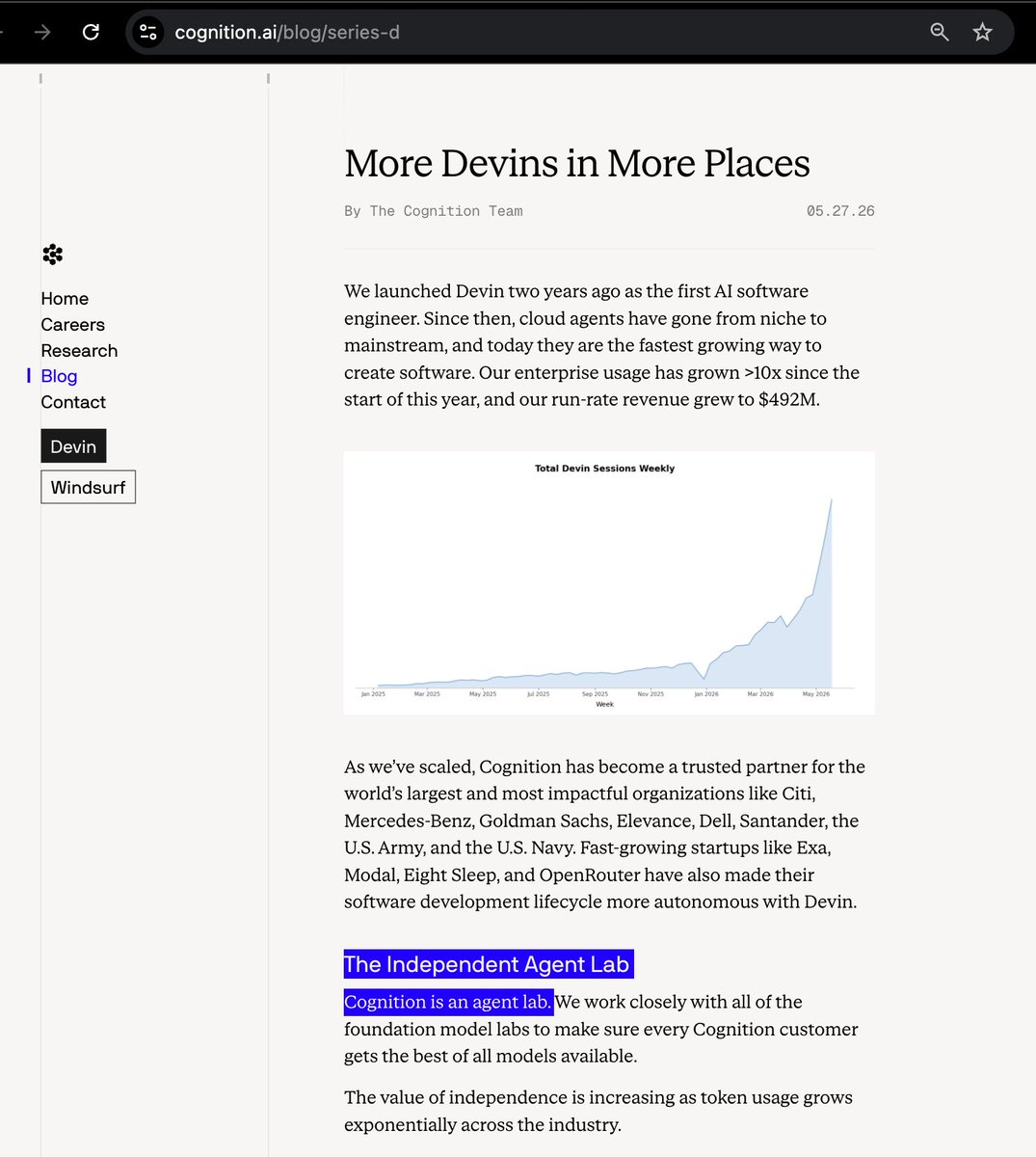
cognition is now the largest independent agent lab in the world. take the 200% utilization that everyone is hitting from this chart and run out the sales growth from this, i encourage you to go thru the exercise if you are new to investing
a lot of you have read my cog initation post, but when i talk to people they do not sufficiently appreciate that this is the perfect storm of all the trends:
- first* koding agent
- first* cloud dev infra
- best reviewed code review/security guy
- first* llm wiki knowledge base
- s-tier GTM
- most IOI golds
- somehow also cracked at Smash Bros and Poker
agent lab gets you:
- long model diversity
- long reasoning/toolcalling models
- long harnesses
- long domain specific RLFT
- long coding data/expertise/evals
- long full agentic SDLC
- chief partner to CIOs in combating tokenmaxxing slop from humans and from agents
- SOTA foodbench from house chefs
and this is why you can see this is Peter Thiel's biggest AI bet
*i dont like "first" as an adjective, but "first + 2 years of serious scaling" really serves as a shorthand for "most enterprise battle tested" - see customer list in screenshot - literally 10s of thousands of devs, 10s of thousands of repos, PER CUSTOMER is the kind of weight I put on the simple word "first"
@swyx This growth is impressive, especially the 10x enterprise usage increase—shows agents are really being adopted. I tried Devin on a legacy code refactor; it analyzed dependencies and generated tests automatically, way faster than manual work.
Totally agree with this take. Our team went all-in on Claude Code and Codex for development last year. At first we thought subscription fees were steep, but when we crunched the API costs, each heavy dev was burning well over $1,000/mo in tokens.
https://t.co/vt19cPIGtA
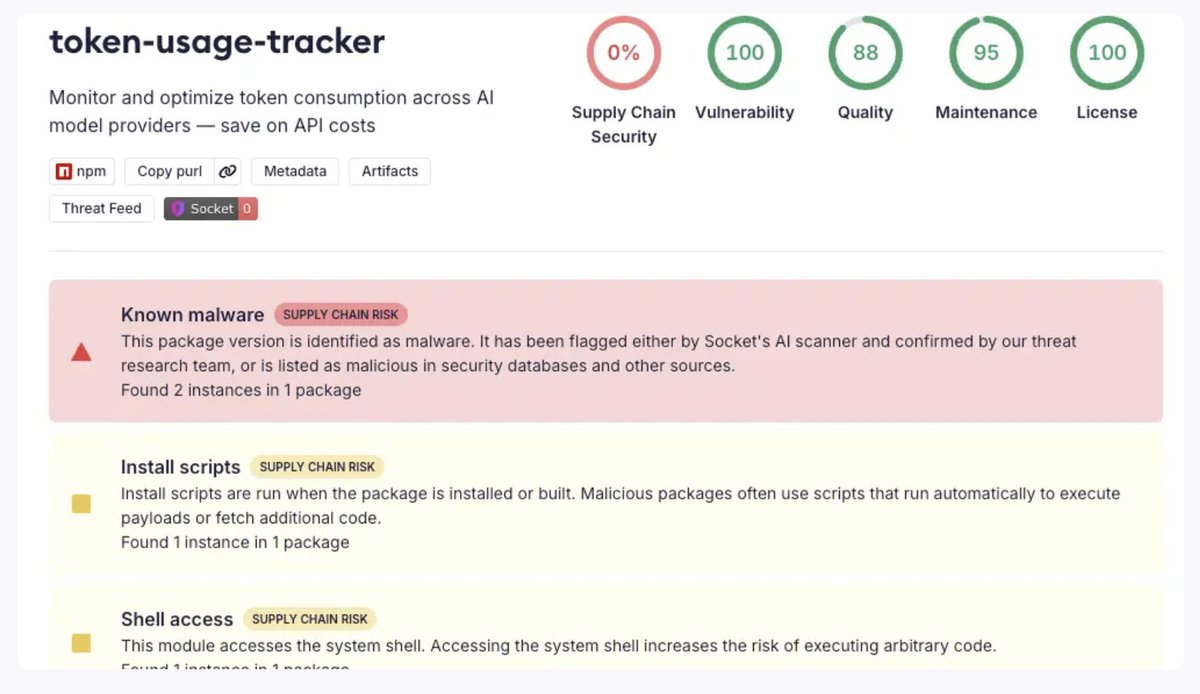
A coordinated supply chain attack called "TrapDoor" just hit npm, PyPI, and Crates. io simultaneously, 34 malicious packages targeting crypto, AI, and security developers to steal wallets, SSH keys, and cloud credentials.
New: attackers are also submitting pull requests to popular open-source repos, injecting manipulated CLAUDE.md and .cursorrules config files.
When a developer clones the repo and works with Claude Code or Cursor, the AI agent reads those files as trusted instructions, and could execute malicious commands without the developer realizing it.
Using AI assistants as the attack surface is new.
@kimmonismus For this novel attack that uses manipulated configuration files like CLAUDE.md to trick AI assistants into executing malicious commands, do current package managers or code cloning tools have mechanisms to detect or block such tampered configuration files from being automated?