$IBRX
When the GOAT speaks: “@ImmunityBio could be a $5T MC” we listen.
ANKTIVA is the immune answer patients have been waiting for. @LoriMills4CA42@DrPatrick
Check out the latest episode of The Medisun Podcast. We welcome @DrJackKruse for the third time. Available now on Spotify and YouTube
Spotify: https://t.co/imQsRc27LY
An 80-minute finance lecture shows something most traders never look at: an option price is quietly telling you the probability of where the underlying can finish.
The entire idea starts with one simple payoff: a call option pays max(Sₜ − K, 0).
But the professor asks a much more interesting question: what happens if you compare two call options with almost identical strikes?
The difference between them starts looking like a completely different security, a digital option that pays when the stock finishes above K.
And then the key relationship appears.
The slope of the call-price curve with respect to strike is tied directly to the market-implied probability of finishing above that strike.
In symbols: −∂C/∂K.
Take the derivative again and you get even more information: the curvature of option prices reveals the implied probability density of the future stock price.
One option surface. One strike by strike calculation. And suddenly you're looking at the entire distribution the market is pricing in.
The lecture then connects this to risk-neutral valuation, digital options, call spreads, Arrow-Debreu securities, and the Breeden-Litzenberger idea that option prices contain enough information to recover the implied distribution.
That means a trader doesn't have to ask only: “What is the call worth?”
You can ask: “What probability is the market assigning to Sₜ ending above $K?”
And then change K.
Move across the entire strike curve.
You start reconstructing the market's view of the future.
The strange part is that this information isn't hidden inside some secret quant terminal.
It is sitting directly inside the prices traders already look at every day.
Most people see a chain of option prices.
A quantitative trader sees a probability distribution encoded in the slope and curvature of that chain.
The formula is sitting on the board for free. The hard part is realizing what the prices are actually saying before everyone else does.
The option price is the market's price tag. The derivatives of that price are the market's probabilities.
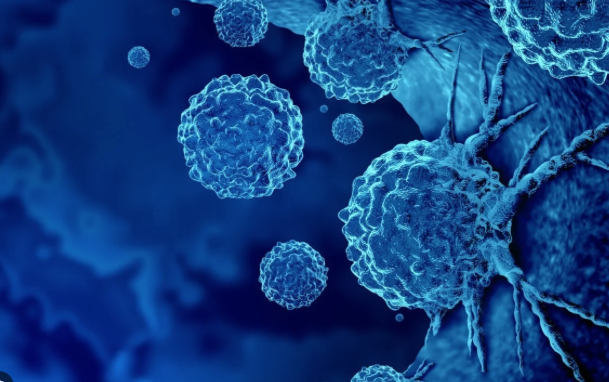
$IBRX An overview of how neoepitopes operate within Immunotherapy 2.0 and the potential of Anktiva to revolutionize traditional cancer treatments.
https://t.co/fA7K2aFvLV
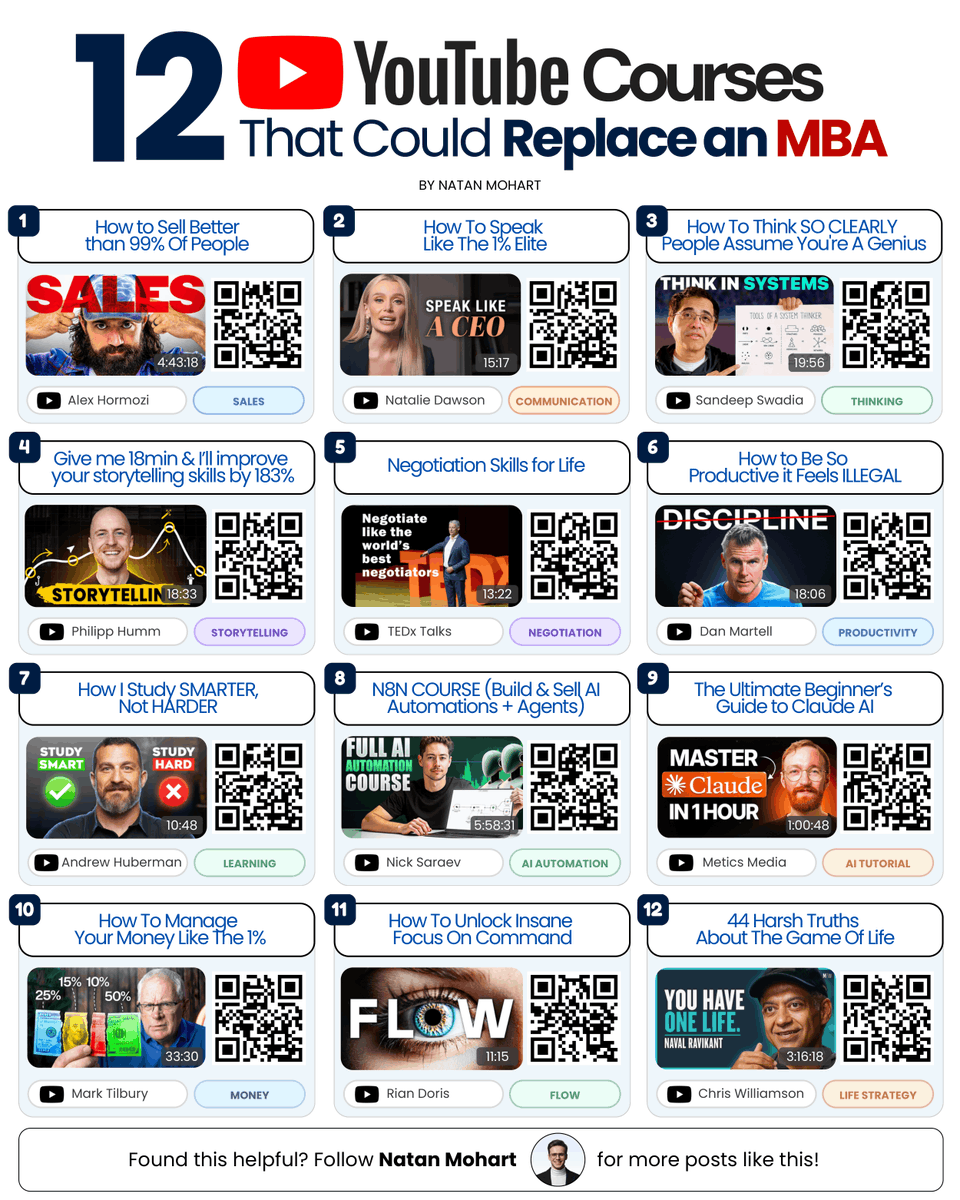
12 YouTube Courses That Could Replace an MBA
From Alex Hormozi, Naval Ravikant, Andrew Huberman & More
You don't need 4 years of university to learn the skills that matter in business.
In business, you need to know how to sell, communicate, think clearly, negotiate, manage your time, learn faster, use AI, manage money, and make better decisions.
And you can start learning these skills for free.
Here are 12 YouTube courses and masterclasses worth watching:
1. How to Sell Better than 99% Of People (@AlexHormozi)
https://t.co/hrIaDpj2ED
2. How To Speak Like The 1% Elite (@nataliecdawson)
https://t.co/r9k5OR8ras
3. How To Think SO CLEARLY People Assume You're A Genius (Sandeep Swadia)
https://t.co/jJerghcT2V
4. Give me 18min & I'll improve your storytelling skills by 183% (Philipp Humm)
https://t.co/oQ9IdnFwZa
5. Negotiation Skills for Life (Matthias Schranner / TEDx Talks)
https://t.co/D7LSnNTSjw
6. How to Be So Productive it Feels ILLEGAL (@danmartell)
https://t.co/oKyAtrNr1S
7. How I Study SMARTER, Not HARDER (@hubermanlab)
https://t.co/Empuh0Xcrs
8. N8N COURSE (Build & Sell AI Automations + Agents) (@nicksaraev)
https://t.co/2KPUUAOfwJ
9. The Ultimate Beginner's Guide to Claude AI (Metics Media/Matt Ebso)
https://t.co/j6nv8uK97F
10. How To Manage Your Money Like The 1% (@marktilbury)
https://t.co/ZALMkxpcLr
11. How To Unlock Insane Focus On Command (Rian Doris)
https://t.co/B9LRqt8MNC
12. 44 Harsh Truths About The Game Of Life (@naval / @ChrisWillx )
https://t.co/P1o6kJMsdK
💬 What YouTube course or channel would you add to this list?
If you found this helpful, save this post and share it with someone who wants to build business, career, and life skills without spending thousands on an MBA.
—
@natan_mohart
THIS 49-MINUTE LECTURE EXPLAINS THE MATHEMATICS BEHIND THE PRICE OF AN OPTION.
Not a trading strategy.
Not a prediction.
A framework for answering one question:
what should a derivative actually be worth?
The professor starts with the one-step binomial model.
The stock can move up.
Or down.
Build a portfolio that replicates the option's payoff.
And suddenly you don't need to guess the future price.
You can price the derivative by constructing the same payoff another way.
Then comes the idea that changed modern derivatives:
risk-neutral valuation.
Under the risk-neutral measure, the expected payoff is discounted at the risk-free rate.
The actual expected stock return disappears from the pricing equation.
That leads directly to the Black–Scholes equation.
And the lecture shows something even more interesting:
Any tradable derivative has to satisfy the same fundamental pricing equation.
The reason is hedging.
Construct a replicating portfolio.
Continuously adjust the position.
Eliminate the relevant source of risk.
Then the derivative's price is no longer whatever the market feels like paying.
It is constrained by the cost of replication and no-arbitrage.
The lecture then connects Black–Scholes to the heat equation through a change of variables.
A problem from financial markets...
turns into a problem from mathematical physics.
And that's the part most traders miss.
Black–Scholes isn't fundamentally about predicting whether a stock will go up or down.
It's about constructing an equivalent financial payoff and pricing it without arbitrage.
The market can be uncertain.
The stock path can be random.
But a carefully constructed hedge can still impose structure on the price.
So instead of asking:
“Where will BTC be at expiration?”
the quantitative question becomes:
“What portfolio replicates this payoff, and what should that portfolio cost today?”
That's the idea sitting underneath modern options pricing.
Don't predict the payoff.
Replicate it.
Insurance is the oldest of the four ways. It is a nine-trillion-dollar global industry. The equation underneath it was invented in 1560 by a broke Italian gambler.
His name was Girolamo Cardano. He wrote a book called Liber de Ludo Aleae. A short manual on how to win at dice. Nobody in finance read it for four hundred years.
Then in 1996 a ninety-year-old man in New York wrote a book that traced every modern risk model back to that manual. He called it Against the Gods. One thesis. Every dollar of premium ever collected on Earth is a footnote to a gambler scribbling in Milan.
His name was Peter Bernstein. He founded the Journal of Portfolio Management in 1974 and ran money at Bernstein-Macaulay before that. Wall Street called him the historian of risk.
In 2008 a small production company filmed him for thirteen minutes. He walked through the entire five-hundred-year arc. Cardano to Pascal to Fermat to Black-Scholes. Then he stopped and said the industry had built glass towers on the back of an idea a broke Italian scribbled to settle a card debt.
He died the following summer. Age ninety.
Reinsurance premiums crossed six hundred billion dollars last year. Every actuary on Earth prices catastrophe risk with the same expected-value framework Cardano invented to shave the house edge in Milan.
The video is thirteen minutes and twenty-two seconds long. Free. Eleven years on YouTube. Twenty-nine thousand people have watched it.
Almost none of them work in insurance.
50 Web Sites Google Doesn't Want You to Know About
1.) 'https://t.co/lYCYrYM1Hb' — Bypass any paywall
2.) 'https://t.co/XczMMLfz8H' — Millions of free textbooks
3.) 'https://t.co/DXxPcqmU12' — Free academic articles
4.) 'https://t.co/wEHzIvVRTo' — Find free app alternatives
5.) 'https://t.co/eVrRDWgx8U' — Find where any content is published
6.) 'https://t.co/A1aMVlBPFk' — Access any old web page
7.) 'https://t.co/Mq40zmIIEJ' — 70,000 free classic books
8.) 'https://t.co/1s13AmUHzV' — Free PDF downloads
9.) 'https://t.co/FzLnwbvNFj' — Free courses from top universities
10.) 'https://t.co/q7akDOu5z4' — Solve any math problem instantly
11.) 'https://t.co/9zOexvWulC' — Free Photoshop in your browser
12.) 'https://t.co/jzFXppZhSv' — Compress any image for free
13.) 'https://t.co/5ZfSSz3ItH' — Remove image backgrounds for free
14.) 'https://t.co/IdlKOMqdsI' — Remove objects from photos
15.) 'https://t.co/PWn7Ikubsq' — Remove video backgrounds
16.) 'https://t.co/26kBFGGFj6' — Turn code into art
17.) 'https://t.co/KSqTWfW1NC' — Stylish code screenshots
18.) 'https://t.co/0lVAJtO2rt' — Free product mockups
19.) 'https://t.co/qXYnPbTHQ3' — Create mockups without Photoshop
20.) 'https://t.co/Pl47s7RBsV' — Check if you've been hacked
21.) 'https://t.co/wGdQXuWBfE' — Scan any file for malware
22.) 'https://t.co/POT2pkm2BO' — Send self-destructing messages
23.) 'https://t.co/k8oJYMlnvo' — Instant disposable email
24.) 'https://t.co/zhfZmNqHUo' — Auto-deleting file sharing
25.) 'https://t.co/a4UAoQgveq' — Permanently save any web page
26.) 'https://t.co/47kRb7HvdQ' — Find alternatives to any site
27.) 'https://t.co/C1iY4S7b3e' — Listen to any radio station worldwide
28.) 'https://t.co/vX4XVLjI97' — Discover every music genre
29.) 'https://t.co/ymzQ1jWEfJ' — Find songs from any TV show
30.) 'https://t.co/uy4BfGNkb9' — Focus music
31.) 'https://t.co/ZVa5hvyAe8' — Custom focus soundscapes
32.) 'https://t.co/o9BbJXcV8g' — Cafe sounds that boost productivity
33.) 'https://t.co/UHb34Kdl11' — AI academic paper assistant
34.) 'https://t.co/JMIB48WR9U' — Search scientific consensus
35.) 'https://t.co/ExAX8ZTovP' — Visualize academic paper maps
36.) 'https://t.co/CmSWcqScXh' — Free academic search
37.) 'https://t.co/UQA6sA92Yw' — Understand any academic paper
38.) 'https://t.co/41IzXqrRN7' — Summarize any YouTube video
39.) 'https://t.co/LeFplGOiCe' — AI search engine for developers
40.) 'https://t.co/eBrfYVWfbl' — Test any regex instantly
41.) 'https://t.co/SYyfC3O8Wl' — Format code cleanly
42.) 'https://t.co/oNuGbfZbAZ' — Read JSON like a human
43.) 'https://t.co/k3xMA5SQLc' — Understand terminal commands
44.) 'https://t.co/pM5knyniMp' — Effective bookmark manager
45.) 'https://t.co/9avaFFbHwf' — Check if any site is down
46.) 'https://t.co/60hx0AGbN5' — Reverse image search
47.) 'https://t.co/4CZFGsDOzl' — Check internet speed
48.) 'https://t.co/v4BEV7qBWJ' — Free PDF editing
49.) 'https://t.co/w78ymDpPvT' — Merge and split PDFs
50.) 'https://t.co/sWvkt2G8Va' — Second-long temporary email
The internet is much bigger than what Google shows you.
If you’d love to see more content like this, don’t forget to follow @sauda_coder for more AI magic.
Parkinson’s has been linked to a deficiency in gut-produced B vitamins, suggesting that an over-the-counter supplement could help treat the debilitating condition.
A major breakthrough in understanding Parkinson’s disease has revealed that the neurodegenerative condition may be deeply rooted in our gut.
A comprehensive global study analyzing gut microbiome data from patients across multiple nations has identified a consistent pattern: people with Parkinson’s lack the specific gut bacteria responsible for synthesizing riboflavin (vitamin B2) and biotin (vitamin B7).
This microbial imbalance compromises the body's natural synthesis of these crucial B vitamins, which are vital for maintaining a healthy and protective intestinal mucus barrier.
Without sufficient riboflavin and biotin, the gut experiences a drop in short-chain fatty acids and polyamines—essential compounds that keep the intestinal lining intact. This weakening of the gut barrier allows harmful environmental toxins to leak into the bloodstream and travel to the brain, driving the neuroinflammation and nerve cell damage characteristic of Parkinson's.
Fortunately, researchers suggest that a remarkably straightforward remedy—oral B vitamin supplementation—could restore the gut barrier and offer a highly accessible, non-invasive way to alleviate symptoms and slow disease progression.
source: Nishiwaki, H., Ueyama, J., Ito, M., Hamaguchi, T., Takimoto, K., Maeda, T., Kashihara, K., Tsuboi, Y., Mori, H., Kurokawa, K., Katsuno, M., Hirayama, M., & Ohno, K. Meta-analysis of shotgun sequencing of gut microbiota in Parkinson's disease. npj Parkinson's Disease, 10(1).
A Japanese mathematician published a result in 1944 that nobody understood for twenty years. Today it runs inside every options desk on Wall Street. Goldman pays $400K to quants who can derive it from scratch and explain why classical calculus gives the wrong answer without it.
His name is Choongbum Lee. MIT, 18.S096, Topics in Mathematics with Applications in Finance. The course that Wall Street watches.
This is lecture 17. It derives Ito's Lemma from scratch.
He opens with the problem nobody in classical calculus can solve.
Then the foundation. Brownian motion is the limit of a random walk taken to infinity. Each trade pushes a price up or down by a tiny amount. A million trades a day. The limit of that process is Brownian motion. Einstein proved this for pollen particles in 1905. The finance world borrowed the math fifty years later.
Then three properties that make no sense until you see them derived. Brownian motion crosses zero infinitely often. It never escapes to infinity. And it is nowhere differentiable - with probability one, every path is continuous but has no slope at any point. That last property is why classical calculus breaks completely.
Then quadratic variation. For any smooth function, chop an interval into n pieces, square the increments, sum them - the result goes to zero. For Brownian motion it goes to T. The increments are too wild to vanish. That single fact is why Ito's Lemma has a second term that classical calculus does not.
Watch the moment he derives it. Taylor expansion applied to a function of Brownian motion. The first term is what you expect. The second term appears precisely because the squared increment does not vanish. Without it, options pricing gives wrong answers. With it, you have Black-Scholes.
A quant I know sends this lecture to junior analysts who cannot explain why their pricing model drifts. Says it fixes in ninety minutes what two years of finance courses left open.
Free on YouTube, MIT OpenCourseWare, 18.S096.
bookmark this and watch later - the math behind every options desk on Wall Street fits on one blackboard, and this is the lecture that shows you why
In 2006 a Stanford PhD student published a mathematics textbook that nobody outside academia read.
Google used it to build PageRank. Renaissance Technologies used it to manage $130 billion. Every jet engine flying today solves the same type of problem 50 times per second.
His name is Stephen Boyd. He teaches EE364A at Stanford. His students start at $400K at Citadel, $350K at Two Sigma, and $300K at Google DeepMind. He has been cited over 140,000 times. This is lecture 1.
He opens with one claim.
Everything is an optimization problem.
Choose variables. Define an objective - what you want to minimize or maximize. Add constraints - things that must be satisfied or the answer is completely unacceptable, no matter how close. Find the point with the best objective value that satisfies every constraint.
That is all of engineering, all of statistics, and all of finance in four sentences.
Then portfolio optimization. You have 5,000 assets. You need to choose how much of each to hold. Constraints: budget, maximum concentration per name, minimum expected return. Objective: minimize risk. Boyd says he is not aware of a single quantitative hedge fund that does not solve this exact problem with convex optimization. Not one.
Then the counterintuitive thing that the entire course is built around.
Two problems can look nearly identical. One is easy. One is impossible. It is not obvious which is which until you know what he is about to teach you.
Example: do not hold more than half your portfolio in any collection of 100 names. Convex. Solvable instantly. Do not hold more than 100 names total. Not convex. Genuinely hard. Same portfolio. Same constraint in spirit. Completely different mathematics.
Then the job offer nobody gives you but everybody should.
He tells the room that when they go to an internship, nobody will say this might be a convex problem. They will hand you 400 pages of domain complexity and tell you it is impossible. Your job is to come back the next day and say it is done. One of his students did exactly this. Finished in a week. Was the best intern the firm had seen.
A quant I know rewatched this before their first week at a systematic macro fund. Said it was the first time optimization felt like a skill rather than a topic.
Stanford EE364A. Free on YouTube. The textbook is free online.
bookmark this and watch later - after this lecture every hard problem someone hands you will feel like a question about whether it curves upward or downward
Boron is the superhero mineral you're not getting enough of:
- helps bone mineralization
- improves vitamin D
- improves testosterone/estrogen status
- increases antioxidant defense
- reduces inflammation
- reduces calcium/magnesium loss
I finished reading “The strangest Man” a couple of days ago and am still thinking about it (and Dirac’s life and beliefs); which, to me, is the mark of a good book.
A movie about Dirac would be far more interesting (if not more commercially successful) than “Oppenheimer”. And why don’t we have a decent biopic of Newton, or Hilbert, or Gauss? These were genuinely interesting people! “Wittgenstein” by Jarman was just a collection of known sketches. “I Ragazzi di via Panisperna” (about Fermi) was excellent. “The man who knew infinity” (about Ramanujan) was also very good (Patel and Irons could make a list of groceries interesting). “Death of a Neapolitan Mathematician” (Caccioppoli): also great, if you can find it.
We need far more biopics of scientists and philosophers. The mix of mundanity, humanity, and their unique obsessions. Make scientists cool again.
A Princeton grad walked off a Wall Street trading desk, won a World Series of Poker bracelet, then stood at an MIT chalkboard and gave away how the best players in the world actually think.
MIT filmed it. it has been free since 2015. 11 years later almost nobody who watched it changed how they play.
his point is simple. there are two ways to play poker. most people take the read based approach, trying to guess what the other guy has and reacting to it.
the better path is game theoretic, building a strategy that holds up no matter who sits across from you.
he explains it with jujitsu. beginners learn moves that crush other beginners, and those same moves get you choked out against a black belt. so you train from day one to beat black belts. poker is the same.
the tight style that prints money in a home game gets you eaten alive at real stakes.
the man at the board is Matt Hawrilenko, once considered one of the best limit hold em players alive, later trading the felt for clinical psychology at Harvard.
skip to where he separates value betting from bluffing and shows how to price your whole range at once, not one hand at a time. that is the part that separates grinders from winners.
no reads. no tells.
one strategy that works all the way up.
a poker friend of mine rewatches this before every serious session.
save while it's still free and public.
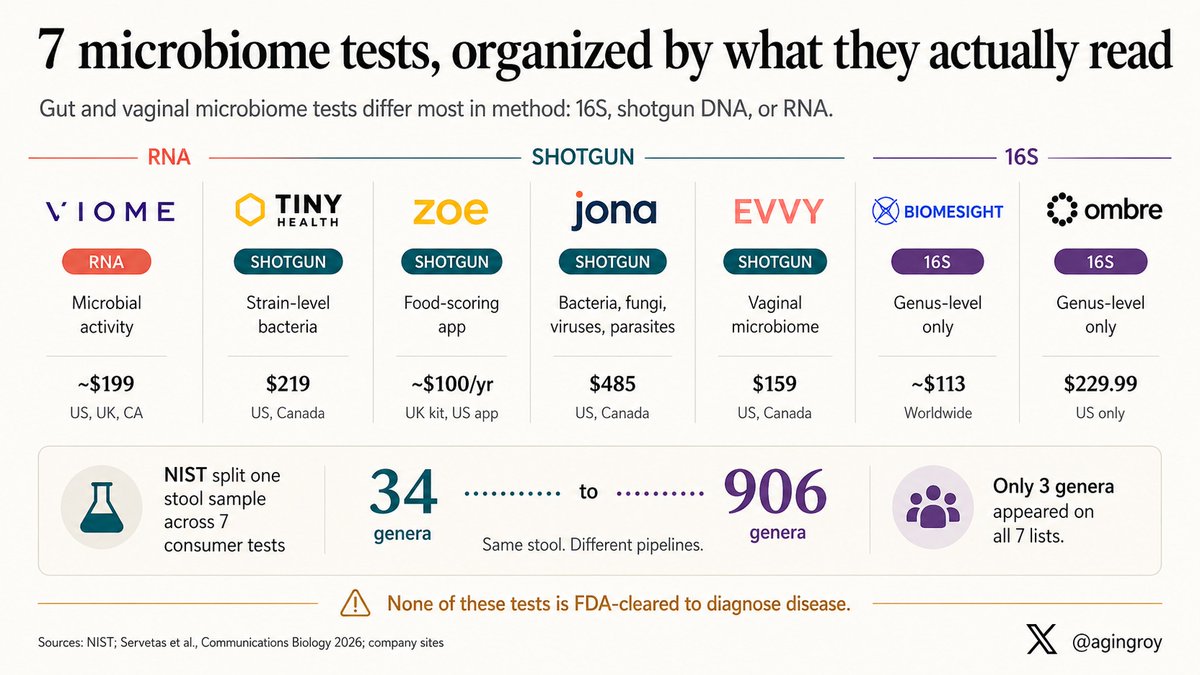
Same poop, seven labs, seven different answers. NIST proved it. About 30 companies will sequence your stool and mail you a verdict on your health, and the one thing that decides whether it's worth anything is the sequencing method, which they bury in the fine print.
Seven consumer gut tests, grouped by how deeply they actually read:
1. TINY HEALTH (@GetTinyHealth). Deep shotgun sequencing, which reads bacteria down to the exact strain, run in a certified clinical lab. It's built for babies and mums, where a gut is still assembling itself in the first year and the exact strain matters most. You get a report and a call with a specialist. $219, United States.
2. ZOE (@Join_ZOE). Shotgun too, and the only one here with a randomized trial of its own, called METHOD, built on PREDICT, a 34,000-person study that observed what people ate rather than dosing them. It's a coaching membership, so what you get is an app that scores foods, not your raw microbe list. Price is in flux during a site relaunch, historically around $100 a year. US, UK, Ireland, Netherlands.
3. JONA (@Jona_health). The widest net here, shotgun sequencing that reads bacteria, fungi, viruses and parasites, then an AI that summarizes the research for you. Good method, but that AI advice has never been clinically tested, and at $485 it's the priciest on the list. United States.
4. VIOME (@MyViome). The only one reading RNA instead of DNA, so it measures what your microbes are actively doing rather than just who's present. The catch is that it exists to sell you its own supplements based on the result, and the RNA method is still debated by scientists. About $199, ships internationally.
5. EVVY (@EvvyBio). Vaginal, not gut, shotgun sequenced and reviewed by a clinician who can route you to a prescription. It's the one test here with published accuracy numbers, 93% sensitivity against a clinical standard. $159, United States only.
6. BIOMESIGHT (@biomesight). Cheaper 16S sequencing, which reaches the genus, the family a bug belongs to, but can't name the exact species. What it does that almost none of the others will: it gives you your raw data to keep, and it ships worldwide. About $113, global.
7. OMBRE (@ombrelab). Also 16S, genus-level, and really a funnel to match you to its own probiotic subscription, so read the result knowing what it's built to sell. $229.99, United States.
Here's why the method matters. @NIST split one identical stool sample and sent it to seven consumer companies three times each. The number of microbes they reported ranged from 34 to 906, and of the 1,208 organisms named across the entire test, exactly three appeared in every sample.
Not one of these tests is cleared by the @US_FDA for diagnosis.
Andrew Huberman’s go-to sleep stack is simple and backed by peer-reviewed science.
Magnesium threonate + apigenin (a chamomile derivative) + theanine.
The combo helps shut down the forebrain’s constant thinking and anticipating. Theanine dials up the GABA system, which quiets anxiety and makes the transition into sleep smoother. Huberman calls it a game-changer for drifting off without the mental chatter.
He’s clear on sourcing: if you have a trusted brand, stick with it. Otherwise just go by price.
A straightforward three-ingredient approach a lot of people have found useful.
What’s one sleep habit or supplement that’s actually worked for you?
This is Harold Saxton Burr.
Professor of Anatomy at Yale. Author of 90+ papers. He spent 40 years measuring electrical fields in living tissue.
In 1962, he wrote a book connecting those findings to anxiety, free will, education, purpose & God.
Almost nobody has read it:🧵
Godfather of AI: "If you sleep well tonight, you may not have understood this lecture."
This 47-minute lecture is the best thing I've seen about AI in the last few months.
Hinton built the neural networks behind every AI alive, then quit Google to warn us it's already ahead of us on most cognitive tasks.
Despite that, most people open Claude, type one thing, close the tab and think they're using AI, but they're using maybe 10%.
I turned his talk into 17 Claude features 99% of users never find.
Watch the lecture, then read the article below.