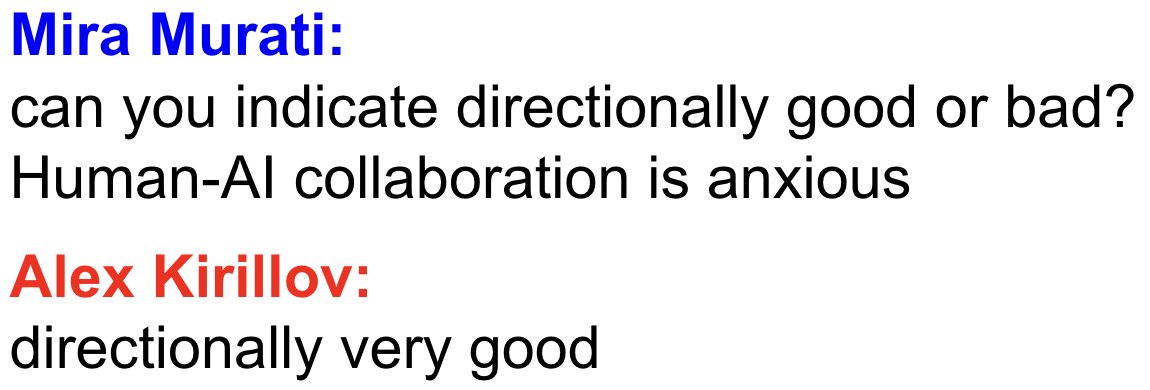
We are offering grants of $100,000 + Tinker credits to researchers advancing the field of human-AI interactivity. Submit your proposals by June 19th!
https://t.co/907HfBy7g3
1. (System design) - The Interaction Models see your screen and collaborates with you live. Here we're building a scalable system architecture together — no copy-pasting, no switching tabs, just thinking out loud and drawing on the screen together.
Very happy to see our dMel paper cited and used in @thinkymachines’ interaction model. We introduced dMel as a simple, training-free, streamable speech representation. Seeing it used for real-time full-duplex multimodal interaction is especially rewarding.
People talk, listen, watch, think, and collaborate at the same time, in real time. We've designed an AI that works with people the same way.
We share our approach, early results, and a quick look at our model in action.
https://t.co/AFJZ5kH7Ku
Today we're sharing our work on interaction models. A new class of model trained from scratch to handle real-time interaction natively, instead of gluing it onto a turn-based one.
https://t.co/MoS5s4cm60
Welcome @luke_drago_ and @LRudL_ to @thinkymachines. They started Workshop Labs determined to build AI that keeps the future human. They’ll continue that mission at Thinking Machines, where we create powerful AI systems that think alongside humans and extend our agency.
From Tinker to our research grants to the work we're doing to advance the frontier, everything we do is in service of the same mission -- AI that keeps our civilization empowered. Luke and Rudolf have been building toward the same thing.
There's a path for AI to make humans matter more. Glad to have them working on it with us.
Tinker is now generally available. We also added support for advanced vision input models, Kimi K2 Thinking, and a simpler way to sample from models.
https://t.co/nvaJHkGxc0
Today we’re announcing research and teaching grants for Tinker: credits for scholars and students to fine-tune and experiment with open-weight LLMs.
Read more and apply at: https://t.co/EAx6uOpDCS
One interesting "fundamental" reason for Tinker today is the rise of MoE. Whereas hackers used to deploy llama3-70B efficiently on one node, modern deployments of MoE models require large multinode deployments for efficiency.
The underlying reason? Arithmetic intensity.
(1/5)
Tinker provides an abstraction layer that is the right one for post-training R&D -- it's the infrastructure I've always wanted. I'm excited to see what people build with it.
"Civilization advances by extending the number of important operations which we can perform without thinking of them" -Whitehead
Introducing Tinker: a flexible API for fine-tuning language models.
Write training loops in Python on your laptop; we'll run them on distributed GPUs.
Private beta starts today. We can't wait to see what researchers and developers build with cutting-edge open models!
https://t.co/tJsgxgBuWo
Today on Connectionism: establishing the conditions under which LoRA matches full fine-tuning performance, with new experimental results and a grounding in information theory
LoRA makes fine-tuning more accessible, but it's unclear how it compares to full fine-tuning. We find that the performance often matches closely---more often than you might expect. In our latest Connectionism post, we share our experimental results and recommendations for LoRA.
https://t.co/fYV4FPi71m
Efficient training of neural networks is difficult. Our second Connectionism post introduces Modular Manifolds, a theoretical step toward more stable and performant training by co-designing neural net optimizers with manifold constraints on weight matrices.
https://t.co/PGG4zy3u23
We explore a fundamental understanding of the geometry of neural network optimization.
It's been an exciting 3 months at Thinky and so much has happened already!
Imo we're building some of the best research infra around. Research infra is about jointly optimizing researcher *and* GPU efficiency, and it's been a joy to work on this with the other great folk here!
Thinking Machines Lab exists to empower humanity through advancing collaborative general intelligence.
We're building multimodal AI that works with how you naturally interact with the world - through conversation, through sight, through the messy way we collaborate. We're excited that in the next couple months we’ll be able to share our first product, which will include a significant open source component and be useful for researchers and startups developing custom models. Soon, we’ll also share our best science to help the research community better understand frontier AI systems.
To accelerate our progress, we’re happy to confirm that we’ve raised $2B led by a16z with participation from NVIDIA, Accel, ServiceNow, CISCO, AMD, Jane Street and more who share our mission.
We’re always looking for extraordinary talent that learns by doing, turning research into useful things. We believe AI should serve as an extension of individual agency and, in the spirit of freedom, be distributed as widely and equitably as possible. We hope this vision resonates with those who share our commitment to advancing the field. If so, join us. https://t.co/EaAKidpany
Introducing Mirage Studio.
Powered by our proprietary omni-modal foundation model.
Generate expressive videos at scale, with actors that actually look and feel alive. Our actors laugh, flinch, sing, rap — all of course, per your direction.
Just upload an audio, describe the scene or drop in a reference image, and create energetic content in minutes.
Built for marketers, creative teams, and anyone serious about crafting great narrative videos.
Available for everyone at mirage dot app.
Get started with a few ideas below.