For 40 years, US increased its deficits and debt by:
-Offshoring manufacturing to China.
-Spending 8 trillions of borrowed money for invading Middle East
-Bailing out banks and moving debt from private to sovereign balance sheet (2008 > qe, zirp)
But during this 40 years, Yields were in a downtrend thanks to:
-Fed reducing rates
-Foreigners buying USTs with their surpluses
-China entering into WTO, manufacturing for the world at lower cost.
The 40-year downward trend was reversed and broken upwards after 2020:
Inflation spikes > rates up > dollar up > yield up.
Deficit and debt/gdp exponentially up. A monster was created.
Red curve is the monster. It feeds off of yellow curve. Yellow curve feeds off of the green curve.
This monster can't be tamed. The only option is to break its back and 'kill' it (reduce debt/gdp quickly)
So, the only way to kill red is by killing green: weak dollar > high inflation > gdp up > debt/gdp down.
Only after this, new Trump admin can reshore and do DOGE. Not before.
Michael Howell: Dollar stablecoins are a weapon against every rival monetary system on earth.
Anonymity from local tax authorities, easier to open than a bank account, rapid transactions, and "a currency which is going to devalue at a slower rate than many of these domestic units."
The EU, China, Turkey, emerging markets - none of them have a great answer to this.
FT @CrossBorderCap@BitcoinJesusETH.
@HenrikZeberg#Bitcoin will not save it.
#Bitcoin will be the only one left standing when debt-based fiat monetary ponzi inevitably, gradually then suddenly collapses.
Just by producing blocks every ten minutes.
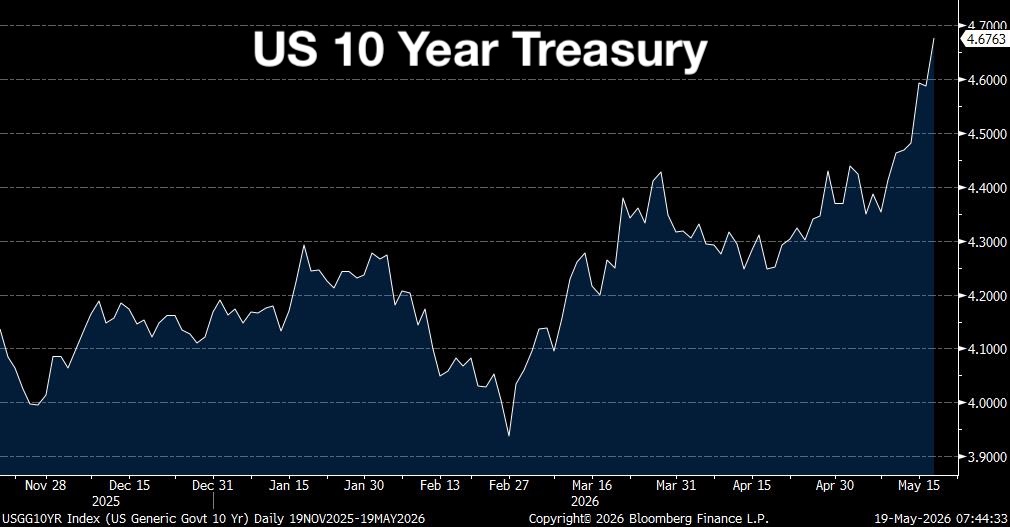
Sustained high 10Y yields act as a slow-motion chokehold on a debt-driven economy.
For governments, interest expense rise and eat from budget.
For banks, if depositors start pulling money out to chase higher-yielding altenatives, banks are forced to sell these devalued bonds at a massive loss to raise cash.
For corporates, refinancing gets harder.
Eventually plumbings start cracking and fed intervenes.
Inevitable.
As the 10 Year US Treasury yield explodes higher, pay close attention to what new Fed Chair Warsh and other officials say in the coming days and weeks.
Why?
1. The 10 Year is the benchmark for just about all consumer borrowing rates in the US, including credit cards, auto loans, and mortgages.
2. The Fed controls the overnight rate by voting on the Fed Funds Target. But the 10 Year is set by the bond market itself. Buyers and sellers voting on inflation, credit risk, and Treasury supply in real time.
3. To keep consumer rates from following the 10 Year higher, the Fed has one tool left in the kit. Print money and buy the bonds themselves to force yields lower. Yield Curve Control.
And that is what drives excess money supply and the next leg of asset inflation.
Their words, and any fancy new acronyms, will be your first clue.
If you bought the S&P in late 2024 betting on 8-10% returns, you're about to lose a decade of your financial life.
Billionaire investor Howard Marks on the JP Morgan chart everyone's ignoring:
At the end of 2024, the S&P was at a P/E of 23. Historically, every single time the market hits a P/E of 23, the next 10 years returned between 2% and -2% annualized.
NO exceptions.
What this means: if you invested $100K at the end of 2024, by 2034 you'll have between $82K and $122K.
Best case (2% annualized): you barely beat inflation
Worst case (-2% annualized): you lose 18% of your money
Either way, high-yield savings beats your "aggressive" portfolio
This isn't a bearish prediction. It's a historical certainty based on the price you chose to pay.
@thesamparr@ShaanVP
if spx crash (or chop 10yrs) > tax revenue dips > fiscal deficit rips > more debt issuance > higher yields due to insufficient demand as seen in 2020s > repeat.
why? if debt and deficits are this high, stocks and bonds crash together. debt doom loop.
in 1930s and 70s, debt to gdp was far below 50%. today %120+.
that's why fiscal dominance means the end of cb independence.
the us gov spends 7T usd while its tax revenue is 5T. and fed has to do anything to accomodate that by working with treasury. (reserve management, qe, btfp, standing repo facility and all those tools).
that's why nothing stops this train. that's why admin said "we'll run it hot" after failing with doge.
hard to see how spx can chop 10 yrs without causing gov insolvency.
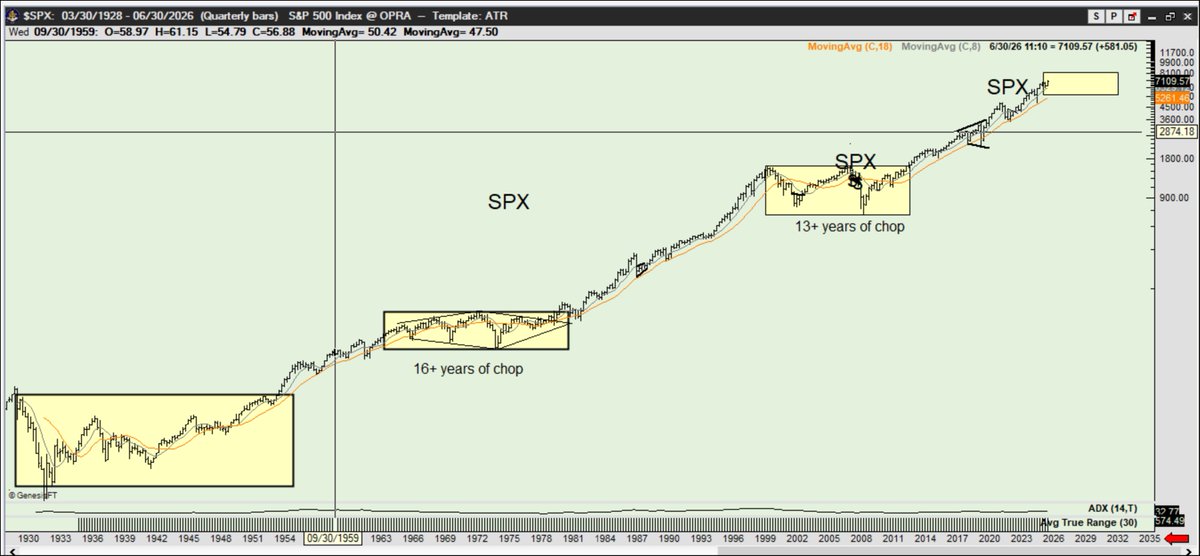
U.S. equity investors -- get ready for five to ten years of chop suey
During the past 100 years the S&P index chopped sideways for 54 years. That is 46 years of no new net gain (other than from dividends)
S&P Index is entering another major period of chop $SPX
1980-2020: smooth, low vol era. driven by CBs, private credit cycles. rates went lower and lower thanks to disinflationary globalization.
2020- : new, high vol era. driven by government fiscal policy. high debt-to-gdp. debt monetization. demographic pressures, political protectionism and populism (money for the people). higher rates mean more interest (more money injection). multi polar world.
watch real yields. watch policy response against AI impact on employment.
If US wants foreigners to sell their USTs at a discount, then:
-which balance sheet is capable of buying all those? only Fed thru YCC.
-what happens to US10y unless Fed does YCC?
-what'll be the new global reserve asset for settling trade surpluses? Gold?
-what happens to usd as a reserve currency if Fed does YCC?
was it the scarcity of silver? or this:
A farmer sells his corp for copper coins. But but his taxes were legally mandated to be paid in silver (due to the Single Whip Reform). Because he couldn't "break" his small copper holdings into the tiny slivers of silver required, he was forced to go to money changers who charged predatory rates. The "scarcity" was actually a denominational collapse of copper against silver.
Every time a transaction occurred, the silver had to be weighed and its purity (fineness) tested by a specialized money changer. You couldn't just hand over a "satoshi" of silver; you had to physically cut a piece of metal, weigh it on a scale, and argue over its quality. This created massive transaction friction and slowed velocity of money.
Also, to move wealth from the commercial hubs of the south to the political capital in the north, merchants had to hire armed escorts. When money is physically heavy and scarce, the cost of transporting it adds to its scarcity. Unlike a digital ledger where "portability" is near-instant and near-free, Ming silver had a "carrying cost" that acted as a tax on the entire economy.
So, the problem was not scarcity of silver. It was lack of easy divisibility and lack of portabity.
Bitcoin fixes this.
@cryptocene@ZynxBTC 1. strc goes already down after dividend payment as it should (because company has less cash and that fact is reflected in price of preferreds as well)
2. bid-ask spreads, transaction costs etc
Powell was able to reduce bs thanks to rrp cushion over 2T in 2022.
Now that RRP is drained, every dollar Kevin Warsh tries to remove from the bs comes directly out of Bank Reserves.
That would: scares banks, freeze lending and spike rates like in 2019.
https://t.co/RgrwdxMM2W
@LynAldenContact@conksresearch Yes said that before, and yet here we are today with the balance sheet $2.5 trillion lower. Your “nothing stops this train” mantra is clouding your judgement.