Our review on AI for protein engineering is out now, about this too-fast-moving field full of hype and overclaim, yet one that is having a real impact on the world and can be described in a coherent manner without histrionics
https://t.co/woOWuyTV5R
Our new ICLR paper on leveraging “soft decomposability” of design spaces (eg protein sequence) wrt a target property (eg enzymatic activity) in order to more efficiently search through the design space. Active site vs. scaffold, for eg. @jamesbowden_ joint with @svlevine
Our new paper on leveraging ML to characterize the fitness landscape of two proteins binding through evolution, wrt geometry, epistasis, etc. The super hard work of Hanlun Jiang, Stephan Allenspach and @jamesbowden_ on our end. https://t.co/qtrURlRYyM
New, full length ProteinGuide manuscript, now spanning interpolative, extrapolative and multi-property (extending Pareto optimality) settings; comparisons to fine-tuning; and beating 7 rounds of directed evolution with just one round of ProteinGuide.
https://t.co/wIexIhNow2
Delighted to share our publication in @NatureComms on the computational design of generalist carbene transferases with tailored, stereodivergent selectivity! Great collab with Sagar Khare! Kudos to Zhuofan, Mary, and Xinkun and all other coauthors!
https://t.co/YAtfzLI0np
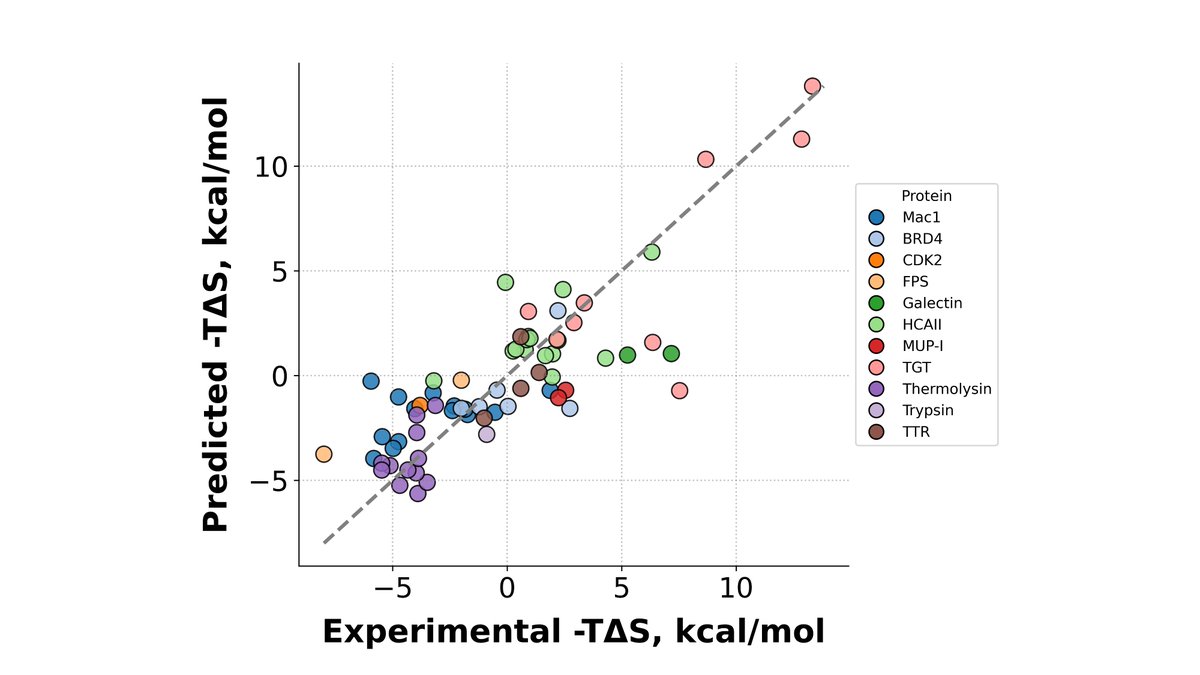
New Preprint!! We show that binding entropy can be quantitatively predicted from crystallographic ensemble models, accounting for both protein conformational entropy and solvent entropy! https://t.co/h9L4glyBYr
https://t.co/SSytLwl6i1... most proteins are multi domain but our understanding of how architectures evolve is limited - we mapped 40K chitinases and show a stepwise grammar of domain gain/loss and localisation changes that predicts ecological strategy and physiological function
Protein design mostly targets single domains; but bio builds function by recombining domains into larger multi domain proteins. Understanding the evolutionary rules of domain assembly will be important if we want to design the level of functionality seen in many native proteins
‘Protein evolution as a complex system’ – A new Comment discusses protein evolution in terms of complex systems theory and machine learning approaches to model the dynamics of protein evolution
https://t.co/L62p40MOQh
Really proud of this work by Jae Kennemur and Yueming Long. #Enzymes rock, with a little help from #directedevolution to do #chemistry not known in nature (and not easily done by humans).
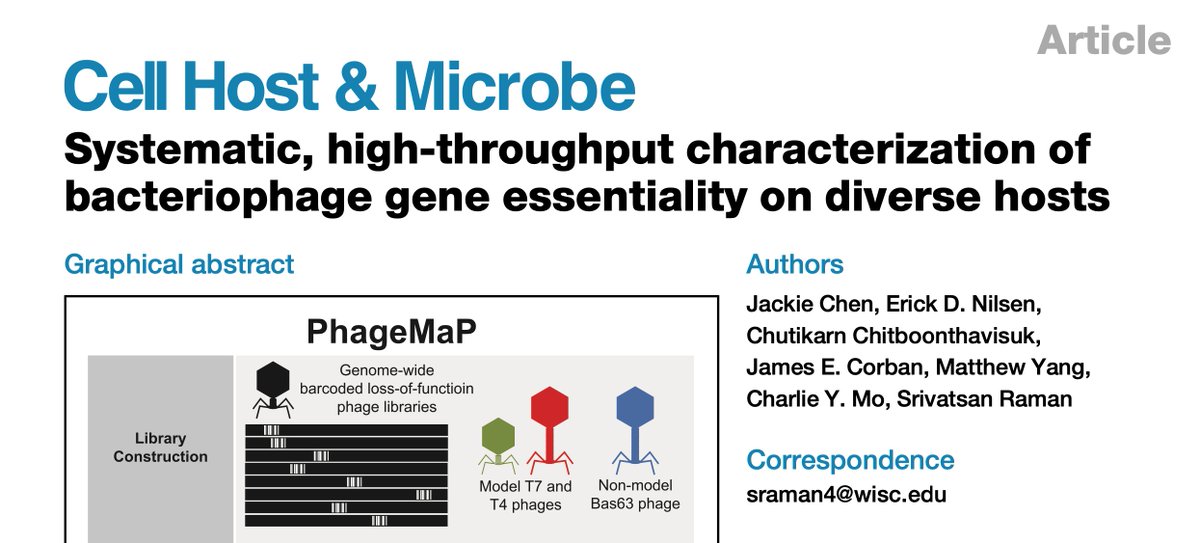
Excited to share our new work—PhageMaP, a high-throughput platform for genome-wide knockout screening in diverse phages across multiple hosts. PhageMap reveals essential, non-essential and conditionally-essential genes, interactors with host anti-phage defenses & enables rational phage design. Fun collab with Charlie Mo, exceptional work by Jackie Chen!
📝 Cell Host & Microbe: https://t.co/Lb5pr5mjNm
Stepping into Substack, starting with (baby) thoughts on LLMs & Scientists. Inspired by great work coming out of ICML, new endeavors like @FutureHouseSF, and self reflections on my use of LLMs. https://t.co/gneY4Ad107
Our recent paper looking at history of flagellar motility now online in final form @ISMEJournal
We looked at 10,000 species to map the diversity and history of the bacterial #flagellar motor across the tree of life.
@UNSWBABS@UNSWScience
https://t.co/ded2vSGC5h